Póvoa De Lanhoso Castle From Braga
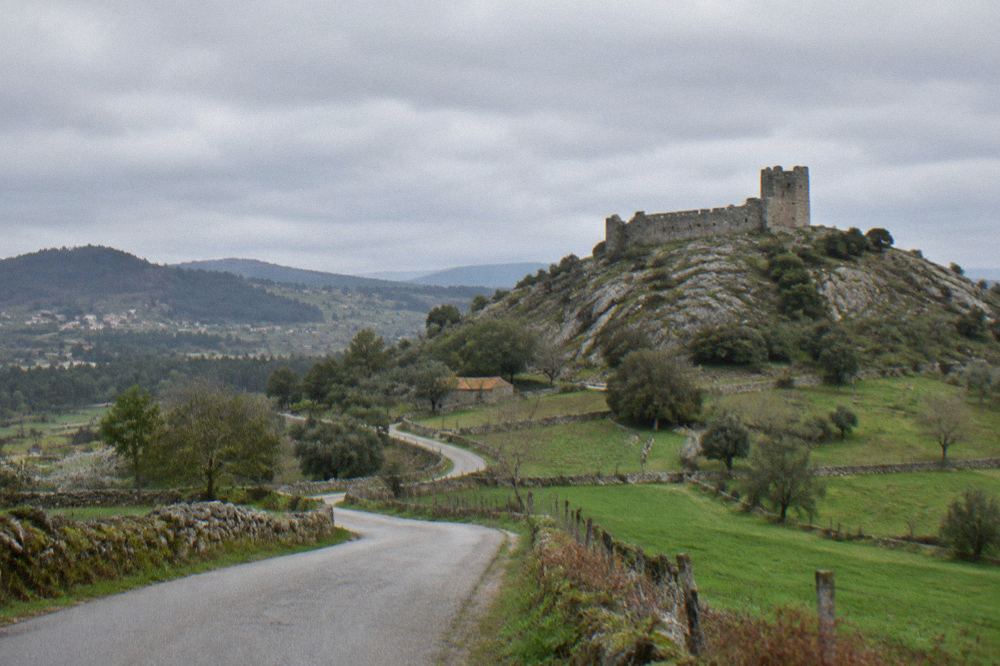
Póvoa de Lanhoso Castle stands on a granite massif a short drive from Braga, one of the most dramatic castle settings in the Minho. This guide covers what it is, how to reach it from Braga and how to fit it into a day in northern Portugal.
Short answer
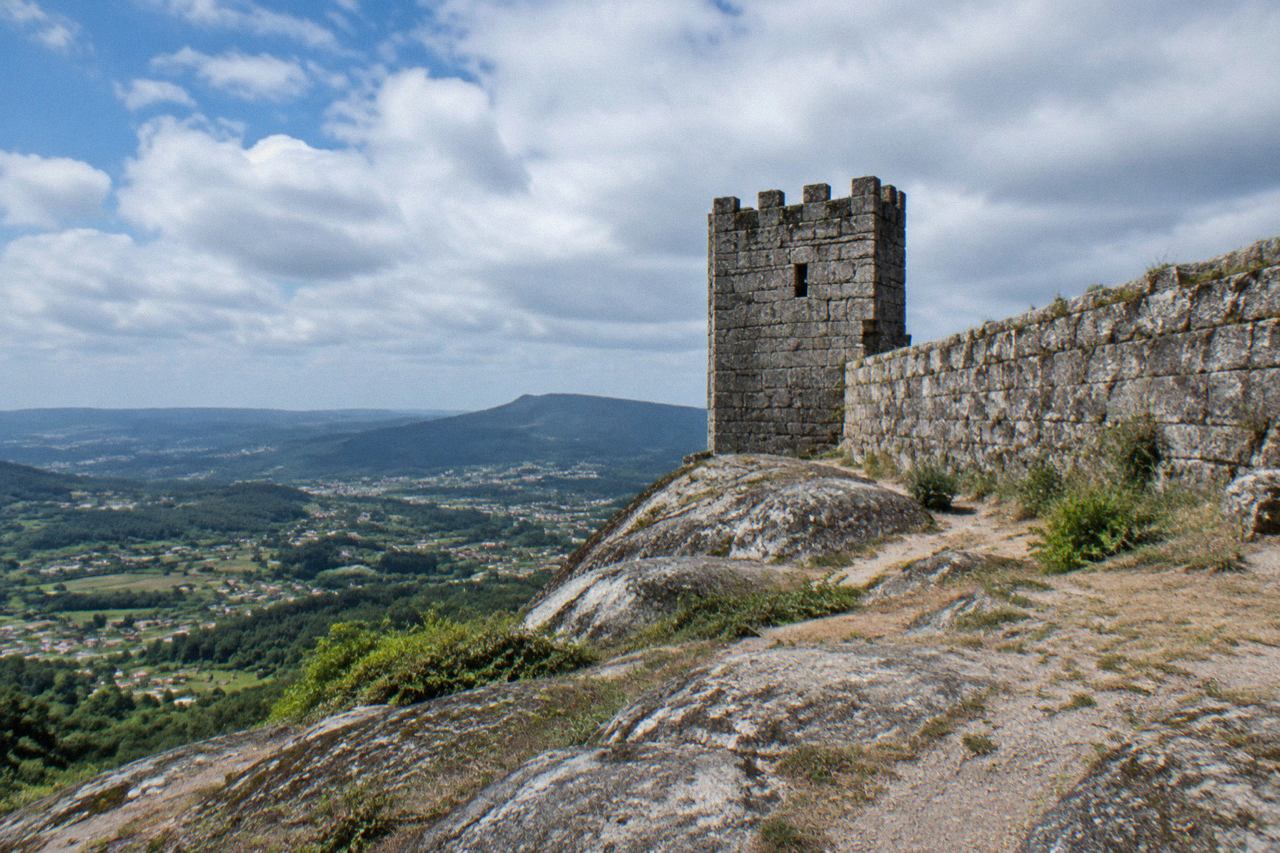
Póvoa de Lanhoso Castle is a medieval hilltop castle in the Póvoa de Lanhoso municipality, south-east of Braga in northern Portugal, built on and around one of the largest granite boulders in Europe. There is no verified public transport schedule or fare for the castle from Braga, so a car, a taxi or a guided private tour is the practical way to reach it.
Póvoa de Lanhoso Castle is one of the most striking medieval sites within easy reach of Braga, the historic city in the Minho region of northern Portugal. The castle sits on and beside an enormous granite outcrop above the town of Póvoa de Lanhoso, and the rock itself is as much the attraction as the walls on top of it. This guide from Braga Travel Guide covers what the castle is, how to get there from Braga, what you can see once you arrive, and how to combine it with other Minho sights into a full day out.
What Is Póvoa De Lanhoso Castle?
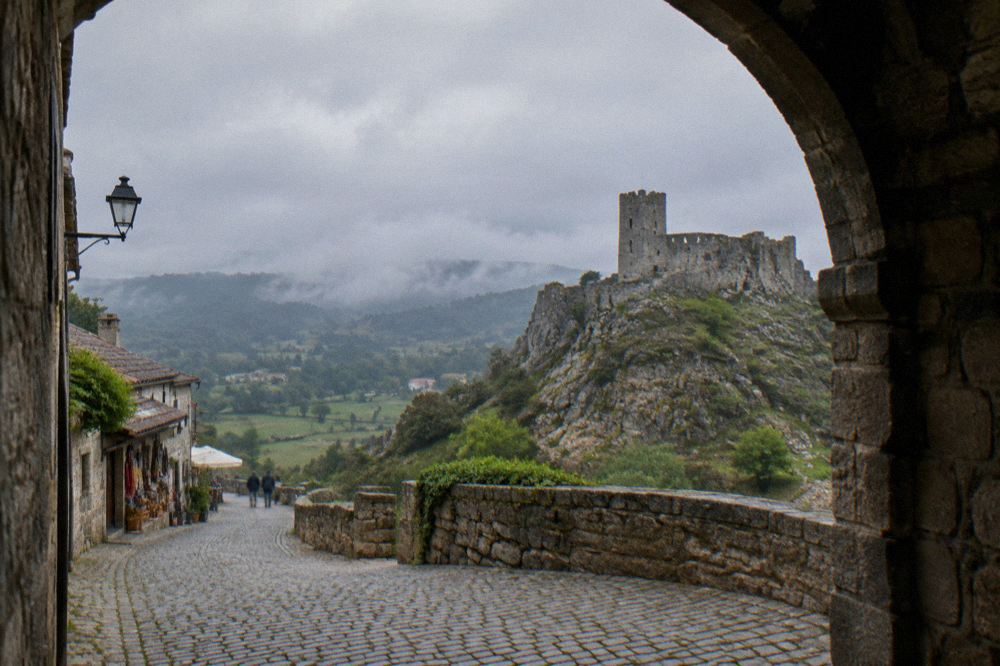
Póvoa de Lanhoso Castle is a medieval hilltop fortification in the Póvoa de Lanhoso municipality, a short distance south-east of Braga in northern Portugal, whose keep and walls crown a colossal granite monolith that dominates the surrounding countryside. The site is often described as resting on one of the largest granite boulders in Europe, and the rock is integral to the castle's design rather than merely its foundation.
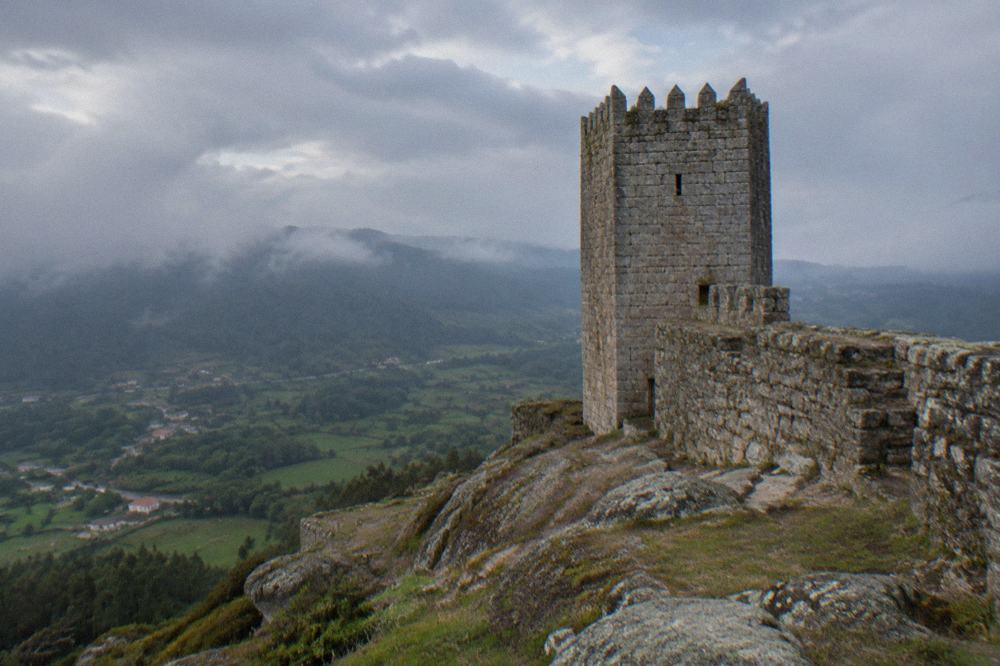
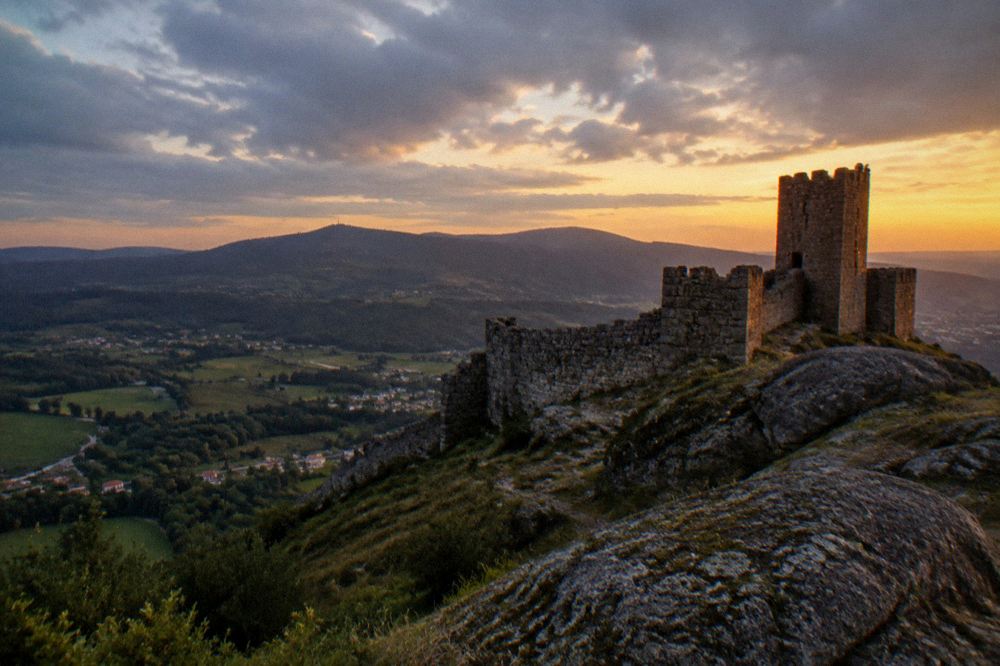
The castle's documented story belongs to the medieval kingdom of Portugal, when hilltop keeps of this kind anchored the defence of the Minho, the frontier region between Portugal and Galicia. The square tower you see today is the classic Portuguese donjon type, a freestanding keep built to be defended on its own if the outer walls fell. The setting is what makes the visit memorable: the granite massif rises abruptly from a green valley, and the views from the top reach across the countryside towards Braga and the hills that separate the Minho from the Gerês massif to the north.
The rock has a longer history than the castle. Granite formations of this kind in the Minho were used as refuge and settlement sites long before medieval masons arrived, and the Póvoa de Lanhoso outcrop sits in a landscape dotted with prehistoric and castro-era remains. The nearby Citânia de Briteiros, which you can visit on the same day, is the region's flagship Iron Age hill fort. The castle at Póvoa de Lanhoso belongs to the same tradition of using the Minho's high ground, first for safety, then for control.
How Do You Get To Póvoa De Lanhoso Castle From Braga?
There is no verified public bus schedule or fare connecting Braga to Póvoa de Lanhoso Castle, so the practical options are a hire car, a taxi or ride-hailing app from Braga, or a private guided tour that includes the Minho countryside. The castle lies in the Póvoa de Lanhoso municipality, south-east of Braga, and the drive is a straightforward one on regional roads.
To reach the castle on your own schedule, book a rental car here.
The honest transport picture is this: Braga's regional buses are run by the AITC, the Cávado intermunicipal transport authority, and its verified lines from Braga bus station cover Guimarães, Ponte de Lima, Vila Verde, Arcos de Valdevez, Caldas do Gerês, Covide, Esposende, Póvoa de Varzim and Famalicão. No schedule or fare for Póvoa de Lanhoso was confirmed in the 2026 sources, so this guide will not print a journey time or a bus number that may not exist. If you want to try public transport, check the AITC timetables before you travel; if nothing suits, a car is the reliable answer.
| AITC line from Braga bus station | Destination | Notes |
|---|---|---|
| Line 100 | Vila Verde and Arcos de Valdevez | Yes, line number only |
| Line 101 | Guimarães (Central) via the A11 | Yes, line number only |
| Line 105 | Ponte de Lima | Yes, line number only |
| Line 200 | Covide via Campo do Gerês | Yes, line number only |
| Line 201 | Caldas do Gerês | Yes, line number only |
| Line 106 | Póvoa de Varzim | Yes, line number only |
| Line 107 | Esposende and Póvoa de Varzim | Yes, line number only |
| Line 109 | Famalicão | Yes, line number only |
Regional bus fares and journey times are not verified for any of these routes, so plan on checking the current timetables at the Braga bus station or on the operator's site. For Póvoa de Lanhoso specifically, a hire car gives you the freedom to continue to the Citânia de Briteiros or the Tibães monastery afterwards, which is the natural shape of the day. If you would rather not drive, a private tour is the alternative worth weighing.
If your Minho trip starts in Porto rather than Braga, the Best of Braga and Guimarães day trip from Porto covers both historic cities in one day with lunch included, and Check availability before committing to a date. It is a From Porto product, so it does not start in Braga, but it pairs well with a longer stay in northern Portugal. For travellers based in Braga who want a guided countryside day, the Peneda-Gerês hiking and sightseeing private experience is the more relevant option, and shows its current listing.
What Can You See At Póvoa De Lanhoso Castle?
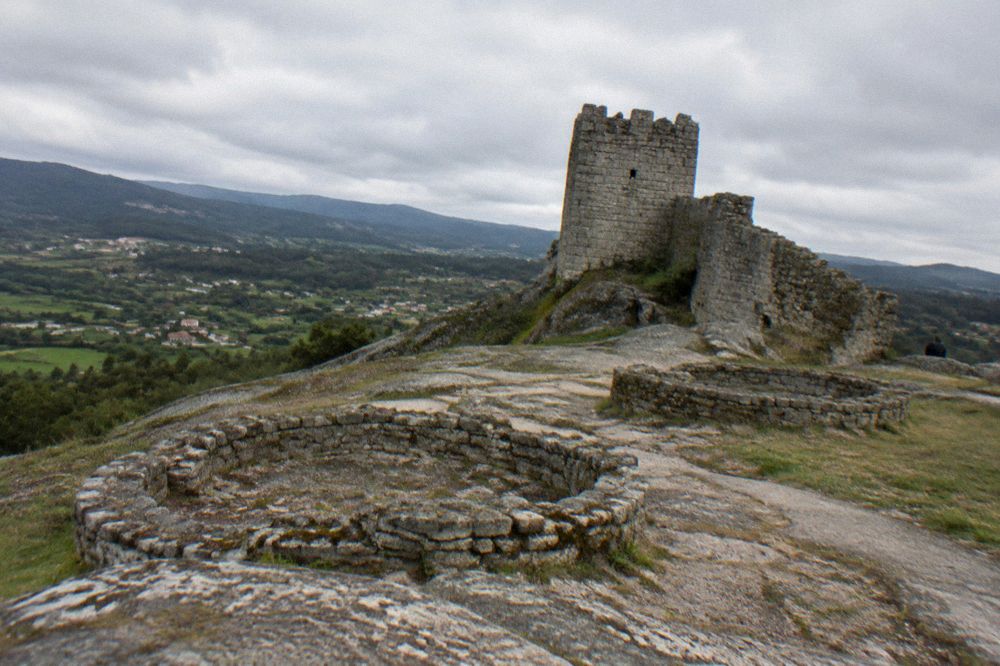
The castle's headline sight is the granite monolith itself, with the medieval keep and curtain walls built onto and around the rock, reached by a path that climbs from the town below. From the summit the panorama stretches across the Minho countryside towards Braga, making the ascent the main event. The town of Póvoa de Lanhoso at the foot of the hill holds the parish church and quiet streets worth a short wander.
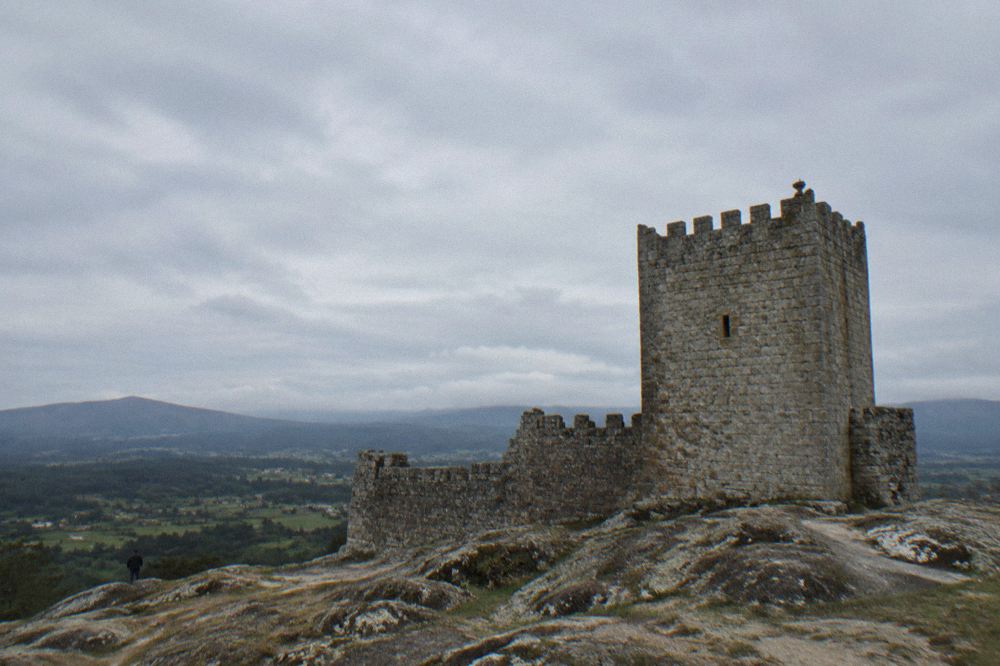
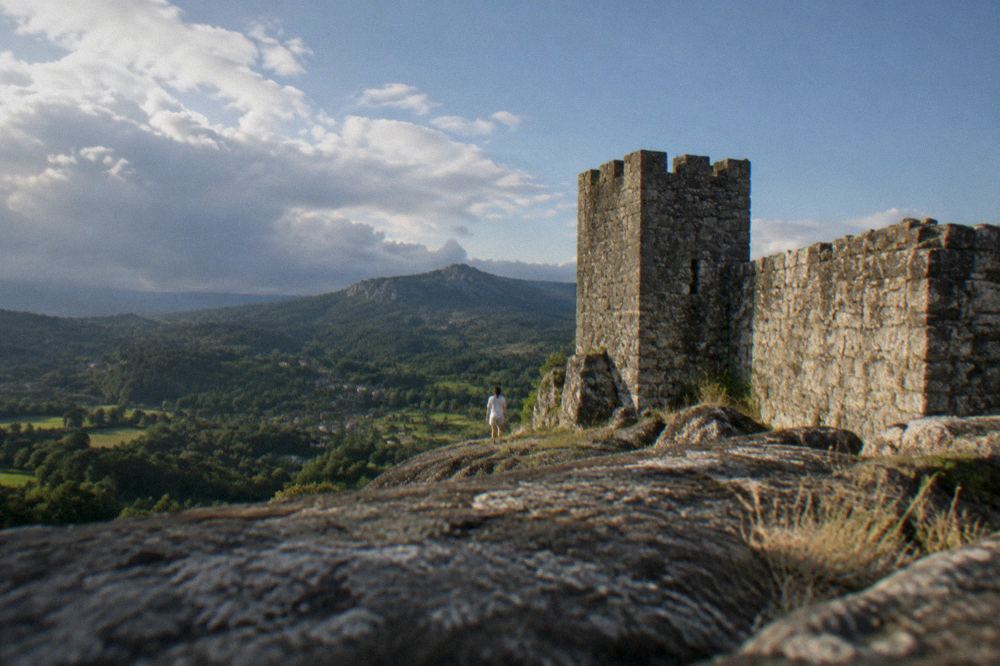
The keep is the classic photo subject: a squat square tower in granite, the same stone as the hill it stands on, so that in low light the two merge into a single silhouette. Walk the walls if the access is open, and give the rock itself time. The boulder's scale only registers when you stand beside it, and the worn paths around its base show how many centuries of feet have traced the same circuit. The municipality has invested in the site over the years as a heritage destination, and the approach from the town is signed, but opening arrangements at small Portuguese castle sites can change with the season, so check the local information before setting out.
The practical advice is simple. Wear shoes with grip, because granite polished by weather and footsteps is slippery when damp, and the Minho is a damp part of the world: IPMA's 1991 to 2020 climate normals for the Braga / Merelim station show rain of one millimetre or more on roughly 12 to 13 days a month from October through January. Go early or late in the day in summer, when the exposed rock holds the heat. And treat the castle as a half of a day rather than a whole one, because the surrounding area rewards the extra hours.
When Is The Best Time Of Year To Visit?
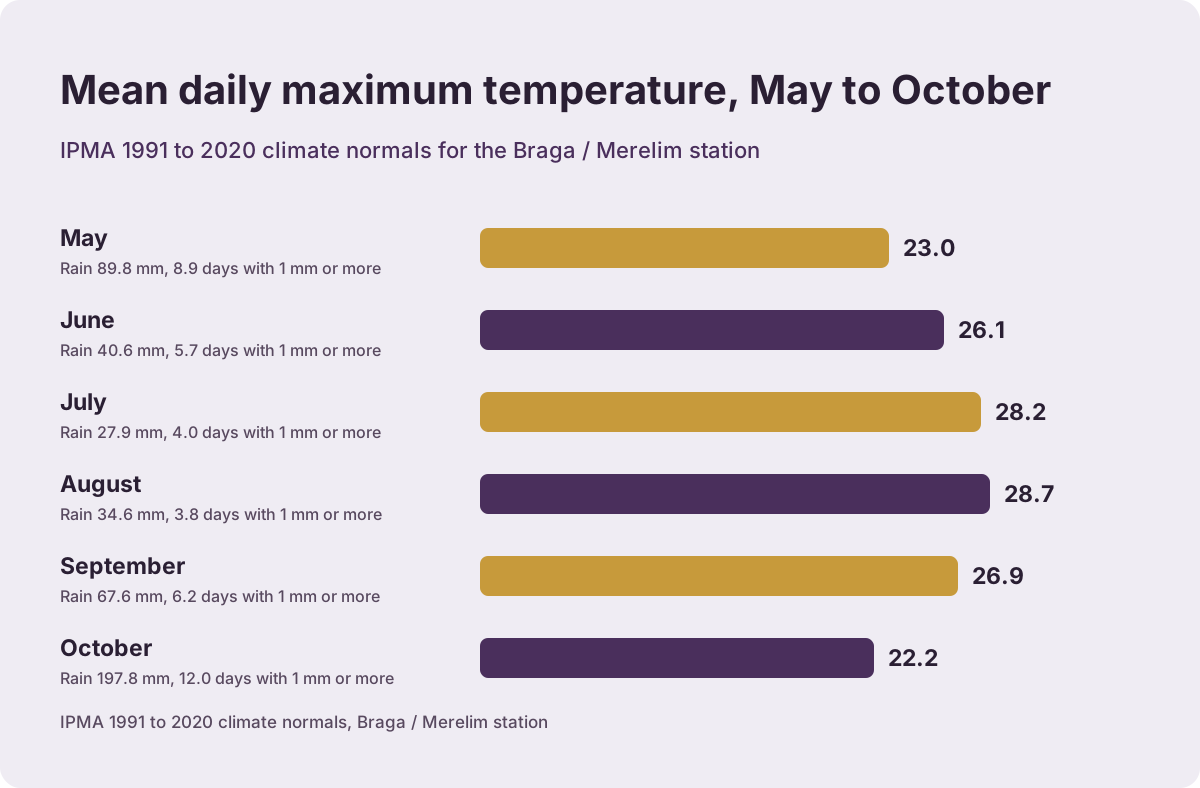
The most reliable visiting window is late spring to early autumn, when the May to September normals for the Braga area show the driest and warmest months of the year, with July and August the driest of all. October is the wettest month on average in the Braga area, and December and January are almost as wet, so autumn and winter visits need a weather window and waterproofs.
The climate table below is drawn from IPMA's 1991 to 2020 normals for the Braga / Merelim station, the closest long-term record to Póvoa de Lanhoso. It shows why the Minho is so green, and why the castle's granite gleams so often in photographs: this is a landscape that rains.
| Month | Mean max (C) | Mean min (C) | Rain (mm) | Days with 1 mm or more |
|---|---|---|---|---|
| May | 23.0 | 10.4 | 89.8 | 8.9 |
| June | 26.1 | 13.2 | 40.6 | 5.7 |
| July | 28.2 | 14.3 | 27.9 | 4.0 |
| August | 28.7 | 14.0 | 34.6 | 3.8 |
| September | 26.9 | 12.4 | 67.6 | 6.2 |
| October | 22.2 | 10.1 | 197.8 | 12.0 |
Two practical readings of the table. First, July and August combine the highest mean maximums with the fewest rain days, which is exactly what you want on an exposed hilltop, though the same months bring the crowds to the Minho coast and the Gerês park. Second, September is a genuinely good compromise: the mean maximum of 26.9 C is actually higher than June's 26.1 C, the crowds thin after the school holidays, and only six days a month see meaningful rain. If you are combining the castle with the Peneda-Gerês National Park, note that summer car access to the Mata de Albergaria section of Gerês is limited and charged, so a September visit can dodge that too.
What Else Can You Combine With Póvoa De Lanhoso Castle?
The strongest pairings are the Citânia de Briteiros, the Iron Age hill fort in the Guimarães area with verified hours and admission, and the Mosteiro de São Martinho de Tibães on the edge of Braga, a restored monastery with a summer and winter opening schedule. Both sit in the same arc of countryside between Braga and Guimarães, so a car loop of castle, citânia and monastery makes a full and varied day.
The Citânia de Briteiros is the region's great prehistoric site, a reconstructed hill settlement of round stone houses. The verified details: admission is about 5 EUR, reduced 2.50 EUR, and the ticket includes the Museu da Cultura Castreja; from 27 March to 31 October it opens daily 09:30 to 12:30 and 14:00 to 18:00, and from 1 November to 26 March Tuesday to Sunday 09:30 to 12:30 and 14:00 to 17:00. Pairing a medieval castle with an Iron Age citânia in one day tells the story of the Minho's high ground across two millennia, and the drive between them is part of the pleasure.
Tibães, by contrast, is monastic rather than military. The Mosteiro de São Martinho de Tibães, the mother house of the Portuguese Benedictine congregation, is a short distance from Braga's centre, with verified hours of 10:00 to 18:00 in winter and 10:00 to 19:00 in summer, closed Mondays, and admission of about 4 to 5 EUR depending on the ticket circuit. The monastery church was closed for conservation works until around March 2026, so check that the full circuit is open on the day you plan. For more on the monastery, see the Tibães Monastery guide.
| Site near Póvoa de Lanhoso | Type | Verified admission | Verified hours |
|---|---|---|---|
| Citânia de Briteiros | Iron Age hill fort | About 5 EUR, reduced 2.50 EUR, museum included | Daily in season; Tue-Sun in winter |
| Mosteiro de São Martinho de Tibães | Benedictine monastery | About 4 to 5 EUR by circuit | 10:00-18:00 winter, 10:00-19:00 summer, closed Mondays |
| Póvoa de Lanhoso Castle | Medieval castle on granite | Not verified, check locally | Not verified, check locally |
Back in Braga itself, the day can end with the city's own layered history: the Roman-era collections at the D. Diogo de Sousa Museum, the medieval keep that survives at the Castle of Braga, or simply a slow circuit of the historic centre. The castle keep in Braga makes a natural comparison with Póvoa de Lanhoso's tower, two medieval keeps serving two very different sites.
Is Póvoa De Lanhoso Castle Worth The Trip From Braga?
For visitors with a car and half a day to spare, yes: the castle's granite setting is unlike anything else within range of Braga, and the combination of castle, citânia and monastery makes one of the best rural loops in the Minho. For visitors relying purely on public transport, the lack of a verified bus connection makes it a harder proposition, and a guided or private option is the better use of the day.
The honest comparison is with what else your Braga time could buy. Braga's own attractions, from the Santa Bárbara Garden to the São Frutuoso Chapel, fill two days comfortably, and the city's tourist infrastructure is excellent: the TUB urban network sells a whole-network tourist ticket at 3.35 EUR for one day, 6.05 EUR for two days and 8.05 EUR for three days per person, in force since February 2026. If your time in the region is short, the city and the Bom Jesus sanctuary come first. If you have a third day or a spare afternoon with wheels, the castle earns its place.
For a wider Minho circuit, the established day trips from Braga are worth comparing before you commit. Guimarães is the cradle-of-Portugal counterpart to Braga, reachable by AITC Line 101 from the bus station. Barcelos is famous for its Thursday market and its rooster legend. The Peneda-Gerês National Park is the big outdoor option, with canyoning and waterfall tours running from the Gerês village. And for a coastal change, the Vila do Conde and Póvoa de Varzim day trip pairs two seaside towns on AITC Lines 106 and 107.
| Minho day trip from Braga | Best for | Getting there |
|---|---|---|
| Póvoa de Lanhoso Castle | Medieval drama, granite scenery | Car, taxi or private tour |
| Citânia de Briteiros | Iron Age archaeology | Car, or combine with the castle loop |
| Guimarães | Medieval old town | AITC Line 101 from Braga bus station |
| Peneda-Gerês National Park | Hiking, waterfalls, canyoning | AITC Lines 200 and 201, or a guided tour |
| Póvoa de Varzim and Vila do Conde | Beaches and seafood | AITC Lines 106 and 107 |
One budgeting note that catches visitors out: Braga levies a municipal tourist tax of 1.55 EUR per person per night, for up to four nights, all year, charged by hotels and local accommodation to guests aged 16 and over. It is small, but it applies across the municipality, so factor it into any overnight plan that uses Braga as a base for the castle loop.
If the countryside options feel like too much logistics, there is a case for flipping the plan: take a guided day and let someone else drive. The Peneda-Gerês private hiking and sightseeing experience covers the park's trails and viewpoints with a guide and door-to-door transport, which suits travellers who want the Minho's landscapes without the hire car. Within Braga itself, the tuk tuk city tour is a low-effort way to see the historic centre, and shows what the listing currently offers. For a broader overview of the city's options, start with things to do in Braga and build outward.
How Should You Plan The Day Practically?
Start from Braga in the morning, drive to Póvoa de Lanhoso while the light is still good on the rock, allow a relaxed hour or two at the castle and town, then continue to the Citânia de Briteiros for its afternoon opening window, and finish either at Tibães on the way back into Braga or with dinner in the city. Check the castle's access locally before you go, since no verified hours or admission figure exists for it.
The reason for the morning start is the light and the weather. The Minho clouds up as the day goes on in the wetter months, and the castle photographs best with low sun on the granite. The reason for checking access is honesty: small Portuguese castle sites run seasonal and variable opening arrangements, and the 2026 sources for Póvoa de Lanhoso Castle did not confirm hours or a ticket price, so this guide prints none. The tourist office in Braga, at Avenida da Liberdade 1, open Monday to Friday 09:00 to 18:30, can help with current local information if you ask in person.
| Time of day | Plan | Why |
|---|---|---|
| Morning | Braga to Póvoa de Lanhoso Castle | Best light on the rock, coolest hours for the climb |
| Midday | Lunch in Póvoa de Lanhoso or en route | Small-town Minho restaurants, quieter than Braga |
| Afternoon | Citânia de Briteiros | Afternoon opening window, 14:00 to 18:00 in season |
| Late afternoon | Tibães Monastery or return to Braga | Monastery closes at 18:00 winter, 19:00 summer |
If you are staying overnight in Braga rather than day-tripping in, the city's food scene is the right ending: the Braga market and the city's restaurants cover everything from the famous Pudim Abade de Priscos dessert to the fresh fish that arrives daily from the coast. And if the castle visit has stirred an interest in the region's older footpaths, the Camino from Braga follows pilgrimage routes that have crossed this same granite landscape for centuries.
Common Questions About Póvoa De Lanhoso Castle
Where is Póvoa de Lanhoso Castle?
Póvoa de Lanhoso Castle stands on a large granite outcrop above the town of Póvoa de Lanhoso, in the Braga district of northern Portugal, south-east of the city of Braga. The castle and its rock dominate the surrounding Minho countryside.
Can you reach Póvoa de Lanhoso Castle by public transport from Braga?
No verified public transport schedule or fare connects Braga to Póvoa de Lanhoso Castle in the 2026 sources. The practical options are a hire car, a taxi or ride-hailing app, or a private guided tour. If you want to try a regional bus, check the current AITC timetables before travelling.
Is Póvoa de Lanhoso Castle open to visitors, and what does it cost?
No verified opening hours or admission figure for Póvoa de Lanhoso Castle were confirmed in the 2026 sources, so check locally before you go, at the Braga tourist office on Avenida da Liberdade 1 or through the Póvoa de Lanhoso municipal information. The site's access arrangements can vary with the season.
How long should you spend at Póvoa de Lanhoso Castle?
The castle and the town below reward a relaxed morning or afternoon rather than a full day. Most visitors combine the castle with the Citânia de Briteiros, about 5 EUR admission with the Museu da Cultura Castreja included, or with the Mosteiro de São Martinho de Tibães on the way back to Braga.
What is the best time of year to visit?
May to September is the most reliable window. IPMA's 1991 to 2020 climate normals for the Braga area show July and August as the driest months, with September nearly as warm at the top end and less crowded. October is the wettest month on average, so an autumn visit needs a weather window and grippy shoes on the granite.
Is Póvoa de Lanhoso Castle worth a day trip from Braga?
Yes, for visitors with a car or a private tour: the granite setting is one of the most dramatic in the Minho and pairs naturally with the region's other hilltop sites. Visitors relying on public transport will find the lack of a verified bus connection a real obstacle, and Braga's own attractions, or a guided day trip, are the better use of limited time.