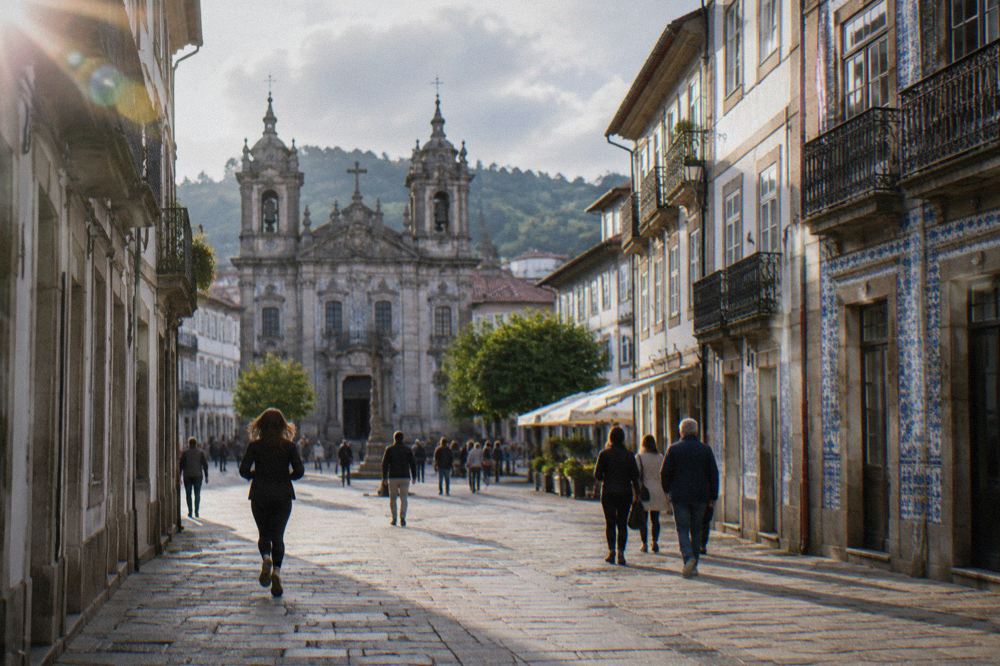
Barcelos Day Trip From Braga
Barcelos is the Minho's market town, a short hop from Braga, and its Thursday market is one of the largest in northern Portugal. Here is what to see, how to get there and how to fit it into a Braga itinerary.
Short answer
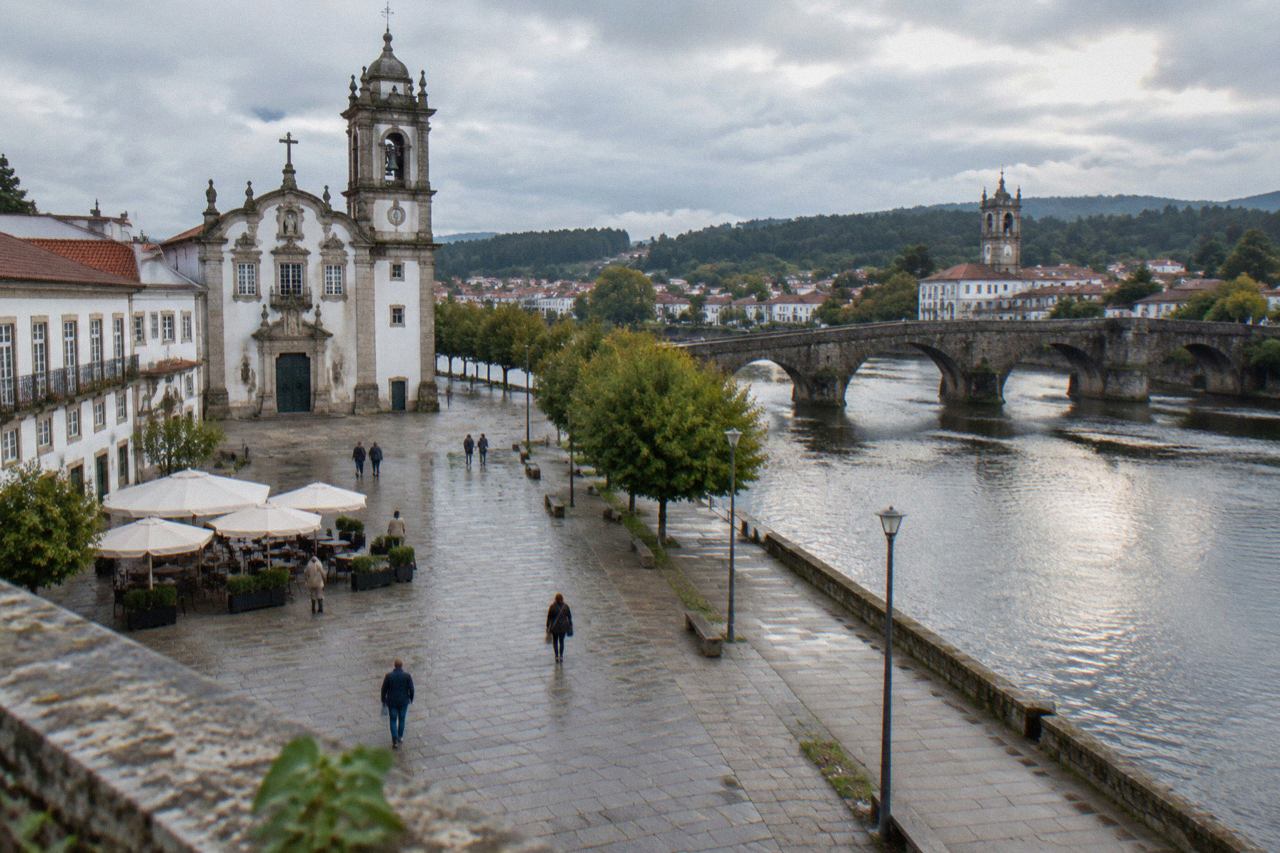
Barcelos is a market town on the Cávado river, reachable from Braga by train with a change at Nine. Its Thursday market is the biggest weekly market in the Minho, and the town is the home of the Rooster of Barcelos, Portugal's unofficial national symbol.
Barcelos is the great market town of the Minho, and it makes an easy day trip from Braga, the historic city in northern Portugal that this site is built around. The two towns face each other across the Cávado river valley: Braga with its sanctuaries and baroque stairways, Barcelos with its weekly fair, its medieval bridge and the rooster legend that turned a small town's folk tale into the unofficial symbol of the whole country. A visitor based in Braga can do the trip comfortably in a day, and market day transforms it entirely, so the first planning decision is not how to get there but which day to go.
This guide covers what Barcelos is actually known for, how the Thursday market works, what the rooster legend says, how to reach the town from Braga by train, and how the trip compares with the other Minho day trips covered on Braga Travel Guide. Practical note before anything else: the funicular at Bom Jesus do Monte, Braga's headline hillside attraction, has been out of service since 26 September 2026 with no end date published, so if your Braga stay doubles as your sightseeing time, plan the sanctuary around the replacement shuttle rather than a ride.
What Is Barcelos Portugal Known For?
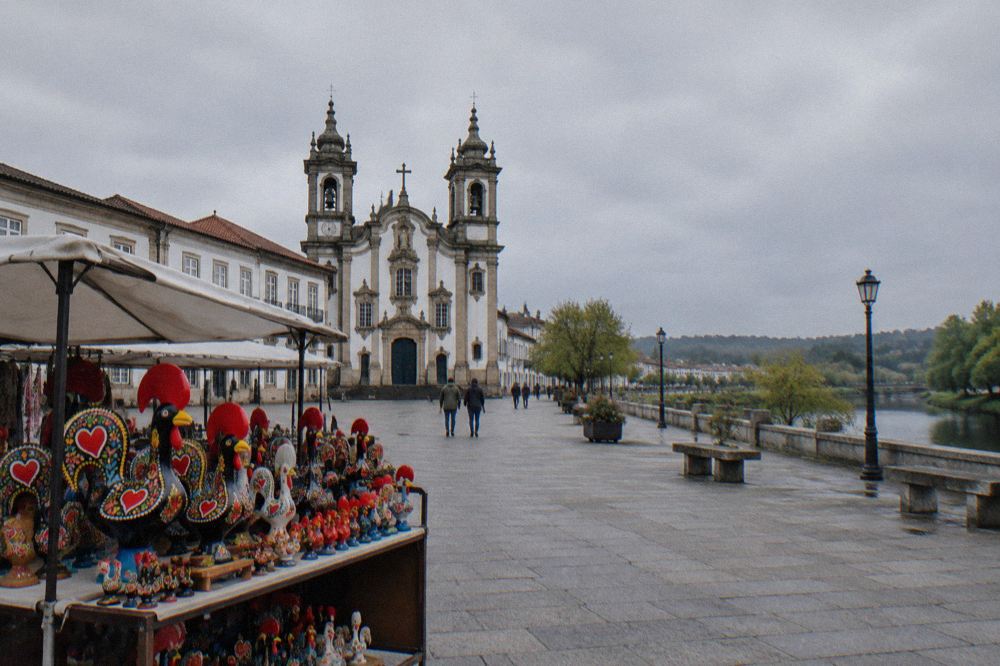
Barcelos is known for three things above all: the Rooster of Barcelos legend and its painted clay roosters, the Thursday market that fills the town with stalls and buyers from across the Minho, and a well-preserved medieval core that includes a stone bridge, the Paço dos Condes and the church of Santa Maria Maior with its azulejo-covered interior. The rooster is the emblem visitors meet everywhere, on ceramics, souvenirs and even the tail of the national airline's aircraft.
The legend behind the rooster is a folk tale rather than a documented event, and it is worth knowing the shape of it before you go, because every shop in town will assume you do. A pilgrim on his way to Santiago de Compostela is wrongly accused of theft in Barcelos and sentenced to hang. He protests his innocence and points to a roasted cockerle on the judge's table, declaring that the cooked bird will crow at the hour of his hanging to prove him innocent. The judge, the story goes, delays the execution, the rooster stands up and crows, and the pilgrim goes free. The tale has no verified date or named pilgrim, and the town does not claim otherwise: it is folklore, and the town celebrates it as folklore, most visibly in the ceramic roosters painted in the local style.
The Thursday market is the other half of the town's identity. It is a confirmed, recurring event, one of the largest weekly markets in northern Portugal, and it is the reason many travellers time the whole trip around it. On other days Barcelos is quieter but far from empty: the historic centre, the riverside, the Campo da Feira and the museums hold up on their own. For a fuller verdict on the town as a destination, see is Barcelos Portugal worth visiting, and for what lands on the plate there, what kind of food Barcelos is known for covers the local table.
How Do You Get From Braga To Barcelos?
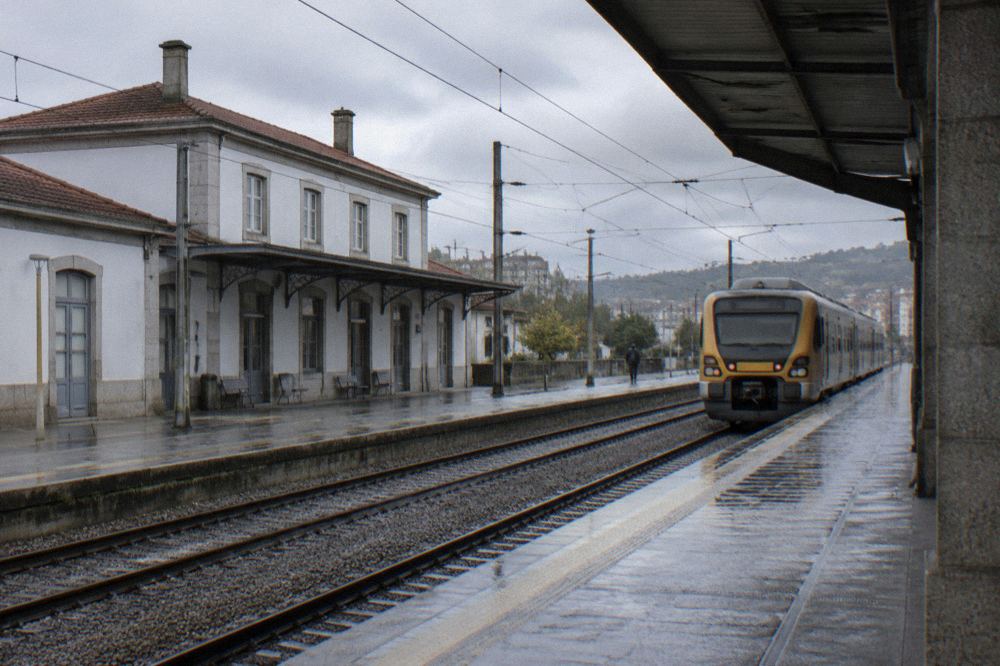
There is no direct train from Braga to Barcelos: the rail route runs through Nine, where you change trains, and the whole journey is short enough to do as a day trip with a late start. Barcelos is also reachable by road, and many visitors simply drive or take a bus, but the rail connection through Nine is the fixed, published fact to plan around. The station in Barcelos sits close to the historic centre, so arrival to first sightseeing involves very little walking.
Rather drive across the Cávado valley yourself? Book a rental car here.
The train is the simplest option for most visitors staying in Braga without a car. Braga is the terminus of CP's urban line from Porto via Nine, and Barcelos lies on the Minho line that branches west from Nine toward Viana do Castelo. The change at Nine is the single piece of operational information that matters: it is a small interchange station, and the connection is a normal, timetabled transfer rather than an awkward one. Fares on this route are priced by zone, and this site does not publish an exact figure for it: expect a few euros, and check the CP timetable and fare tool before you travel. The current urban timetable for the Braga line has been valid since 26 July 2026.
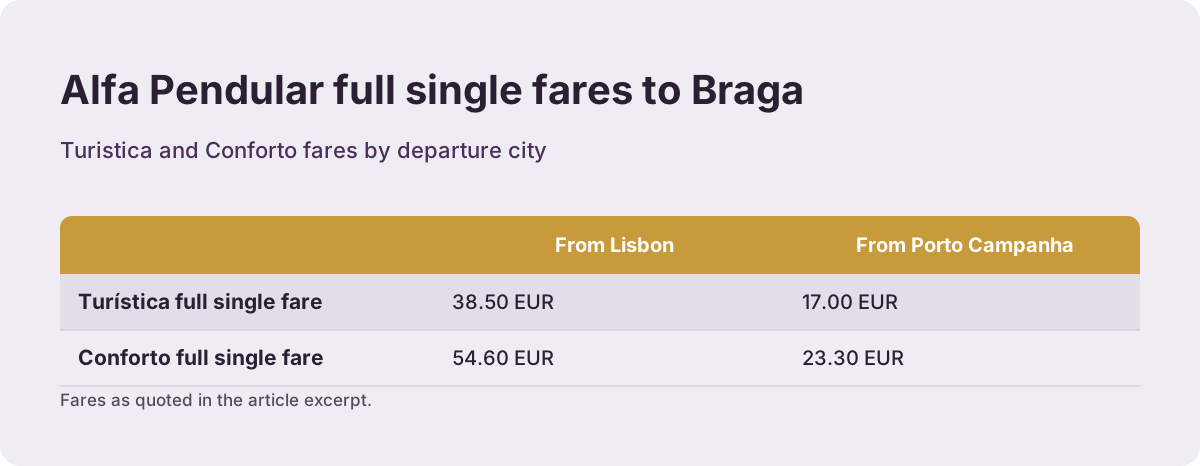
If you are combining Braga and Barcelos with a wider rail itinerary, it helps to know that Braga's own rail links are strong: direct Alfa Pendular services run from Lisbon with a full single Turística fare of 38.50 EUR and Conforto at 54.60 EUR, and from Porto Campanha at 17.00 EUR and 23.30 EUR respectively. The urban train from Porto to Braga takes a little over an hour. For all of that, see the detailed Porto to Braga connection guide and the broader how to get around the Minho pages.
| Mode | Route from Braga | What to plan around |
|---|---|---|
| Train | Braga to Nine, change, Nine to Barcelos | Fixed published connection; check the CP timetable for transfer times |
| Car | Road route west across the Cávado valley | Parking near the centre is busiest on Thursday market days |
| Bus | Regional services from Braga bus station | This site publishes no verified fare or journey time for this route |
| Organised day trip | Combine with Braga sightseeing | See the tour options below for Braga-based products |
Before or after the Barcelos leg, a guided orientation of Braga itself saves half a day of map-reading. The Braga tuk tuk city tour, a 30-minute to two-hour ride rated 4.8 from 179 reviews, covers the historic centre without wearing out your legs before a market day, and you can Check availability alongside it.
What Should You Actually See In Barcelos?
The core sights cluster within a few minutes of each other: the Campo da Feira and the Thursday market stalls, the medieval Ponte de Barcelos over the Cávado, the Paço dos Condes with its archaeological open-air museum of carved stone crosses and coats of arms, the church of Santa Maria Maior, and the riverside walk that ties them together. The town is compact and flat by Minho standards, and the whole circuit works as one walking loop.
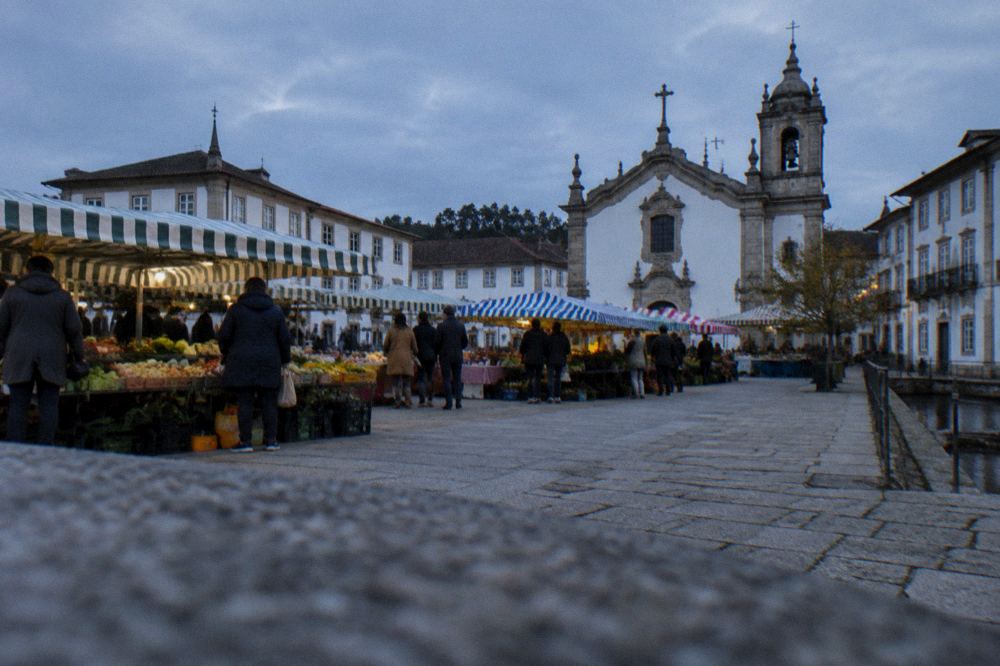
Start at the Campo da Feira, the large open square that hosts the weekly market and gives the town its rhythm. On Thursdays the market spreads out from here across the surrounding streets, mixing produce, household goods, clothing and the region's crafts, and it is as much a social event as a commercial one. Arrive in the morning: the market thins through the afternoon, and the best of the browsing, and the roasted chestnuts and grilled sardines when in season, happen before midday.
The Paço dos Condes, the former counts' palace beside the square, now holds the town's municipal museum, and its grounds form one of the strangest and best open-air collections in Portugal: rows of medieval stone crosses, pillories and carved coats of arms gathered from across the region, each with its own carved narrative. The stone cross of the rooster legend's judge is part of this local heritage story. The church of Santa Maria Maior, a short walk away, is a historic building whose interior is lined with azulejo tiles, and it is the town's most rewarding interior visit.
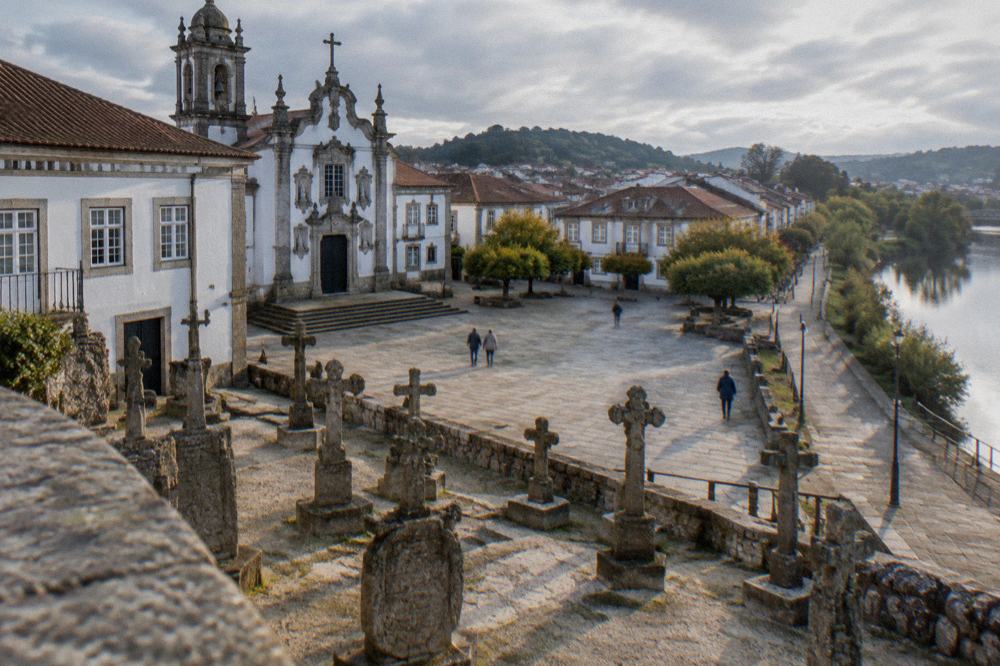
Cross the old stone bridge over the Cávado for the classic postcard view back at the town's towers, then follow the riverside path either direction for a quieter stretch before looping back. The bridge is pedestrian, photogenic at both ends, and the natural turnaround point of the walking circuit. If you have energy left, the Nossa Senhora do Terço church, with its distinctive blue-and-white tiled facade showing the rooster legend itself, sits near the riverside and closes the loop neatly.
| Sight | What it is | Best moment |
|---|---|---|
| Campo da Feira | The market square, heart of the weekly fair | Thursday morning, stalls at their fullest |
| Paço dos Condes | Municipal museum and open-air stone collection | Mid-morning, before the market crowds drift over |
| Ponte de Barcelos | Medieval stone bridge over the Cávado | Late afternoon light on the towers |
| Santa Maria Maior | Historic church with a tiled interior | A quiet interior visit any day |
| Nossa Senhora do Terço | Church with a tiled facade of the rooster legend | A short stop on the riverside loop |
Should You Go On Thursday Market Day Or A Quiet Day?
Go on Thursday if the market is the reason you are going: it is the town's defining event, and the stalls, the crowds and the atmosphere exist only on that day. Go on any other day if you want the museums, the bridge and the churches to yourself, if you are combining Barcelos with another town, or if you dislike crowds and market logistics. Both versions of Barcelos are worth the trip, and they are almost different destinations.
Market Thursday is loud, sprawling and genuinely local. Buyers come from across the Minho, the surrounding streets fill with parked cars by mid-morning, and the town's cafes do a roaring trade in coffee and bifana sandwiches. The market is the largest weekly event of its kind in the region and it rewards an early start: the first hours have the fullest stalls and the most bargaining energy, and the difference between 9am and 2pm is the difference between a festival and a wind-down.
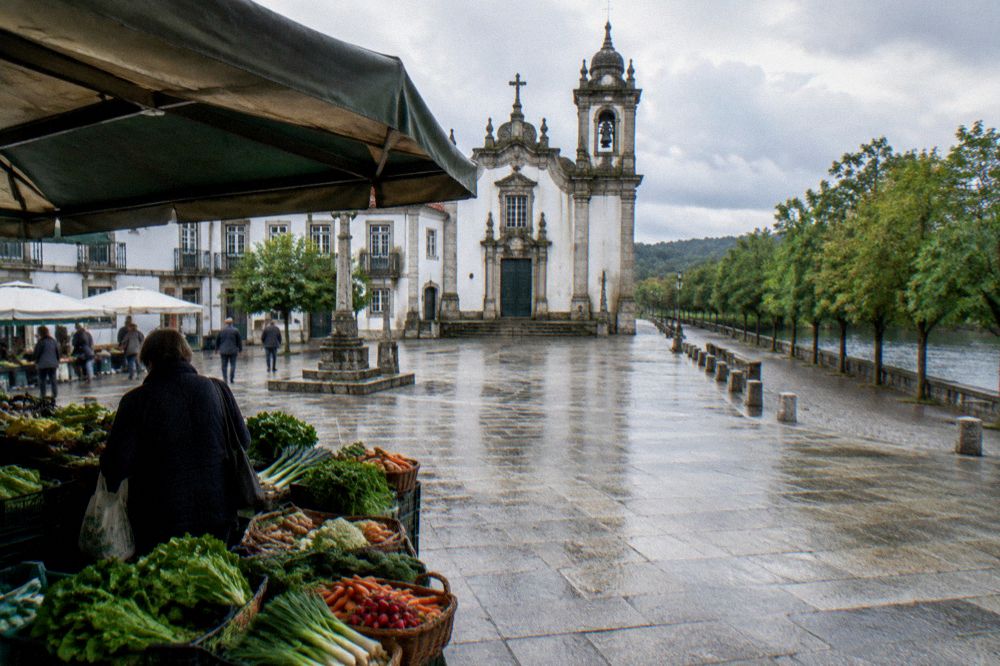
A quiet-day visit suits a different traveller. The museum grounds, the church interiors and the bridge are all reachable without the market crowds, the riverside is calm, and the town's restaurants run at a relaxed pace. The trade-off is simple: you lose the market, and the market is the single thing Barcelos does that nowhere else in the Minho does on the same scale. If your Braga itinerary is already packed, the quiet-day version pairs well with a second stop, and the one day in Braga planner shows how to split a day between the city and a short hop out.
| Version | Atmosphere | Best for | Skip if |
|---|---|---|---|
| Thursday market day | Busy, loud, festival-like | First visits, market lovers, photographers | You need parking near the centre |
| Any other weekday | Calm, unhurried | Museums, interiors, a relaxed lunch | The market is your main reason |
| Weekend | Between the two, quieter than Thursday | Couples, slow walkers | You want full market energy |
What And Where Should You Eat In Barcelos?
Barcelos sits in the Minho, so the table is the region's table: caldo verde, cod dishes, roast suckling pig, river fish from the Cávado, and the region's vinho verde white wines, all served in the restaurants around the market square and the riverside. On market Thursday, the food is partly the market itself: roast chestnuts, grilled sardines in season, and stall food eaten standing up between purchases.
The Minho's cooking is honest and hearty, and Barcelos, as a market town, gets the raw end of that deal better than most. Vinho verde, the young lightly sparkling wine of the region, is the default pour, and the town's restaurants pour it by the carafe. The local sweet tradition leans on convent-style egg puddings, and the rooster appears on the pastry counter as often as on the souvenir shelf. For the full regional picture, including the dishes to look for by name, read what kind of food Barcelos is known for, and for the wine behind it, the vinho verde guide on this site explains what the name actually means.
Tipping follows the national norm, and Turismo de Portugal's own wording is worth repeating: service is included in the bill in restaurants, though it is customary to leave an additional tip of about 5 to 10 percent of the total, and it is normal to tip taxi drivers 5 to 10 percent or round up to the nearest euro. Braga, as a point of comparison for your wider stay, levies a municipal tourist tax of 1.55 EUR per person per night for up to four nights, all year, charged through your accommodation, so budget it into a multi-night Minho trip.
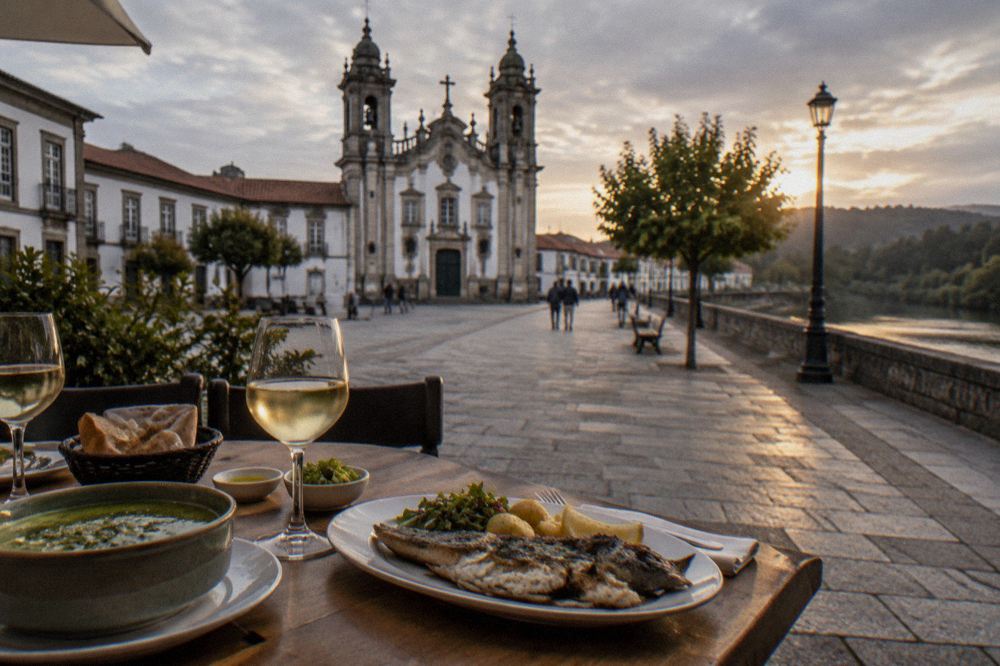
A food-focused way to spend the Braga half of your trip is the small-group food tour of Braga, a three-hour tasting walk rated 5 from 5 reviews, which pairs well with a market day in Barcelos later in the week.
How Does Barcelos Compare With The Other Day Trips From Braga?
Barcelos is the market-and-folklore choice among Braga's day trips, where Guimarães is the history-and-castle choice, Ponte de Lima is the riverside-scenery choice and Viana do Castelo is the coastal-city choice. All four sit in the Minho and all four work as day trips from Braga, but they answer different questions, and a week in Braga can comfortably fit two or three of them.
Guimarães, the cradle-of-Portugal town to the east, is the strongest pairing with Barcelos in a single itinerary, and this site's Braga and Guimarães in one day planner covers the mechanics. Note one verified operational fact: there is no direct train from Braga to Guimarães, and the regional bus line 101 runs from Braga bus station to Guimarães via the A11, though this site publishes no fare or journey time for it. Ponte de Lima, reached on regional bus line 105, is Portugal's chartered market town with a famous Roman bridge; Viana do Castelo, further up the coast, pairs a basilica-topped hill with a working port. Each has its own page: Guimarães, Ponte de Lima and Viana do Castelo.
| Day trip | The town in one line | The reason to choose it |
|---|---|---|
| Barcelos | Market town of the rooster legend | Thursday market, folklore, ceramics |
| Guimarães | Medieval birthplace-of-Portugal town | Castle, palace, historic core |
| Ponte de Lima | Riverside town with a Roman bridge | Scenery, quiet, riverside walking |
| Viana do Castelo | Coastal city with a hilltop basilica | Sea air, squares, a grand viewpoint |
How Do You Fit Barcelos Into A Braga Itinerary?
The cleanest plan is two nights in Braga with Barcelos as a mid-week or Thursday day trip: use the first day for Braga's historic centre and the Sé de Braga, the second for Bom Jesus do Monte and the sanctuary hill, and slot Barcelos between or after them. A single-night stay works too, because the rail connection through Nine makes the round trip short, but the two-night version removes every timing pressure.
Braga itself needs more time than most day-trippers give it. The cathedral's three visit routes cost 3.00 EUR each, or 7.00 EUR combined for all three, and the Treasury-Museum closes on Mondays, facts worth knowing before you stack a museum day against a market day. The Bom Jesus stairway is 566 steps by the Confraria's count, and with the funicular out of service the choice is the steps or the shuttle, so a sanctuary morning is a real morning's work. The 3 days in Braga planner lays all of this out day by day.
If Barcelos is one stop on a wider northern Portugal route, the northern Portugal itinerary page sequences Braga, Guimarães, the coast and the Peneda-Gerês National Park into a single driving loop, and the day trips from Porto answer page covers the same ground for visitors starting in Porto. Barcelos sits naturally on the coastal leg of either route, between Braga and Viana do Castelo.
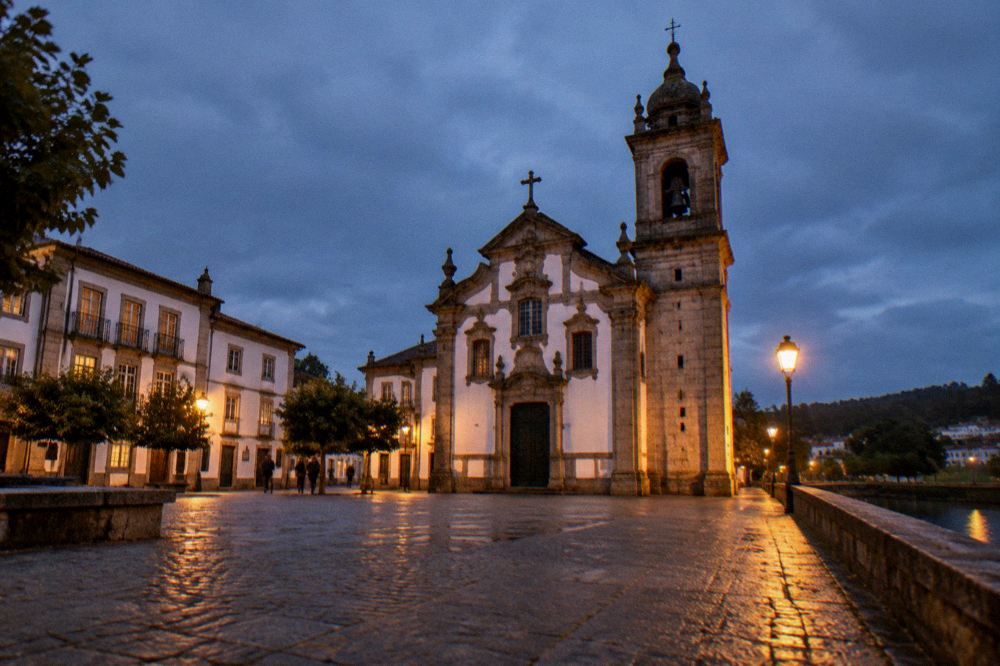
For travellers who want the Braga half of the trip guided, the small-group Braga half-day tour with Bom Jesus Sanctuary, three hours, rated 4.8 from 24 reviews, covers the centre and the sanctuary in one sweep, and it is worth booking ahead of your dates, since the funicular works change the sanctuary logistics.
Common Questions About A Barcelos Day Trip
Is Barcelos worth visiting?
Yes, for most travellers on a Braga or Minho itinerary. The Thursday market is one of the largest weekly markets in northern Portugal, the medieval bridge and museum grounds are genuinely good, and the rooster legend gives the town a story no other Minho town can tell. The full verdict, including who should skip it, is on this site's dedicated answer page.
Is there a direct train from Braga to Barcelos?
No. The rail route runs from Braga to the interchange station at Nine, where you change trains onto the Minho line toward Barcelos. The change is a normal timetabled connection, and Barcelos station sits close to the historic centre.
What day is the market in Barcelos?
Thursday. The weekly market is a confirmed recurring event and the town's defining occasion, filling the Campo da Feira and the surrounding streets. Go early in the morning for the fullest stalls.
What is the Rooster of Barcelos?
It is the town's folk legend: a pilgrim wrongly condemned to hang declares that a roasted cockerel on the judge's table will crow to prove his innocence, and the bird does. The painted ceramic rooster became the unofficial national symbol of Portugal and appears across the town's crafts.
Can you combine Barcelos with another town in one day?
Yes. Barcelos pairs naturally with Viana do Castelo on the coastal route, or with a half-day in Braga itself if you start early. Combining it with Guimarães in one day is tighter, since Guimarães sits in the opposite direction from Braga.
Do you need to book anything in advance for Barcelos?
No tickets or timed entries are needed for the town itself; the market is free and open, and the museums are turn-up-and-buy. Only the guided tours around Braga, and any Alfa Pendular rail seat if you are arriving from Lisbon or Porto, benefit from advance booking.
Barcelos rewards exactly the kind of traveller Braga attracts: someone with a base in one of Europe's oldest archiepiscopal cities, a free day, and an appetite for markets, legends and riverbank light. Pick your Thursday if the market is the point, pick any other day if the museums are, and let the change of trains at Nine be the hardest part of the plan.