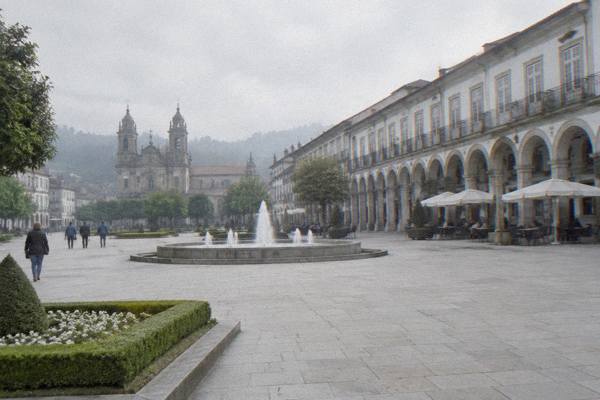
Santa Bárbara Garden, Braga: The Complete Visitor Guide
The Jardim de Santa Bárbara is the small formal garden pressed against the eastern flank of Braga Cathedral, the greenest corner of Braga's historic centre in northern Portugal.
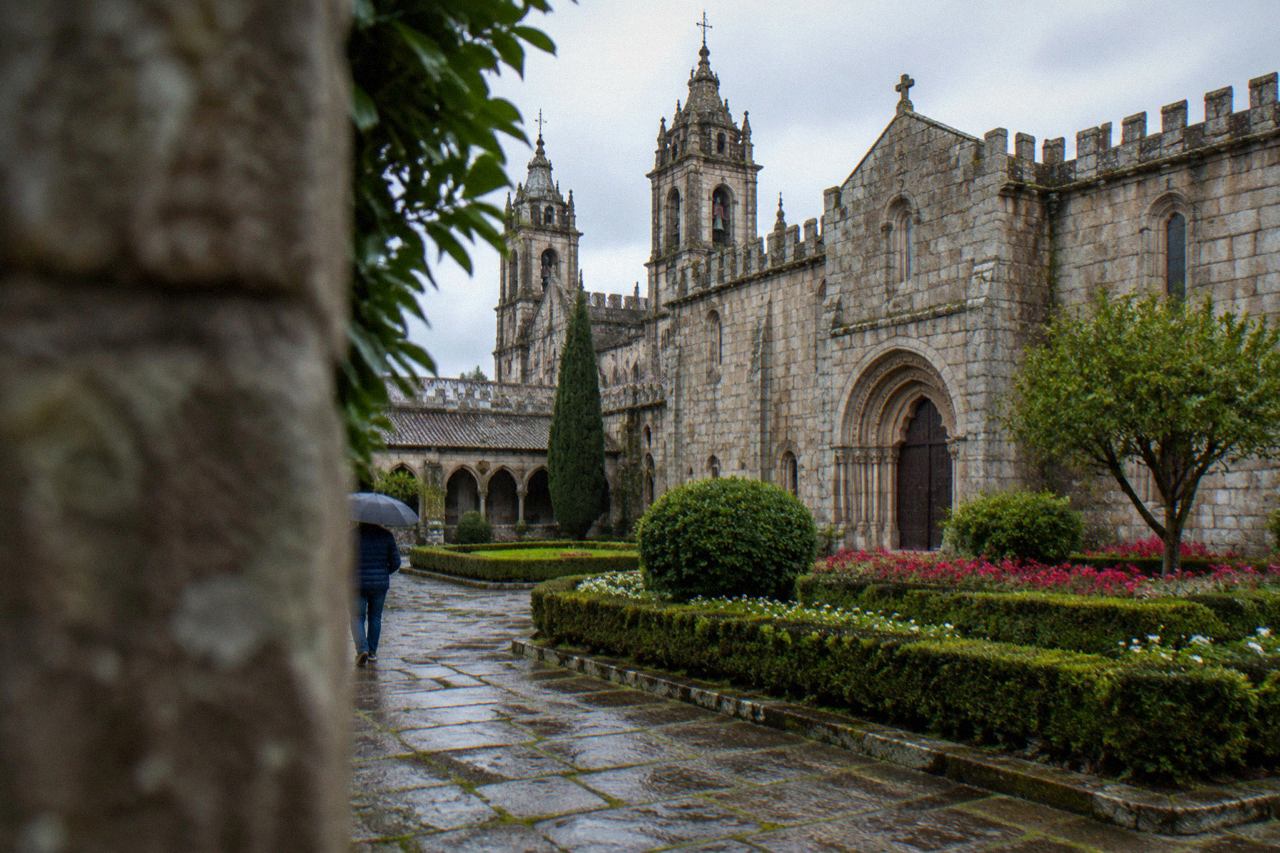
Short answer
The Jardim de Santa Bárbara is a free public garden beside Braga Cathedral in Braga, Portugal, open to walk through at any time, and best combined with a cathedral visit and a circuit of the historic centre.
The Jardim de Santa Bárbara is a small, formal public garden tucked against the eastern side of the Sé de Braga, the cathedral that anchors the historic centre of Braga, the city in the Minho region of northern Portugal. It is the kind of place a first-time visitor reaches within minutes of stepping into the old town and remembers longer than several of the ticketed sights: clipped hedges, seasonal flower beds laid out in geometric patterns, benches under trees, and the cathedral's stone rising directly over the green. The garden carries no entry charge and no gate, which makes it the easiest stop on any walk through the city, and the Braga Travel Guide historic-centre coverage treats it as the natural hinge between the cathedral, the Arcada and the Rua do Souto pedestrian spine.
What Is The Jardim De Santa Bárbara In Braga?
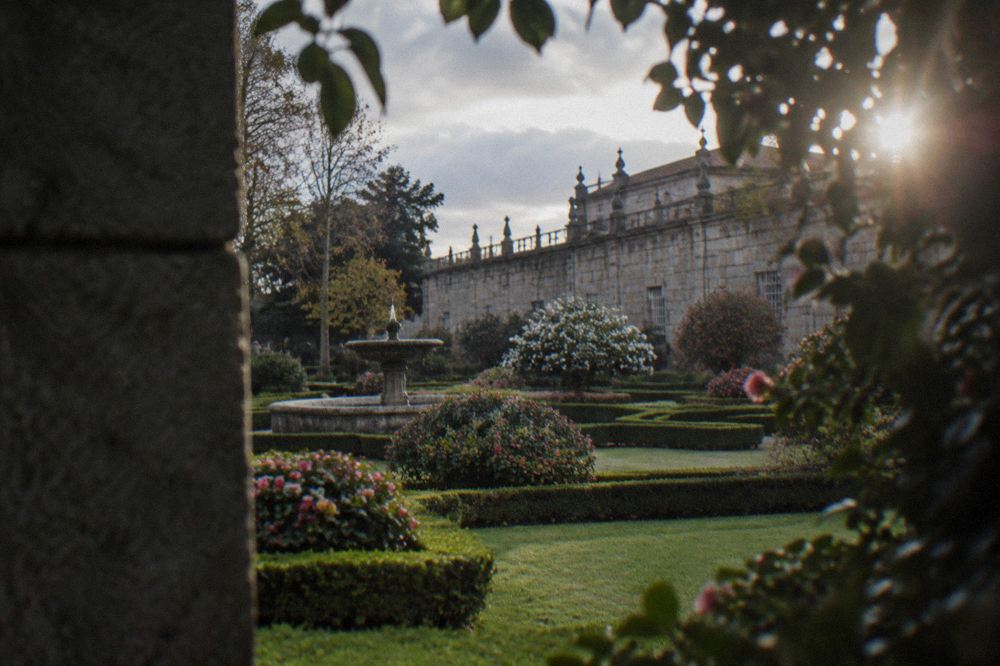
The Jardim de Santa Bárbara is a free public garden in the historic centre of Braga, Portugal, sitting immediately beside the Sé de Braga, the city's cathedral, on the ground of the former Archbishop's Palace complex. It has no tickets, no opening booth and no published closing time, because it is a municipal garden open to the street, and its whole appeal is the contrast between formal, geometric planting and the heavy granite of the cathedral rising behind it.
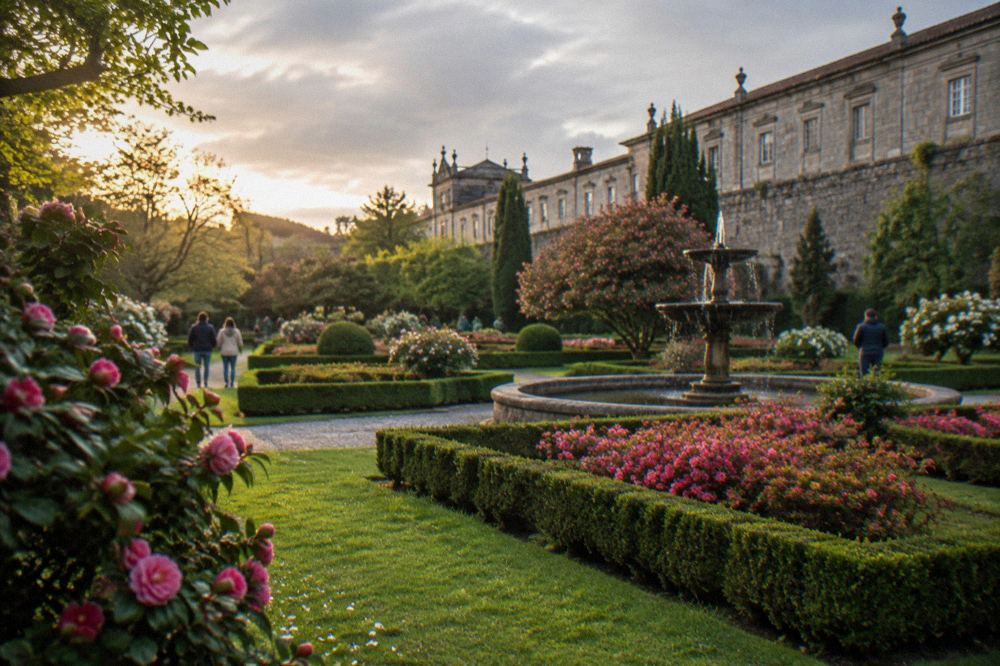
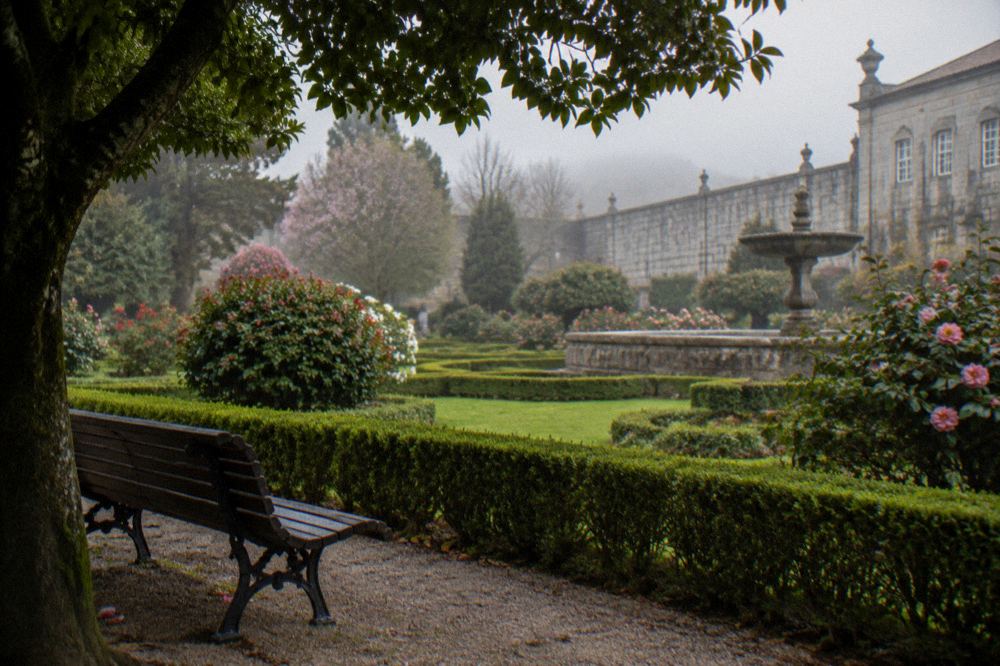
That contrast is the reason the garden photographs so well. The beds are laid out in symmetrical patterns and replanted through the year, so the colours change with the seasons: spring bulbs and early bedding, high-summer colour, and autumn replaced with winter planting. Low clipped hedges frame the beds, gravel paths run between them, and mature trees give shade over the benches. Because the garden is small and walled on several sides, it holds a stillness that the busy Avenida da Liberdade, a few minutes downhill, does not.
The setting matters as much as the planting. Braga was a church city for centuries, governed by its archbishops, and the garden sits on the footprint of the palace complex that once adjoined the cathedral. The Archbishop's Palace, the Paço Episcopal, still stands in part around the cathedral's east and south sides, and the garden grew up in its shadow. A visitor standing among the flower beds is standing inside the most historically loaded block of the city, with the cathedral cloister reception, the Rua do Souto shopping street and the Praça da República all within a short walk.
For planning purposes, treat the garden as a fifteen-minute stop rather than a destination. It is a pause, a photo stop and a shade break on the way between bigger sights, and it costs nothing, which in a city where the cathedral, the museums and the hill sanctuaries all charge admission is worth saying plainly. Pair it with the cathedral itself, and you have the core of a morning in the old town.
What Can You See From Inside The Garden?
From inside the Jardim de Santa Bárbara you see the eastern towers and walls of the Sé de Braga at close range, the stonework of the former Archbishop's Palace complex around the garden, seasonal geometric flower beds with clipped hedging, mature shade trees, and benches set along gravel paths. The garden is best known as the classic viewpoint for the cathedral's upper structure, which is why most photographs of Braga Cathedral's exterior are taken from here rather than from the street.
The cathedral view deserves a few words on timing. Morning light falls on the garden from the east and can be harsh against the stone; late afternoon and early evening light warms the granite and is the window most photographers prefer. In summer the sun stays up well past 19:00, and in the weeks around Noite Branca, Braga's white-night festival on the first weekend of September, the whole area is lit and busy late. There is no fee, no queue and no ticket desk at any hour, and the garden is a public space, so access is simply a matter of walking in.
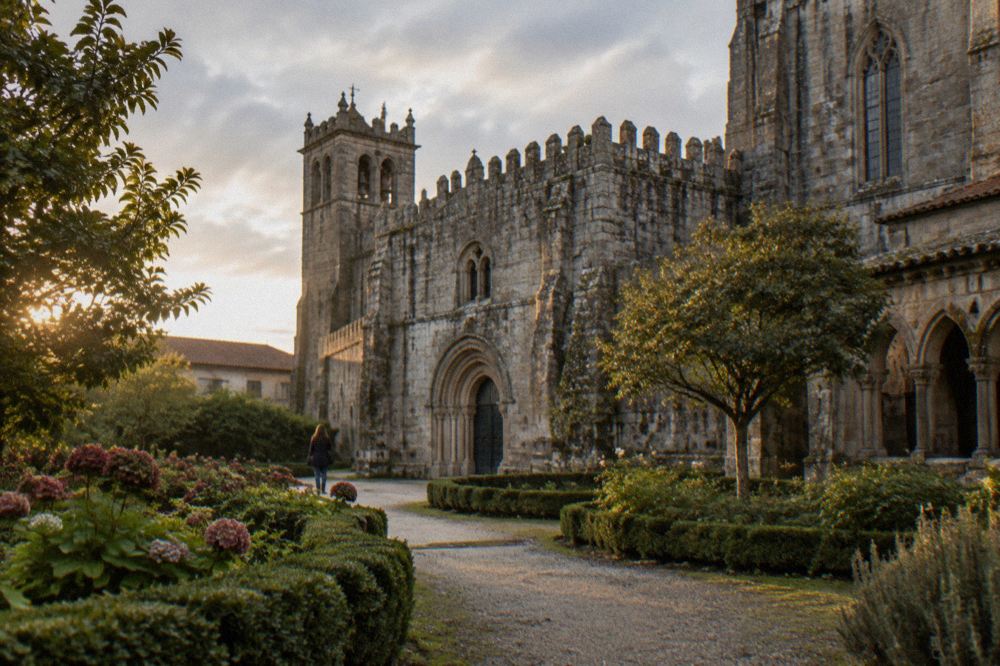
The planting is worth a slow look, not just the backdrop. The beds are renewed several times a year, and the municipal gardeners work in a formal Iberian tradition of patterned parterres rather than the loose English style, so the shapes read best from the corners and from the upper end near the cathedral wall. Azulejo tiles, the painted ceramic tiles found across northern Portugal, appear on walls and features in and around the garden, and the mix of tile, granite and hedge is very much the local vocabulary.
Visitors who want a guided version of this walk have several options. The Tuk Tuk City Tour passes through the historic centre's main squares and monuments with a driver-guide in an electric tuk tuk, from $22.66 per person according to the listing, and runs between 30 minutes and 2 hours depending on the option chosen. Check availability. A walking alternative, the Portuguese Rome walking tour, covers the cathedral quarter on foot in about an hour and a half.
Prefer a guided walk through the old town? Book a free walking tour here. (Guided in Spanish)
When Is The Best Time Of Year To Visit The Garden?
The best months for the Jardim de Santa Bárbara are May, June and September, when Braga's mean daily maximum runs from 23.0 to 26.9 degrees Celsius, rain days are at their lowest of the year, and the bedding plants are in full colour. July and August are the warmest and driest months but also the busiest, while October, November and December are the three wettest months of the year in Braga, so the garden is green but often wet.
Those figures come from IPMA's 1991 to 2020 climate normals for the Braga / Merelim station, which is the city station, not the district, and they shape any garden visit more than a cathedral visit, because a garden is weather-dependent in a way stone is not. October is statistically the wettest month in Braga, at 197.8 millimetres on average, with December and January close behind. Summer is genuinely dry: July averages just 27.9 millimetres across the whole month.
| Month | Mean max (C) | Mean min (C) | Rain (mm) | Days with 1 mm or more |
|---|---|---|---|---|
| March | 17.8 | 5.9 | 150.1 | 11.8 |
| April | 19.6 | 7.8 | 127.9 | 12.0 |
| May | 23.0 | 10.4 | 89.8 | 8.9 |
| June | 26.1 | 13.2 | 40.6 | 5.7 |
| July | 28.2 | 14.3 | 27.9 | 4.0 |
| August | 28.7 | 14.0 | 34.6 | 3.8 |
| September | 26.9 | 12.4 | 67.6 | 6.2 |
| October | 22.2 | 10.1 | 197.8 | 12.0 |
Two local events change the feel of the garden's neighbourhood dramatically, and both are worth planning around. Semana Santa, Braga's Holy Week, fills the historic centre with processions, and the 2026 edition ran from 29 March to 5 April; Holy Week is always the week before Easter, so the date moves. São João, the city's June festival, ran from 17 to 24 June in 2026, peaking on the night of 23 June into the 24 June municipal holiday. During both, the streets around the cathedral are crowded in the evenings, and the garden becomes a resting point between processions rather than a quiet corner. The Semana Santa guide covers the programme in detail.
How Much Does It Cost To Visit The Jardim De Santa Bárbara?
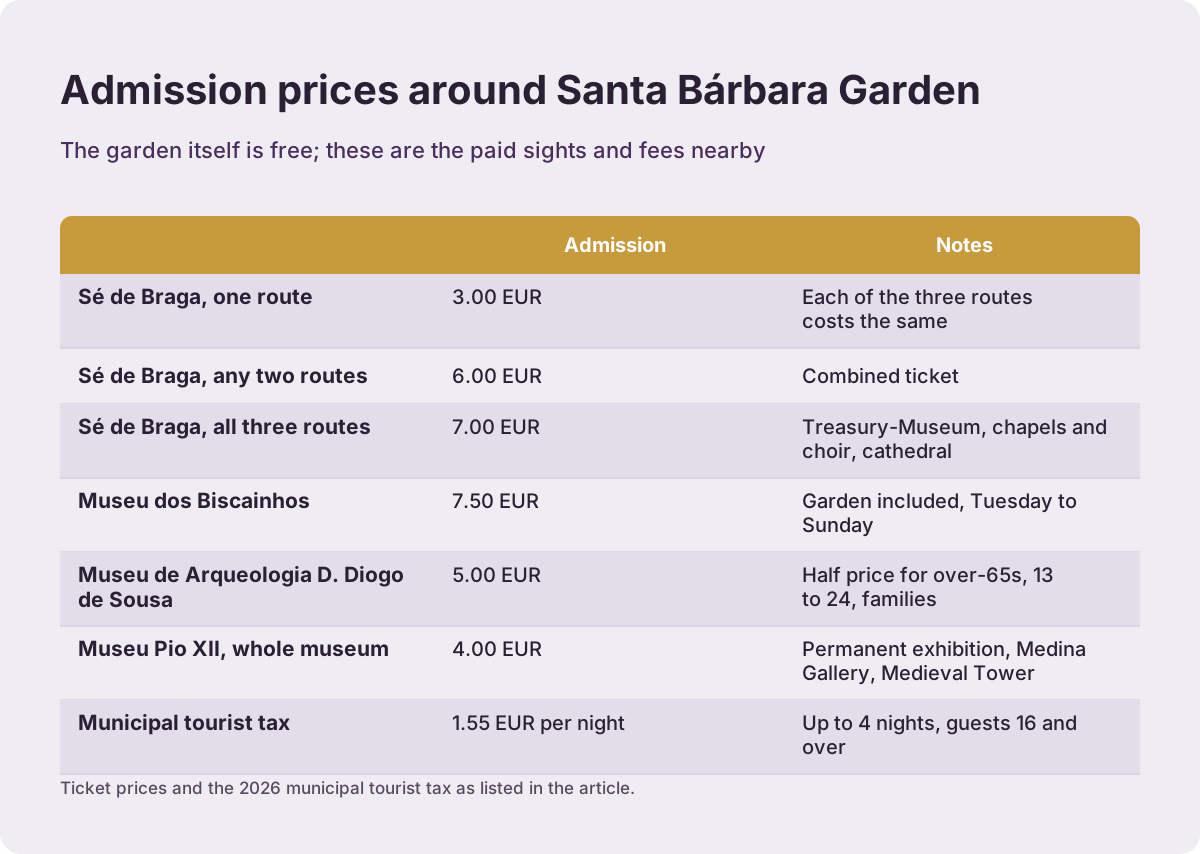
The Jardim de Santa Bárbara costs nothing to enter, because it is a free municipal garden with no gate, ticket desk or published hours. The costs around it are the ones to plan for: the Sé de Braga charges 3.00 EUR per visit route or 7.00 EUR for all three combined, the nearby museums charge between 3.00 and 7.50 EUR, and Braga's municipal tourist tax adds 1.55 EUR per person per night, for up to four nights, to any hotel stay.
The tourist tax is easy to miss because it is usually not in the room rate. The 2026 municipal fee table sets it at 1.55 EUR per person per night, up from 1.50 EUR in 2025, charged by hotels and local accommodation whatever the booking channel, for a maximum of four consecutive nights per person per stay, and it applies all year. Guests under 16 are exempt. It is small money, but on a family stay it adds up, and it is worth knowing before you reach the front desk.
| Item | Price | Notes |
|---|---|---|
| Jardim de Santa Bárbara | Free | Public garden, no ticket desk |
| Sé de Braga, one route | 3.00 EUR | Each of the three routes costs the same |
| Sé de Braga, any two routes | 6.00 EUR | Combined ticket |
| Sé de Braga, all three routes | 7.00 EUR | Treasury-Museum, chapels and choir, cathedral |
| Museu dos Biscainhos | 7.50 EUR | Garden included, Tuesday to Sunday |
| Museu de Arqueologia D. Diogo de Sousa | 5.00 EUR | Half price for over-65s, 13 to 24, families |
| Museu Pio XII, whole museum | 4.00 EUR | Permanent exhibition, Medina Gallery, Medieval Tower |
| Municipal tourist tax | 1.55 EUR per night | Up to 4 nights, guests 16 and over |
No city-wide attraction pass is on sale in Braga. The only multi-use product that genuinely exists is the TUB tourist ticket for the city buses, covered below, which is a transport product rather than an attraction pass.
What Is There To See Right Next To The Garden?
The sights immediately around the Jardim de Santa Bárbara are the Sé de Braga itself, whose cloister ticket reception is entered from Rua do Cabido or the side entrance by Rua D. Diogo de Sousa; the Arcada and Praça da República a few minutes downhill; the Rua do Souto pedestrian street; the Museu de Arqueologia D. Diogo de Sousa within the same historic block; and the castle keep of Braga a short walk north. Everything on that list is reachable on foot from the garden without transport.
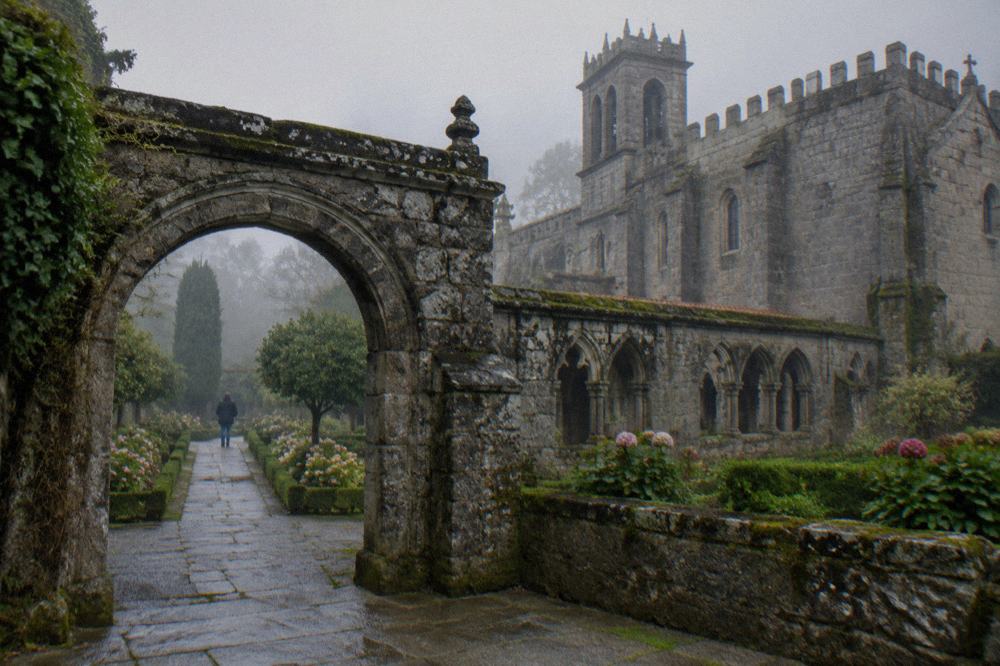
The cathedral is the obvious pairing, and it deserves more than a glance from the beds. The visit is organised in three routes, each 3.00 EUR on its own: Percurso 1, the Treasury-Museum; Percurso 2, the funerary chapels and high choir; and Percurso 3, the cathedral itself. All three together cost 7.00 EUR, and any two cost 6.00 EUR. Tourist visits run Monday to Saturday 09:30 to 13:00 and 14:30 to 17:00, and Sunday 09:30 to 10:45 and 14:30 to 17:00, with last entry 30 minutes before closing; the building itself opens earlier for worship, and visits to the interior are suspended during services. The Treasury-Museum is closed on Mondays. The Braga Cathedral guide walks through all three routes.
The D. Diogo de Sousa archaeology museum sits in the same quarter and is the best context for what lies under the city: Braga was a Roman city, and the museum's collection covers that layer of the Minho. It is open Tuesday to Sunday 10:00 to 17:30 and charges 5.00 EUR, half price for over-65s, visitors aged 13 to 24 and families, and free for under-12s with an adult. The castle keep, all that remains of Braga's medieval castle, is another free-to-see stone landmark within the old town, and the whole circuit, garden, cathedral, keep, squares, is the backbone of the things to do in Braga list.
| Sight | Relation to the garden | Admission |
|---|---|---|
| Sé de Braga | The garden sits against its eastern side | 3.00 EUR per route, 7.00 EUR all three |
| Museu de Arqueologia D. Diogo de Sousa | Same historic block, short walk | 5.00 EUR |
| Braga castle keep | Short walk north in the old town | Public monument |
| Praça da República and the Arcada | Downhill from the cathedral | Free public space |
| Rua do Souto | Pedestrian street off the squares | Free public space |
| Mercado Municipal | Further out, worth the detour on market days | Free to enter |
How Do You Get To The Jardim De Santa Bárbara?
The Jardim de Santa Bárbara is in Braga's pedestrianised historic centre, reached on foot from Avenida da Liberdade or Praça da República in a few minutes, and by TUB city bus using the pre-bought or digital single fare of 0.75 EUR for one zone or 1.50 EUR for two zones, against 1.55 EUR and 2.00 EUR bought on board. There is no parking at the garden itself, and the old town is best entered without a car.
The bus fares matter more than they look, because the difference between buying ahead and paying the driver is real. The 2026 TUB tariff, in force since 21 February 2026, sets the on-board single at 1.55 EUR for one zone and 2.00 EUR for two zones, while a pre-bought or digital ticket is 0.75 EUR and 1.50 EUR for the same journeys, with transfer validity of one hour for one zone and one and a half hours for two. For a visitor making several trips, the tourist ticket covers the whole network at 3.35 EUR for one day, 6.05 EUR for two days and 8.05 EUR for three days per person.
| TUB ticket type | 1 zone | 2 zones | Notes |
|---|---|---|---|
| On-board single | 1.55 EUR | 2.00 EUR | Bought from the driver |
| Pre-bought or digital single | 0.75 EUR | 1.50 EUR | Cheapest single option |
| Tourist ticket, 1 day | 3.35 EUR | whole network | Per person |
| Tourist ticket, 2 days | 6.05 EUR | whole network | Per person |
| Tourist ticket, 3 days | 8.05 EUR | whole network | Per person |
Visitors arriving from farther out should read the how to get to Braga context in the site's transport pages: the city is the terminus of CP's urban line from Porto São Bento via Campanhã and Nine, with the current timetable valid from 26 July 2026, and the urban fare is priced by zone, so expect a few euros rather than a fixed printed figure. From Braga's station the old town is a straightforward walk, and once inside the pedestrian streets the garden needs no transport at all. Anyone planning to drive should use the site's parking guidance rather than the streets around the cathedral, which are narrow, partly pedestrianised and rarely worth the circling.
A tuk tuk is a sensible middle option for visitors who want the historic centre's geography explained without walking every street. The Tuk Tuk City Tour is rated 4.8 from 179 reviews on the listing, and its route options run from 30 minutes to 2 hours, which makes it easy to fit around a cathedral visit. The flexible walking alternative, the Personal and Flexible Walking Tour, starts from $11.33 per person and runs about 3 hours in the historic centre.
Can You Combine The Garden With A Half-Day Or Full-Day Walk?
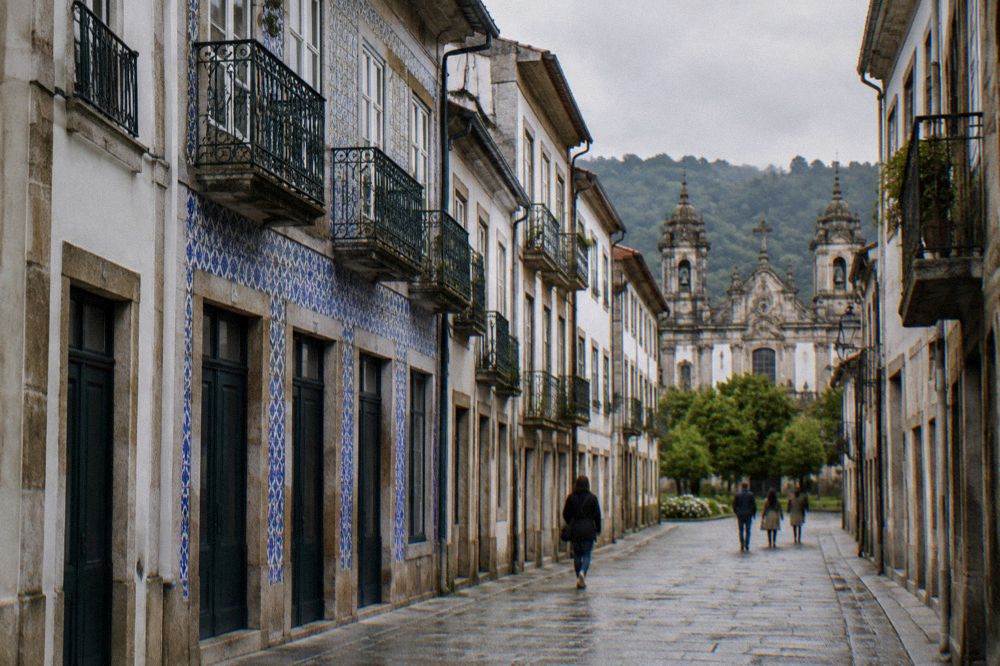
Yes, and the garden is the natural first stop of a half-day circuit that runs from the Jardim de Santa Bárbara into the Sé de Braga, out to the castle keep, down through Praça da República and Rua do Souto, and ends at the Arcada, all on foot in a morning. A full day adds the hill sanctuaries, Bom Jesus do Monte and Santuário do Sameiro, or a day trip to Guimarães, Barcelos or the Peneda-Gerês park beyond the city.
The half-day version needs no booking and no car. Start at the garden while the light is still soft, buy the 7.00 EUR combined cathedral ticket when the visit hours open at 09:30, spend the middle of the morning in the cathedral and the archaeology museum, and finish with lunch in the old town. The one day in Braga and itinerary pages on this site build exactly this circuit, with timings and food stops.
The full-day version splits by interest. The sacred-architecture route goes up to Bom Jesus do Monte, the UNESCO-listed sanctuary whose stairway climbs 566 steps by the Confraria's count, and on to the Sameiro sanctuary, whose precinct is open around the clock and free, with a 2 EUR fee only for the dome viewpoint. Note one standing operational fact before planning that route: the Bom Jesus funicular has been out of service since 26 September 2026, with a replacement shuttle running every day from 09:00 to 20:00, roughly every 30 minutes each way, between the Portico and the sanctuary, and no return date for the funicular has been published, so check the operator's notice before you go.
| Circuit | Main stops | Time needed |
|---|---|---|
| Garden and cathedral morning | Jardim de Santa Bárbara, Sé de Braga, cloister | Half day |
| Historic-centre full circuit | Garden, cathedral, castle keep, Praça da República, Rua do Souto, Arcada | Half day to a full day |
| Hill sanctuaries day | Bom Jesus do Monte, Sameiro | Full day |
| Minho day trip | Guimarães, Barcelos or Ponte de Lima beyond the city | Full day |
The day-trip version leaves the city entirely. The Ponte de Lima and Citânia de Briteiros pages cover the two most rewarding directions, the Lima valley and the iron-age hill fort, and the answers page is Ponte de Lima worth visiting handles the common comparison. None of these need a car if you use the regional bus lines from Braga's bus station, though fares and journey times on those lines should be checked on the day rather than assumed.
What Do Locals And Repeat Visitors Know That First-Timers Don'T?
The things regular visitors learn quickly are that the garden is at its quietest in the early morning and in the hour after lunch, that the cathedral's ticket reception is in the cloister rather than the main front, that the Treasury-Museum closes on Mondays while the cathedral visit does not, and that the whole historic centre, garden included, is best treated as a morning-and-evening place in July and August, with the middle of the day given to museums, cafés or the hills.
The cloister entrance detail saves real time. Tickets for the cathedral's three routes are bought at the reception point in the cloister, reached from Rua do Cabido or the side entrance by Rua D. Diogo de Sousa, not from the great west front where most visitors instinctively head. Anyone combining the garden with a cathedral visit should walk the beds first, then enter through the cloister, which also avoids backtracking through the crowds on the square.
The Monday pattern matters for itinerary order. The Treasury-Museum is closed on Mondays, so a Monday visitor can take the cathedral route and the garden but not the full three-route ticket at the Treasury; the Museu dos Biscainhos, the D. Diogo de Sousa museum and the Mosteiro de São Martinho de Tibães all close on Mondays too, as does the Museu Pio XII, so Monday is the day for the garden, the cathedral, the streets and the hills rather than the museums. The Tibães Monastery page covers the monastery, which charges about 4 to 5 EUR and sits on the hill outside the centre.
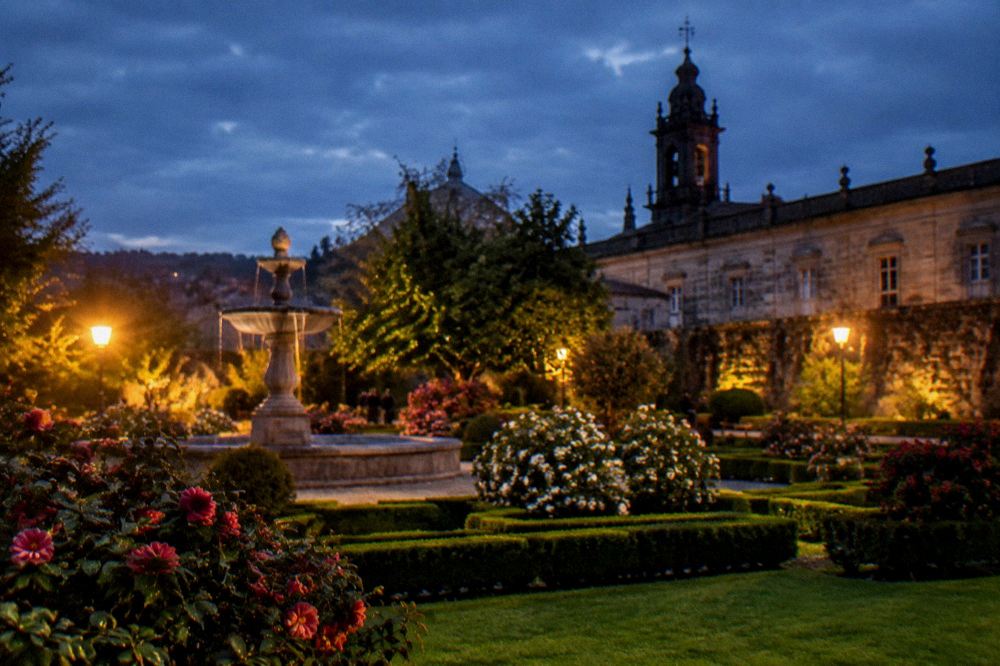
One more local rhythm: the garden's neighbourhood changes character completely during the city's festival weeks. During Semana Santa the streets around the cathedral hold processions that start in the evening, and during São João the whole centre is given over to the festa for the week around 23 and 24 June. On those nights the garden is a standing room, not a quiet corner, and the Braga market and food pages on this site are the better companions for daytime planning. For anyone wanting a guided hand through the festival-period old town, the Explore the Portuguese Rome walk, rated 4.9 from 68 reviews and about 1.5 hours, is the lightest way to get the quarter's story.
Common Questions About The Santa Bárbara Garden In Braga
Is the Jardim de Santa Bárbara free?
Yes. It is a municipal public garden with no gate, ticket desk or entry charge, and it can be walked through at any time as part of the historic centre.
Where exactly is the Jardim de Santa Bárbara in Braga?
It sits against the eastern side of the Sé de Braga, in the historic centre of Braga, the city in the Minho region of northern Portugal, a few minutes on foot from Praça da República and the Rua do Souto pedestrian street.
How long should I spend in the garden?
Treat it as a short stop, typically ten to twenty minutes for the planting and the cathedral view, longer if you are using the benches as a rest between the cathedral and the rest of the old town. It pairs naturally with a cathedral visit of an hour or more.
Can you visit the garden and the cathedral together?
Yes, and that is the standard pairing. Cathedral visits run Monday to Saturday 09:30 to 13:00 and 14:30 to 17:00, and Sunday 09:30 to 10:45 and 14:30 to 17:00, with tickets bought at the cloister reception. Each of the three visit routes costs 3.00 EUR, any two cost 6.00 EUR, and all three cost 7.00 EUR.
When is the garden at its best?
May, June and September combine warm temperatures, low rainfall and full bedding colour, according to IPMA's 1991 to 2020 normals for the Braga / Merelim station. July and August are the warmest but busiest; October, November and December are the wettest months, so expect showers and green rather than flowers.
Is the garden suitable for children and visitors with limited mobility?
The garden is flat, small and entered directly from street level, with gravel paths and benches, which makes it workable for children and for slow, seated visits. The surrounding historic-centre streets are partly pedestrianised but paved in granite, and the site's accessibility page covers the wider city picture.
The Jardim de Santa Bárbara is the smallest of Braga's headline sights and one of the few that costs nothing, which makes it the easiest yes in any itinerary: walk in off the street, look up at the Sé, and let the rest of the old town arrange itself around you.