Living In Braga: A Practical Guide To Daily Life In Northern Portugal
Braga, the city in the Minho region of northern Portugal, combines university-town energy with baroque architecture and some of the lowest urban transport costs in the country. Here is what moving there involves in practice.
Short answer
Living in Braga means a compact, walkable historic centre, a TUB bus network with a 12 EUR monthly one-zone pass, a 1.55 EUR per night municipal tourist tax that applies to visitors rather than residents, and a damp Atlantic-influenced climate with October the wettest month. The municipality counted 193,324 residents at the 2021 census.
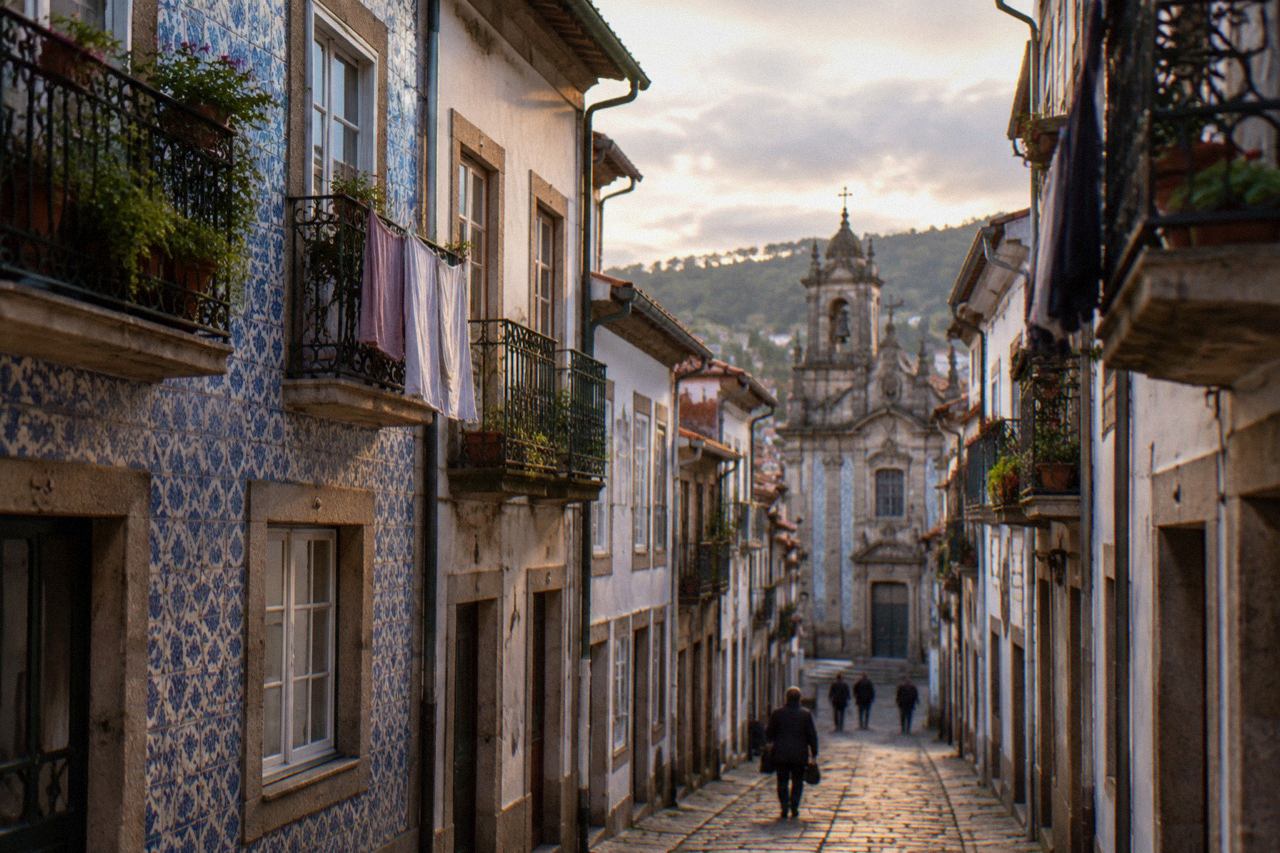
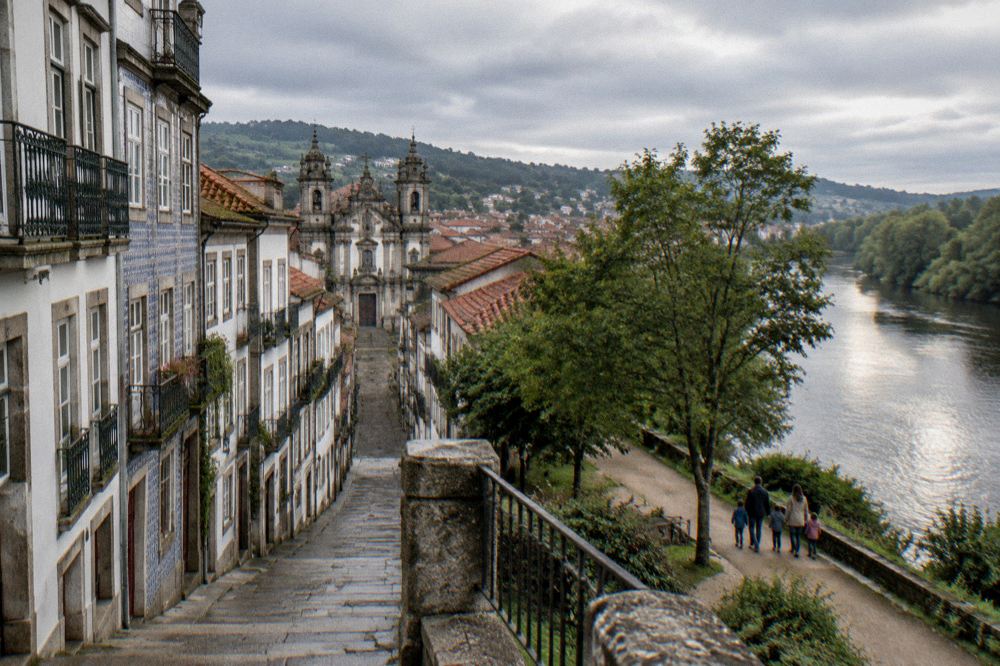
Braga, the city in Portugal's Minho region, is the kind of place where a baroque staircase, a Roman wall and a university campus sit within twenty minutes of each other on foot. The municipality counted 193,324 residents at the 2021 census, and the city functions as the administrative and religious capital of northern Portugal without ever feeling like a metropolis. Anyone considering living in Braga is really choosing between a compact historic core, a ring of residential parishes on the hills, and a daily rhythm set by the academic calendar, the liturgical calendar and the rain.
This guide covers the practical side of the move: what the city costs day to day, how the transport system works, which neighbourhoods suit which lives, what the weather does month by month, and the paperwork that comes with residency. It draws on municipal fare tables, the 2026 transport tariff and the official climate record for the Braga station, not on impressions.
What Is Daily Life Like In Braga?
Daily life in Braga runs on foot inside a compact historic centre, punctuated by a dense calendar of municipal events, and supported by a bus network whose 2026 monthly pass costs 12.00 EUR for one zone. The city is walkable end to end, the municipality programmes festivals across the year, and the 2025 Portuguese Capital of Culture programme left permanent cultural venues and habits behind. Life is quieter than in Porto, cheaper at street level, and organised around squares rather than boulevards.
The rhythm of the week is visible in the streets. Saturday belongs to Praça da República and the café tables along Rua do Souto, the pedestrian spine that links the civic square to the Sé de Braga. Sunday shifts to family lunches and the gardens. The Mercado Municipal, rebranded as Praça, operates as the city's food anchor, and the municipal cultural agenda is unusually full for a city of this size: Semana Santa runs the week before Easter, the Festas de São João occupied 17 to 24 June in 2026, Braga Romana took over the late-May weekend, and Noite Branca opened September.
The Capital of Culture year of 2025 changed the texture of the city in ways a new resident notices. The programme left legacy projects running into 2026 and beyond, including Supracasa at Theatro Circo, the Clube Raiz music series and Festival Extremo. Two venues reopened after long closures: the Museu da Imagem returned in early September 2026 after roughly seven years of works, and Casa dos Crivos reopened on 19 and 20 September 2026 as a municipal gallery. MUZEU, a five-floor contemporary art museum from dstgroup, opened in the historic centre in April 2026. For a resident, this means the exhibition calendar is fuller now than at any point in the recent past.
Practical orientation takes a weekend. The tourist office on Avenida da Liberdade 1 is open Monday to Friday 09:00 to 18:30, and a first walk should cover the historic centre, the Santa Bárbara Garden and the climb to Bom Jesus do Monte, whose stairway of 566 steps by the Confraria's count is the city's signature walk. The Braga Travel Guide walking tours page collects the guided options if a first visit doubles as a scouting trip.
How Much Does It Cost To Live In Braga?
The fixed, published costs of living in Braga are low by Portuguese city standards: a TUB one-zone monthly pass is 12.00 EUR, a pre-bought bus ride 0.75 EUR, the Alfa Pendular to Lisbon 38.50 EUR full fare in second class, and museum entry between 2 and 7.50 EUR. Housing costs are not published in any municipal source this page can cite, so treat rent as the variable to research locally. The tourist tax of 1.55 EUR per night does not apply to residents.
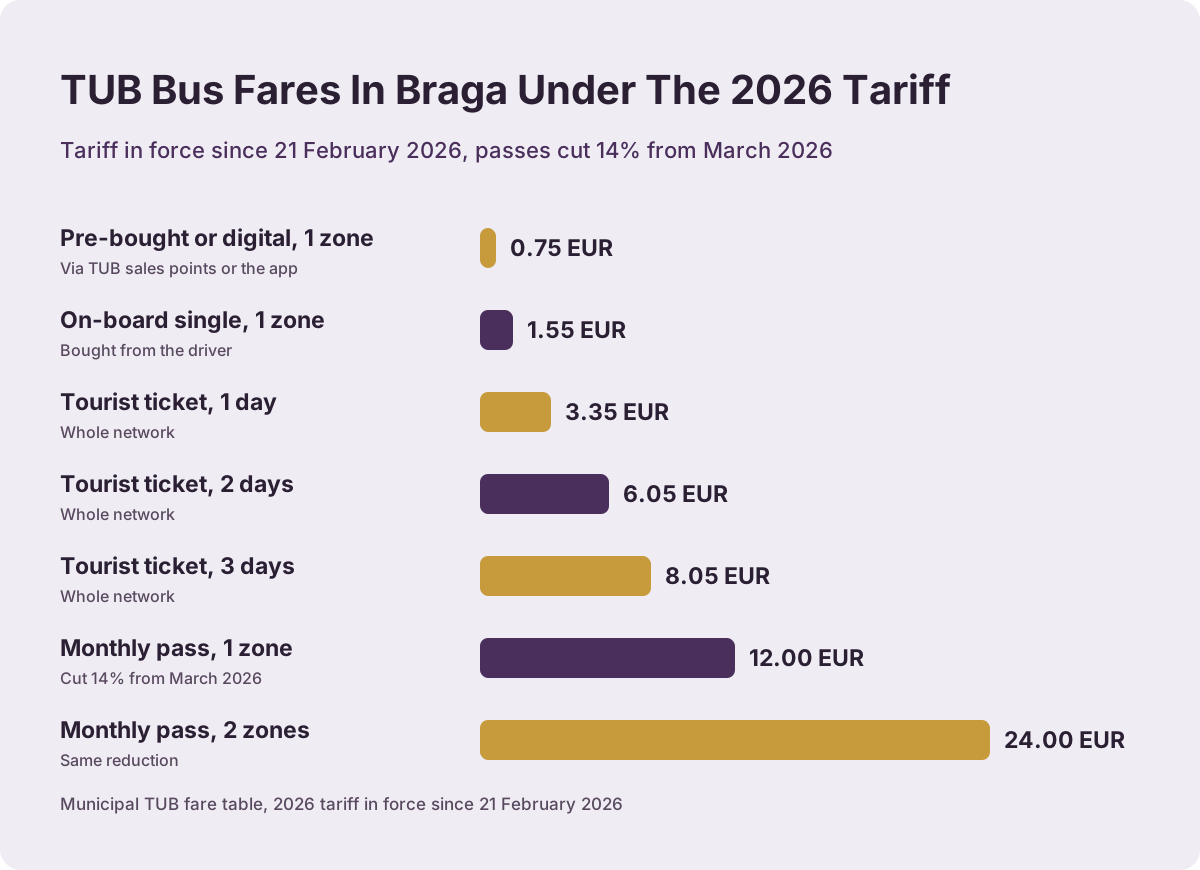
The transport numbers are the clearest published baseline. The TUB tariff in force since 21 February 2026 sets a one-zone monthly pass at 12.00 EUR and a two-zone pass at 24.00 EUR, and the municipality cut all TUB passes by 14% from March 2026. Occasional travellers pay more per ride than pass holders, which matters for visitors and new arrivals still finding their feet.
| TUB ticket (2026 tariff) | Fare | Notes |
|---|---|---|
| On-board single, 1 zone | 1.55 EUR | Bought from the driver |
| On-board single, 2 zones | 2.00 EUR | Bought from the driver |
| Pre-bought or digital, 1 zone | 0.75 EUR | Via TUB sales points or the app |
| Pre-bought or digital, 2 zones | 1.50 EUR | Same channels |
| Tourist ticket, 1 day | 3.35 EUR | Whole network |
| Tourist ticket, 2 days | 6.05 EUR | Whole network |
| Tourist ticket, 3 days | 8.05 EUR | Whole network |
| Monthly pass, 1 zone | 12.00 EUR | Cut 14% from March 2026 |
| Monthly pass, 2 zones | 24.00 EUR | Same reduction |
Culture is cheap. The Museu dos Biscainhos charges 7.50 EUR with the garden included, the Museu de Arqueologia D. Diogo de Sousa 5.00 EUR, the Museu Pio XII and Medieval Tower 4.00 EUR for the whole museum, and the cathedral's three-route combined ticket 7.00 EUR. Theatro Circo guided tours cost 3.50 EUR. A resident who buys nothing else still has free access to the sanctuary grounds at Bom Jesus do Monte and Sameiro, the Santa Bárbara Garden and the Sete Fontes area, whose eco-park works began in October 2025.
| Attraction or museum | Adult price | Published hours basis |
|---|---|---|
| Museu dos Biscainhos | 7.50 EUR | Tue to Sun, 10:00 to 12:30 and 14:00 to 17:30 |
| Museu de Arqueologia D. Diogo de Sousa | 5.00 EUR | Tue to Sun, 10:00 to 17:30 |
| Sé de Braga, all three routes | 7.00 EUR | Any two routes 6.00 EUR, single route 3.00 EUR |
| Museu Pio XII and Medieval Tower, full | 4.00 EUR | Tue to Sat, 09:30 to 12:30 and 14:00 to 18:00 |
| Museu Nogueira da Silva | 3.00 EUR | Card payment only |
| Theatro Circo guided tour | 3.50 EUR | Scheduled dates, 45 minutes |
| Estadio Municipal guided tour | 6.00 EUR | Self-guided option 4.00 EUR |
| Bom Jesus sanctuary grounds | Free | Open daily |
One cost that does not touch residents is the municipal tourist tax. Braga levies 1.55 EUR per person per night, up to a maximum of 4 nights per stay, charged by hotels and local accommodation to guests aged 16 and over. The regulation applies all year following the 2025 amendment, but it is a visitor tax, not a residence tax, and long-term rental contracts sit outside it. Neighbouring cities run their own schemes, which matters if you are comparing the region.
| City | Tourist tax per night | Maximum nights | Applies from age |
|---|---|---|---|
| Braga | 1.55 EUR | 4 nights | 16 |
| Guimarães | 1.50 EUR | 2 nights | 21 |
| Porto | 3.00 EUR | 7 nights | 13 |
| Viana do Castelo | 1.50 EUR high season, 1.00 EUR low season | 5 nights | Over 16 |
Eating out follows the national pattern. Turismo de Portugal's published guidance is that service is included in the bill, with an additional tip of about 5 to 10% customary, and the same rounding-up habit applies to taxis. The regional cuisine is built around dishes like bacalhau à Braga and the Pudim Abade de Priscos, and the what to eat in Braga guide and the restaurant guide cover where the city actually eats.
How Do You Get Around Braga Without A Car?
Braga is walkable inside the historic centre and served by the TUB bus network beyond it, with a one-zone pre-bought fare of 0.75 EUR, transfers valid for one hour, and Line 2 running to the foot of the Bom Jesus stairway. For intercity travel, CP trains run to Porto and Lisbon, Getbus connects the city to Porto Airport in 45 minutes from 9.00 EUR, and AITC regional buses reach Guimarães, Ponte de Lima and Gerês. A car is optional for daily life.
The city itself rarely demands a car, though one is useful for the Minho coastline on summer weekends. The historic centre is pedestrian or near-pedestrian, parking is covered in detail on the parking in Braga guide, and the bus network covers the parishes. Transfers are valid for one hour from first validation on a one-zone ticket and one hour thirty on two zones. The TUBmobile app has supported digital tickets with Apple Pay, Google Pay and MB Way since late 2025, which has largely replaced paper for regular users.
Planning weekend trips beyond the city? Book a rental car here.
The hill sanctuaries are the exception that needs planning. TUB Line 2, Ponte de Prado to Bom Jesus, ends at the Pórtico at the foot of the stairway. The Bom Jesus funicular has been out of service since 26 September 2026 with no end date published, and a replacement shuttle runs every day from 09:00 to 20:00, roughly every 30 minutes each way, between the Pórtico and the sanctuary. Anyone living in Braga should treat the shuttle, the 566 steps or the car park as the three ways up the hill. The how to get to Bom Jesus do Monte guide keeps the current options in one place.
Rail connects Braga to the national network. The CP urban line runs to Porto São Bento via Campanhã and Nine under the timetable valid since 26 July 2026, with tickets loaded onto a reusable Siga card costing 0.50 EUR. The fare is priced by zone; check the current amount at the machine or on CP's page before assuming a figure. For long distance, the Alfa Pendular full single fare from Lisbon valid from 1 January 2026 is 38.50 EUR in Turística class and 54.60 EUR in Conforto, and from Porto Campanhã to Braga it is 17.00 EUR and 23.30 EUR respectively. CP ran a promotion in late September 2026 with Alfa Pendular seats to Braga from 8 EUR on selected October dates, which is worth watching if you commute or host visitors.
| Route | Operator and service | Published fare | Journey basis |
|---|---|---|---|
| Braga to Porto (urban) | CP Urbanos, Siga card | Priced by zone, check at the machine | A little over an hour on the first-to-last span |
| Braga to Lisbon | CP Alfa Pendular | 38.50 EUR Turística, 54.60 EUR Conforto | Direct services, reservation required |
| Braga to Porto (long distance) | CP Alfa Pendular | 17.00 EUR Turistica, 23.30 EUR Conforto | Reservation required |
| Porto Airport to Braga | Getbus coach | From 9.00 EUR one-way | 45 minutes, direct |
| Braga to Guimarães | AITC Line 101 | Check with AITC | Via the A11 |
| Braga to Caldas do Gerês | AITC Line 201 | Check with AITC | Regional service |
The airport connection is the practical lifeline for anyone with family abroad or a remote job with travel. Getbus runs a direct, non-stop coach between Porto Airport and Braga bus station from 9.00 EUR one-way, taking 45 minutes, with the operator's page listing 16 departures a day each way on the day this was checked: from the airport between 05:00 and 00:45, from Braga between 04:00 and 23:45. Passengers are asked to be at the stop 15 minutes early. The Porto Airport to Braga guide has the full detail, and the getting around Braga guide covers the city network beyond it.
For regional exploring without a car, AITC buses leave from the Central de Camionagem: Line 101 to Guimarães, Line 105 to Ponte de Lima, Line 201 to Caldas do Gerês and Line 107 to the coast at Esposende and Póvoa de Varzim. There is no direct train from Braga to Guimarães, so the bus is the standard route to the birthplace city. The Guimarães guide and the Peneda-Gerês National Park guide cover the destinations themselves.
What Is The Weather Like When You Live In Braga?
Braga has a mild, damp Atlantic climate: IPMA's 1991 to 2020 normals for the Braga / Merelim station show a yearly mean of 14.9 C, July and August mean maxima of 28.2 C and 28.7 C, and October as the wettest month with 197.8 mm of rain against July's 27.9 mm. Rain days of 1 mm or more run 12 to 13 a month from October to January. Winters rarely freeze hard, and summers see about 10 days at 30 C or above in August.
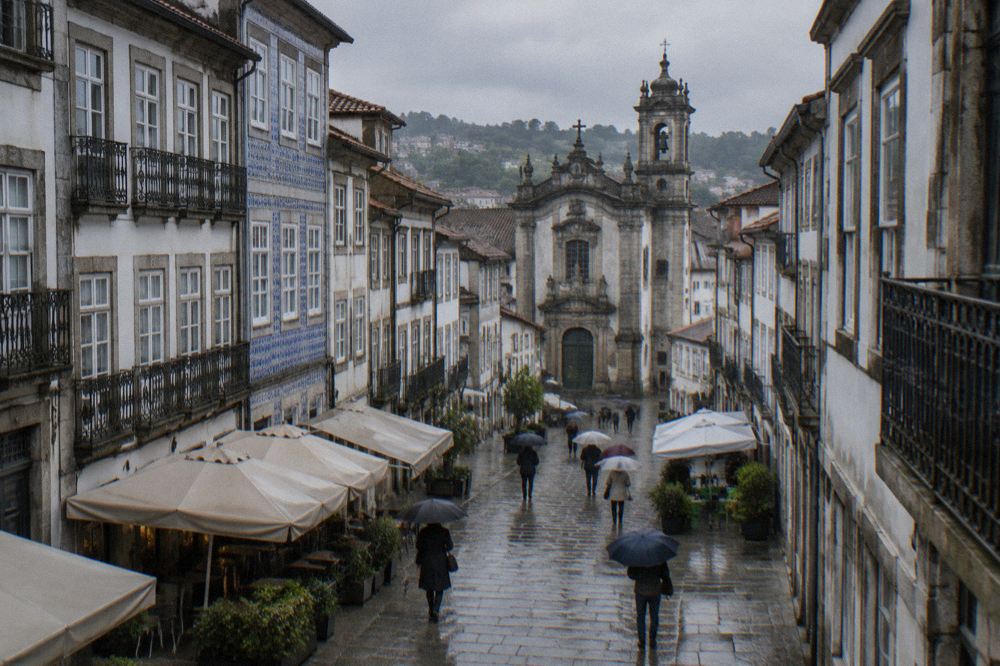
The single fact that most shapes daily life is the autumn and winter rain. October averages 197.8 mm, December 190.3 mm and January 179.5 mm, and the wettest single day on record dumped 110.9 mm in October. From October through January, expect rain on roughly every third day. This is not the Algarve's climate, and the Minho is green for a reason. Anyone moving from a dry climate should budget for good rain gear and accept that the serra weekends will sometimes be written off.
| Month | Mean max C | Mean C | Mean min C | Rain mm | Rain days 1 mm+ |
|---|---|---|---|---|---|
| January | 14.1 | 8.6 | 3.1 | 179.5 | 13.1 |
| February | 15.5 | 9.5 | 3.4 | 111.1 | 9.6 |
| March | 17.8 | 11.9 | 5.9 | 150.1 | 11.8 |
| April | 19.6 | 13.7 | 7.8 | 127.9 | 12.0 |
| May | 23.0 | 16.7 | 10.4 | 89.8 | 8.9 |
| June | 26.1 | 19.7 | 13.2 | 40.6 | 5.7 |
| July | 28.2 | 21.2 | 14.3 | 27.9 | 4.0 |
| August | 28.7 | 21.4 | 14.0 | 34.6 | 3.8 |
| September | 26.9 | 19.7 | 12.4 | 67.6 | 6.2 |
| October | 22.2 | 16.1 | 10.1 | 197.8 | 12.0 |
| November | 17.0 | 11.5 | 6.0 | 170.1 | 12.9 |
| December | 14.9 | 9.3 | 3.7 | 190.3 | 13.3 |
Summer is genuinely pleasant rather than extreme. The record high at the station is 42.2 C in August, but the normals show only about 10 days a year at 30 C or above in August and fewer in July. September stays warm, with a mean maximum of 26.9 C that is actually higher than June's 26.1 C, and the September rain total of 67.6 mm sits well below October's. Frost happens, mostly in January, with the normals showing 8.5 days per January with a minimum below 0 C. Snow in the city itself is rare; the record low of -6.4 C came in December.
For planning purposes, the best months for outdoor life are May through September, and the best time to visit Braga guide and the Braga weather guide work through the same record for visitors. Residents should also note the funicular outage when planning hill trips in winter: the replacement shuttle's 09:00 to 20:00 window is narrower than the stairway, which is always open.
Which Neighbourhoods Of Braga Suit Which Life?
Braga's liveable neighbourhoods split into the historic centre parishes around the Sé and Praça da República, the hill parishes of São Vítor and Gualtar towards the university, and the quieter residential areas of Lamaçães and Maximinos, with Bom Jesus do Monte and Tibães on the green periphery. The historic centre suits car-free living, Gualtar and São Vítor suit students and university staff, and Maximinos offers Roman-heritage surroundings at a lower intensity of tourism.
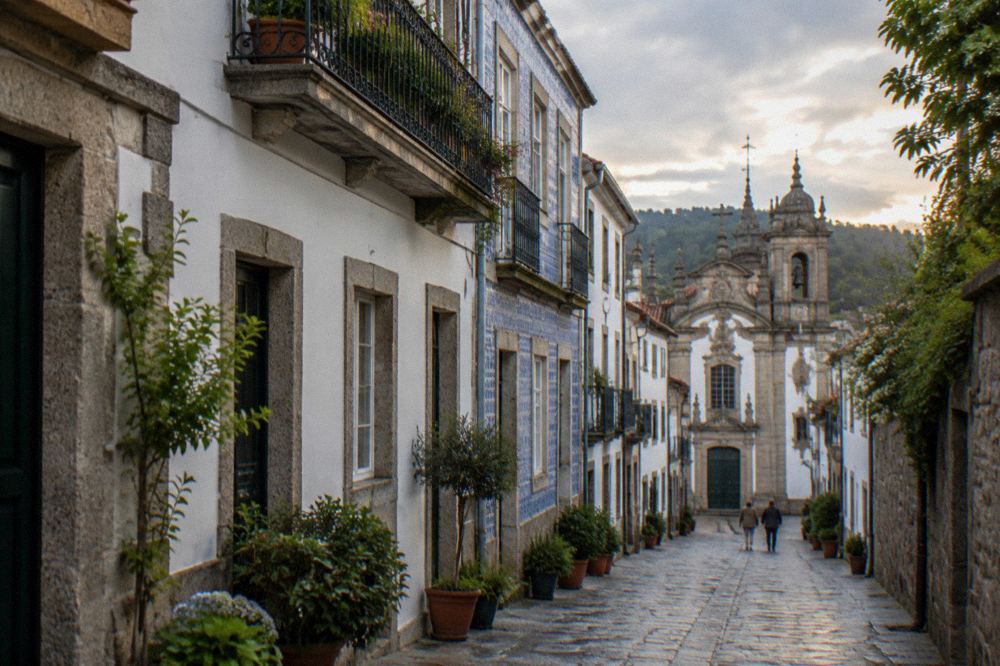
The historic centre is the obvious first choice for anyone who wants to live without a car. Everything from the Sé de Braga to the Arco da Porta Nova sits within a short walk, and the pedestrian Rua do Souto keeps the core quiet on the surface while the café life runs late. The trade-off is tourist-season foot traffic and older building stock. The historic centre guide maps the streets in detail.
Gualtar, on the eastern side of the city, grew around the University of Minho's campus and holds much of the student population, along with the residential sprawl that serves it. São Víctor, between the centre and the campus, mixes family housing with student rentals. The Gualtar and the university guide and the São Vítor guide describe both. Lamaçães, to the southeast, is quieter and more residential, and the Lamaçães guide covers it. Maximinos, west of the centre, contains the Roman baths site at Alto da Cividade and the Fonte do Ídolo, and the Maximinos and Cividade guide is the reference.
On the periphery, the parishes around Bom Jesus do Monte and Tibães offer green surroundings within the municipality, at the cost of depending on a car or infrequent buses for daily errands. The where to stay in Braga guide covers short-term bases, and the practicalities of a first scouting trip, including parking rules and car rental, are covered in the car rental in Braga guide.
| Area | Character | Best suited to |
|---|---|---|
| Historic centre | Baroque core, pedestrian streets, café life | Car-free residents, short stays |
| São Vítor | Mixed family and student housing near the centre | First-time renters |
| Gualtar | University district, student population | Students and university staff |
| Lamaçães | Quiet, residential, southeast | Families |
| Maximinos | Roman heritage sites, lower tourist intensity | Value seekers, history lovers |
| Bom Jesus / Tibães periphery | Green hills, sanctuaries, sparse buses | Car owners, nature lovers |
A private walking tour with a professional guide is a surprisingly effective way to scout a neighbourhood before committing to it. A two-hour private walk can be pointed at the parishes you are considering, and the guide's local knowledge fills in the gaps no listing shows. The operator's listing carries current availability and pricing.
How Does Portuguese Bureaucracy Work For A New Resident?
Moving to Braga as a resident means registering with the municipality, obtaining a fiscal number, and, for non-EU nationals, complying with Schengen rules that allow 90 days in any 180-day period. EES, the EU Entry/Exit System, has been fully operational at all external Schengen borders since 10 April 2026. ETIAS, the travel authorisation for visa-exempt visitors, is not yet in operation and is expected from late 2026; no start date has been announced. Residency itself is a separate process from border entry.
For EU citizens, residence rights are automatic, and the practical steps are local: registering at the Junta de Freguesia of your parish, getting a Número de Identificação Fiscal from the tax office, and opening a bank account. For non-EU citizens, the entry regime and the residence regime are two different things. The Schengen short-stay rule allows 90 days in any 180-day period, calculated across the whole zone, and the passport must have been issued within the previous 10 years and be valid at least 3 months beyond departure.
The border layer changed recently and permanently. EES registers passport data, fingerprints, a facial image and each entry and exit for non-EU nationals on short stays, and it has been fully operational since 10 April 2026. ETIAS, the electronic travel authorisation that will apply to visa-exempt travellers from countries like the United States, United Kingdom, Canada and Australia, is not yet in operation. The fee will be 20 EUR with exemptions for under-18s and over-70s, and the authorisation will be valid for up to three years or until the passport expires. The European Union has said it will announce the start date several months before launch; until then, no application exists to make.
Healthcare access, school enrolment and employment registration are all separate from the border formalities, and the municipality's Loja da Cidadania on Avenida da Liberdade is the single counter where most of them start. Bring a translator or patience with Portuguese forms; the desk handles everything from residency declarations to utility contracts. New residents arriving from abroad through Porto should read the how to get to Braga guide and the Braga train station guide for the arrival logistics.
What About Working, Studying And Healthcare In Braga?
Braga's working life centres on the University of Minho's campus, a growing technology and services sector, and the municipal and ecclesiastical institutions of a regional capital, with the municipality's 193,324 residents served by the public hospital network of the Minho region. The city has a student population that reshapes the calendar every September, and the 2025 Capital of Culture legacy added cultural-sector jobs that continue into 2026. Remote workers benefit from the airport link and the Alfa Pendular to Lisbon.
The University of Minho is the largest institution in the city and the reason Gualtar exists in its current form. The academic calendar sets the rhythm of the rental market: September is the crunch month for housing, and anyone moving in summer should expect the best stock to move fast in July and August. Beyond the university, the dstgroup construction and engineering conglomerate is headquartered in the city, and its MUZEU museum opening in April 2026 signals the company's cultural investment in its home town.
Healthcare for registered residents runs through the national Serviço Nacional de Saúde, with the Hospital de Braga as the main referral hospital. New residents register with a centro de saúde in their parish after obtaining their residence documents. Private clinics cluster around Avenida da Liberdade, and private health insurance is widely used to skip queues for non-urgent care. As with housing costs, no published price table for insurance or consultations exists in any municipal source this page can cite, so treat those figures as research to do locally.
For working life, the practical anchors are the train and the airport. The Alfa Pendular to Lisbon takes under four hours on the fastest direct services, and the urban line to Porto runs from early morning until late evening, with the last departure from Porto São Bento at 00:50 arriving in Braga at 01:55. Getbus runs 16 departures a day each way to Porto Airport, from 9.00 EUR. A remote worker with occasional travel can live in Braga without feeling cut off. The Porto to Braga guide and the Lisbon to Braga guide detail both corridors.
For new arrivals hosting visiting family, a tuk tuk city tour is the easiest way to show relatives the city without walking them into the ground. The tour runs from 30 minutes up to 2 hours and covers the core sights at open-air pace. The operator's listing has current times and availability.
How Do You Actually Settle In: The First Month In Braga?
The first month in Braga should be spent walking the city, buying a TUB pass at 12.00 EUR per month for one zone, registering with the parish and the tax office, and learning the event calendar that will structure the year: Holy Week before Easter, São João in late June, Braga Romana in May and Noite Branca in early September. The city rewards residents who engage with its calendar, and most of the flagship events are free to watch.
The settling-in sequence that works is bureaucratic first, social second. Get the fiscal number, register the address, open the bank account, then start living like a local: a coffee standing at a counter, groceries at the Praça market, and a weekend walk up to Bom Jesus or Sameiro. The sanctuary grounds at both are free and open all day, every day, and the Sameiro precinct never closes.
The event calendar is the social glue. Semana Santa, the 2026 edition of which ran 29 March to 5 April, fills the historic centre with processions and is registered in the National Inventory of Intangible Cultural Heritage. The Festas de São João ran 17 to 24 June 2026, peaking on the night of 23 June into the municipal holiday on 24 June, when most museums close. Braga Romana took the late-May weekend, and Noite Branca ran the first weekend of September, from 19:00 on Friday 4 September to 23:30 on Sunday 6 September in 2026. The 2027 dates for all of these have not been announced, so check the municipal pages each year. The Semana Santa guide covers the biggest of them.
Weekends belong to the region. The Minho is small enough that a Saturday can take in the Póvoa de Varzim coast by AITC Line 107 or 106, the Ponte de Lima riverside by Line 105, or the Gerês park by Line 201 to Caldas do Gerês. The beaches near Braga and hiking near Braga guides list the options, and the free things to do in Braga guide covers the no-spend days.
Common Questions About Living In Braga
Is Braga expensive to live in?
The published fixed costs are low: a one-zone TUB monthly pass is 12.00 EUR, museum entries run 2 to 7.50 EUR, and the Alfa Pendular to Lisbon is 38.50 EUR full fare. Housing costs are not published in any municipal source, so research rent locally. The 1.55 EUR per night tourist tax applies to visitors, not residents.
Do you need a car living in Braga?
No, not for daily life in the city. The historic centre is walkable, the TUB network covers the parishes from 0.75 EUR pre-bought, and Line 2 reaches the Bom Jesus Pórtico. A car helps for the Minho countryside, though AITC regional buses run to Guimarães, Ponte de Lima, Gerês and the coast.
What is the rainiest month in Braga?
October, by IPMA's 1991 to 2020 normals for the Braga / Merelim station, averaging 197.8 mm. December is close behind at 190.3 mm and January at 179.5 mm. July is the driest at 27.9 mm.
Does the tourist tax apply to residents?
No. Braga's municipal tourist tax of 1.55 EUR per person per night, up to 4 nights, is charged by hotels and local accommodation to guests aged 16 and over. Long-term residents in ordinary rental contracts are outside its scope.
How cold does Braga get in winter?
Mild by most standards. January's mean minimum is 3.1 C, and the normals show 8.5 January days per year with a minimum below 0 C. The record low at the station is -6.4 C, set in December.
How do I get from Braga to Porto Airport?
Getbus runs a direct, non-stop coach from Porto Airport to Braga bus station, from 9.00 EUR one-way, taking 45 minutes, with 16 departures a day each way. Tickets can be bought online, at the airport office or from the driver.
A final word on the settling-in walk. The small-group walking tour with the Bom Jesus sanctuary is the three-hour introduction that most new residents end up taking in their first fortnight, covering the historic core and the sanctuary hill in one small-group outing. Check availability on the operator's listing, and let the first walk up the 566 steps happen before the rainy season arrives in October.
Whichever way you choose to see the city first, the underlying argument of this guide stands: Braga is a city small enough to learn on foot within a month, cheap enough at street level to ease the transition, and green enough, even in the October rain, to keep you walking it for years.