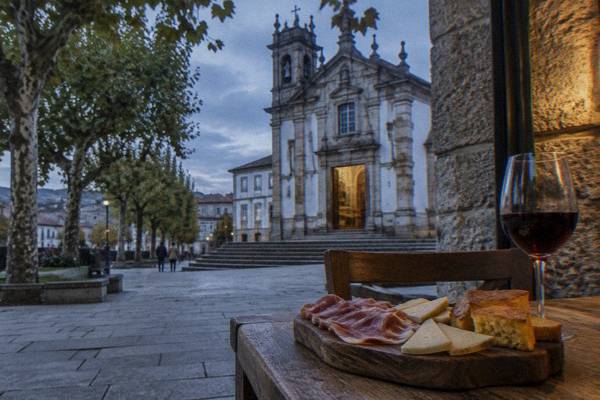
Braga Restaurants: Where And What To Eat In Portugal's Northern Food Capital
Braga, in Portugal's Minho region, eats differently from the south: hearty northern dishes, vinho verde poured young, and a historic centre of small dining rooms and café terraces.
Short answer
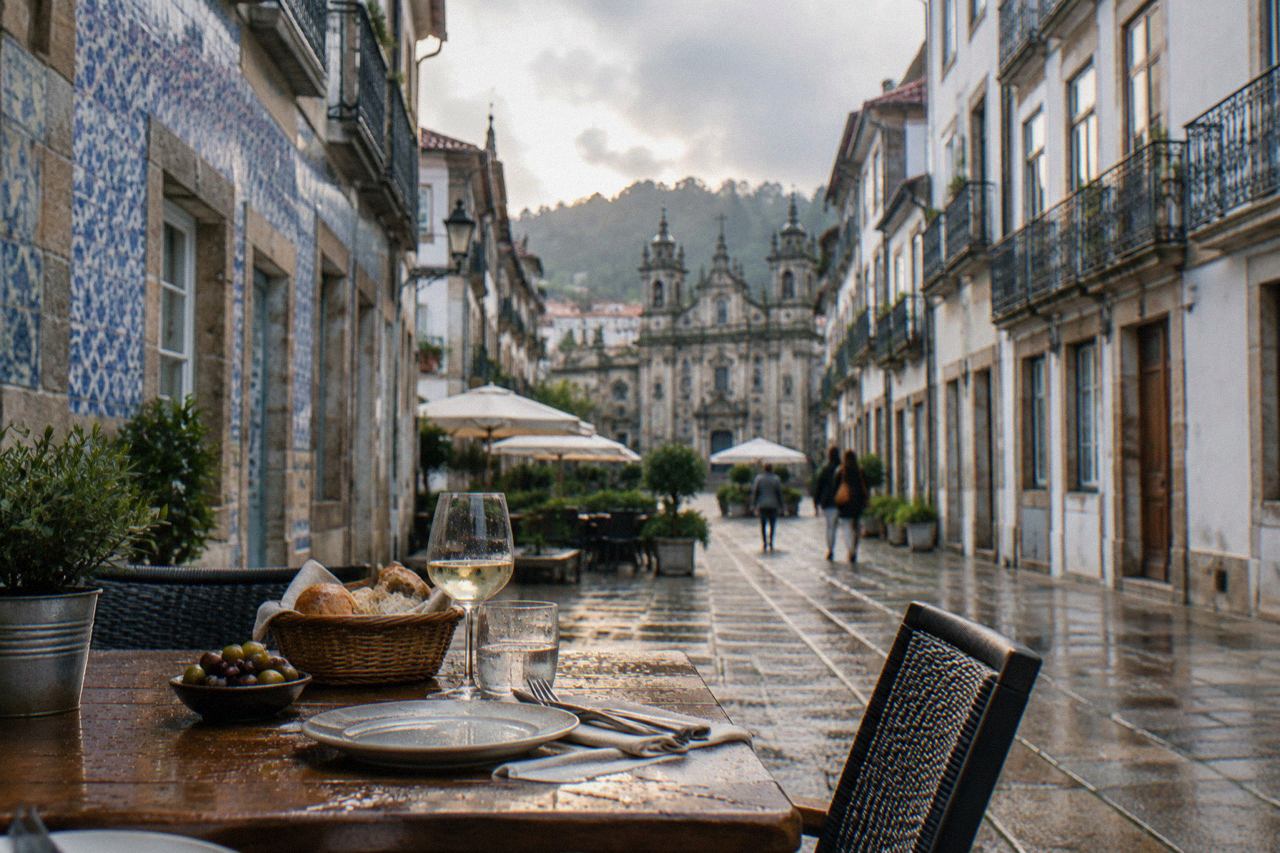
Braga's restaurant tables centre on Minho traditions: bacalhau a Braga, rojoes, sarrabulho, frigideiras and the pudim Abade de Priscos, washed down with vinho verde. Eat in the historic centre and the streets around it, order the regional dishes rather than the tourist menu, and budget for a 1.55 EUR per night municipal tourist tax at your hotel.
Braga, the city in Portugal's Minho region, is one of the country's most rewarding places to eat, and it has nothing to prove with foam, tweezers or a tasting menu counted in courses. Its restaurant identity is northern: salt cod cooked in the city's own style, pork in every form the Minho has invented, rich abbey desserts, and vinho verde poured cold and young from the hills that surround the city. The historic centre packs all of this into a compact area you can cross on foot between lunch and dinner, which is exactly how the city's residents have always done it.
This guide covers what the city's kitchens are actually known for, which parts of Braga you should eat in, how to read a Minho menu without ordering the wrong thing, and the small practical details, from tipping to the municipal tourist tax, that shape a food trip here. For the wider food culture of the region, see the companion page on what to eat in Braga, and for the wine that goes with all of it, the guide to vinho verde.
What Food Is Braga Known For?
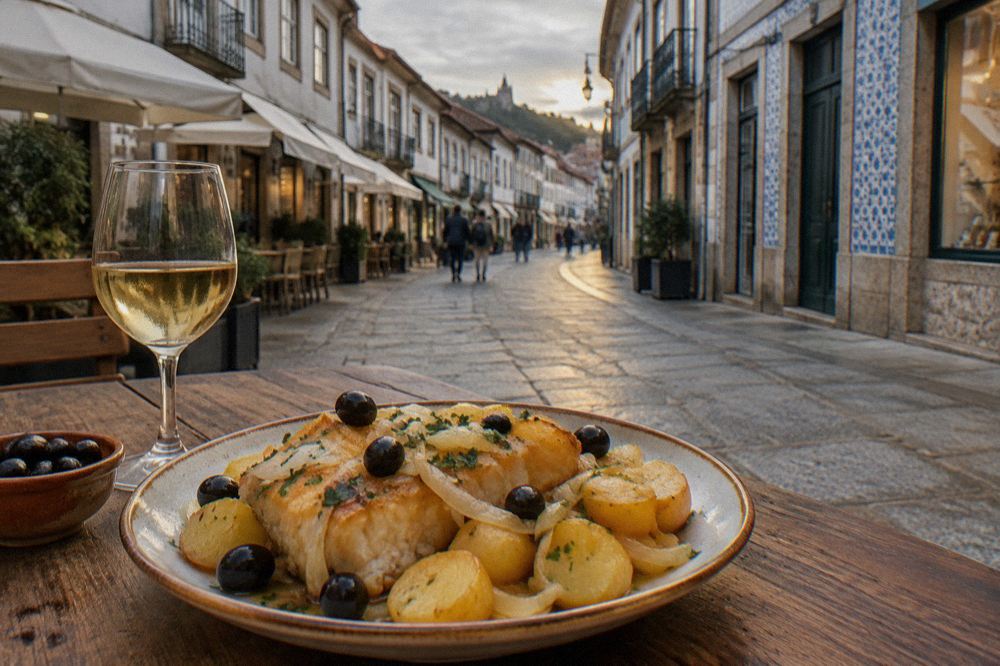
Braga's tables are defined by a handful of Minho dishes: bacalhau a Braga, salt cod fried with potatoes, onions and olives; rojoes, braised pork; sarrabulho, a rice cooked with pork blood, a winter dish of the region; frigideiras, small fried pastries filled with shredded meat; and pudim Abade de Priscos, a caramel egg pudding, the city's most famous dessert. Almost all of it is food built for appetite rather than display, and almost all of it pairs with vinho verde, the light, often slightly sparkling wine of the Minho.
The thread running through the city's cooking is the monastery. Braga is an archiepiscopal city, and the richest desserts in the Portuguese repertoire came out of religious houses, where sugar, eggs and patient hands were all available. The pudim Abade de Priscos is the example every local will name: a crème caramel made unusual by a piece of bacon that melts into the custard, giving it a savoury depth no other version has. Frigideiras carry the same history in pastry form, invented as a way to use leftover roast meat.
The second thread is the market. Northern Portugal eats seasonally by long habit, and menus in Braga shift with it. Sarrabulho and other heavy pork dishes belong to the cold months and the festival calendar. In summer, the lighter fish plates and the young white wines take over. If a dish is on the menu in its proper season, order it, because that is when the kitchen wants to cook it.
| Dish | What it is | When to order it |
|---|---|---|
| Bacalhau a Braga | Salt cod, floured and fried, served with fried potatoes, onions, hard-boiled egg and olives | Any time of year; the city's signature plate |
| Rojoes a moda do Minho | Cubes of pork braised with garlic, paprika and white wine, often with potatoes | Cooler months |
| Sarrabulho | Rice cooked with pork, chicken and pig's blood, a festival dish of the Minho | Winter and festa season |
| Frigideiras | Small fried pastry parcels filled with shredded meat, sold by the half dozen | As a snack or starter |
| Pudim Abade de Priscos | Caramel crème caramel enriched with bacon fat, from the Priscos abbey tradition | Always; the essential Braga dessert |
Where Should You Eat In Braga?
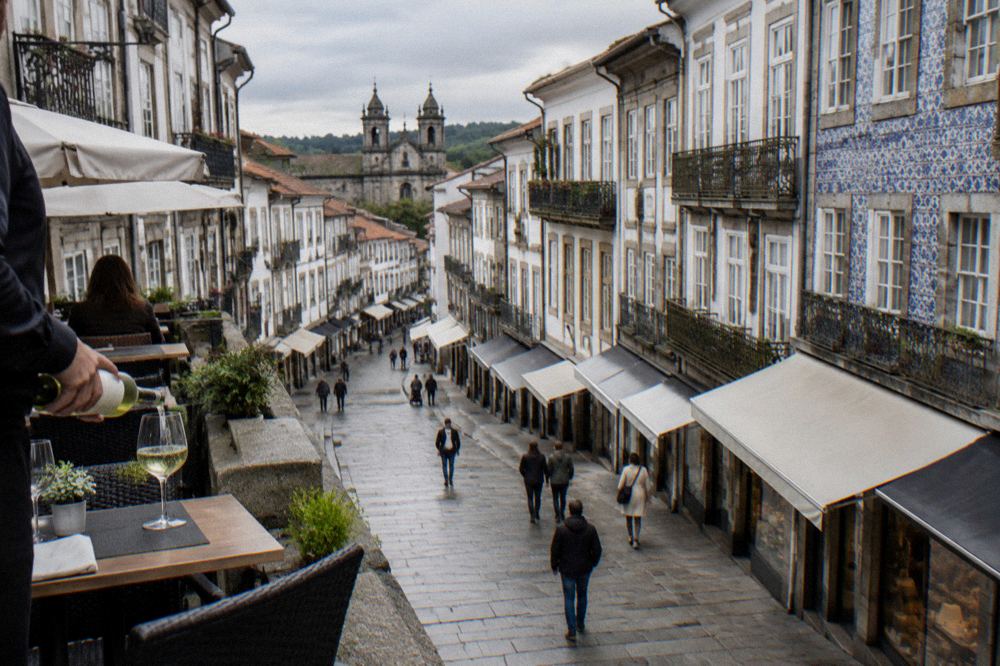
Eat inside or just off the historic centre: the streets around the Sé de Braga, Rua do Souto, Avenida da Liberdade and the lanes behind the Arco da Porta Nova hold the highest concentration of dining rooms, tascas, cafés and pastry shops, all within a ten-minute walk of each other. The centre is compact enough that location matters less than the menu, so pick the kitchen, not the postcode.
The pedestrian spine of the city is Rua do Souto, and the streets feeding into it carry most of the café life. A Brasileira, the ornate café on the corner by the Arco da Porta Nova, is a Braga landmark in the same way its Lisbon namesake is: a place to stand at the counter with a coffee and watch the city go by rather than a destination for a meal. Around it, the lanes of the historic centre hold small dining rooms that have cooked the same short menu for decades.
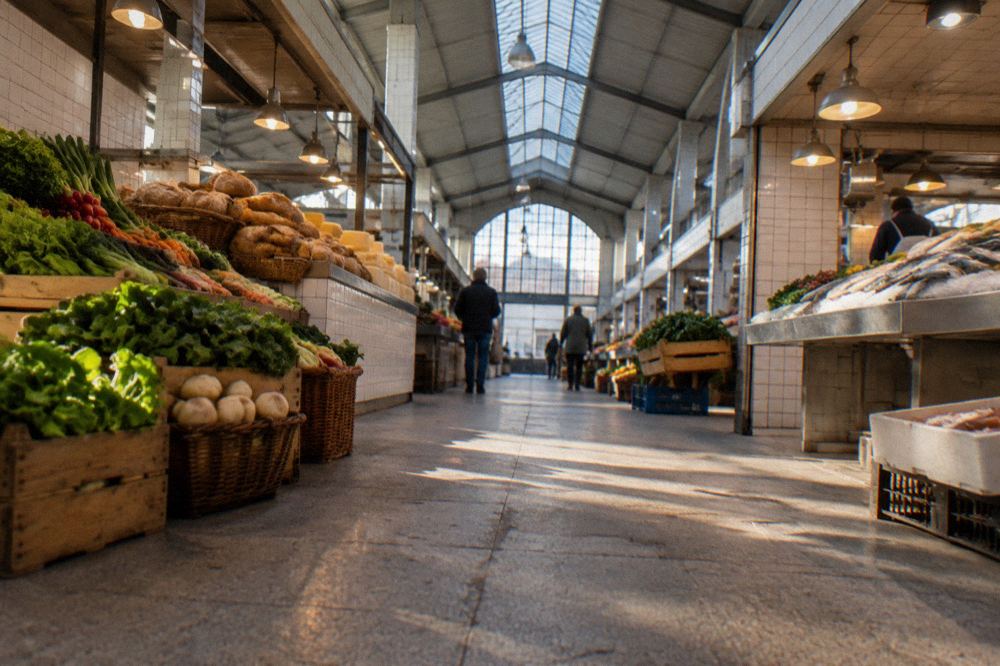
A little outside the ring, the Mercado Municipal, branded Praça, Mercado Municipal de Braga, is the city's food anchor: a covered market where the region's growers, butchers and fish sellers trade. Even if you cook nothing on your trip, walk it early in the morning, because it shows you exactly what the restaurants a hundred metres away are cooking that day. The market is open and trading as the municipality's own food venue.
For where to sleep within reach of all of this, the guide to where to stay in Braga maps the neighbourhoods, and the page on getting around Braga covers the buses that connect them.
| Part of the city | Character | What to look for |
|---|---|---|
| Historic centre, around the Sé | Lanes, small dining rooms, café terraces | Traditional kitchens with short menus |
| Rua do Souto and side streets | Pedestrian, busy, café life | Coffee, pastries, people-watching |
| Avenida da Liberdade | Belle-epoque avenue with terraces | Longer lunches and café sitting |
| Praça, Mercado Municipal de Braga | Covered municipal market | Morning produce, fish, bread, butcher stalls |
How Do You Read A Minho Menu Without Ordering The Wrong Thing?
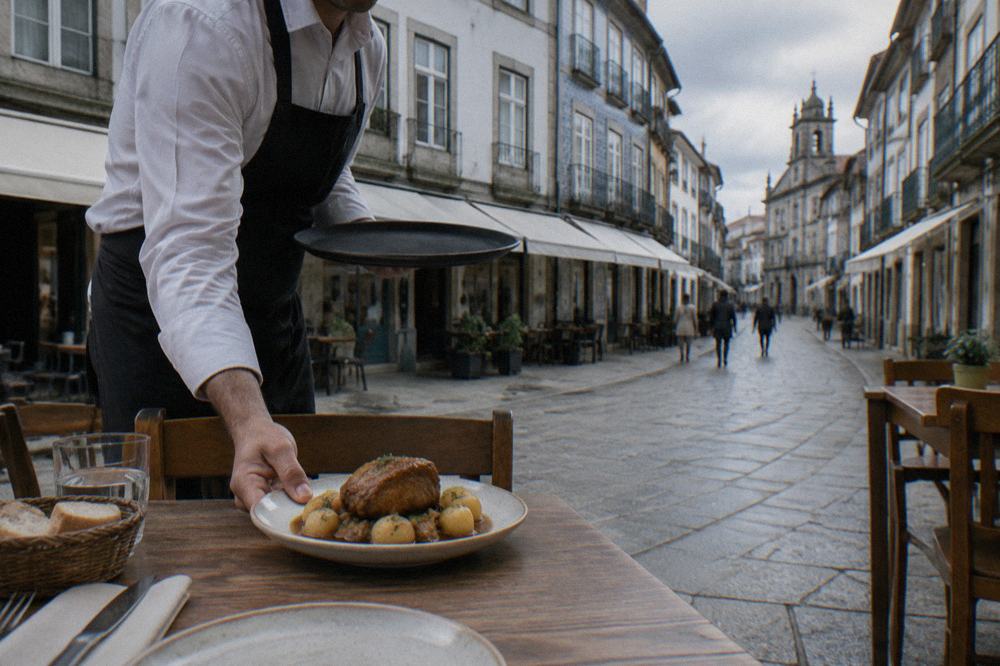
Read the menu for the region's own dishes first: if bacalhau a Braga, rojoes, sarrabulho, frigideiras or pudim Abade de Priscos appear, order one of them, because those are the plates this city's kitchens cook with conviction; treat anything that looks like a standard tourist menu of the same dishes at every door as a warning sign rather than a promise.
A few habits help. Portions in northern Portugal run generous, and the prato do dia, the dish of the day, is usually the kitchen's honest best value. Couvert arrives at the table without being asked: bread, olives, sometimes cheese and cured sausage. These are not free, and that is normal, not a scam; the charge appears on the bill and you can decline them by pushing the plate to the side untouched. Ask for the daily specials aloud if they are not printed, because they often are not.
Fish is the other half of the equation. Being close to the Atlantic, Braga eats both salt cod, the preserved fish that defines Portuguese cooking, and fresh fish brought up from the coast. If the menu names the fish and its origin, it is a kitchen that cares. If it says only "fish of the day", ask which fish before you commit.
One way to short-circuit the learning curve is to let a local guide do the ordering for an afternoon. The Braga Experience guided tour with tastings pairs the city walk with stops at food producers and dining rooms, and you can Check availability on the operator's live listing before you travel.
Happy to let a local guide do the ordering for an afternoon. Book a small-group food tour here.
What Is Vinho Verde And Why Is It Everywhere In Braga?
Vinho verde, literally "green wine", is the wine style of the Minho region, and it is not a grape but a way of making wine: picked young, bottled young and drunk young, most often white, light in body and frequently carrying a light, natural sparkle from the fresh fermentation. Braga sits in the middle of the region that produces it, so it is the default pour at every table in the city.
The sparkle surprises people the first time. It is not champagne, and it is not a sparkling wine in the formal sense: it is a faint prickle in a fresh white, sometimes helped along for the bottled versions, and it is exactly why the wine suits the region's food. Bacalhau a Braga and a cold vinho verde is the pairing the Minho has been making for generations. The red and rosé versions exist too, and the reds in particular are an acquired, tannic, distinctly northern taste that locals defend with passion.
The wine deserves its own reading, and the site's guide to vinho verde covers the styles, the grapes behind them and how to buy it at home. For a deeper plunge, a tasting at a quinta in the surrounding hills turns the glass into a landscape; the region's producers sit within easy reach of the city.
| Style | Character | Pairs with |
|---|---|---|
| White vinho verde | Light, fresh, often lightly sparkling, low in alcohol relative to southern whites | Salt cod, grilled fish, salads, hot afternoons |
| Rosé vinho verde | Dry, fruity, cool and easy | Light lunches, frigideiras as a snack |
| Red vinho verde | Young, tart, tannic, deeply traditional in the Minho | Heavier pork dishes, if you like the style |
| Sparkling vinho verde | Made by the classic method, for occasions | Celebrations, desserts, festival meals |
How Much Does Eating In Braga Cost, And How Does Tipping Work?
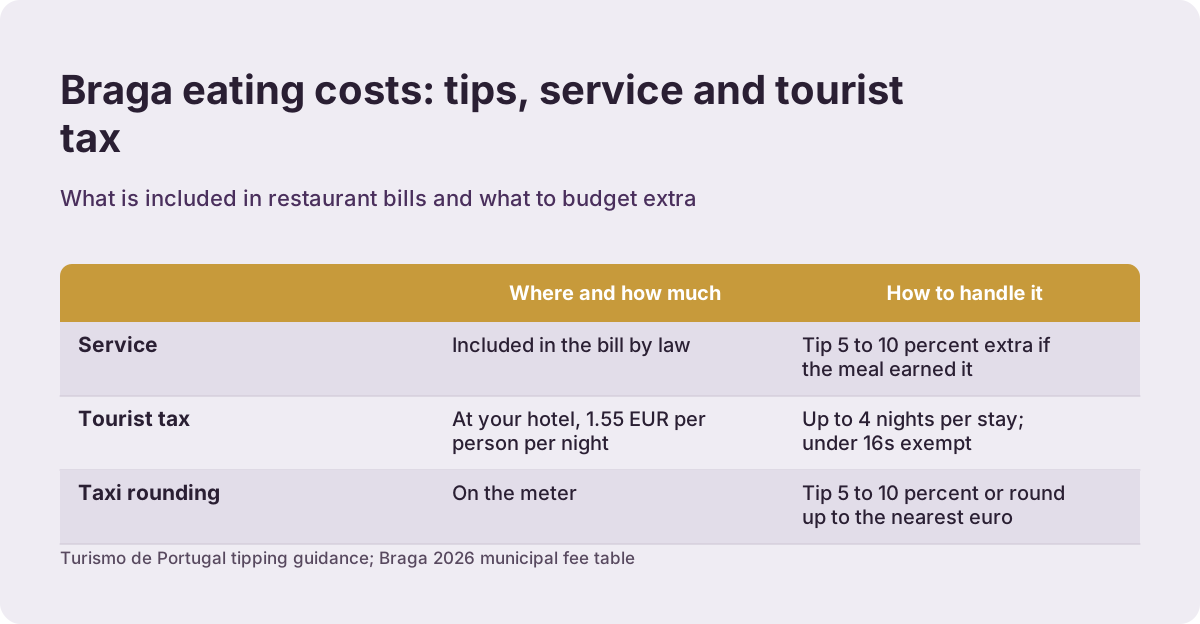
Service is included in restaurant bills in Portugal, and Turismo de Portugal's own guidance says it is customary to leave an additional tip of about 5 to 10 percent of the total, with taxi drivers tipped 5 to 10 percent or by rounding up to the nearest euro, so plan on a modest rounding-up rather than an American-style addition. The bill you receive already includes service; anything extra is a genuine extra, and nobody will chase you for it.
The other charge to plan for is not on the restaurant bill at all. Braga levies a municipal tourist tax of 1.55 EUR per person per night, for up to four consecutive nights, charged all year by hotels and local accommodation, with guests aged under 16 exempt. It was 1.50 EUR in 2025 and rose to 1.55 EUR in the 2026 municipal fee table, so expect it at hotel checkout rather than at the dinner table. The wider set of guides lives on Braga Travel Guide.
The couvert charge is the last small surprise. Bread, olives, cheese and sausage placed on your table are billed if you eat them, usually at a modest per-person rate set by the house. It is not a tourist trick; it is how Portuguese restaurants operate, and the honest answer is to eat what you want and expect it on the bill.
| Charge | Where it appears | How to handle it |
|---|---|---|
| Service | Included in the restaurant bill by law and custom | Nothing to add; tip 5 to 10 percent extra if the meal earned it |
| Couvert | On the bill, per person, for bread, olives, cheese | Eat it and pay, or set it aside |
| Tourist tax | At your hotel, 1.55 EUR per person per night, up to 4 nights | Budget it into the stay; under-16s exempt |
| Taxi rounding | On the meter | Tip 5 to 10 percent or round up to the nearest euro |
What Are Braga'S Cafés And Pastry Shops About?
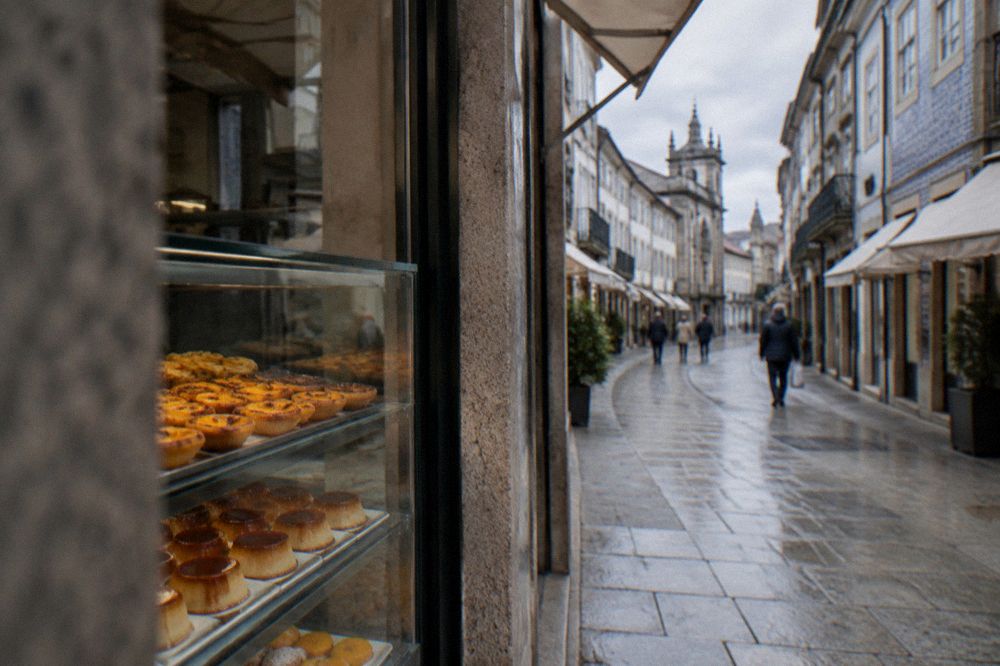
Braga's café culture runs on counters, not armchairs: you stand or sit briefly with a small coffee, an um galao or a pastry, and the city's pastry shops sell the convent tradition in edible form, from frigideiras to the egg-yolk sweets that northern monasteries perfected over centuries. The café is where the day is organised, and the pastry counter is where the monastery inheritance is eaten.
Start with the coffee vocabulary, because it decides everything. A um cafe is a small, strong espresso and the default order. A galao is the same coffee stretched with a tall glass of milk, the morning drink. A meia de leite sits between them. Say which one you want at the counter and the transaction takes seconds, and that speed is the point.
The pastry side is the convent tradition again. Egg yolks, sugar and almonds, turned into small, dense, intensely sweet shapes, came out of religious houses across northern Portugal, and Braga's pastry counters carry them all alongside the frigideiras. The pudim Abade de Priscos is the headline, but the counters hold a full range of the smaller egg sweets as well. Buy a small box of mixed pastries and work through them; it is the fastest food lesson in the city.
Can You Explore Braga'S Food Scene On A Guided Tour?
Yes, and it is one of the best uses of an afternoon: Braga has guided food tours and tasting walks that route you through the historic centre with a local guide, plus free, tip-based walking tours on GuruWalk that orient you before you eat your way through the city, so you can combine a food tour with a general walk in a single day.
The paid options cover different depths. A guided tour with tastings, like the Braga Experience walk, moves from landmark to producer to dining room and explains what you are eating as you eat it. A private walking tour with a professional guide lets you set the pace and the theme, and can be pointed squarely at food if that is the trip. The small-group food tours in the city run about three hours and pair the market, the pastry counter and the dining room into one narrative.
The free, tip-based walks deserve their own note, because this site names them honestly: they run on GuruWalk, they cost nothing up front and you tip the guru at the end, and they are a genuine bargain for orientation. The Essential Free Tour of Braga (guided in Spanish), run by a blue-umbrella guide, and the Essential Free Tour Braga (guided in Spanish) with its green-umbrella guru, both cover the historic centre in about two hours. The Best of Braga Sunset & Night Free Walking Tour (guided in Spanish) shows the city after the kitchens open. None of these is a food tour, but all of them end within a short walk of somewhere good to eat, and the guru will always tell you where that is.
For travellers building a whole trip around it, the guide to Braga walking tours compares the formats, and the master list of things to do in Braga places the food side alongside everything else the city offers.
When Is The Best Time Of Year To Eat Your Way Through Braga?
The best eating seasons in Braga are spring and early autumn: April to June and September to October bring mild temperatures, the full range of both meat and fish dishes, and the festival calendar, while winter delivers the heaviest traditional food and the Semana Santa atmosphere, and July and August bring heat, tourists and the lightest menus. The city's food follows its weather, and the weather is worth knowing before you book.
The climate data for the city tells the story precisely. IPMA's 1991 to 2020 normals for the Braga / Merelim station show July and August averaging 28.2 and 28.7 degrees Celsius as daytime highs, with October the wettest month on average at 197.8 mm of rain and July the driest at 27.9 mm. Rain days of one millimetre or more run 12 to 13 a month from October through January. In plain terms: summer lunch is an outdoor affair, autumn dinner wants a dining room, and the deep-winter dishes exist because the Minho winter is real.
The event calendar matters as much as the thermometer. Semana Santa, Holy Week, fills the city in the week before Easter and every kitchen runs at full tilt. The Festas de São João, in late June around the 24 June municipal holiday, put grilled sardines and street food into the squares. Noite Branca, on the first weekend of September, turns the centre into an all-night street party where eating happens standing up. The guide to the best time to visit Braga and the one on Braga weather break all of this down month by month.
| Season | Weather at the Braga / Merelim station | What it means for eating |
|---|---|---|
| Spring, March to May | Mean highs rising from 17.8 to 23.0 C | Full menus, terraces opening, Holy Week crowds |
| Summer, June to August | Mean highs 26.1 to 28.7 C, driest months | Light dishes, grilled fish, outdoor tables |
| Autumn, September to November | Mean highs falling from 26.9 to 17.0 C, October wettest at 197.8 mm | Heavier dishes return, dining rooms, Noite Branca |
| Winter, December to February | Mean highs 14.1 to 15.5 C, frost nights | Sarrabulho, rojoes, the full winter table |
How Do You Build A Food-Focused Day In Braga?
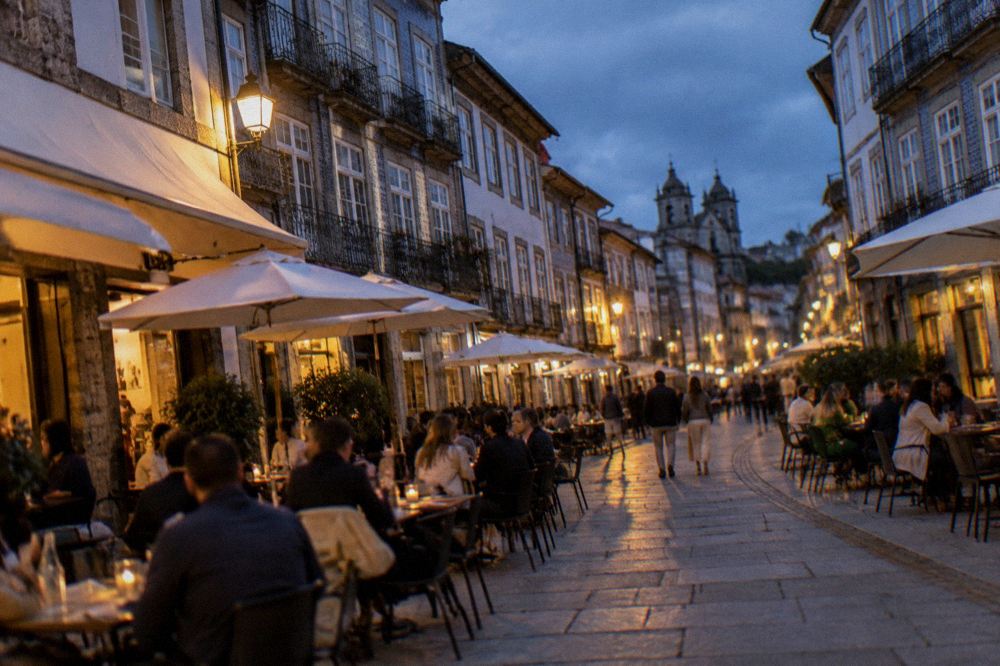
Build the day around three anchors: the Praça market in the morning for the produce and the atmosphere, a long traditional lunch in the historic centre, and a late-afternoon pastry and coffee stop, then either a full dinner in a dining room around Rua do Souto or, on a festival weekend, street food in the squares until late. The city is compact enough that all of it happens within a walkable kilometre or two.
Morning belongs to the market. Get there early, when the stalls are full and the restaurants are doing their own shopping, and you will see the whole Minho in one hall: the vegetables, the fish, the bread, the sausages. Buy something you cannot name and ask the stallholder what to do with it; the answer is usually a recipe. Then walk it off through the historic centre, past the Sé de Braga and the Arco da Porta Nova, until lunch.
Lunch is the serious meal of the Portuguese day, and the kitchens treat it that way. Order the regional plate, take your time, and let the afternoon close in around the coffee. If you have booked a guided food tour, the afternoon slot is the one that works: you walk, you taste, you finish in time for a rest before the evening. The private walking format suits couples and families who want the guide's full attention on the food stories.
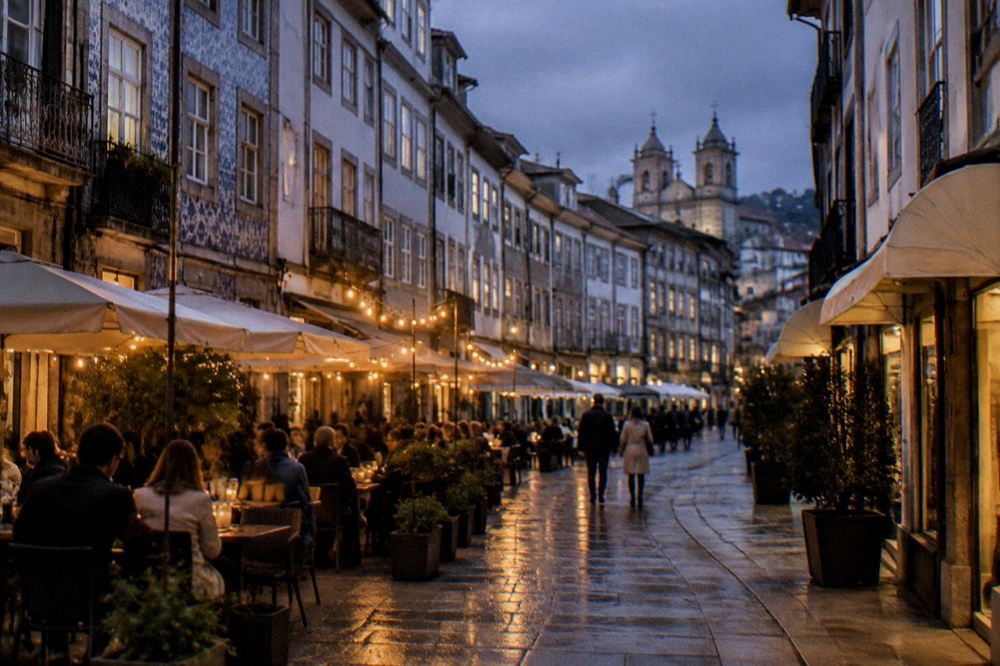
Dinner in Portugal starts later than many visitors expect, and Braga is no exception; the squares fill as the evening cools. Pair the meal with the right wine, order the pudim Abade de Priscos even when you are certain you are full, and finish with a short walk under the arcades. If you are staying more than one day, the itineraries for one day in Braga and longer stays show how the food stops fit with the churches, the gardens and the sanctuary on the hill.
Common Questions About Braga Restaurants
What is the most famous dish in Braga?
Bacalhau a Braga, salt cod fried and served with potatoes, onions, hard-boiled egg and olives, is the city's signature plate, and pudim Abade de Priscos, a caramel egg pudding, is its most famous dessert.
Do you tip in restaurants in Braga?
Service is included in the bill. Turismo de Portugal's guidance says it is customary to leave an additional tip of about 5 to 10 percent of the total, and rounding up is perfectly acceptable.
What wine should you drink with dinner in Braga?
Vinho verde, the young, often lightly sparkling wine of the Minho region. The white is the default pour and pairs with the city's fish and salt cod dishes; the red is a tannic, traditional northern taste.
Is the bread and olives on the table free?
No. The couvert, bread, olives, sometimes cheese and cured sausage, is billed if you eat it. It is standard practice across Portugal, not a tourist charge, and you can decline it.
Where should you eat in Braga for traditional food?
In and around the historic centre: the lanes near the Sé de Braga, Rua do Souto and the streets off Avenida da Liberdade hold the traditional dining rooms, all within a short walk of each other.
Are there food tours in Braga?
Yes. Guided tasting walks, small-group food tours and private tours all operate in the city, and free, tip-based orientation walks run daily on the GuruWalk platform with a local guru.
Eat the way the city eats: one honest regional plate at a time, a glass of vinho verde beside it, and the pudding regardless. That is the whole method, and Braga, Portugal's northern food capital, has been perfecting it for centuries.