Parking In Braga: Where To Leave The Car And When Not To Bring One
Braga's historic centre is compact, partly pedestrianised and largely unsuited to cars, which makes parking the single biggest practical question of any visit by road. This guide sets out how the city is laid out for drivers, what the verified prices are where prices exist, and how the bus network and the airport coach compare with bringing a car at all.
Short answer
Park outside Braga's pedestrianised historic core, walk in, and use TUB Line 2 or the replacement shuttle for Bom Jesus do Monte, where the car park costs 1.00 EUR for cars and motorcycles. A car is optional in Braga itself: the airport coach from Porto runs from 9.00 EUR and TUB tourist tickets cover the whole network for 3.35 EUR a day.
Braga, the city in Portugal's Minho region, is one of the easiest northern Portuguese cities to explore on foot and one of the more frustrating to drive into. The historic core around Rua do Souto, Avenida da Liberdade and Praça da República is a dense web of narrow streets, pedestrianised stretches and restricted access zones, and the sights most visitors come for, from the Sé de Braga to the Arco da Porta Nova, sit inside it. The good news is that the city is small enough that parking on the edge and walking in costs almost nothing in effort, and that the two hill sanctuaries outside the centre are served by bus. This guide covers how to think about parking in Braga, what the verified prices are where prices are published, and the alternatives that make leaving the car behind a genuine option rather than a consolation prize.
Where Can You Actually Park In Braga?
The honest answer is: not inside the historic centre's restricted streets, and rarely on them. Braga's core is a patchwork of pedestrianised streets, resident-priority zones and access-controlled areas around Rua do Souto and Praça da República, so the working strategy is to park in a car park or street bay on the edge of the centre and walk the rest, which in a city of this size means minutes on foot rather than a hike.
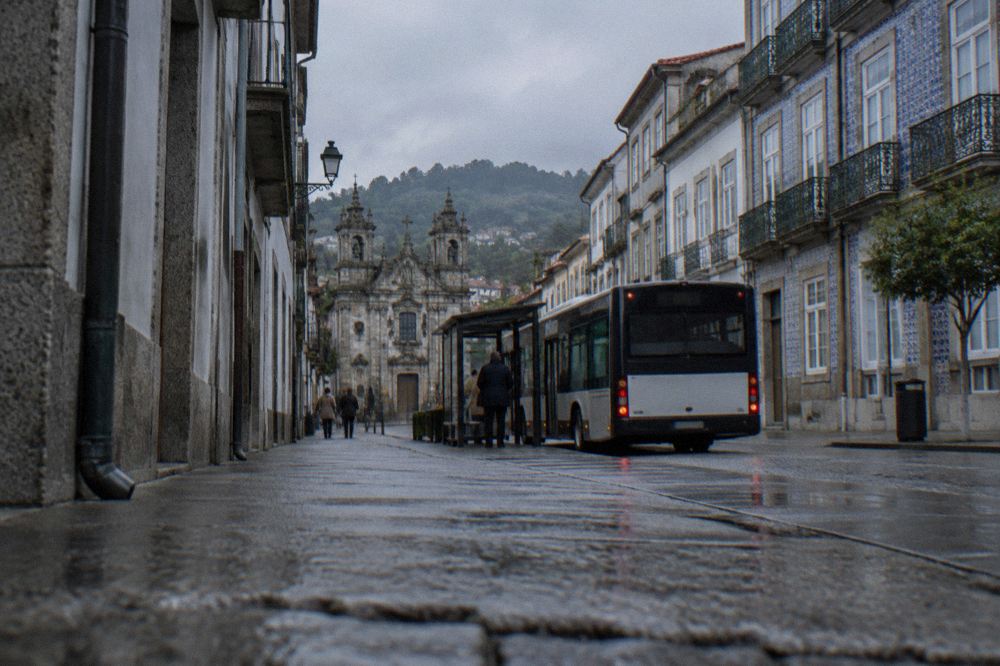
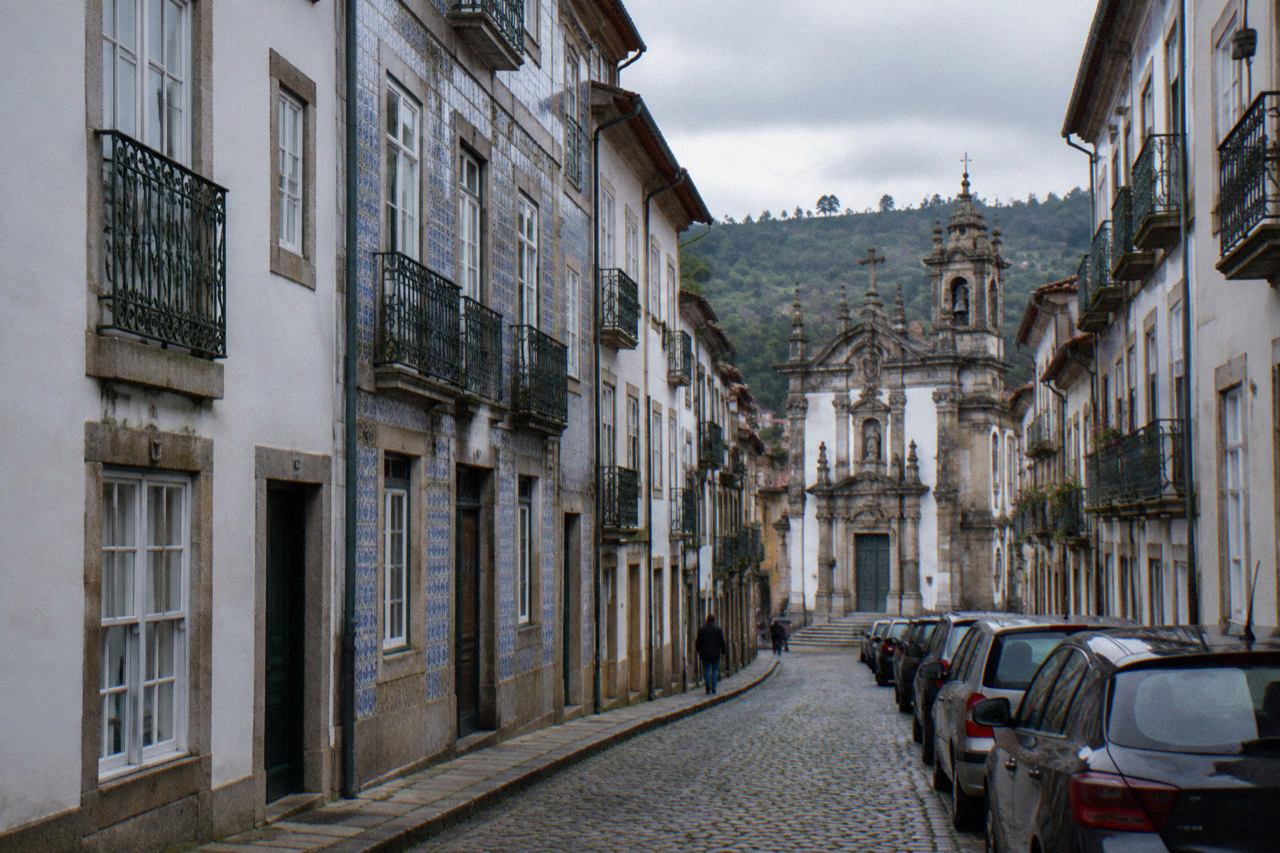
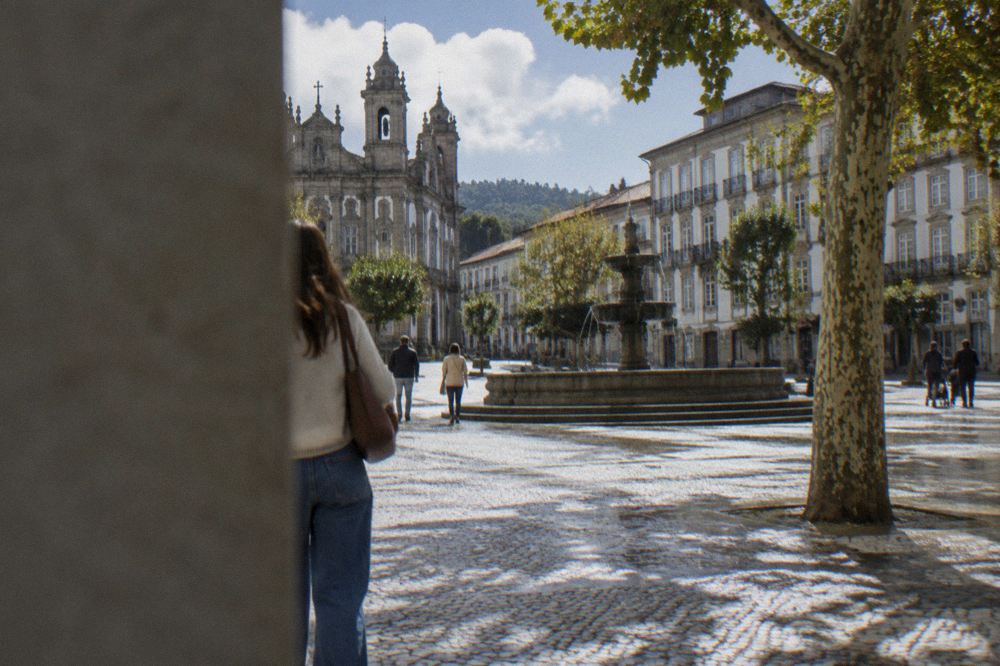
The centre of Braga is built for pedestrians first. Rua do Souto, the main shopping street, is pedestrianised, and the streets feeding it are narrow, one-way and often closed to through traffic. Drivers who aim straight for the Sé de Braga or the Praça da República usually end up circling. The pattern that works is the opposite: pick a target on the ring of wider avenues around the core, park there, and let the visit happen on foot.
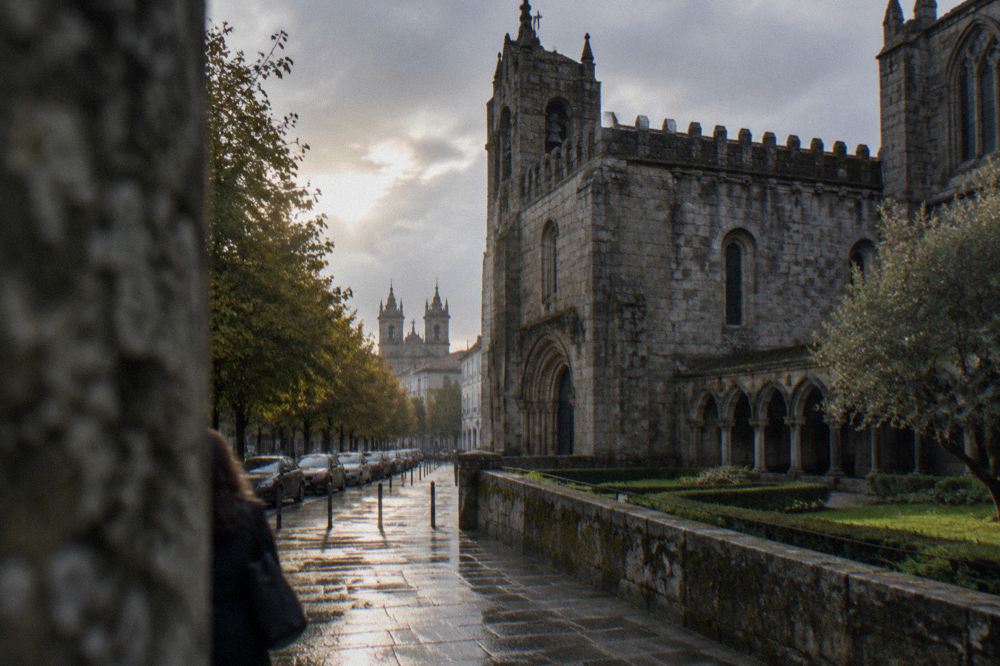
Street parking in Portuguese cities typically splits into metered zones close to the centre and free or cheaper zones further out, with blue-line bays meaning pay-and-display and white or unmarked bays meaning free where signs allow. Braga follows that general pattern, but the city's own tariff tables are the authority on prices and hours: check the machine or the posted tariff sign at the bay before assuming anything, because zones and hours change and this guide does not print a street-parking price the city has not published in a form a visitor can check at the kerb. What can be said firmly is the structural point: the closer to Praça da República, the shorter the maximum stay and the scarcer the bay.
Underground and structured car parks sit at several points around the edge of the historic centre, typically signed from the approach avenues, and these are the reliable choice for a half-day or full-day visit. They remove the circling problem entirely. Prices vary by operator and by duration, so read the board at the entrance before you drive in; the tariff is always posted at the barrier or the pay machine.
Do You Need A Car In Braga At All?
For visiting Braga itself, no: the historic centre is walkable end to end, TUB buses cover the city including Line 2 to Bom Jesus do Monte, and the tourist ticket for the whole network costs 3.35 EUR for one day, 6.05 EUR for two days and 8.05 EUR for three days. A car only earns its keep if you are touring the Minho region's smaller towns and the Gerês park, where buses are thinner on the ground.
This is the question that should come before any parking question, because it changes everything. Braga's sights cluster tightly: the cathedral, the Museu dos Biscainhos, the Santa Bárbara Garden, the Arco da Porta Nova and the Roman baths site all sit within a walkable core, and the two hill sanctuaries, Bom Jesus do Monte and Sameiro, are on TUB bus routes. The 2026 TUB tariff, in force since 21 February 2026, prices a pre-bought or digital single at 0.75 EUR for one zone and 1.50 EUR for two zones, against 1.55 EUR and 2.00 EUR bought on board, so buying ahead or through the app nearly halves the fare.
| TUB ticket (2026 tariff) | 1 zone | 2 zones |
|---|---|---|
| On board | 1.55 EUR | 2.00 EUR |
| Pre-bought or digital | 0.75 EUR | 1.50 EUR |
| Transfer validity | 1 hour | 1 hour 30 |
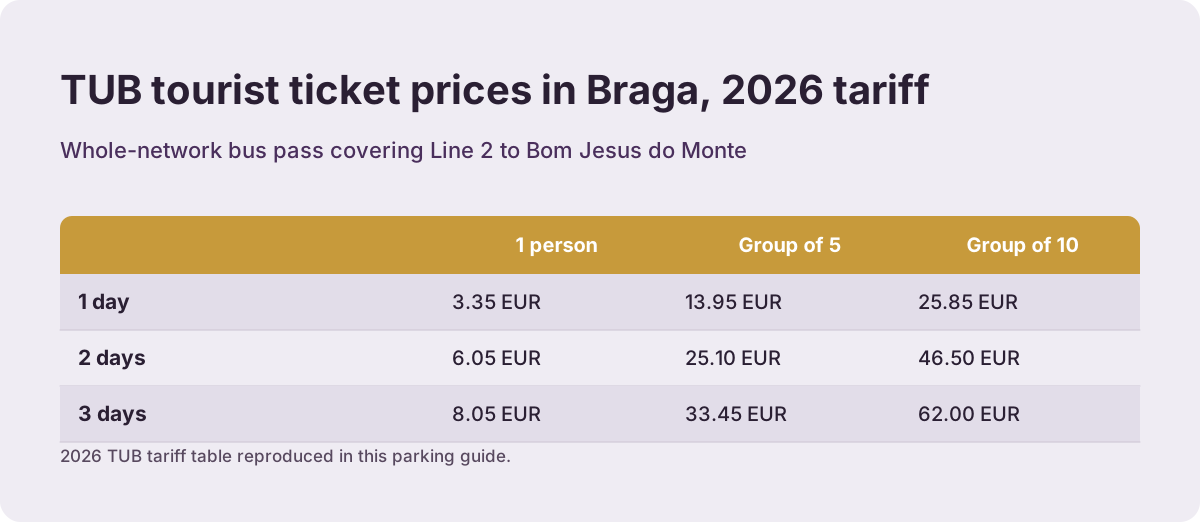
The tourist ticket deserves a special mention for anyone parking on the edge of town and hopping about by bus. It covers the whole network, not just one route, and the group rates scale down the per-person cost further.
| TUB tourist ticket | 1 person | Group of 5 | Group of 10 |
|---|---|---|---|
| 1 day | 3.35 EUR | 13.95 EUR | 25.85 EUR |
| 2 days | 6.05 EUR | 25.10 EUR | 46.50 EUR |
| 3 days | 8.05 EUR | 33.45 EUR | 62.00 EUR |
For a fuller comparison of the car-free case, the getting around Braga guide covers the bus network in detail, and the car rental in Braga guide covers when renting actually makes sense. If you are arriving from Porto, the Porto to Braga guide lays out the train option, and the airport route has its own page at Porto Airport to Braga.
If the plan is a walking-first day anyway, a guided option removes the parking question from the centre entirely. The Braga Small-Group Walking Tour & Bom Jesus pairs the car-free historic core with the sanctuary on the hill, and the trio below covers the three most useful variants for a driver who plans to leave the car parked.
Where Do You Park For Bom Jesus Do Monte?
Bom Jesus do Monte's own car park charges 1.00 EUR for cars and motorcycles, 10.00 EUR for caravans and minibuses and 15.00 EUR for coaches, per the Confraria's published information page, and TUB Line 2 runs from the city to the Portico at the foot of the stairway if you would rather not drive the hill at all. The sanctuary grounds and basilica charge no admission.
The Bom Jesus sanctuary, a UNESCO World Heritage property since 2019, sits on a hill east of the city, and the Confraria do Bom Jesus do Monte runs the site and publishes its prices on its own information page. For a driver, the car park at the top is the practical answer, and at 1.00 EUR for a car it is one of the cheapest hilltop parking arrangements in the country. The same page lists no entry charge for the sanctuary, the grounds or the basilica, so the parking fee is the only driving-specific cost of the visit.
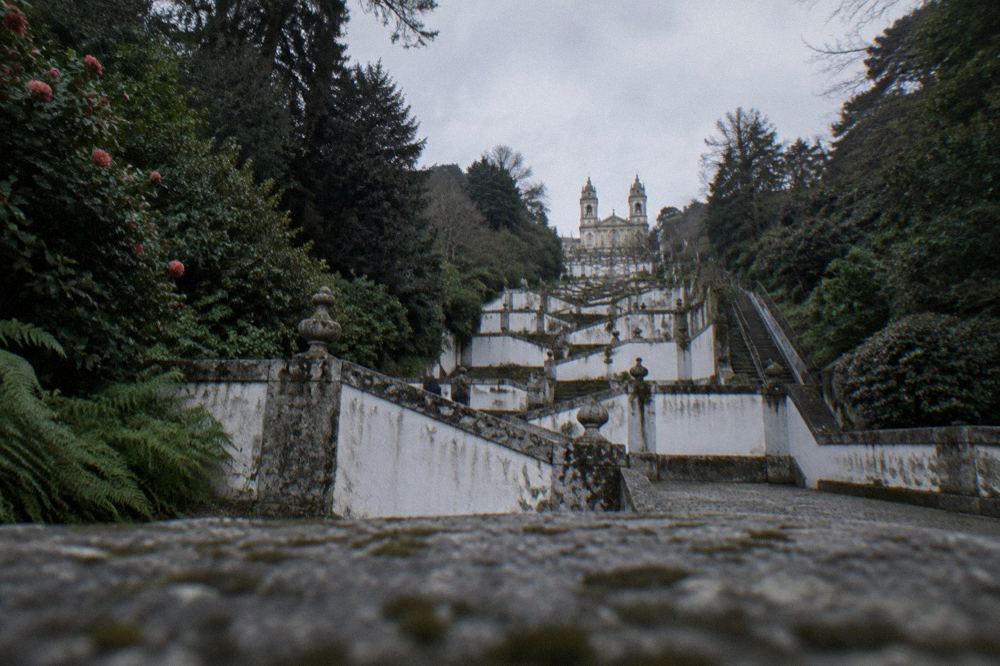
One standing fact changes the hill's logistics: the Bom Jesus funicular, the water-counterweight lift from 1882, has been out of service since 26 September 2026, with no end date published. A replacement shuttle runs every day from 09:00 to 20:00, roughly every 30 minutes each way, between the Portico, where TUB Line 2 terminates, and the sanctuary. The Confraria's listed funicular fares, 2.50 EUR single and 4.00 EUR return, are the normal prices and will apply when it runs again, but a visitor planning around a ride should check the operator's notice before going, because no return date has been announced. The stairway itself, 566 steps by the Confraria's count over 615 metres and 116 metres of ascent, remains the free and always-available route up.
| Bom Jesus do Monte: priced items | Price |
|---|---|
| Car park, cars and motorcycles | 1.00 EUR |
| Car park, caravans and minibuses | 10.00 EUR |
| Car park, coaches | 15.00 EUR |
| Funicular (currently out of service), single | 2.50 EUR |
| Funicular (currently out of service), return | 4.00 EUR |
| High choir and bell tower | 1.00 EUR |
| Lake boats, per person per 15 minutes | 3.00 EUR, minimum 2 people |
The rest of the hill, the gardens, the chapels of the Via Crucis and the basilica itself, carries no charge. The full logistics of the hill, including the bus routes and the stairway sections, are covered in the how to get to Bom Jesus do Monte guide, and the site itself has a dedicated Bom Jesus do Monte guide.
The tuk tuk option deserves a mention here, because it solves the hill problem without a car park at all. The Braga Tuk Tuk City Tour runs from 30 minutes up to 2 hours and is rated 4.8 from 179 reviews, and a private variant of the same idea appears below.
The hill climb is easier with someone else driving. Book a tuk tuk city tour here.
What About Parking At The Airport And Arriving By Coach?
Porto Airport, the airport Braga visitors actually use, is served by Getbus, a direct non-stop coach to Braga bus station from 9.00 EUR one way, with 16 departures a day each way, running from the airport between 05:00 and 00:45 and taking about 45 minutes, so flying in and renting a car at the airport is a choice rather than a necessity. Braga's own aerodrome is a small general-aviation field, not a scheduled passenger airport.
Most visitors driving to Braga arrive via Porto Airport or by train, and the airport question is really a rental-car question. The Getbus coach removes it for city-focused trips: the operator's page lists the direct service from 9.00 EUR, the Braga stop inside the bus station at platform 20, and the airport stop at P8. Passengers are asked to be at the stop 15 minutes early with a legible printed or digital ticket, and a flexible ticket allows riding the next departure if a flight runs late.
| Arriving at Braga without a car | What it is | Key figure |
|---|---|---|
| Getbus coach, Porto Airport to Braga | Direct, non-stop, every day | From 9.00 EUR one way, about 45 minutes |
| Departures each way | 16 a day on the operator's listing | Airport 05:00 to 00:45, Braga 04:00 to 23:45 |
| CP urban train, Porto to Braga | Terminates at Braga station | Priced by zone, a few euros, on a 0.50 EUR Siga card |
| Alfa Pendular, Porto Campanhã to Braga | Fast long-distance service | 17.00 EUR Turística, 23.30 EUR Conforto |
The train figures matter for a parking guide because they frame the alternative: if a car is only wanted for a day or two of Minho touring, arriving by coach or train and renting locally for those days is often cheaper and simpler than a week of airport rental plus city parking. The Braga train station guide covers the station end, and the Lisbon to Braga guide covers the long-distance Alfa Pendular option from the capital, with the 2026 full single fare at 38.50 EUR in Turística class.
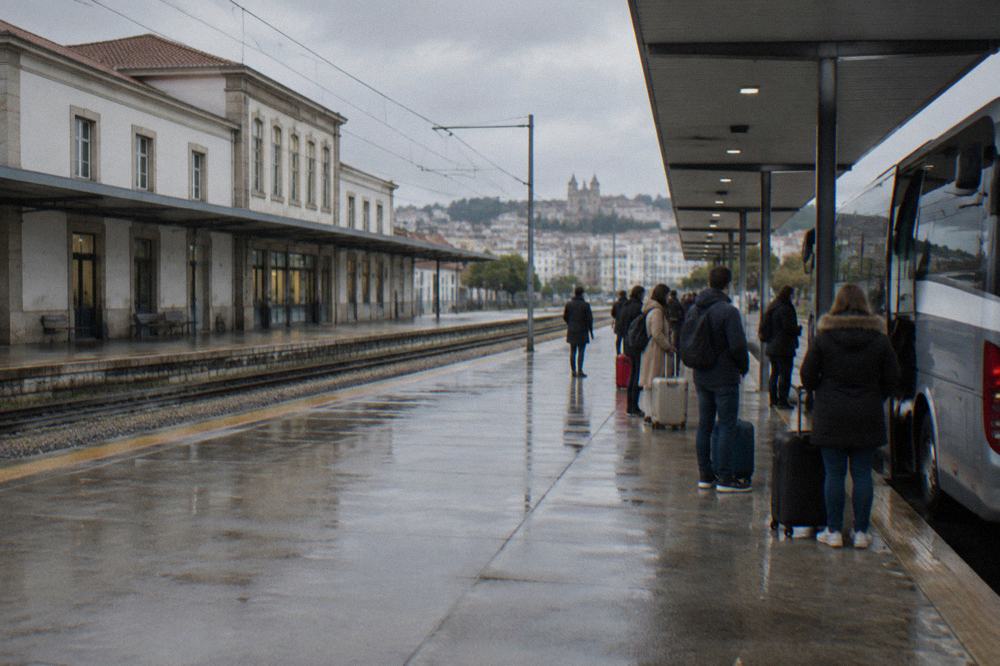
For anyone who does land at Porto Airport and drive, the run north to Braga is a straightforward motorway drive, and the parking strategy on arrival is the same as for any other day: head for the edge of the historic core, park, and walk in. The Braga airport guide explains what the local aerodrome is and is not, so no one plans a scheduled flight into a general-aviation field.
If even the drive from the airport feels like one parking decision too many, a guided day that starts on foot in the centre is the cleanest hand-off, and the featured tour below covers both the historic core and the sanctuary hill in one small-group outing.
How Does Parking Work During Braga'S Festivals?
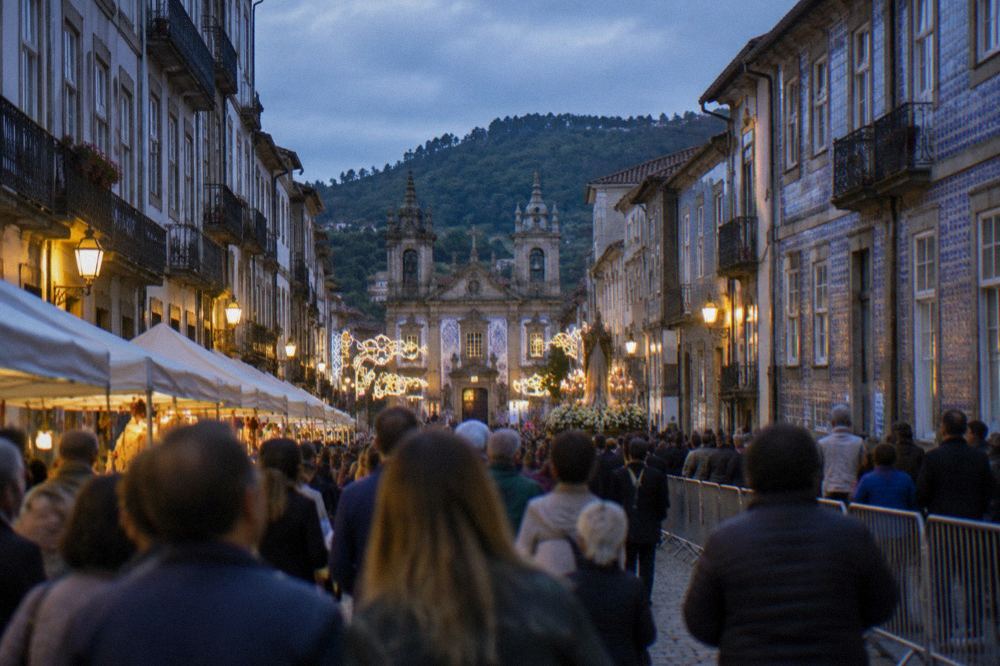
During Semana Santa, São João, Braga Romana and Noite Branca, the centre's streets fill with processions, stages and stalls, street parking in the core becomes close to impossible, and the bus-and-walk strategy stops being a preference and becomes the only sensible plan: park on the ring, or arrive by train or coach, and expect road closures around Praça da República and the processional routes.
Braga's calendar has four moments when the city's streets belong to crowds. Semana Santa de Braga ran 29 March to 5 April in 2026, with the night processions, the Burrinha on 1 April, Ecce Homo on 2 April and the Enterro do Senhor on 3 April, all starting at 21:30, closing central streets for hours at a time. The Festas de São João ran 17 to 24 June 2026, peaking on the night of 23 June into the 24 June municipal holiday. Braga Romana takes the city back to its Roman past in late May, and Noite Branca, the white night of art and music, ran from 19:00 on Friday 4 September to 23:30 on Sunday 6 September 2026. The full index of guides sits on Braga Travel Guide.
The 2027 dates for these events are not announced, so check the event pages before planning a trip around them, but the pattern is stable: Holy Week is the week before Easter and moves with it, São João peaks on the night of 23 June, Braga Romana falls in late May and Noite Branca on the first weekend of September. The Semana Santa Braga guide covers the processions in detail. A driver visiting during these windows should assume the inner streets are closed, park well outside the core, and treat any car movement in the evening as impractical. It is the one set of dates when even the most committed driver should read the best time to visit Braga guide and consider timing the trip around, rather than through, the crowds.
Where Do You Park For Day Trips Out Of Braga?
Use Braga as a base and park at each destination rather than driving into them: the regional bus network, with AITC lines to Guimarães, Ponte de Lima, Esposende and the Gerês park, covers most of the Minho, but a car wins for the national park and the smaller villages, where the Peneda-Gerês park itself is free to enter and only the Mata de Albergaria section charges a seasonal car-access fee in summer.
The Minho is the region where a car genuinely pays. The Peneda-Gerês National Park, the coastal towns, and the string of historic centres from Ponte de Lima to Viana do Castelo are linked by buses, but thinly. AITC, the regional authority, runs the numbered lines out of Braga bus station: Line 101 to Guimarães, Line 105 to Ponte de Lima, Line 106 and 107 to Póvoa de Varzim and the coast at Esposende, and Line 201 to Caldas do Gerês. The line numbers are published; fares and journey times for these routes are not printed here, so check the timetable PDFs or ask at the bus station before committing a day to a bus connection.
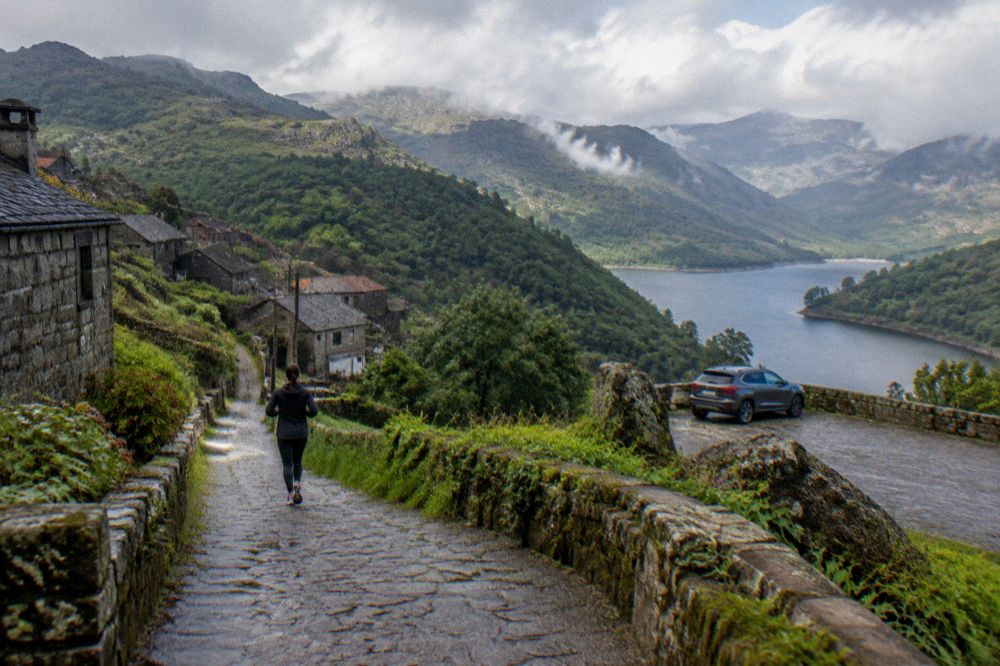
For the park itself, the structural facts are favourable: entry to Peneda-Gerês is free, and the only driving-specific charge is the seasonal access arrangement for the Mata de Albergaria section in summer, where car access is limited and carries a small fee, with traffic managed at the boundary. A private guided day out is the other way to see the region without parking anxiety, and the private walking option in the trio below covers the city end of that spectrum.
What Should A Driver'S Day In Braga Actually Look Like?
The pattern that works is a single parking decision, made once: park at a structured car park or edge-of-centre bay, spend the morning in the historic core on foot, take TUB Line 2 or drive to the Bom Jesus car park for the sanctuary in the afternoon, and never move the car in between. Trying to park near each individual sight in the centre wastes more time than the walk between them.
The mistake most first-time visitors make is treating Braga like a city where sights are spread out. They are not. The Sé de Braga, the Santa Bárbara Garden, the Museu dos Biscainhos, the Roman baths and the Arco da Porta Nova form a cluster that a visitor covers on foot without effort, and the only significant outlier is the hill. One parking decision, held for the day, beats four parking hunts.
For ticket planning inside that day, the Braga attraction tickets and passes guide explains the honest state of passes in the city: no city-wide card is on sale, so each ticket is bought separately, and the TUB tourist ticket is the only multi-use product that exists. The cathedral's own ticketing is straightforward: each of the three visit routes costs 3.00 EUR, any two together cost 6.00 EUR, and all three cost 7.00 EUR.
| The driver's day, planned | What to do | What it costs |
|---|---|---|
| Morning | Park at the edge of the core, walk the historic centre | Car park tariff, check the board |
| Cathedral visit | Three routes at the Sé de Braga | 3.00 EUR each, 6.00 EUR any two, 7.00 EUR all three |
| Afternoon | TUB Line 2 to Bom Jesus, or drive to the hill car park | 0.75 EUR pre-bought single, or 1.00 EUR parking |
| Hill extras | High choir and bell tower, lake boats | 1.00 EUR, and 3.00 EUR per person per 15 minutes |
| Evening | Return to the car, or stay for dinner in the centre | No second parking move needed |
If the day is a tight one, the one day in Braga guide sequences the sights, and the free things to do in Braga guide lists what costs nothing, including the sanctuary grounds and gardens. A guided small-group day compresses the same ground efficiently; the related tour below is the site's featured pick for exactly this plan, and it appears here as the solo recommendation it is.
Is Parking In Braga Safe And What Should You Never Leave In The Car?
Braga is a low-crime city by Portuguese standards and car parks and street bays are not a particular risk, but the standard Portuguese rules apply everywhere: never leave valuables, luggage or anything visible in a parked car, use a structured car park for overnight parking rather than a street bay, and prefer attended or barriered facilities when the car carries luggage for a multi-day trip.
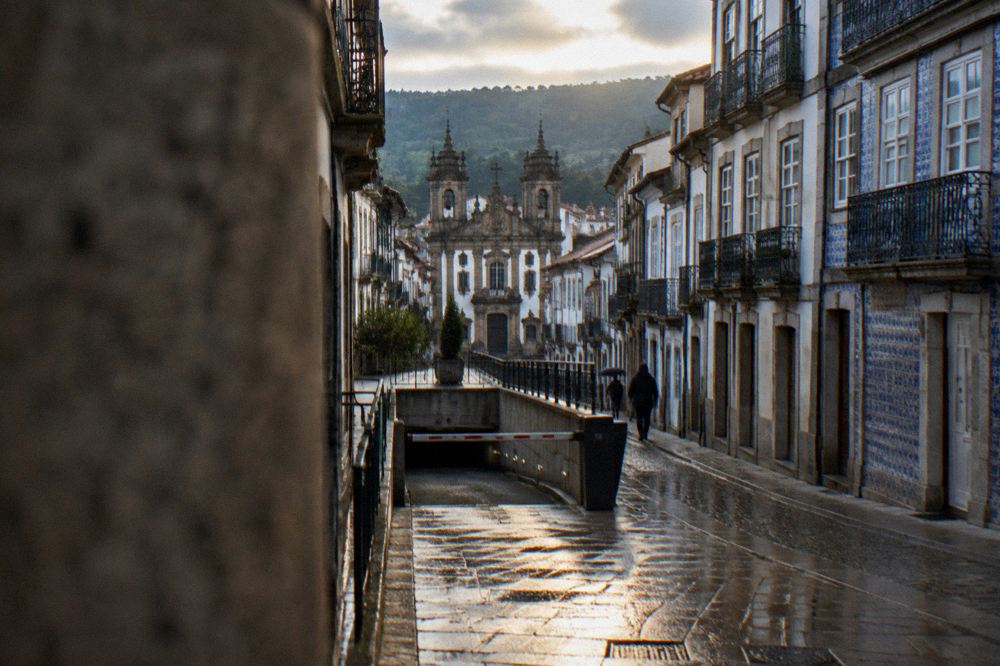
The safety question for a driver is mostly a luggage question. A day visitor with an empty boot has little to worry about in a city where the is Braga safe guide records a low-crime environment. A visitor using Braga as a touring base, with suitcases shuttling between hotel and car, should treat the car park choice with the same care as anywhere in southern Europe: barriered, attended or hotel-arranged parking beats a quiet residential street for a car loaded with luggage.
Two Braga-specific points round this off. First, the tourist tax: Braga levies 1.55 EUR per person per night, up to 4 nights, all year, charged through hotels and local accommodation, so it appears on the accommodation bill rather than the parking bill, but drivers touring the region should know it exists in Guimarães and Viana do Castelo too. Second, the funicular notice at Bom Jesus: the replacement shuttle and the stairway keep the hill fully accessible, so a driver parked at the top car park loses nothing of the visit, and a driver parked in the city can still reach the sanctuary without a car. Check the operator's notice before relying on any specific service, and read the tariff board at any car park before driving in, and the parking side of a Braga trip takes care of itself.
For a final framing of the whole question, the trio below returns the three tours that best replace a day of driving with a day of walking, riding and being guided through a city that rewards arriving on foot.
Common Questions About Parking In Braga
Is parking in Braga free?
Street parking in the centre is generally metered and time-limited, and structured car parks charge by duration; the only verified parking prices published by an attraction are at Bom Jesus do Monte, where cars and motorcycles pay 1.00 EUR. Read the meter or the tariff board at the bay, because zone prices and hours are set by the city and change.
Can you drive into Braga's historic centre?
Only partially. The core around Rua do Souto and Praça da República is pedestrianised or access-restricted, and the streets feeding it are narrow and one-way. The practical approach is to park on the ring of avenues or in a structured car park and walk in.
Where do you park for Bom Jesus do Monte?
The sanctuary's own car park charges 1.00 EUR for cars and motorcycles, 10.00 EUR for caravans and minibuses and 15.00 EUR for coaches. Alternatively, TUB Line 2 runs from the city to the Portico at the foot of the stairway, and a replacement shuttle connects the Portico to the sanctuary while the funicular is out of service.
Is the Bom Jesus funicular running?
No. The funicular has been out of service since 26 September 2026, with no end date published. A replacement shuttle runs every day from 09:00 to 20:00, roughly every 30 minutes each way, between the Portico and the sanctuary, and the 566-step stairway remains open. Check the operator's notice before your visit.
Do you need a car to visit Braga?
No. The historic centre is walkable, TUB buses cover the city, and the tourist ticket costs 3.35 EUR for one day, 6.05 EUR for two days and 8.05 EUR for three days across the whole network. A car is worth having mainly for touring the Minho region and the Peneda-Gerês National Park.
How much does the bus cost in Braga?
Under the 2026 TUB tariff, a single bought on board costs 1.55 EUR for one zone and 2.00 EUR for two zones, while a pre-bought or digital ticket costs 0.75 EUR and 1.50 EUR for the same zones. Transfers are valid for one hour on a one-zone ticket and one hour thirty on a two-zone ticket.