Best Time To Visit Braga
Braga, the city in Portugal's Minho region, is at its best in late spring and early autumn, when the weather is warm, the rain is light and the festival calendar is full. Here is how each month actually behaves, according to the IPMA climate record.
Short answer
The best time to visit Braga is May, June or September: IPMA's 1991-2020 normals for the Braga / Merelim station show mean highs of 23 to 28.7 C, monthly rainfall between 27.9 and 89.8 mm, and only 4 to 9 rain days. July and August are hottest and driest but busiest; October through January is wet, with 12 to 13 rain days a month.
Braga, the city in the Minho region of northern Portugal, rewards visitors who time their trip around two things: the weather and the festival calendar. IPMA's 1991 to 2020 climate normals for the Braga / Merelim station show a place with genuinely distinct seasons, from July's 27.9 mm of rain and 28.2 C average highs to October's 197.8 mm, and the city's event year swings from Holy Week processions in spring to the São João festivities in June. This guide works through both, month by month, so you can match your dates to what you actually want from the city.
What Is The Best Time Of Year To Visit Braga?
The best time to visit Braga is May, June or September. IPMA's 1991 to 2020 normals for the Braga / Merelim station show May averaging 23 C highs and 89.8 mm of rain, June 26.1 C and 40.6 mm, and September 26.9 C and 67.6 mm, each with fewer than nine rain days a month. These months combine the warmest, driest stretch of the year with shoulder-season crowds, and June adds the Festas de São João.
The logic behind those three months is simple once you read the climate table. July and August are technically the best weather months, with 27.9 mm and 34.6 mm of rain respectively, but they are also the busiest, and the mean highs climb to 28.2 C and 28.7 C, with 9.8 and 10.4 days at or above 30 C. May and September sit just either side of that peak: warm enough for everything you want to do outdoors, but with meaningfully fewer visitors on the Escadório do Pórtico and in the historic centre's narrow streets.
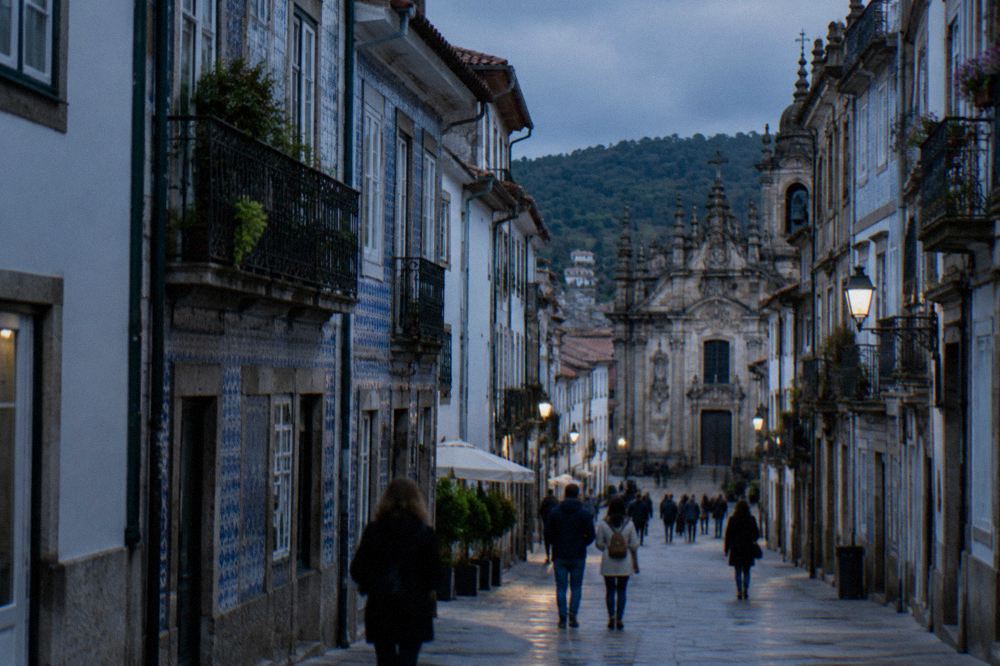
Spring has one more argument in its favour. Semana Santa, Braga's Holy Week, ran from 29 March to 5 April in 2026 and is the city's most distinctive event, registered in the National Inventory of Intangible Cultural Heritage. If you want to see Braga at its most itself, late March or early April is the time, accepting that March averages 150.1 mm of rain over 11.8 rain days. The full picture of the city's climate is covered in detail in the Braga weather guide.
How Does Braga'S Weather Change Month By Month?
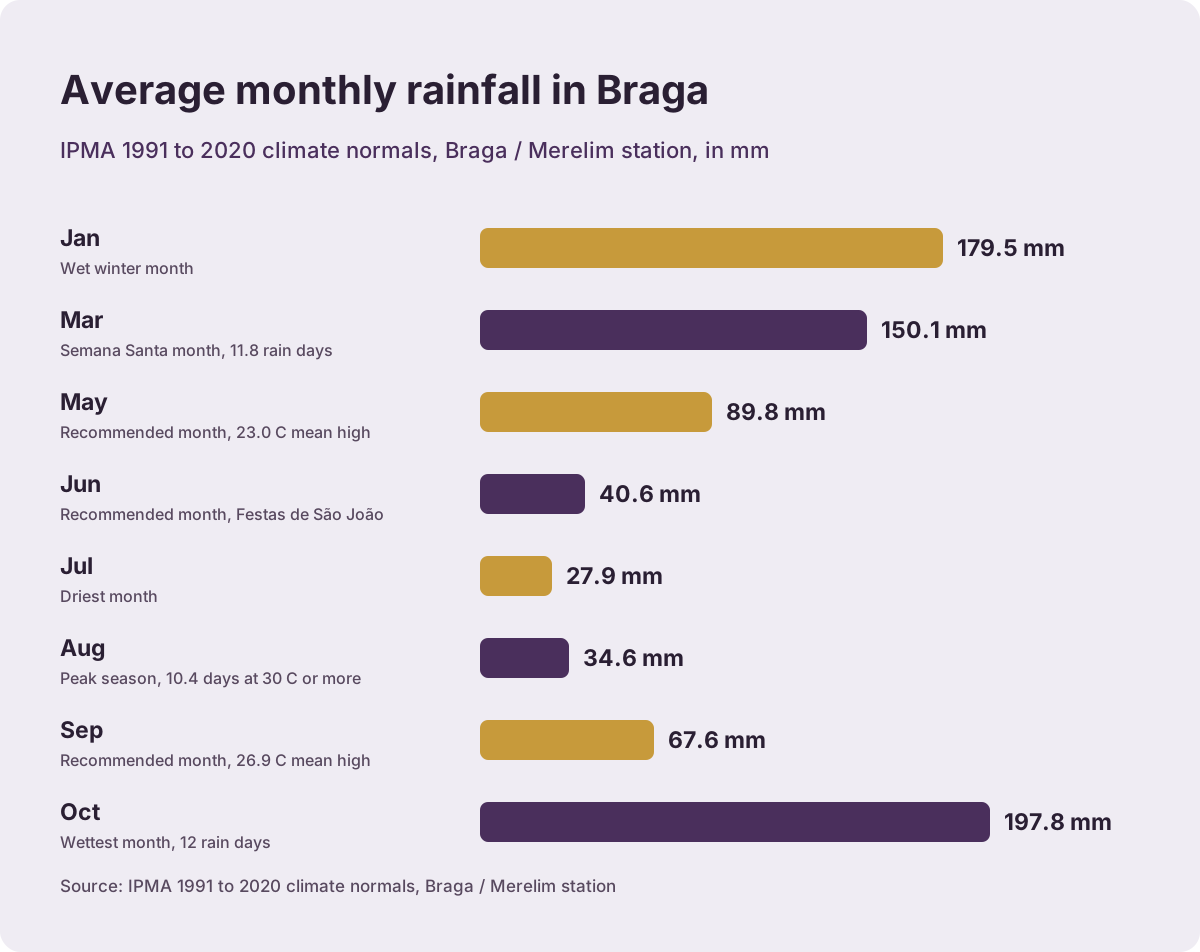
Braga has a temperate Atlantic climate with a warm, dry summer and a wet winter. IPMA's 1991 to 2020 normals for the Braga / Merelim station show mean temperatures ranging from 8.6 C in January to 21.4 C in August, monthly rainfall from 27.9 mm in July to 197.8 mm in October, and 113.5 rain days a year. October is the wettest month on average and July the driest.
The table below is the full monthly record, and it is worth reading closely before booking. Note in particular that October, not a winter month, is the wettest of the year, and that September is actually warmer at the top end than June, with a mean maximum of 26.9 C against 26.1 C.
| Month | Mean max C | Mean C | Mean min C | Rain mm | Days 1 mm+ rain | Days 30 C+ |
|---|---|---|---|---|---|---|
| Jan | 14.1 | 8.6 | 3.1 | 179.5 | 13.1 | 0 |
| Feb | 15.5 | 9.5 | 3.4 | 111.1 | 9.6 | 0 |
| Mar | 17.8 | 11.9 | 5.9 | 150.1 | 11.8 | 0 |
| Apr | 19.6 | 13.7 | 7.8 | 127.9 | 12.0 | 0 |
| May | 23.0 | 16.7 | 10.4 | 89.8 | 8.9 | 2.9 |
| Jun | 26.1 | 19.7 | 13.2 | 40.6 | 5.7 | 6.7 |
| Jul | 28.2 | 21.2 | 14.3 | 27.9 | 4.0 | 9.8 |
| Aug | 28.7 | 21.4 | 14.0 | 34.6 | 3.8 | 10.4 |
| Sep | 26.9 | 19.7 | 12.4 | 67.6 | 6.2 | 7.4 |
| Oct | 22.2 | 16.1 | 10.1 | 197.8 | 12.0 | 0 |
| Nov | 17.0 | 11.5 | 6.0 | 170.1 | 12.9 | 0 |
| Dec | 14.9 | 9.3 | 3.7 | 190.3 | 13.3 | 0 |
Two extremes from the same station frame the range: a record high of 42.2 C in August and a record low of -6.4 C in December. Neither is typical. The mean annual temperature is 14.9 C, and frost is a real but modest presence, with 8.5 nights below 0 C in January and 7.0 in December.
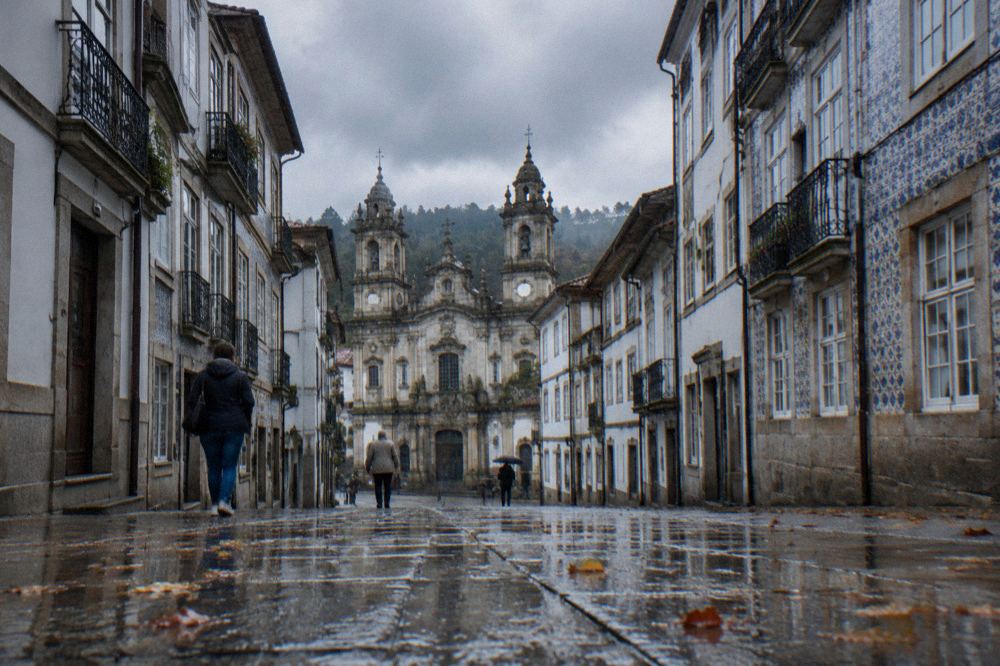
For anyone planning to explore on foot, which is how Braga is best seen, the rain-day column matters more than the totals. From October to January, IPMA records 12 to 13 days a month with a millimetre or more of rain. A flexible walking tour is one way to keep the historic centre enjoyable in that season, and the personal and flexible walking tour in the historic centre adapts its pace and route to the group, which is useful when the sky changes.
When Is Braga'S Peak Season And Should You Avoid It?
Braga's peak season runs from late June through August, when the climate is at its driest and the school-holiday crowds arrive, with July and August averaging 28.2 C and 28.7 C mean highs and only 3.8 to 4 rain days each. Avoid it only if you want quiet: the weather is the year's best, but the Escadório do Pórtico and the Sé de Braga are at their busiest, and 10.4 August days reach 30 C or more.
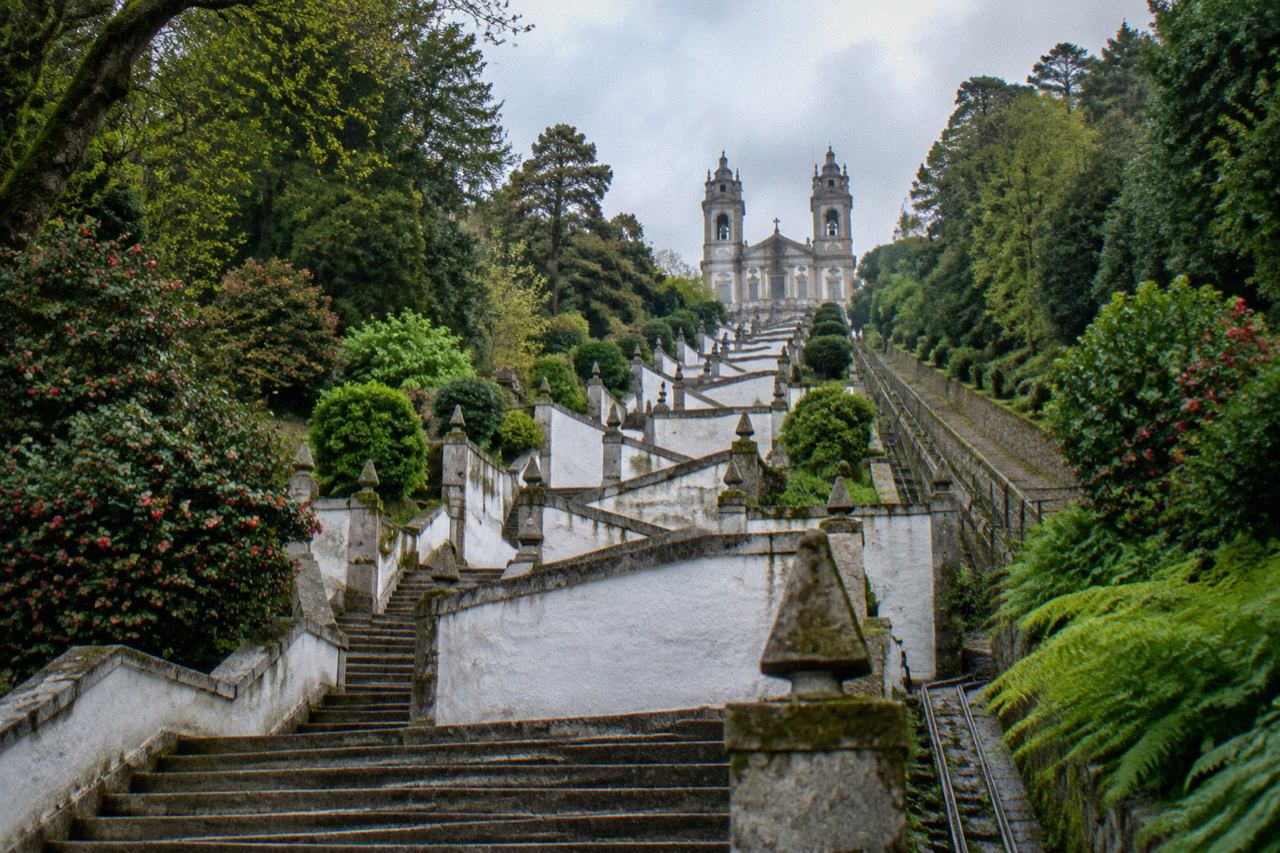
The honest trade-off is this. Summer in Braga is genuinely pleasant by southern European standards, because the Atlantic keeps the nights cool: August's mean minimum is 14.0 C, so evenings outdoors are comfortable. The Bom Jesus do Monte grounds, the Santa Bárbara Garden and the café terraces around Praça da República are all at their best used. What you give up is space and calm, particularly at Bom Jesus do Monte, where the 566-step stairway, by the Confraria's count, carries a steady stream of visitors in high summer.
One operational fact belongs in any peak-season planning: the Bom Jesus funicular has been out of service since 26 September 2026, with no end date published, and a replacement shuttle runs every day from 09:00 to 20:00, roughly every 30 minutes each way, between the Pórtico and the sanctuary. Check the operator's notice before you go. The practical way up the hill is covered in the how to get to Bom Jesus do Monte guide.
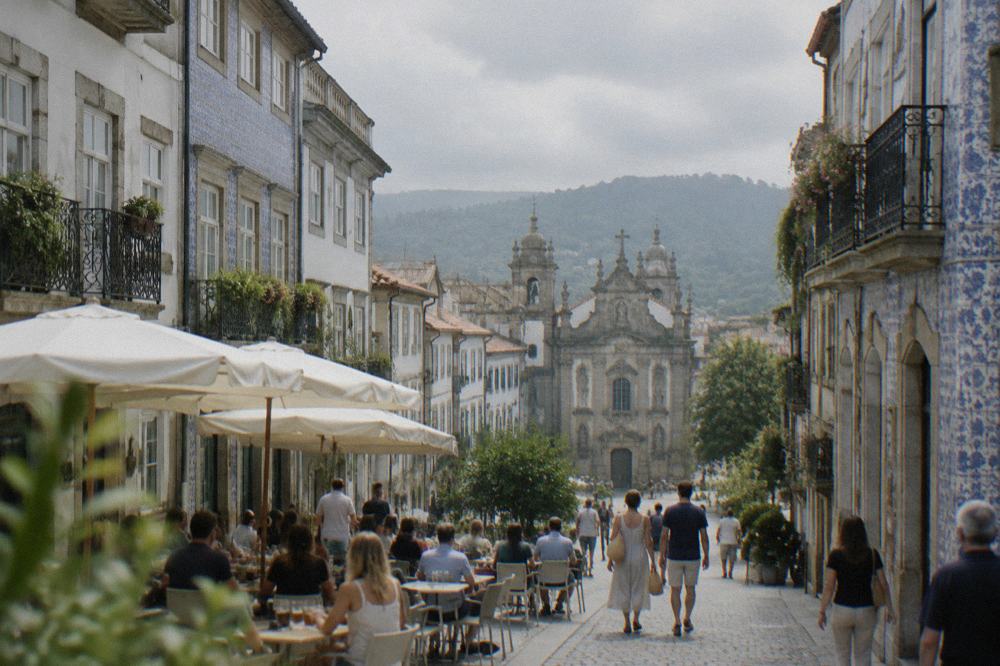
If you do travel in peak season, shift your days early. The basilica at Bom Jesus opens at 08:00 in summer, and the stairway is at its most peaceful in the first two hours after that. A tuk tuk tour is another way to cover the city's spread-out sights without adding a long walk in the heat, and it can be booked through the operator's live listing.
What Is The Rainiest Month In Braga?
October is the rainiest month in Braga on average, with 197.8 mm of rain over 12 rain days at the Braga / Merelim station, ahead of December at 190.3 mm and January at 179.5 mm. The single wettest day on record at the station brought 110.9 mm, also in October. July is the driest month, with 27.9 mm.
That October figure surprises visitors who expect a simple summer-winter pattern. The transition months carry the Atlantic fronts, and the numbers fall off quickly on either side of them: September drops to 67.6 mm and November to 170.1 mm, so the shoulder either side of October is much drier than October itself. If your dates are flexible within autumn, September is the better month by every measure, warmer and with roughly half the rain.
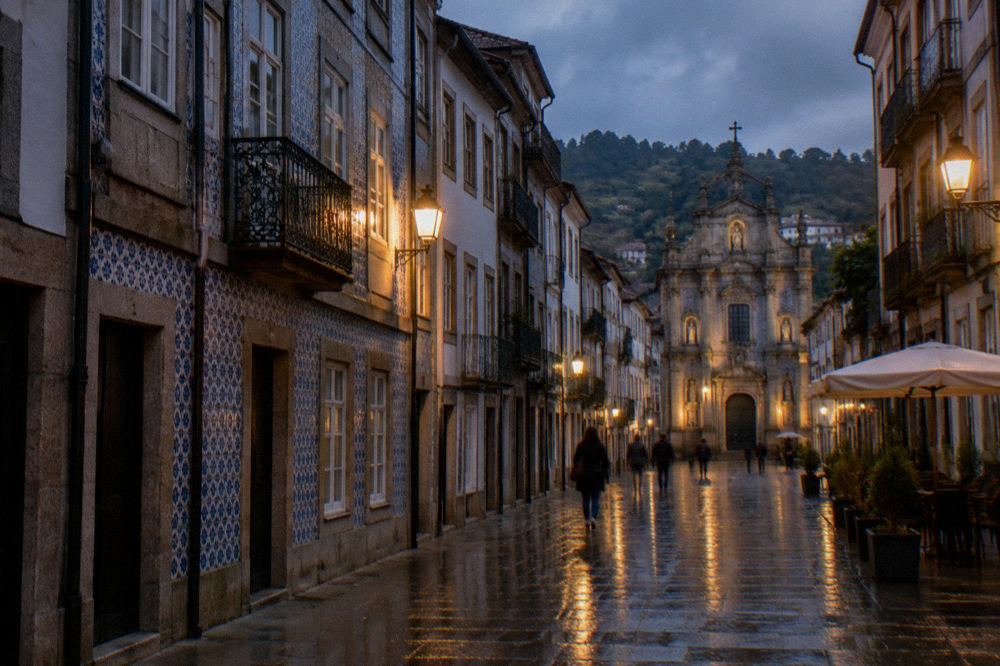
A wet-day plan for Braga is not a consolation prize. The city's museums are strong and mostly central: the Museu dos Biscainhos, the Museu de Arqueologia D. Diogo de Sousa and the Museu Pio XII with its medieval tower can fill a rainy afternoon, and the cathedral's three visit routes, at 3.00 EUR each or 7.00 EUR combined for all three, easily absorb a morning. The full wet-weather options are laid out in the things to do in Braga overview.
When Are Braga'S Main Festivals And Events?
Braga's four headline events are Semana Santa, which ran 29 March to 5 April in 2026; the Festas de São João, 17 to 24 June 2026; Braga Romana, held in late May, with the 2026 edition in the third week of May; and Noite Branca, on the first weekend of September, 4 to 6 September in 2026. Holy Week moves with Easter, and 2027 dates have not been announced for any of them.
Each event changes the character of the city in a different way, and each suits a different kind of visitor.
| Event | 2026 dates | What it is | Best for |
|---|---|---|---|
| Semana Santa | 29 Mar to 5 Apr | Holy Week processions, including the Burrinha on 1 April and the Enterro do Senhor on 3 April, both at 21:30 | Photography, tradition, evening spectacle |
| Braga Romana | Third week of May | Roman-era reenactment, organised by the municipality, XXII edition in 2026 | Families, history, street atmosphere |
| Festas de São João | 17 to 24 Jun | City festival peaking on the night of 23 June into the 24 June municipal holiday | Nightlife, music, crowds |
| Noite Branca | 4 to 6 Sep | White Night: late-opening cultural venues and concerts from 19:00 Friday to 23:30 Sunday | Art, music, a city-wide evening |
| Encontros da Imagem | 18 Sep to 1 Nov | Photography festival with more than 30 exhibitions | Photography, galleries |
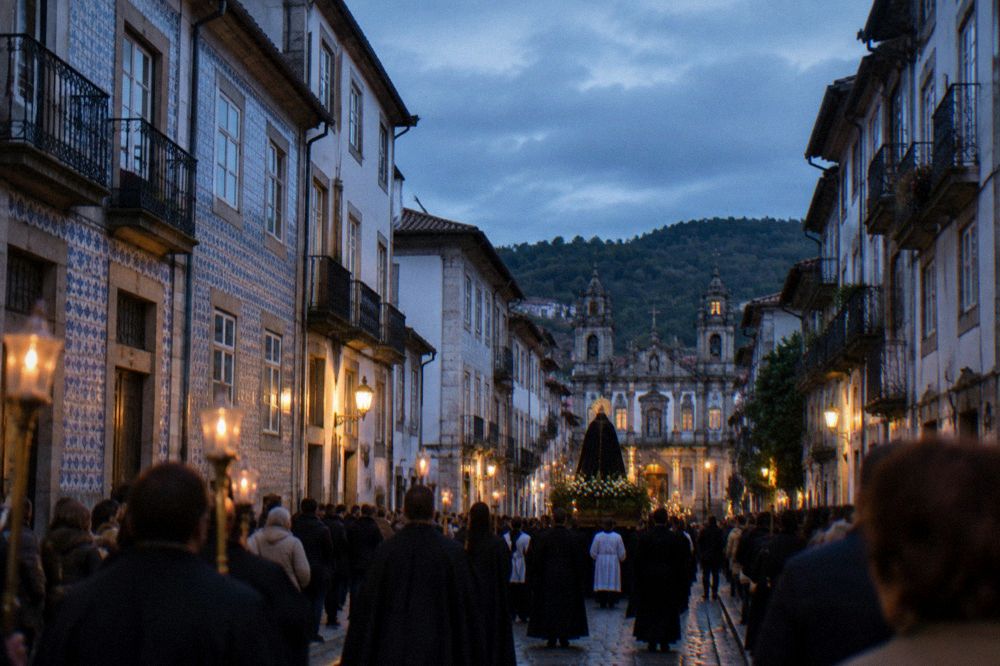
Semana Santa is the one that defines Braga. The week is organised by the Comissão da Quaresma e Solenidades da Semana Santa de Braga with the cathedral chapter and the brotherhoods, and its processions fill the historic centre's streets after dark. It is covered in full in the Semana Santa guide. Be aware that the weather that week is a coin toss: March averages 150.1 mm of rain, so pack for both.
São João is the loudest week of the year and the busiest for accommodation, because the festival overlaps the municipal holiday on 24 June, when several museums close. Noite Branca is the connoisseur's pick: an early-September weekend when the city stays up late, the weather is still fully summer, and the crowds are local rather than tour-bus.
Is Spring Or Autumn Better For Visiting Braga?
Autumn is better for weather: September averages 26.9 C mean highs with 67.6 mm of rain, and October still reaches 22.2 C, while spring's counterpart months, March and April, average 17.8 C and 19.6 C with 150.1 mm and 127.9 mm of rain. Spring is better for events and colour, because Semana Santa and Braga Romana both fall in it, and the gardens are at their freshest.
Put plainly, autumn wins on the climate record and spring wins on the calendar. A September visitor gets near-summer warmth with two-thirds of the August crowd and no major festival competing for space, unless Noite Branca falls in their dates, which is a bonus rather than a problem. An April visitor gets processions, Roman reenactment in late May, and the city in bloom, but should expect rain on roughly 12 days of the month.
| Spring (Mar-May) | Autumn (Sep-Nov) | |
|---|---|---|
| Mean high range | 17.8 to 23.0 C | 26.9 to 17.0 C |
| Rain per month | 89.8 to 150.1 mm | 67.6 to 197.8 mm |
| Rain days per month | 8.9 to 12.0 | 6.2 to 12.9 |
| Headline events | Semana Santa, Braga Romana | Noite Branca, Encontros da Imagem |
| Crowd level | Busy in Holy Week, calm in May | Calm, except Noite Branca weekend |
| Best month | May | September |
May deserves a special mention as the single most balanced month in the year: 23.0 C mean highs, 89.8 mm of rain, only 2.9 days at or above 30 C, and Braga Romana on the streets. The Santuário do Sameiro and the Mosteiro de São Martinho de Tibães, both on the hills just outside the historic centre, are at their best in that light.
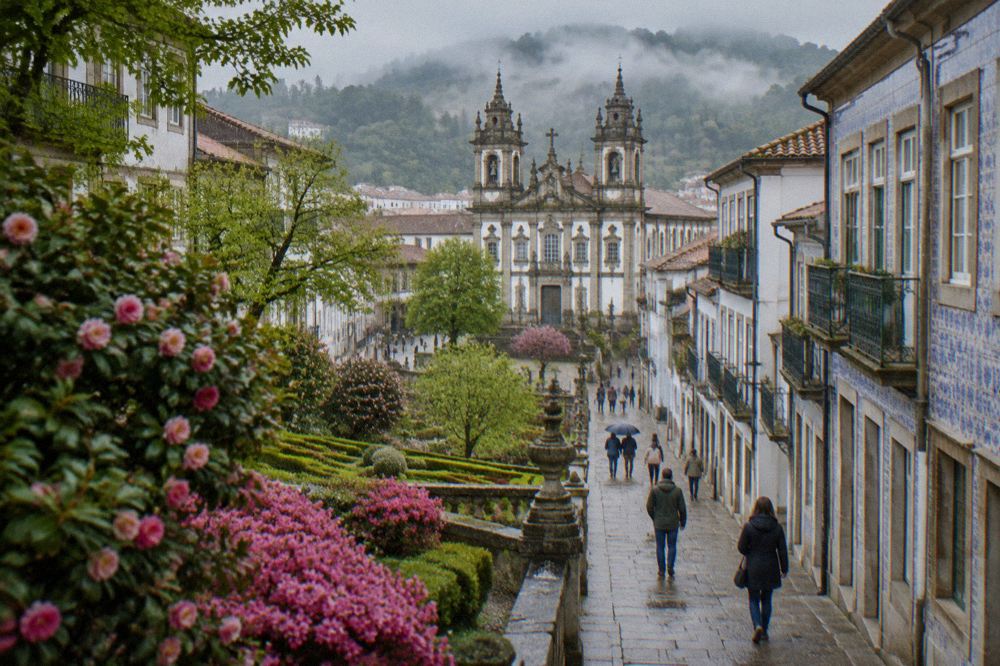
What Is The Best Time To Visit Bom Jesus Do Monte?
The best time to visit Bom Jesus do Monte is early morning between May and September, when the sanctuary grounds open in daylight, the basilica opens at 08:00, and the mean high is between 23 and 28.7 C. The stairway is 566 steps by the Confraria's count, so summer afternoons, when 10.4 August days reach 30 C or more, are the wrong time to climb it.
The sanctuary's own information page lists no admission charge for the grounds or the basilica, and the basilica opens at 08:00 in summer and 08:00 in winter, so the early start costs nothing but an alarm. The car park charges 1.00 EUR for cars and motorcycles, and the rowing boats on the lake run from 10:00, at 3 EUR per person per 15 minutes, if you want the full morning there.
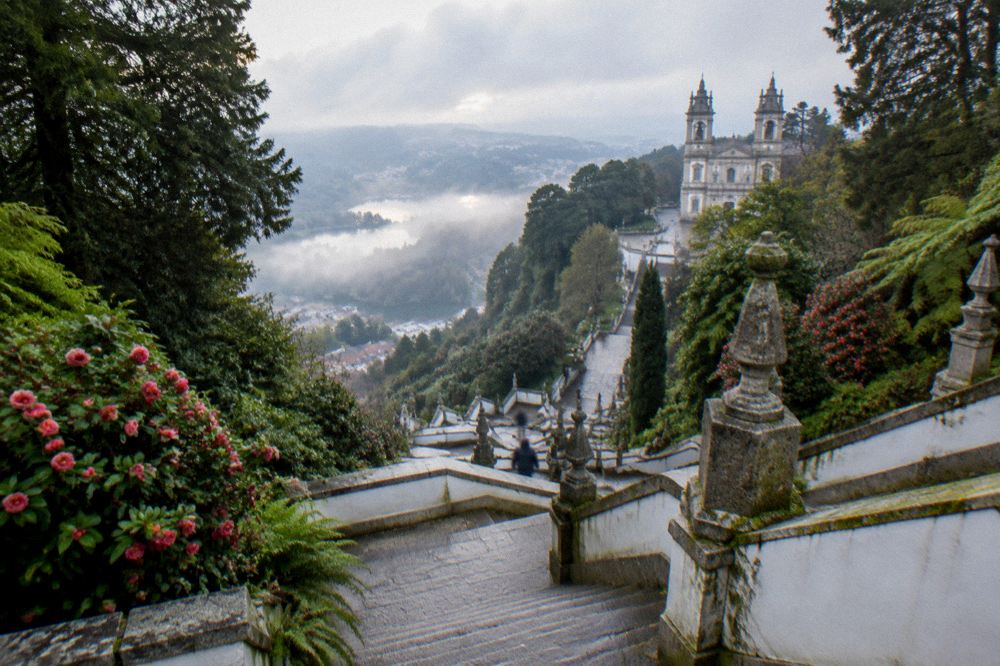
The funicular adds one planning wrinkle: it has been out of service since 26 September 2026 with no published return date, replaced by a shuttle every 30 minutes between 09:00 and 20:00. If riding the 1882 water-counterweight funicular is part of why you are coming, check the operator's notice close to your travel date rather than relying on older guides. A private walking tour with a professional guide can fold Bom Jesus into a wider city itinerary and handles the timing questions for you.
What Is The Cheapest And Quietest Time To Visit Braga?
The cheapest and quietest time to visit Braga is November through February, excluding the Christmas fortnight, when hotel demand drops, the historic centre is calm, and IPMA's normals show 9.5 to 15.5 C mean highs. The trade-off is rain: 111.1 mm in February but 170.1 mm in November, 190.3 mm in December and 179.5 mm in January, with 9.6 to 13.3 rain days a month.
Planning a quiet off-season stay in the city? Book a hotel room here.
Winter visitors get a different city. The processions are months away, the terraces are quieter, and the museums run their full schedules, with the caveat that most close on Mondays and on the municipal holidays of 1 January, Easter Sunday, 1 May, 24 June and 25 December. February is the pick of the winter months on the climate record: it is the driest month between October and April, at 111.1 mm, and the mean high of 15.5 C is comfortable for walking.
December has its own draw, and the Braga in December guide covers it: the Christmas programme lights the historic centre, and the city's café culture, from A Brasileira onward, is built for short days. Where to base yourself in any season is settled in the where to stay in Braga guide, and the year-round free sights are listed in free things to do in Braga.
Common Questions About The Best Time To Visit Braga
What is the best time to visit Braga?
May, June or September. IPMA's 1991 to 2020 normals for the Braga / Merelim station show mean highs of 23 to 28.7 C and monthly rainfall between 27.9 and 89.8 mm across those months, with fewer than nine rain days each and thinner crowds than July and August.
What is the rainiest month in Braga?
October, with 197.8 mm of rain on average over 12 rain days at the Braga / Merelim station, ahead of December at 190.3 mm and January at 179.5 mm. July is the driest, at 27.9 mm.
What is the hottest month in Braga?
August, with a mean maximum of 28.7 C and 10.4 days at or above 30 C. The record high at the station is 42.2 C, also in August, but nights stay cool, with a mean minimum of 14.0 C.
Is Braga worth visiting in winter?
Yes, if you plan around the rain. Mean highs run from 14.1 C in January to 15.5 C in February, the museums run full schedules, and the city is quiet. Expect 9.6 to 13.3 rain days a month between November and February.
When is Braga's festival season?
Spring through early autumn. Semana Santa ran 29 March to 5 April in 2026, Braga Romana falls in late May, the Festas de São João ran 17 to 24 June 2026, and Noite Branca ran 4 to 6 September 2026. Holy Week moves with Easter, and 2027 dates have not been announced.
Is the Bom Jesus funicular running?
Not currently. It has been out of service since 26 September 2026, with no end date published, and a replacement shuttle runs every 30 minutes between 09:00 and 20:00. Check the operator's notice before your visit.
Whatever month you choose, the pattern holds: match your dates to the rain column first, the festival calendar second, and the rest of the trip, from the Braga walking tours to the city's restaurants, will fall into place around it. Braga Travel Guide covers every season of the city in depth, and the climate record above is the same one the weather page tracks month by month.