Braga Vs Aveiro And Viana Do Castelo
Three northern Portuguese cities, three completely different trips: a full comparison of Braga, Aveiro and Viana do Castelo, with verified Braga prices and honest advice on which one fits your plans.
Short answer
Braga suits travellers who want churches, baroque architecture and a full historic-centre city break; Aveiro is the canal-and-lagoon choice for a relaxed half-day; Viana do Castelo pairs a small historic centre with a dramatic coastal setting. All three are reachable from Porto, and Braga rewards the longest stay.
Braga, the city in the Minho region of northern Portugal, gets compared to two very different places: Aveiro, the lagoon city on the coast south of Porto, and Viana do Castelo, the folklore capital where the Lima river meets the Atlantic. The three names appear together in itineraries because all three sit within reach of Porto, but they are not variations on one theme. Braga is a baroque pilgrimage city built around churches and granite; Aveiro is a low-lying town of canals, painted boats and art-nouveau façades; Viana do Castelo is a small coastal city watched over by a basilica on a hill above the sea. Choosing between them is really a question about what kind of day, or week, you want.
This comparison leans on what can actually be checked. For Aveiro and Viana do Castelo, this page describes what each place is and is known for, and prints no price, hour or distance that has not been verified for that exact subject.
Which Should You Visit: Braga, Aveiro Or Viana Do Castelo?
Choose Braga for a full city break built around religious architecture, gardens and food, and give it two or three days. Choose Aveiro for a short, relaxed half-day of canals and lagoon light. Choose Viana do Castelo if you want a small historic centre plus open coastal scenery, and plan one day with an optional second for the beaches north of the city. All three work as day trips from Porto; only Braga comfortably fills several days on its own.
The honest starting point is that these three cities are not competing for the same slot in most trips. Aveiro is often described as a Portuguese Venice, a comparison that oversells the canals but captures the point: the visit is a boat ride, a wander, a plate of soft-egg sweets called ovos moles, and not much more. Viana do Castelo trades on costume, gold filigree and one of the country's great pilgrimage basilicas, the Sacré-Cœur-like Templo do Sagrado Coração de Jesus on Monte de Santa Luzia. Braga trades on depth: a cathedral with three separate visit routes, a UNESCO-listed sanctuary on a hill, a monastery, half a dozen museums and a restaurant scene that justifies an evening plan.
If you are travelling without a car and want the densest concentration of sights per minute walked, Braga wins on the historic centre alone. If the trip is really about the coast, Viana do Castelo wins. If the trip is a single relaxed day with children or with someone who does not want to climb hills, Aveiro is the flattest and gentlest of the three.
What Is Each City Known For?
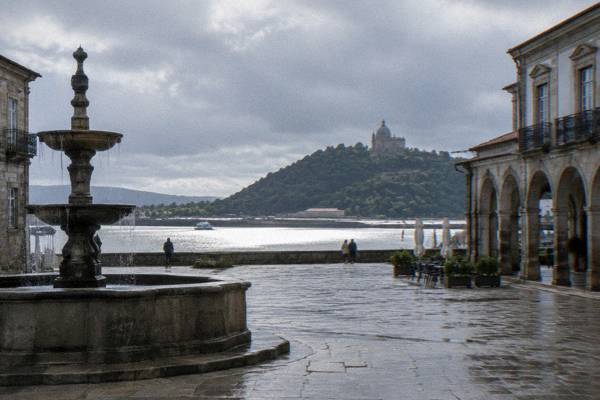
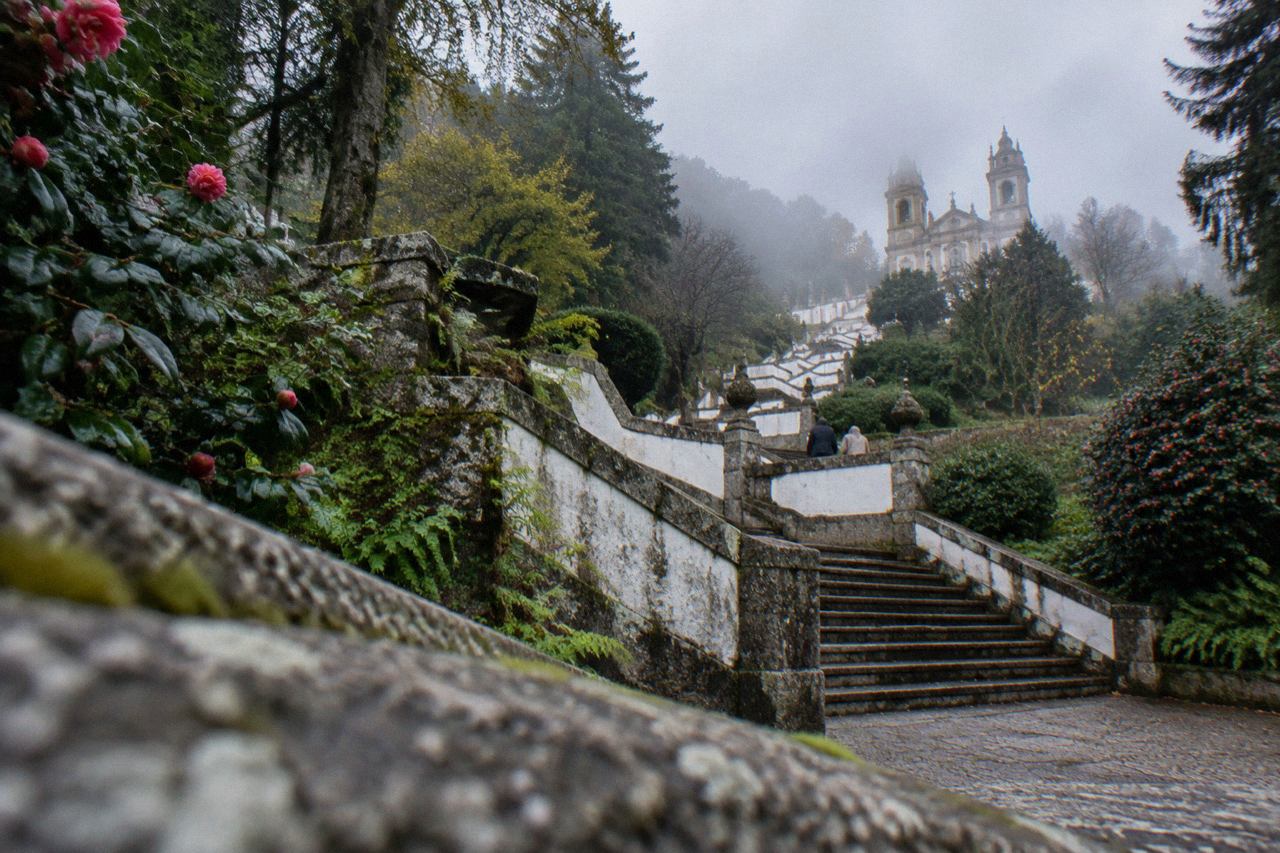
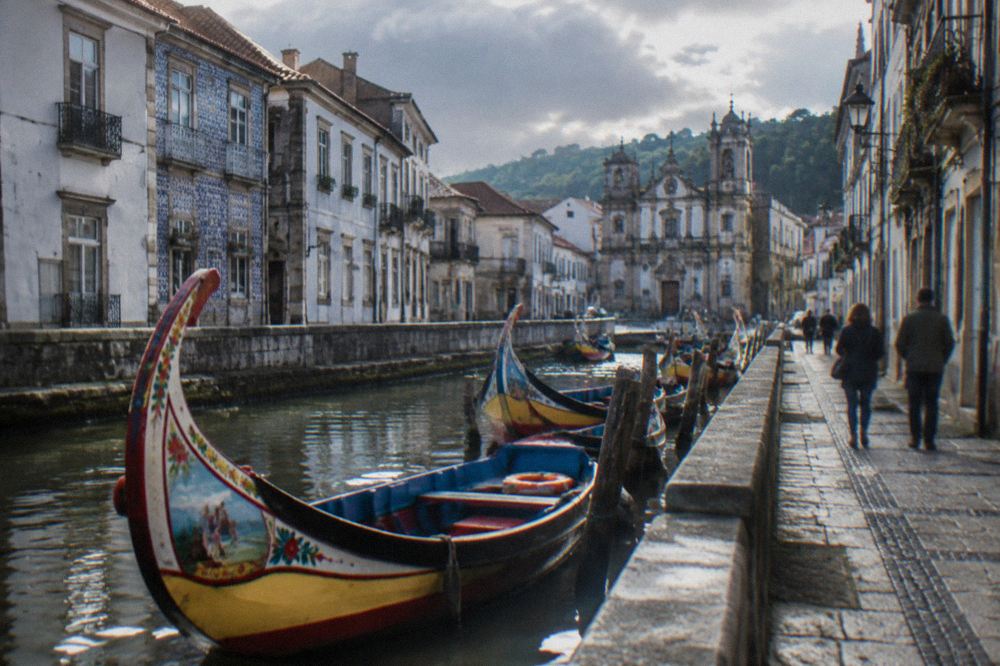
Braga is known for its baroque religious architecture, above all the Sanctuary of Bom Jesus do Monte, a UNESCO World Heritage property since 2019, and the Sé de Braga, whose visit programme splits into three separate routes. Aveiro is known for its lagoon, canals and painted moliceiro boats, and for art-nouveau streets rather than monuments. Viana do Castelo is known for its folklore costumes, gold filigree, the pilgrimage basilica on Monte de Santa Luzia and its position at the mouth of the Lima river.
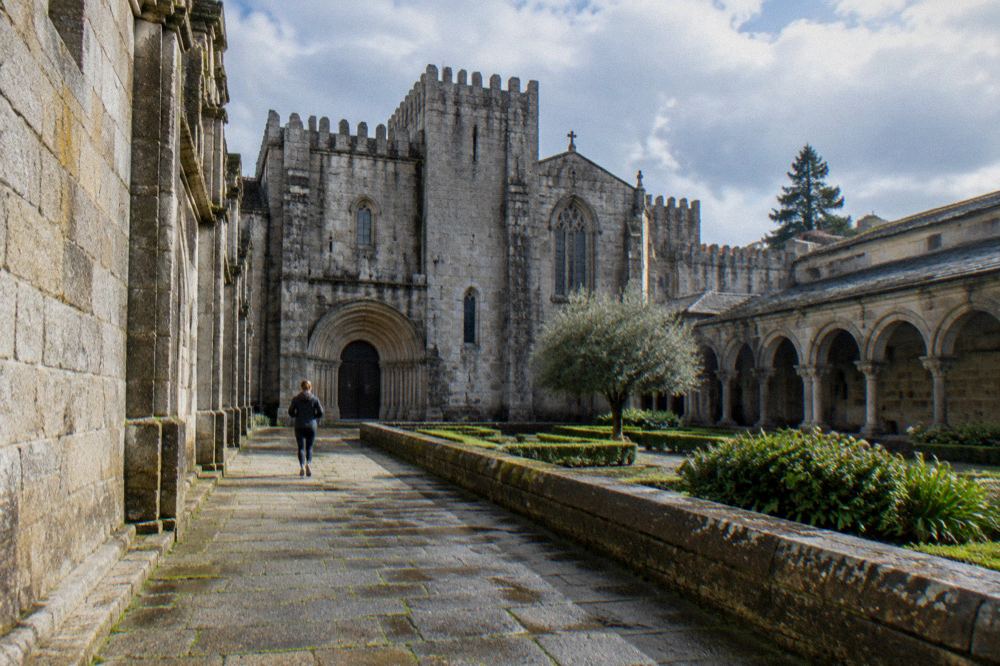
Each city's identity shapes what a visit actually feels like. In Braga you move between enclosed spaces: the cathedral's funerary chapels, the museum houses of the Biscainhos and Nogueira da Silva families, the gardens of Santa Bárbara. The Confraria do Bom Jesus do Monte's own page counts 566 steps on the Escadório do Pórtico and the two stairways above it, rising 116 metres, and the sanctuary's information page lists no admission charge for the grounds or the basilica. That is the shape of a Braga day: a climb, a church, a garden, a long lunch.
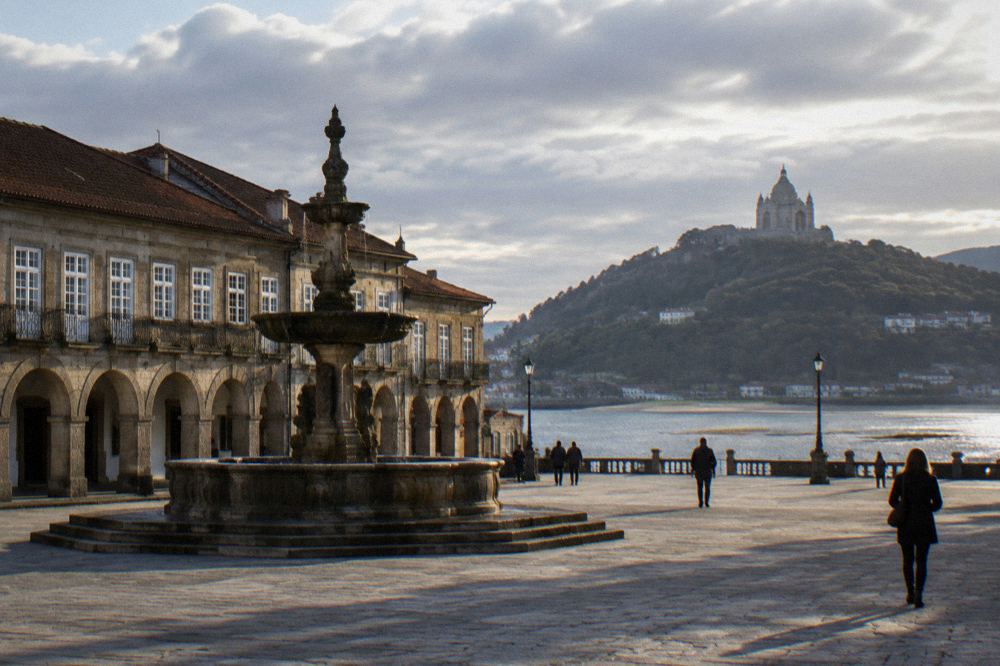
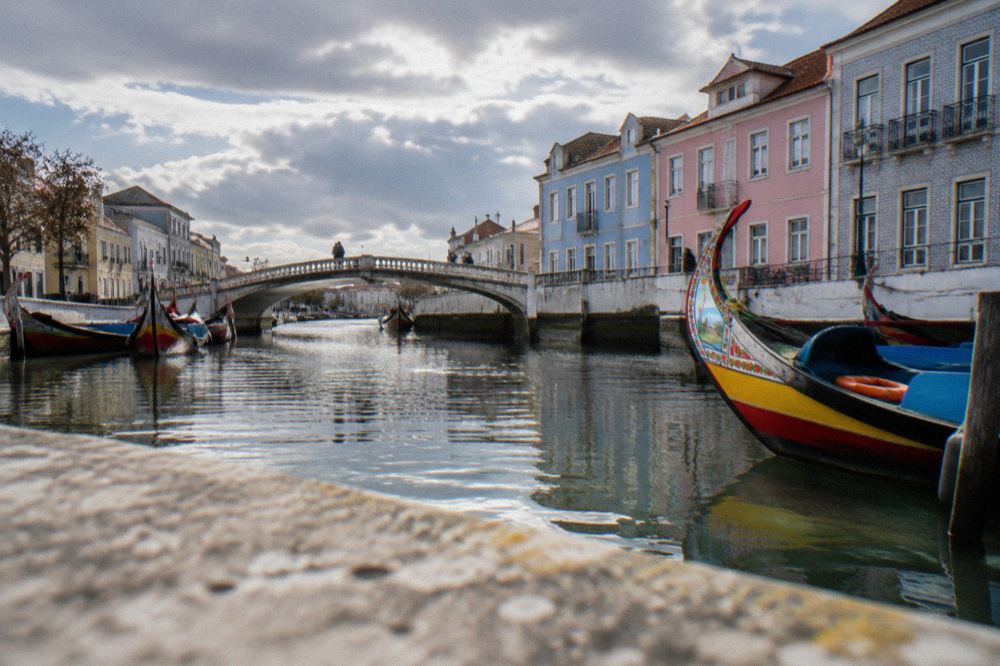
Aveiro inverts that. The town sits on the edge of a shallow lagoon, and the visit is horizontal rather than vertical: a moliceiro trip along the canals, the fish-market quarter, the striped art-nouveau façades, and the beaches a short ride away on the sand spit that separates the lagoon from the sea. Viana do Castelo combines the two registers: a compact, granite-and-tile old town around the Praça da República, and then a funicular or drive up to the basilica for the wide view over the river mouth and the Atlantic.
| Braga | Aveiro | Viana do Castelo | |
|---|---|---|---|
| Setting | Inland city in the Minho, hills on three sides | Lagoon and canals just inland from the coast | At the mouth of the Lima river, facing the Atlantic |
| Signature sight | Sanctuary of Bom Jesus do Monte, UNESCO-listed since 2019 | Moliceiro boats on the central canals | Basilica on Monte de Santa Luzia above the city |
| Architecture | Baroque churches, granite historic centre | Art-nouveau façades, salt-warehouse quarter | Manueline and revivalist old town, pilgrimage basilica |
| Food identity | Minho cooking, cod dishes, Vinho Verde | Fish, salt-cod traditions, ovos moles sweets | Fish, shellfish and Minho river cuisine |
| Best trip length | Two to three days | Half a day to one day | One to two days |
For travellers who want a fuller sense of how Braga stacks up against a bigger university city instead, the Braga versus Coimbra comparison covers a different pairing, and the round-up of things to do in Braga lists the sights this page only touches.
How Do The Three Cities Feel Different To Walk Around?
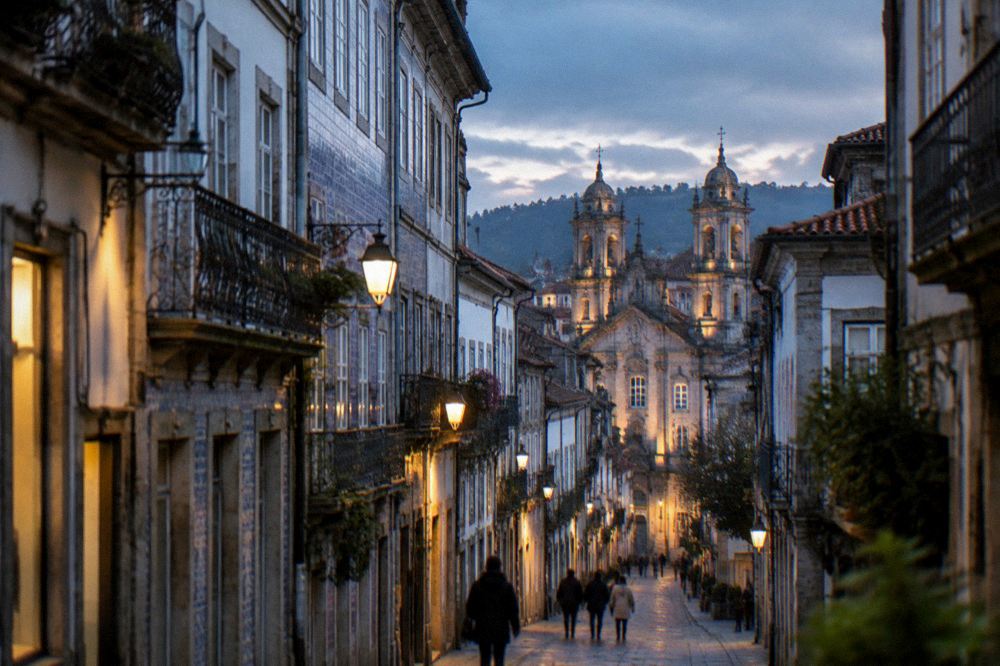
Braga's historic centre is compact but layered, with a pedestrian spine along Rua do Souto and sights that fan out to the hills, so a full visit involves some climbing. Aveiro is flat and small enough to cover on foot in a couple of hours, with the canals as the orientation device. Viana do Castelo's old town is similarly compact, but the basilica above it sits on a hill reached by road or funicular, so the walk splits into an easy low part and an optional ascent.
Scale matters here more than any single sight. Braga's centre holds a working city: the municipality counted 193,324 residents across the whole municipality at the 2021 census, and the streets between the Sé and the Arco da Porta Nova carry that life alongside the tourist flow. The hills are real but manageable, and the 2026 TUB tariff offers a tourist ticket covering the whole urban network at 3.35 EUR for one day, 6.05 EUR for two and 8.05 EUR for three, which takes the strain off the Bom Jesus climb if you would rather ride.
Aveiro asks the least of your legs and rewards the slowest pace: the canals are the point, and the visit is mostly a loop. Viana do Castelo sits between the two: the old town is a gentle grid around the main square, and the ascent to Santa Luzia is the one demanding excursion, best saved for clear weather when the view stretches up the coast.
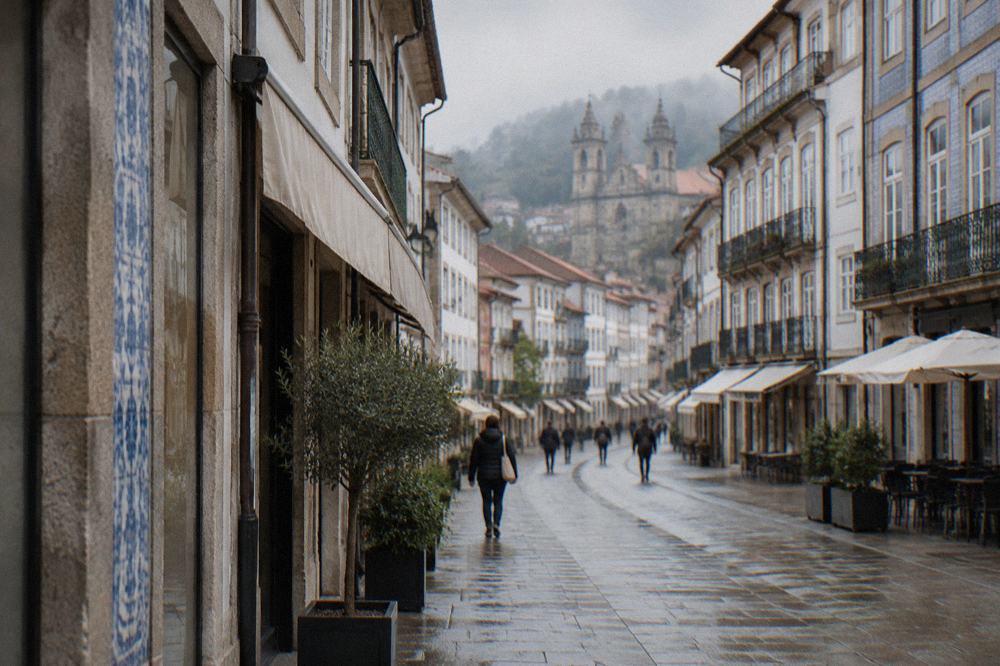
A guided walk is the most efficient way to read Braga's layers, since the centre's story runs from Roman Bracara Augusta through baroque Braga and most of it is written on façades you would walk past alone. The Braga walking tours guide compares the options, and the tuk tuk tour below suits anyone who wants the same ground without the climbs.
Want someone to read those layers for you on arrival? Book a free walking tour here. (Guided in Spanish)
How Much Does A Trip To Braga Cost Compared With The Others?
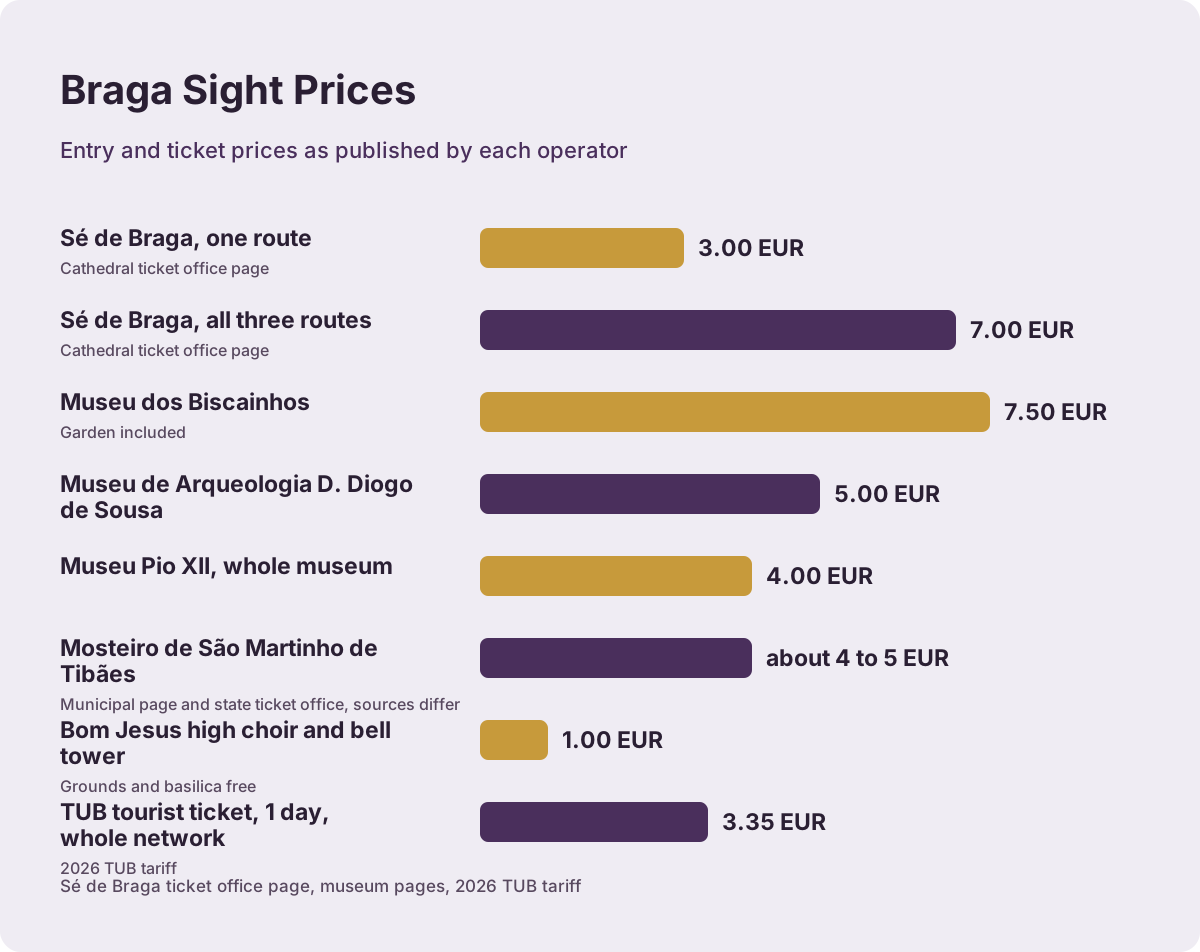
Braga's main sights are individually inexpensive: the Sé de Braga charges 3.00 EUR per visit route, 6.00 EUR for any two and 7.00 EUR for all three; the Museu dos Biscainhos charges 7.50 EUR; the Museu de Arqueologia D. Diogo de Sousa charges 5.00 EUR; Bom Jesus do Monte's grounds and basilica are free. Braga also levies a municipal tourist tax of 1.55 EUR per person per night, up to four nights.
No comparable verified price list exists for Aveiro or Viana do Castelo on this page.
The Braga column of that comparison can be stated with confidence because it comes from the operators' own pages. The Sé de Braga's ticket office page sets out the three routes and the combined prices, and the visit hours published by Visit Braga run Monday to Saturday 09:30 to 13:00 and 14:30 to 17:00, with a shorter Sunday morning window. The museum prices above come from the state museum network and the municipal pages, and the tourist tax figure from the municipality's 2026 fee table, which applies all year to guests aged 16 and over. Check each operator's own listing before you go.
| Braga sight | Price | Source basis |
|---|---|---|
| Sé de Braga, one route | 3.00 EUR | Cathedral ticket office page |
| Sé de Braga, any two routes | 6.00 EUR | Cathedral ticket office page |
| Sé de Braga, all three routes | 7.00 EUR | Cathedral ticket office page |
| Museu dos Biscainhos, garden included | 7.50 EUR | State museum operator page |
| Museu de Arqueologia D. Diogo de Sousa | 5.00 EUR | Museum's own page |
| Museu Pio XII, whole museum | 4.00 EUR | Museum's own page |
| Mosteiro de São Martinho de Tibães | about 4 to 5 EUR | Municipal page and state ticket office, sources differ |
| Bom Jesus do Monte, grounds and basilica | free | Confraria's information page |
| Bom Jesus high choir and bell tower | 1.00 EUR | Confraria's information page |
| TUB tourist ticket, 1 day, whole network | 3.35 EUR | 2026 TUB tariff |
One caution that applies only to Bom Jesus: the funicular, normally 2.50 EUR single and 4.00 EUR return, has been out of service since 26 September 2026, with no return date published. The operator's notice says a replacement shuttle runs every day between roughly 09:00 and 20:00, about every half hour each way, between the Pórtico and the sanctuary. Check the operator's notice before you promise yourself a ride on the oldest working water-counterweight funicular in the world, as the Confraria describes it.
For Aveiro and Viana do Castelo, the honest position is that this page publishes no entry prices, boat fares or museum tickets, because none were verified for those cities. What can be said is qualitative: Aveiro's costs concentrate in the boat trips and sweets rather than monuments, and Viana's basilica and old-town churches are, like most active places of worship in Portugal, generally free to enter, with any paid viewpoint checked on the day.
When Is The Best Time To Visit Each City?
Braga is driest and warmest from June to August, when the IPMA normals for the Braga / Merelim station show 27.9 mm of rain in July against 197.8 mm in October, the city's wettest month; May and September are the comfortable shoulder months. Aveiro's coastal position moderates its weather without changing that rhythm, and Viana do Castelo shares the northern coastal pattern. Plan around events too: Braga's Semana Santa and São João festivals are among the country's most distinctive.
The climate table below is Braga's, from IPMA's 1991 to 2020 normals for the Braga / Merelim station, and it is worth reading closely because the pattern is not the Mediterranean one visitors expect. October, not a winter month, is the wettest on average, at 197.8 mm, with December and January close behind. Summer is genuinely dry: July averages 27.9 mm and August 34.6 mm, with mean maxima of 28.2 and 28.7 degrees Celsius and roughly ten days a month at or above 30 degrees. Frost is a real but small presence, averaging 8.5 nights in January. September averages a higher mean maximum than June, which makes early autumn a quiet bargain. The wider set of guides lives on Braga Travel Guide.
| Month | Mean max (C) | Mean min (C) | Rain (mm) | Days with 1 mm or more |
|---|---|---|---|---|
| January | 14.1 | 3.1 | 179.5 | 13.1 |
| April | 19.6 | 7.8 | 127.9 | 12.0 |
| July | 28.2 | 14.3 | 27.9 | 4.0 |
| October | 22.2 | 10.1 | 197.8 | 12.0 |
| December | 14.9 | 3.7 | 190.3 | 13.3 |
The event calendar matters as much as the rain. Braga's Semana Santa, the week before Easter, is registered in the National Inventory of Intangible Cultural Heritage, and the 2026 edition ran 29 March to 5 April with torchlit processions through the historic centre. São João follows in late June, peaking on the night of 23 June into the municipal holiday of 24 June. Viana do Castelo's own great festival, the Romaria da Senhora d'Agonia in August, is one of the country's most famous pilgrimages and fills the city with traditional costume, which makes it either the best or the worst week to visit depending on your tolerance for crowds. The full rundown is in the best time to visit Braga and Braga weather guides, and the Semana Santa detail is on the Semana Santa in Braga page.
How Do You Get To Braga, Aveiro And Viana Do Castelo?
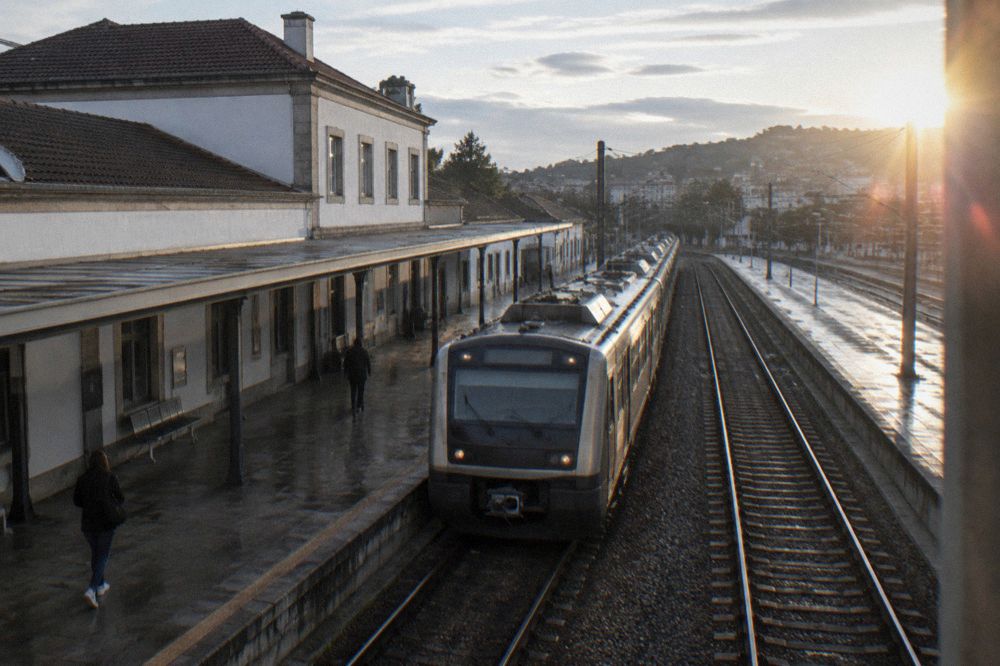
All three cities sit on Portugal's northern rail and motorway network, but Braga and Aveiro are the train destinations while Viana do Castelo is the one most easily reached by coach. Braga's urban train from Porto runs on a timetable valid since 26 July 2026, and the Siga card needed for CP urban tickets costs 0.50 EUR.
The rail geography is the decisive fact. Braga is the terminus of CP's urban line from Porto São Bento via Campanhã, with the first departure of the day at 06:05 and the last arriving in Braga at 01:55, a little over an hour from Porto. The urban Porto to Braga fare is priced by zone, so check the CP price table rather than trusting a blog figure. Long-distance Alfa Pendular services connect Lisbon to Braga directly, with the 2026 full single fare at 38.50 EUR in second class and 54.60 EUR in first, and the Porto to Braga leg at 17.00 EUR in second class. From Porto Airport, the Getbus coach runs direct to Braga bus station from 9.00 EUR in about 45 minutes, with departures listed through the day.
Aveiro sits on the main Lisbon to Porto line, which makes it the simplest rail stop of the three for anyone travelling along the coast. Viana do Castelo also has a station on the Minho line north of Porto, though many travellers prefer the faster coach connections.
| Journey | Best mode | Verified detail |
|---|---|---|
| Porto to Braga | CP urban train | Timetable valid since 26 July 2026; Siga card 0.50 EUR; fare priced by zone |
| Porto Airport to Braga | Getbus direct coach | From 9.00 EUR, about 45 minutes, daily |
| Lisbon to Braga | Alfa Pendular direct | 38.50 EUR second class, 54.60 EUR first class, 2026 fares |
| Braga within the city | TUB bus | Tourist ticket 3.35 EUR for 1 day, whole network |
| Braga to Bom Jesus | TUB Line 2, then shuttle | Line 2 ends at the Pórtico; funicular out of service, replacement shuttle every day |
The step-by-step versions, including the airport transfer and the Bom Jesus leg, are on the Porto to Braga, Porto Airport to Braga and how to get to Bom Jesus do Monte pages, and getting around the city itself is covered in the getting around Braga guide.
Which City Is Best For Food And Wine?
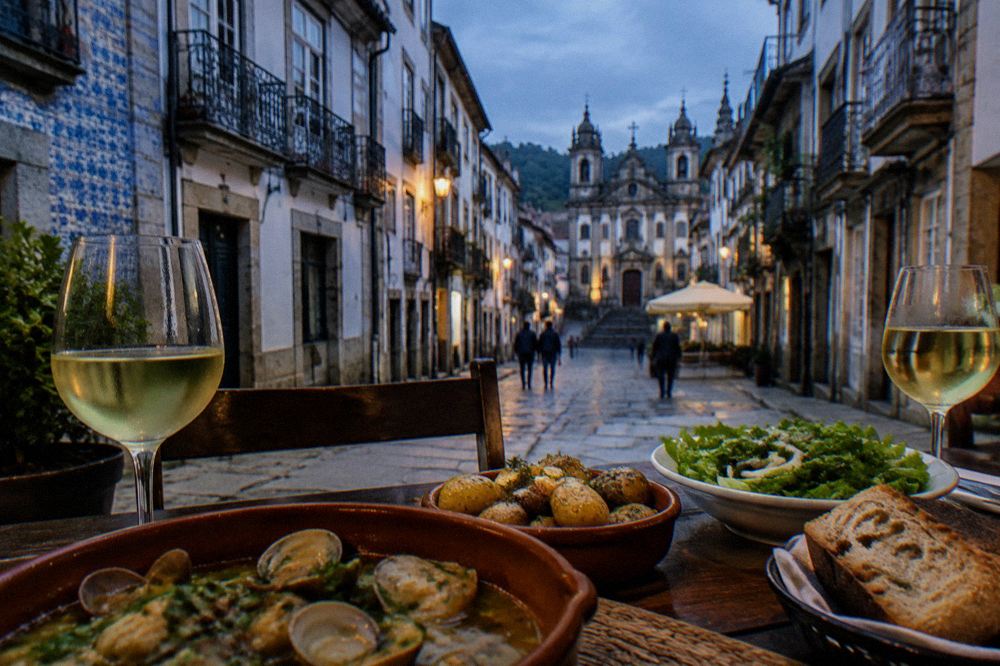
Braga is the strongest food city of the three for a full evening out, with a restaurant scene built on Minho cooking, its own cod dish, bacalhau à Braga, and the crème-caramel pudding created at nearby Tibães, pudim Abade de Priscos, all washed down with the region's Vinho Verde. Aveiro's table is the lagoon's: fish, salt-cod traditions and the ovos moles sweets made from egg yolks and sugar. Viana do Castelo leans on Atlantic fish and shellfish, with the river and the sea both in the market.
The difference is between a restaurant city and two towns with good lunches. Braga supports an evening economy: the cafés around Avenida da Liberdade, the restaurants of the historic centre and the pastries, frigideiras included, that the city claims as its own. The what to eat in Braga and Braga restaurants guides cover the detail, and the Vinho Verde guide explains the region's light, young wines, which pour everywhere in the Minho and rarely on the coast south of Porto.
Aveiro's ovos moles are the single most famous food item of the three cities, a sweet of candied egg yolk in a wheat casing shaped like shells or fish, protected by name and sold all over the old town. Viana do Castelo's cooking is less about one item and more about raw material: the fish market, the shellfish and the river fish, plus the same Vinho Verde pouring to the south. If food is the point of the trip, stay in Braga and day-trip to the others.
Can You Combine Braga With Aveiro Or Viana Do Castelo In One Trip?
Yes, and the pairing that works best is Braga with Viana do Castelo, since both sit in the north, making a two-base Minho trip straightforward. Aveiro pairs less naturally with Braga because it lies south of Porto on the coast, so it fits better as a stop on a Porto to Lisbon itinerary than as a second base for the Minho.
A practical shape is two or three nights in Braga with a Viana day trip, and Aveiro saved for a separate coastal itinerary. The geography decides this. Aveiro sits over an hour south of Porto by train, on the opposite side of the trip, and forcing it into a Minho itinerary means backtracking through Porto twice. The Aveiro day trip page treats it as what it is: an excursion from Porto or a stop on the way south.
| Trip shape | Cities | Works best when |
|---|---|---|
| Minho two-base | Braga plus Viana do Castelo | You have four or more days and want coast and city |
| Braga base with day trips | Braga, Viana, Guimarães, Gerês | You want one hotel and short hops |
| Coastal route south | Porto, Aveiro, continuing to Lisbon | Your itinerary runs north to south along the coast |
| Porto day trips only | Any of the three from Porto | You have one or two free days in Porto |
For the Braga-based version, the practical pages are the how to get to Braga and where to stay in Braga guides, plus the itineraries for one to three days in the city. A tuk tuk tour on the first morning is a reasonable way to fix the city's geography in your head before you commit to a full walking day.
Which Should You Choose For Your Trip?
Choose Braga if you want a city break with the most depth: the UNESCO sanctuary, a cathedral with three visit routes, a monastery, museums and a food scene, at prices this page can state exactly, from 3.00 EUR cathedral routes to a 3.35 EUR day of buses. Choose Aveiro for one gentle, flat, canal-side day between Porto and points south. Choose Viana do Castelo for coastal scenery and folklore.
If you can only pick one and you enjoy architecture and food more than beaches, Braga is the choice this site exists to argue for. The best version of a Viana visit falls in August during the Senhora d'Agonia festival, or on a quieter spring week. That recommendation is not neutral, and it should not pretend to be. Braga Travel Guide covers this city because it rewards the longest stay of the three. But the honest version of the comparison is that the three cities do different jobs, and a trip that includes all three, in the order Porto, Aveiro, then north to Braga and Viana do Castelo, is entirely realistic in a week with a car or a willingness to use the trains and coaches.
If the choice comes down to a single day from Porto, the walking options below cover the historic centre efficiently, and the private, flexible version suits families and anyone who wants to set their own pace.
For a slower, self-directed visit, the flexible historic-centre walk lets you linger where the guided versions move on.
Common Questions About Braga, Aveiro And Viana Do Castelo
Is Braga better than Aveiro?
They serve different trips. Braga offers a dense historic centre, the UNESCO-listed Bom Jesus do Monte sanctuary, a cathedral with three visit routes and a full restaurant scene, and comfortably fills two or three days. Aveiro is a flatter, smaller canal town best suited to a relaxed half-day or one day, often combined with a beach visit. If you want depth and architecture, choose Braga; if you want lagoon light and a short stop between Porto and points south, choose Aveiro.
Is Braga better than Viana do Castelo?
Braga has more sights per day: the sanctuary, the Sé de Braga, the Tibães monastery and several museums, with verified entry prices from 3.00 EUR per cathedral route. Viana do Castelo counters with a coastal setting, the basilica on Monte de Santa Luzia and one of Portugal's most famous festivals, the Romaria da Senhora d'Agonia in August. Choose Braga for a city break, Viana for the coast, or combine them.
Can you visit Braga, Aveiro and Viana do Castelo in one trip?
Yes, in about a week. The natural order is Porto first, Aveiro as a stop south of it, then north to Braga for two or three nights, and Viana do Castelo either as a day trip from Braga or as a final night on the coast. Aveiro pairs least naturally with Braga because it lies on the far side of Porto, so treat it as a coastal-itinerary stop rather than part of a Minho loop.
Which of the three cities is cheapest to visit?
This page can only answer for Braga, where the verified prices are low: 3.00 EUR per cathedral route with all three at 7.00 EUR, the Biscainhos museum at 7.50 EUR, the D. Diogo de Sousa museum at 5.00 EUR, free grounds at Bom Jesus do Monte and a 3.35 EUR whole-network bus day ticket. Add the municipal tourist tax of 1.55 EUR per person per night, up to four nights. For Aveiro and Viana do Castelo, check each operator's own listing, since no verified price list for those cities appears here.
Do you need a car to visit Braga, Aveiro and Viana do Castelo?
No. All three are reachable by train or coach from Porto, Braga and Aveiro are straightforward rail destinations. Within Braga the TUB network, including Line 2 to the Bom Jesus Pórtico, covers the visitor's ground, and the tourist day ticket costs 3.35 EUR. A car helps only if you want to thread in the Gerês national park or the Lima valley villages between the cities.
Which city has the best weather?
All three share northern Portugal's pattern, and Braga's is the one with verified numbers: IPMA's 1991 to 2020 normals for the Braga / Merelim station show July as the driest month at 27.9 mm of rain and October as the wettest at 197.8 mm, with mean summer maxima around 28 degrees. The coast is windier and more humid, so Braga runs hotter in summer and colder on winter nights than either coastal city. May, June and September are the comfortable months everywhere.
The short version: pick Braga for the churches and the food, Aveiro for the canals and an easy afternoon, and Viana do Castelo for the coast and its costumes, and if the trip allows it, see all three in the order that geography suggests.