Arco Da Porta Nova In Braga: The City's Famous Gate
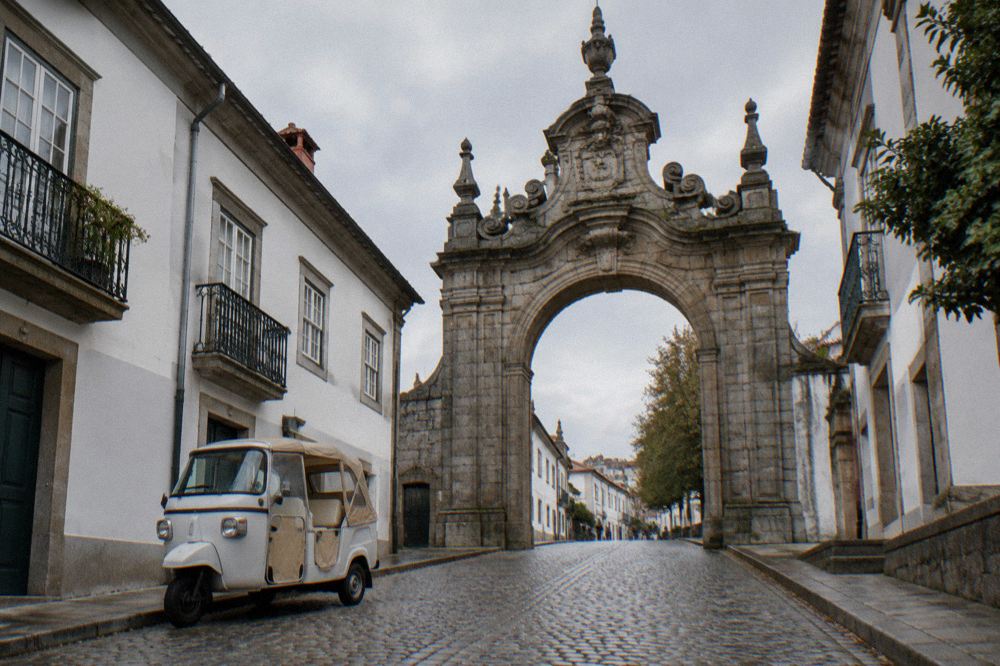
The Arco da Porta Nova is the ceremonial gateway into Braga's historic centre, the arch every visitor walks under between the modern city on Avenida da Liberdade and the baroque streets around the Sé de Braga.
Short answer
The Arco da Porta Nova is a free, always-accessible stone city gate in Braga, Portugal, marking the entrance to the pedestrianised historic centre. You reach it on foot from Avenida da Liberdade or by TUB bus, and it sits among the Museu da Imagem, the Jardim de Santa Bárbara and the streets leading down to the cathedral.
The Arco da Porta Nova is the stone gateway that every visitor to Braga, the city in the Minho region of northern Portugal, ends up walking through at least once. It stands where the modern avenue meets the pedestrianised old town: on one side the cafés and shopfronts of Avenida da Liberdade, on the other the baroque streets that tumble downhill towards the Sé de Braga. The arch costs nothing to see, needs no ticket and never closes, which makes it less a sight you visit than a sight you pass through, again and again, for as long as you stay in the city. This guide from Braga Travel Guide covers what the gate is, how to reach it, and what to build around it.
What Is The Arco Da Porta Nova In Braga?
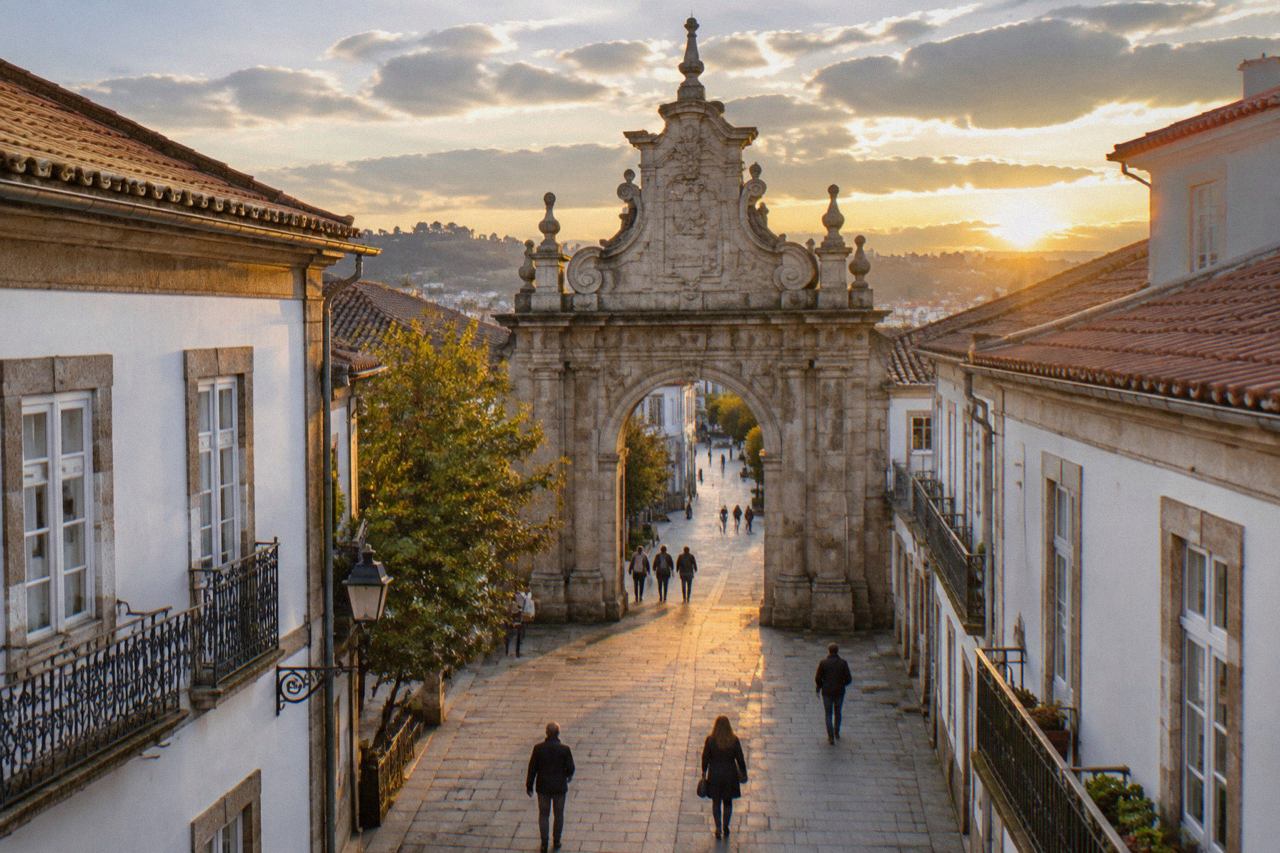
The Arco da Porta Nova is Braga's best-known surviving city gate, a freestanding stone arch that once formed part of the medieval walls and today marks the symbolic boundary between the modern city and the pedestrianised historic centre. It is a public monument in the open street: no ticket, no queue, no opening hours, and it is the point through which almost every walking route into the old town begins.
Braga was a walled city, and like most walled cities it grew through gates rather than around them. The Arco da Porta Nova is the gate that gives the adjacent street and the whole quarter their name, and its survival into a pedestrianised shopping street is precisely why it photographs so well today: no traffic passes under it, only people. Its decorative stone work, with its carved details and crowning ornament, is what makes it more than a gap in a wall, and it is the single most repeated image of Braga on travel sites after the Bom Jesus stairway.
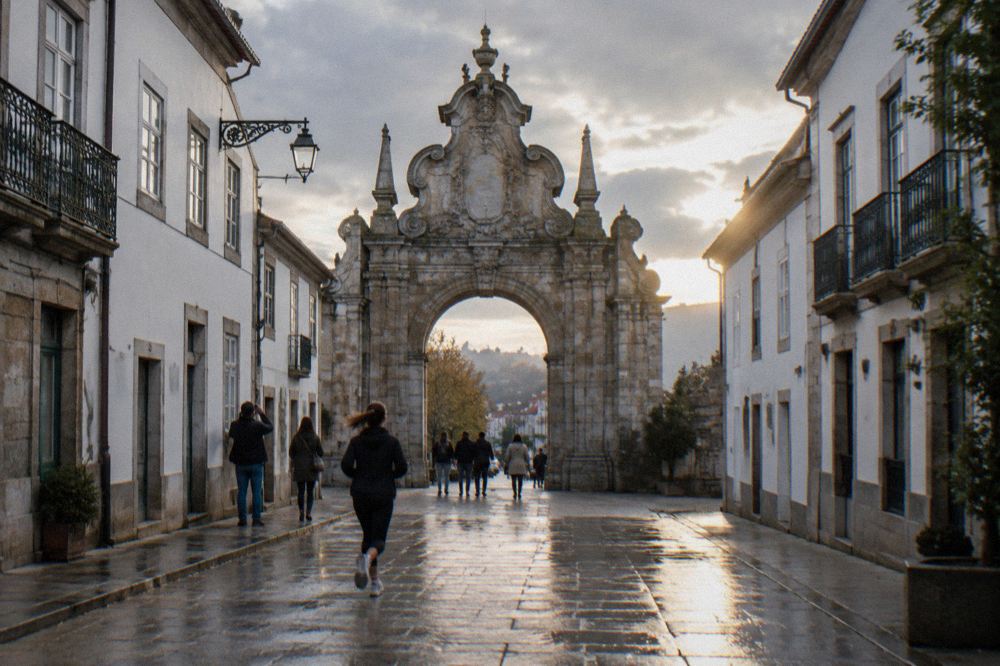
The arch works as an orientation tool as much as an attraction. Stand under it facing uphill and you are looking at Avenida da Liberdade, the tree-lined avenue where the municipal tourist office sits at number 1. Face downhill and you are looking into the old town, with the Museu da Imagem close by and the streets of the historic centre running down towards the cathedral. Learn the arch first and the rest of the city arranges itself around it.
It also happens to be sitting next to one of Braga's newest cultural reopenings. The Museu da Imagem, which had been closed for around seven years of rehabilitation works, reopened in early September 2026 near the Arco da Porta Nova, in time for the Noite Branca festival. The full story is on our dedicated museum of image page, but the short version is that the gate now has a serious cultural neighbour again after years of hoardings.
Where Is The Arco Da Porta Nova And How Do You Get There?
The Arco da Porta Nova stands at the top of Braga's historic centre, where the pedestrian streets begin at the lower end of Avenida da Liberdade. The municipal tourist office is on that same avenue at number 1, open Monday to Friday 09:00 to 18:30, and the arch is on every TUB urban bus route that serves the city centre, with an on-board single ticket at 1.55 EUR for one zone.
Arriving by train, you come into Braga's station and walk into the centre from there; the arch is the natural first landmark to aim for, since the avenue leads to it and the old town starts at it. Arriving by long-distance coach, the bus station's own urban connections and the TUB network take over from there. The TUB tariff, in force since 21 February 2026, is simple enough to plan around, and the tourist tickets are the best value for a day of sightseeing.
| TUB ticket type | 1 zone | 2 zones |
|---|---|---|
| Bought on board | 1.55 EUR | 2.00 EUR |
| Pre-bought or digital | 0.75 EUR | 1.50 EUR |
| TUB tourist ticket | Price per person |
|---|---|
| 1 day, whole network | 3.35 EUR |
| 2 days | 6.05 EUR |
| 3 days | 8.05 EUR |
The tourist card itself costs 1.50 EUR on top, and transfers are valid for one hour on a one-zone ticket and one and a half hours on two zones. If you are doing a full day that takes in the historic centre, the Bom Jesus hill and a museum or two, the day ticket pays for itself quickly; if you are only making one or two rides, the pre-bought single at 0.75 EUR is the cheapest way to move. The full network detail, including the Line 2 service to Bom Jesus, is on this site's companion pages.
For most visitors, though, the honest answer is that you walk. The arch sits inside the pedestrian zone, so no bus passes under it and no car park sits beside it; every route finishes on foot, which is part of the pleasure. The city's parking and access options are covered in detail elsewhere on this site, and the practical rule is simple: park or step off public transport at the edge of the centre and let the arch be your front door.
A guided walk is the other way in, and the one that turns the gate from a photo stop into a story. The Braga Small-Group Walking Tour & Bom Jesus starts from the city's streets and covers the historic centre before heading up to the sanctuary hill, rated 5 from 10 reviews and from $66.85 per person for three hours. Check availability if that structure appeals.
Curious to hear the stories behind the old gate? Book a free walking tour here. (Guided in Spanish)
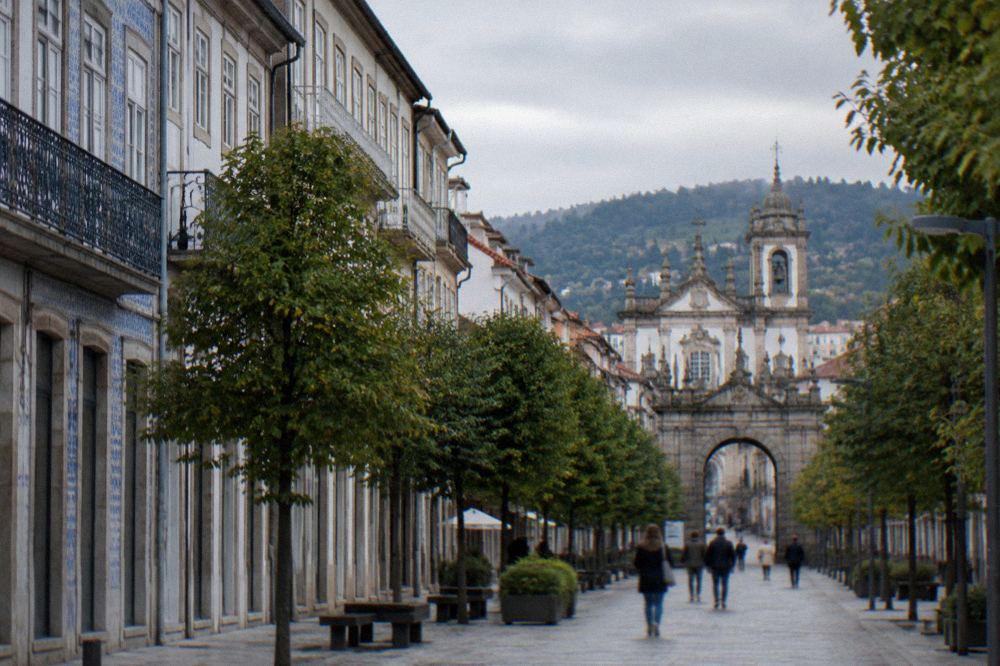
What Can You See Around The Arco Da Porta Nova?
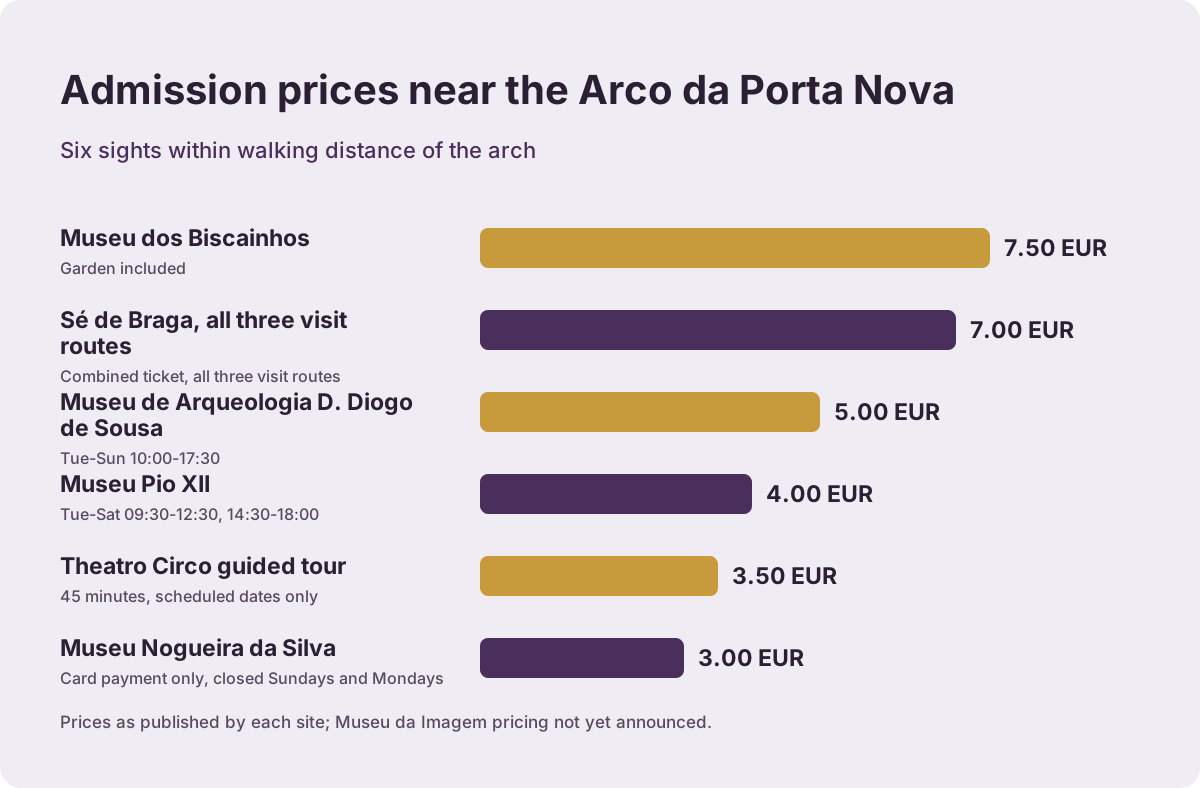
Within the streets immediately around the Arco da Porta Nova you find the reopened Museu da Imagem, the Jardim de Santa Bárbara with its seasonal flower beds, the Museu Nogueira da Silva at 3 EUR, and the upper reaches of the historic centre running downhill towards the Sé de Braga, whose three-route combined ticket costs 7.00 EUR. The arch is not an isolated monument but the hinge of the densest sightseeing cluster in the city.
Start with the garden. The Jardim de Santa Bárbara, covered in our Santa Bárbara Garden guide, sits in the quarter by the arch, a small formal garden that the municipality replants through the year and that serves as the green room of the old town. From there the options fan out in every direction, and the table below is an honest summary of what each one costs and when it is open, all read from the operators' own pages.
| Sight near the Arco da Porta Nova | Admission | Hours as published |
|---|---|---|
| Sé de Braga, all three visit routes combined | 7.00 EUR | Visits Mon-Sat 09:30-13:00, 14:30-17:00; Sun 09:30-10:45, 14:30-17:00 |
| Museu dos Biscainhos, garden included | 7.50 EUR | Tue-Sun 10:00-12:30, 14:00-17:30 |
| Museu de Arqueologia D. Diogo de Sousa | 5.00 EUR | Tue-Sun 10:00-17:30 |
| Museu Pio XII, whole museum | 4.00 EUR | Tue-Sat 09:30-12:30, 14:30-18:00 |
| Museu Nogueira da Silva | 3.00 EUR | Closed Sundays, Mondays and public holidays; card payment only |
| Theatro Circo guided tour, 45 minutes | 3.50 EUR | Scheduled dates only, Portuguese and English |
Two warnings that matter. First, the cathedral: visits to the interior are suspended during services, tickets are bought at the reception point in the cloister with access from Rua do Cabido or the side entrance by Rua D. Diogo de Sousa, and the building itself opens earlier than the visit hours for worship. The Treasury-Museum is closed on Mondays. Our Braga Cathedral guide carries the full detail. Second, the Museu Nogueira da Silva takes card payment only, which catches out visitors carrying only cash, a small thing worth knowing before you set out.
The arch's own immediate neighbour, the Museu da Imagem, reopened in early September 2026 after its long closure, with free entry during the Noite Branca weekend that marked its return. Its regular schedule and pricing had not been published in the sources this site could verify, so check the museum's own notice before planning a visit around it. The pattern of the quarter, though, is clear: one gate, one garden, half a dozen museums and the cathedral, all within the same walkable bowl of streets.
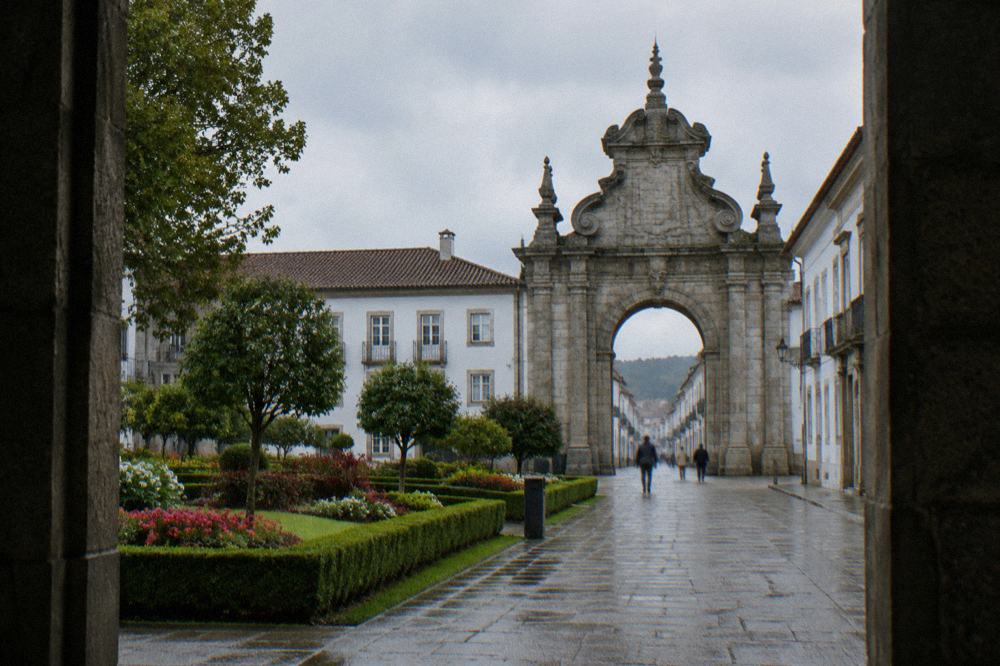
How Does The Arco Fit Into A Walking Route Through Braga?
A sensible route runs downhill: start at the Arco da Porta Nova, walk the pedestrian streets towards the Sé de Braga, visit the cathedral with the 7.00 EUR combined ticket, then continue to the Roman Baths of Alto da Cividade before looping back uphill through the Jardim de Santa Bárbara. The arch is the natural start and finish point because every street of the historic centre is organized around it.
Downhill first, while your legs are fresh. The pedestrian streets that begin at the arch, including the Rua do Souto shopping spine, carry you through the heart of the old town, and the cathedral sits at the bottom of the slope as the reward. Our things to do in Braga page breaks the full walk down stop by stop, including the smaller churches and squares that most visitors rush past.
From the cathedral quarter, the Roman remains extend the story backwards. The Roman Baths at Alto da Cividade belong to the same Bracara Augusta whose street plan still shapes the centre, and they pair naturally with the Museu de Arqueologia D. Diogo de Sousa, whose collection exists to explain exactly that layer of the city. The museum's 5.00 EUR ticket, with half price for over-65s, ages 13 to 24 and families, and free entry for under-12s with an adult, makes it one of the more generous state museums in northern Portugal.
Uphill, the loop closes through the garden and back to the arch. If your day has room for the hill sanctuaries, the Bom Jesus do Monte complex is the big excursion, and one standing fact changes how you plan it: the funicular has been out of service since 26 September 2026, with no end date published, and a replacement shuttle runs every day from 09:00 to 20:00, roughly every 30 minutes each way, between the Portico, where TUB Line 2 ends, and the sanctuary. The stairway itself is 566 steps by the Confraria's own count, 615 metres long with 116 metres of ascent, and the sanctuary grounds and basilica carry no admission charge.
A guided version of this exact shape exists. The small-group walking tour pairs the historic centre with the Bom Jesus sanctuary in three hours, which is enough to see both without rushing either, and it removes the guesswork from the shuttle-and-steps logistics on the hill. For a fuller comparison of the city's guided options, this site's walking tours overview sits alongside the itineraries section.
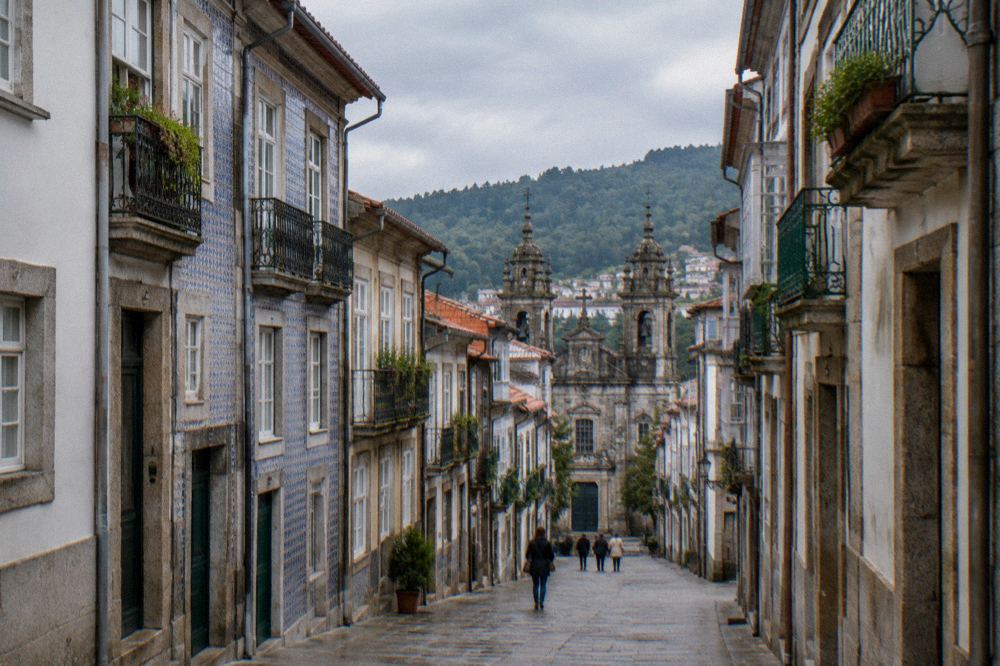
What Are The Best Times To Photograph The Arco Da Porta Nova?
The arch faces onto a pedestrian street and a tree-lined avenue, so the practical photography windows are early morning, when the avenue is quiet and the light is low and warm, and late afternoon into the evening, when the cafés fill and the stone takes on colour. IPMA's 1991 to 2020 normals for the Braga / Merelim station show July and August as the warmest months, with mean maxima of 28.2 and 28.7 C and only 4 and 3.8 rain days of 1 mm or more.
Because the arch is in a pedestrian zone, the crowd is the crowd: there is no early-access ticket and no quiet weekday trick that empties the street. What you can control is the light and the weather, and Braga's climate is generous with both for most of the year. The table below is the verified station data, and it rewards reading properly rather than skimming.
| Month | Mean max C | Mean min C | Rain mm | Days with 1 mm or more |
|---|---|---|---|---|
| January | 14.1 | 3.1 | 179.5 | 13.1 |
| April | 19.6 | 7.8 | 127.9 | 12.0 |
| July | 28.2 | 14.3 | 27.9 | 4.0 |
| October | 22.2 | 10.1 | 197.8 | 12.0 |
Two facts from that data surprise people. October, not a winter month, is the wettest month on average in Braga at 197.8 mm, wetter even than December's 190.3 mm, so an autumn visit needs a rain plan more than a summer one does. And September is warmer at the top end than June, 26.9 C against 26.1 C mean maximum, while also being wetter, which makes early autumn a genuinely good photography season: warm stone, long evenings, and a festival city, since Noite Branca ran across the first weekend of September 2026 and the Encontros da Imagem photography festival ran from 18 September to 1 November 2026.
For the arch specifically, the practical advice is to shoot it from the avenue side in the morning, when the pedestrian street behind is still empty, and from the old-town side in the evening, when the cafés spill out and the stone reads warm. This site's viewpoints and photo spots coverage places the arch in the wider set of angles worth carrying a camera for, from the Monte do Picoto summit to the garden squares of the centre.
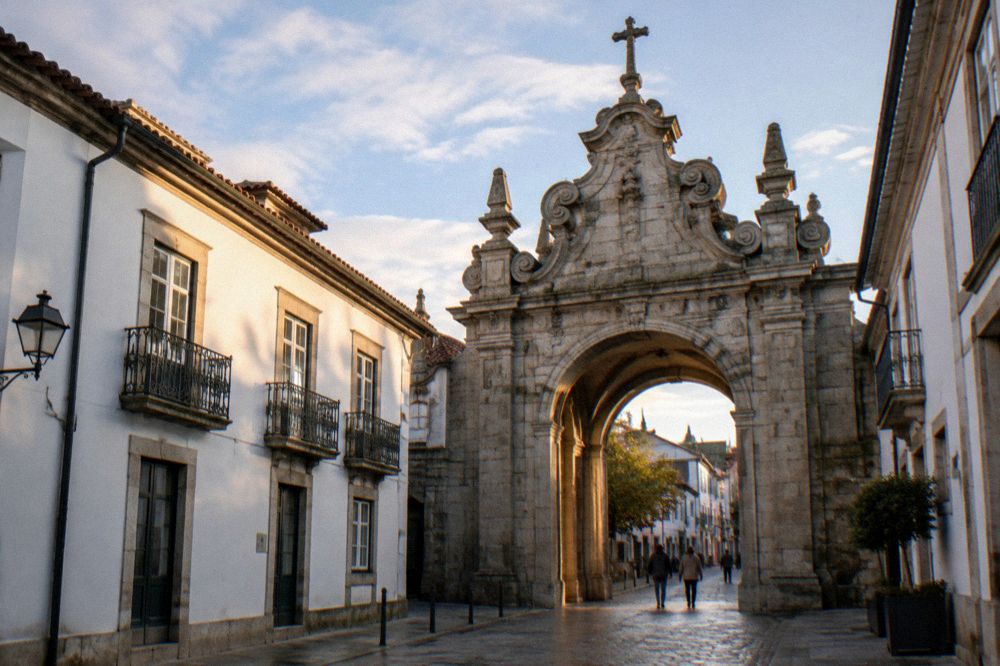
Is The Arco Da Porta Nova Free To Visit?
Yes, the Arco da Porta Nova is completely free: it is a public monument standing in an open pedestrian street, with no ticket, no gate, no queue and no opening hours of its own, so you can walk under it at any hour of the day or night. The only costs in the quarter are the museums and the cathedral around it, and no city-wide attraction pass is currently on sale in Braga, so each ticket is bought separately.
That last point deserves emphasis because it is the opposite of what many Portugal guides imply. The one genuinely multi-use product is the TUB tourist ticket, at 3.35 EUR for one day of unlimited urban bus travel, which matters if you are combining the arch and the old town with the Bom Jesus hill or the Sameiro sanctuary on the same day.
What the free-and-paid split looks like in practice:
| Experience in the arch's quarter | Cost |
|---|---|
| Walking under the Arco da Porta Nova | Free |
| Jardim de Santa Bárbara | Free |
| Sé de Braga, single visit route | 3.00 EUR |
| Sé de Braga, any two routes | 6.00 EUR |
| Sé de Braga, all three routes | 7.00 EUR |
| TUB tourist day ticket, whole network | 3.35 EUR |
The cathedral's pricing deserves a second look because it is unusual. Each of the three visit routes costs 3.00 EUR on its own, any two cost 6.00 EUR, and all three cost 7.00 EUR, so the jump from two routes to three is only 1.00 EUR. Most visitors who have come this far into a religious city will want the third route. The detail on what each route contains, the Treasury-Museum, the funerary chapels and high choir, and the cathedral itself, is on the Braga Cathedral page.
Beyond the quarter, the free list extends further than many visitors expect. The Sameiro sanctuary precinct is open 24 hours a day, seven days a week, free, and the Bom Jesus sanctuary grounds and basilica carry no entry charge either, with only the funicular, the high choir and bell tower, the lake boats and parking priced on the hill. A full free-day plan exists on this site's free things to do pages, and the arch is its natural starting point.
What Is Near The Arco For Food, Drink And Shopping?
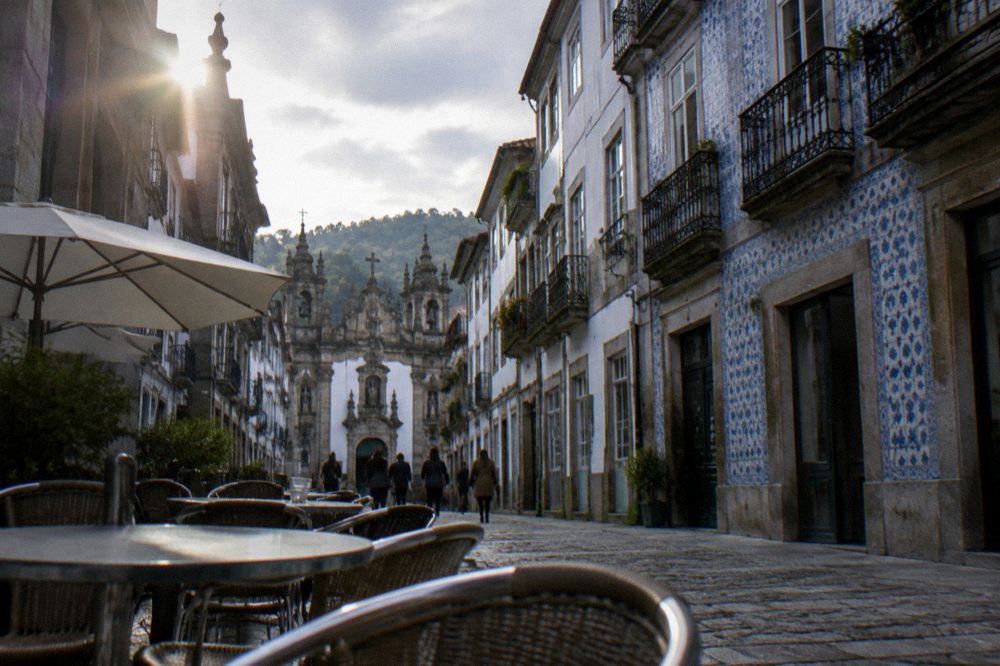
The streets on both sides of the Arco da Porta Nova hold the densest concentration of cafés, pastry shops and retail in Braga: the Avenida da Liberdade side carries the avenue's café terraces and the tourist office at number 1, while the old-town side runs into the pedestrian shopping streets where the city's pastelarias and tasca-style restaurants sit alongside the high-street brands. The arch is, functionally, the front door of Braga's eating and shopping district.
The old town's food identity is its own subject, covered in depth on this site's eating pages, but the geography matters here: everything in it starts at the gate. The pedestrian streets that run downhill from the arch hold the bakeries selling the city's named sweets, the frigideiras and the convent-style puddings that Braga is known for, and the restaurants serving the region's cod dishes and Minho wines. A food-led walk of the centre begins exactly where the arch stands.
For a sit-down version of the same idea, the Braga Small-Group Food Tour: Taste Real Portugal with Local Guide runs three hours of tastings with a local guide, rated 5 from 5 reviews, with the price on the operator's live listing. It is a different product from the walking-and-Bom-Jesus tour, and the two serve different days: one for the sights, one for the table.
Shopping around the arch splits into two registers. The avenue side carries the newer retail, while the old-town side mixes chain stores with older family businesses, and the Thursday market tradition of the wider Minho region, including the famous Barcelos market, sits within day-trip range for visitors who want the full regional version. This site's shopping coverage and the day-trips section carry the detail.
One practical note on money: Portugal's official tourism guidance states that service is included in restaurant bills, though leaving an additional tip of about 5 to 10 percent is customary, and the same guidance applies to taxi drivers. Braga also levies a municipal tourist tax of 1.55 EUR per person per night, for up to four nights, charged all year by hotels and local accommodation, a small line to expect on your bill that has nothing to do with the arch but everything to do with the visit.
Should You Visit The Arco With A Tour Or On Your Own?
On your own is enough for the arch itself, since it is a free public gate you will pass regardless, but a tour adds value for what surrounds it: the small-group walking tour covers the historic centre and Bom Jesus in three hours from $66.85, the private tour with a professional guide runs two hours from $259.43, and the tuk tuk city tour covers the centre in 30 minutes to two hours from $22.66, so the choice is about depth and mobility rather than the gate.
The self-guided option is genuinely good in Braga. The centre is compact, pedestrianised and signposted, the tourist office on Avenida da Liberdade 1 is open Monday to Friday 09:00 to 18:30 and on weekends and holidays 09:30 to 13:00 and 14:00 to 17:30, and the Braga Self-Guided City Walking Tour & Scavenger Hunt turns the same streets into a two-hour game for from $5.78 per person, rated 5 from 22 reviews. For families and for visitors who like a structure to their wandering, it is the cheapest guided product in the city.
The guided options earn their price on the hill and in the churches. A guide who can explain what the cathedral's three routes contain, what the Bom Jesus stairway's chapels depict and how the shuttle is running on the day removes the three things visitors most often get wrong in Braga. The free GuruWalk tours are a third path: The Essential Free Tour of Braga (guided in Spanish), a tip-based two-hour walk rated 4.58 from 586 reviews, covers the centre with a guru, and it costs nothing but the tip you choose to leave.
The private option deserves its own word, because it is the one product that reshapes the day entirely. With a professional guide to yourself for two hours, the route bends around what you care about, whether that is the baroque churches, the Roman layer or the food streets, and the questions get answered at the pace you want them answered. It is the most expensive way in, and for some visitors it is the best value of all.
Whichever way you go, the arch is where you will start, because every version of Braga begins at the same gate: the free stone archway between the avenue and the old town, with the garden on one side, the reopened museum beside it, and the whole baroque city running downhill from its shadow.
Common Questions About The Arco Da Porta Nova
Is the Arco da Porta Nova free to visit?
Yes. The arch is a public monument standing in an open pedestrian street in Braga, Portugal, with no ticket, no gate and no opening hours of its own. You can walk under it at any time of day or night at no cost.
Where is the Arco da Porta Nova located?
The arch stands at the top of Braga's historic centre, where the pedestrianised old town begins at the lower end of Avenida da Liberdade. The municipal tourist office is on the same avenue at number 1, open Monday to Friday 09:00 to 18:30 and on weekends and holidays 09:30 to 13:00 and 14:00 to 17:30.
How do I get to the Arco da Porta Nova by public transport?
TUB urban buses serve the city centre, with an on-board single ticket at 1.55 EUR for one zone and 2.00 EUR for two zones, or 0.75 EUR and 1.50 EUR pre-bought or digital. A whole-network tourist day ticket costs 3.35 EUR. The arch itself sits inside the pedestrian zone, so every route finishes on foot.
What is there to see near the Arco da Porta Nova?
The Jardim de Santa Bárbara, the reopened Museu da Imagem, the Museu Nogueira da Silva at 3 EUR, and the pedestrian streets running downhill to the Sé de Braga, whose combined three-route ticket costs 7.00 EUR. The Museu de Arqueologia D. Diogo de Sousa at 5 EUR and the Roman Baths of Alto da Cividade extend the walk.
Is the Arco da Porta Nova accessible for wheelchairs and pushchairs?
The arch stands in a pedestrianised street, so there are no steps at the gate itself and the ground around it is level with the avenue. The surrounding old-town streets run downhill towards the cathedral, and the paving is a mix of cobbles and smoother surfaces, so accessibility depends more on the route you choose beyond the arch than on the arch.
When is the best time of day to photograph the Arco da Porta Nova?
Early morning, when the pedestrian street is quiet and the light is low, or late afternoon and evening, when the cafés fill and the stone reads warm. IPMA's 1991 to 2020 normals for the Braga / Merelim station show July and August as the driest months, with only 4 and 3.8 rain days of 1 mm or more, while October is the wettest month on average at 197.8 mm.