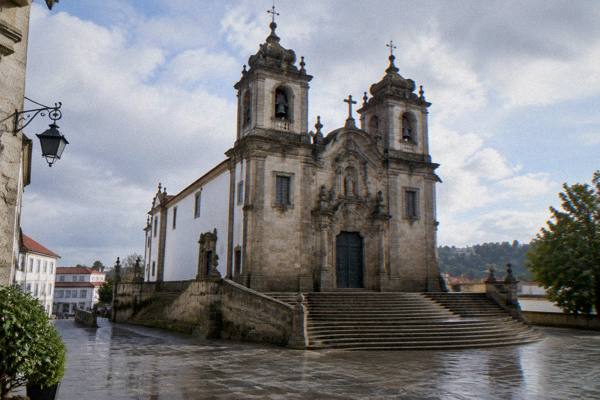
Semana Santa In Braga
Holy Week in Braga is Portugal's most famous Easter celebration: eight days of processions through the historic centre, inscribed on the National Inventory of Intangible Cultural Heritage.
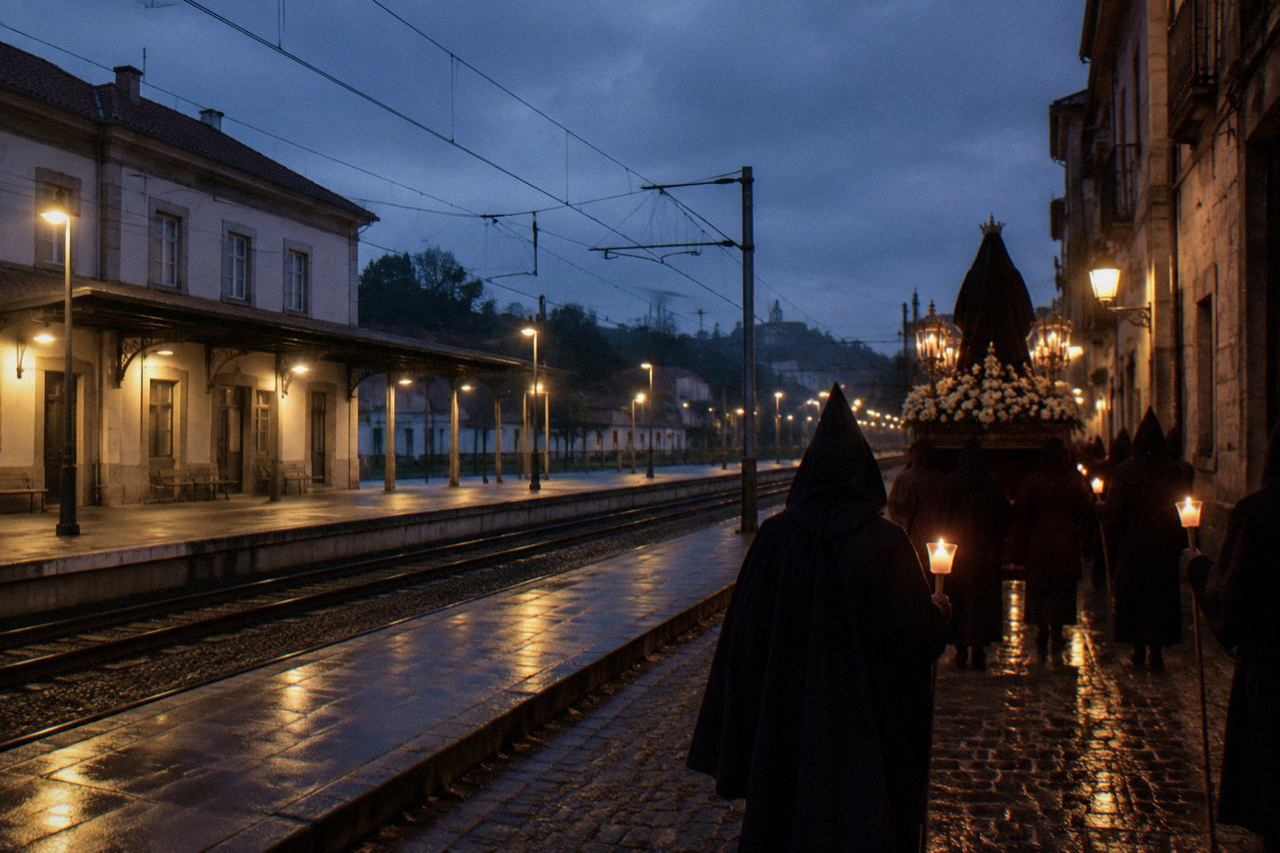
Short answer
Semana Santa de Braga 2026 ran from 29 March to 5 April, with the main processions on Palm Sunday evening and the nights of 1 to 3 April. Holy Week is movable, so the dates shift each year with Easter; the coming edition's dates are published on the organiser's page.
Semana Santa de Braga, the Holy Week celebration in the city of Braga in northern Portugal's Minho region, is the country's most storied Easter tradition. Organised by the Comissão da Quaresma e Solenidades da Semana Santa de Braga together with the cathedral chapter, the brotherhoods, the Santa Casa da Misericórdia and the municipality, it fills the historic centre with processions, barefoot penitents, candlelit streets and church music for the eight days before Easter. The celebration is registered in Portugal's National Inventory of Intangible Cultural Heritage and has been declared of Interest for Tourism by Turismo de Portugal.
What Is Semana Santa In Braga?
Semana Santa in Braga is the city's Holy Week, an eight-day cycle of religious processions and ceremonies that runs from Palm Sunday to Easter Sunday, organised by a dedicated Lenten commission with the cathedral chapter and the municipal brotherhoods. The 2026 edition ran from 29 March to 5 April, and the week is movable, shifting with the date of Easter each year. It is inscribed on Portugal's National Inventory of Intangible Cultural Heritage.
Holy Week here is not a folk festival with a religious theme. It is a liturgical programme, and the processions are acts of worship that happen to pass through public streets. The Comissão da Quaresma e Solenidades da Semana Santa de Braga coordinates the calendar, and the main participating institutions are the Sé de Braga, the city's brotherhoods and confraternities, and the Santa Casa da Misericórdia. The municipality supports the event logistically, closing streets and publishing the official programme.
The week has a rhythm. Palm Sunday opens with the blessing of palms and the Processão dos Passos. Midweek evenings belong to the smaller, darker processions. The nights of Wednesday to Good Friday carry the three most famous events: the Procissão da Burrinha, the Procissão do Ecce Homo and the Procissão do Enterro do Senhor. Easter Saturday is quiet, and Easter Sunday closes the week with the Resurrection procession and, in recent editions, a fireworks celebration at dawn or evening depending on the year's programme.
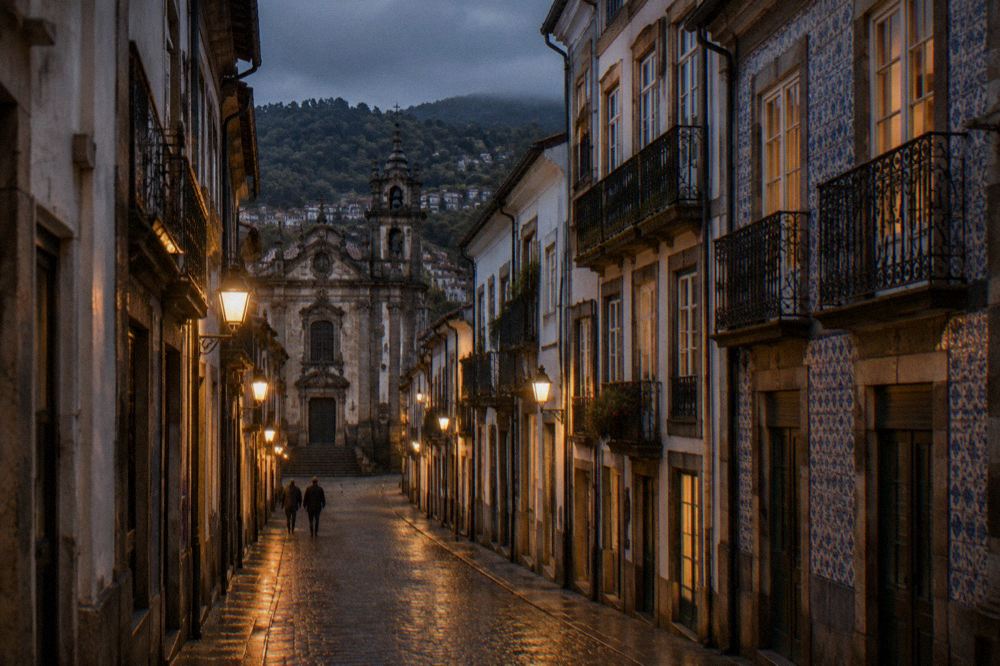
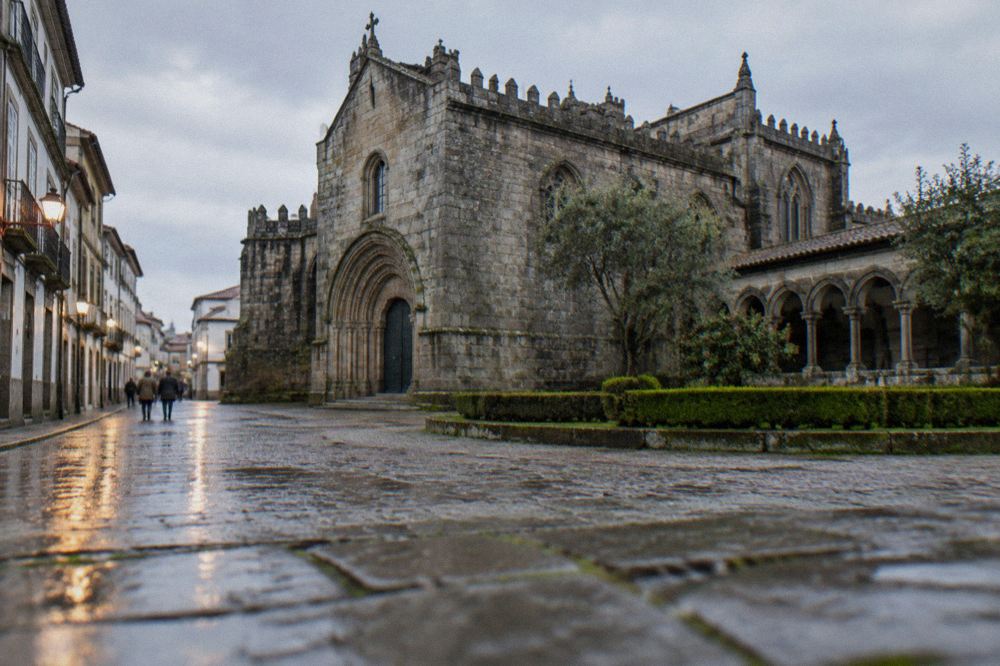
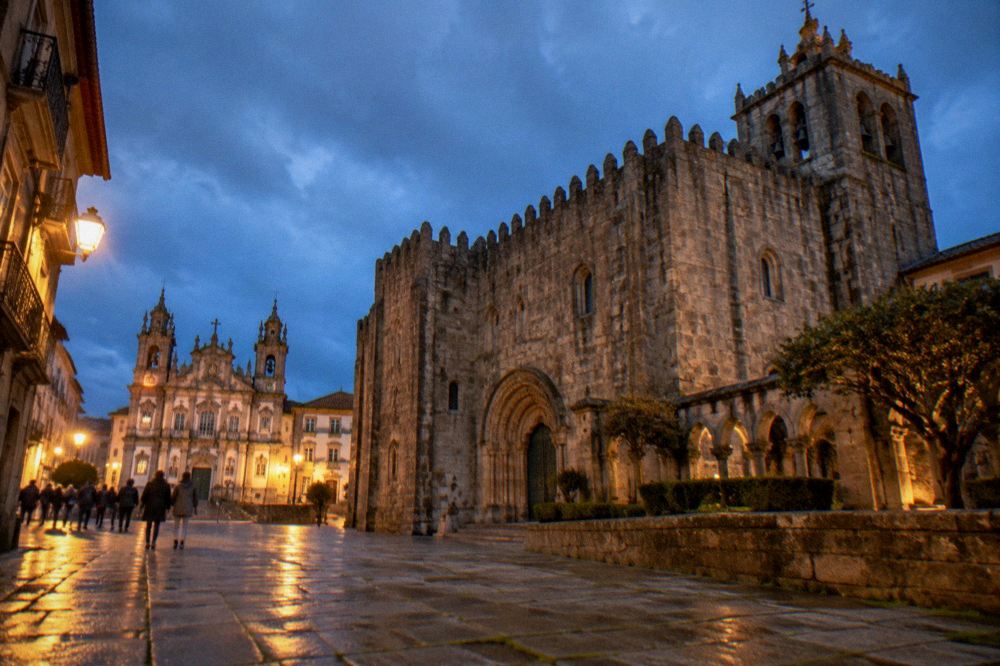
The visual language is distinct and worth understanding before you watch. The farricocos, the barefoot penitents in dark robes with knotted ropes, are unique to Braga's tradition. The andores, the decorated litters bearing religious images, are carried through the streets on the shoulders of members of the brotherhoods. Light matters enormously: several processions are candlelit by design, and the city dims street lighting along the routes. The historic centre around the cathedral, Rua do Souto and the Avenida Central is where almost everything happens.
When Is Semana Santa In Braga And What Are The Dates?
The 2026 edition of Semana Santa de Braga ran from 29 March to 5 April 2026, with the Processão dos Passos on Palm Sunday 29 March at 17:00 and the three great night processions on 1, 2 and 3 April at 21:30. Holy Week is movable and follows the week before Easter, so the dates change every year, and the coming edition's dates are published on the organiser's page.
The fixed anchor is Easter itself. Holy Week is always the seven days before Easter Sunday, so Semana Santa in Braga falls somewhere between mid-March and late April depending on the year. The municipality announces each edition's programme in the weeks before Lent, and the processions keep their traditional slots: Palm Sunday for the palms and the Passos, Wednesday night for the Burrinha, Thursday night for the Ecce Homo, and Friday night for the Enterro.
The 2026 schedule, as published in the municipality's edital, gives the concrete shape of the week:
| Event | Day And Date (2026) | Time |
|---|---|---|
| Blessing of palms and Processão dos Ramos | Sunday 29 March | 11:00 |
| Processão dos Passos | Sunday 29 March | 17:00 |
| Procissão da Burrinha | Wednesday 1 April | 21:30 |
| Procissão do Ecce Homo | Thursday 2 April | 21:30 |
| Procissão do Enterro do Senhor | Friday 3 April | 21:30 |
| Easter Sunday closing celebrations | Sunday 5 April | per programme |
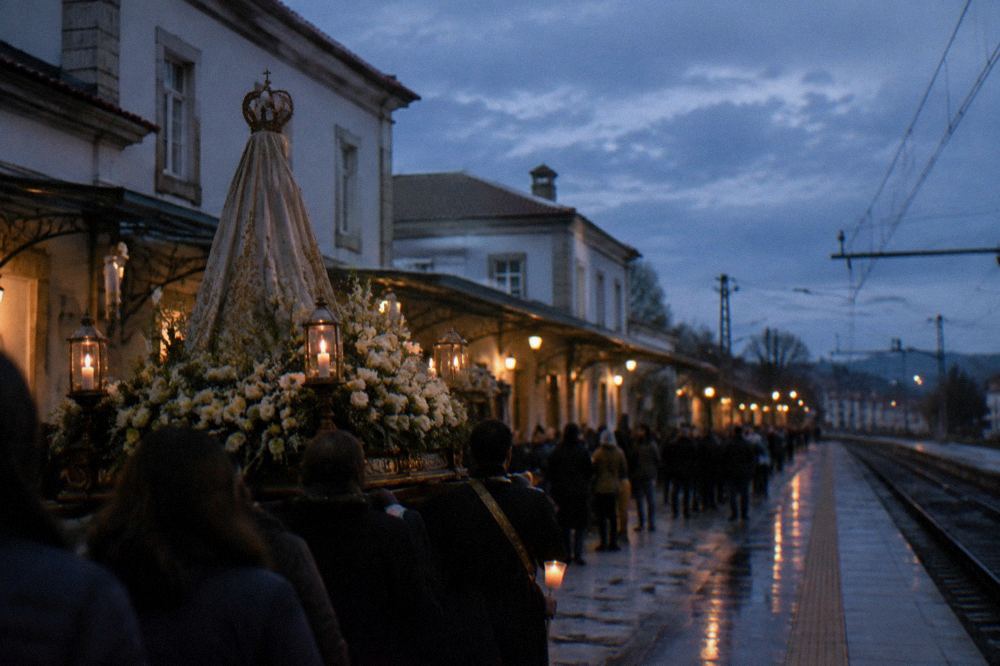
Planning around these times is straightforward once you accept two things. First, the night processions start at 21:30 and can run for two hours or more, so this is a late evening commitment with standing time in cool spring air. Second, the streets along the routes fill well before the start. The Passos on Sunday afternoon is the most family-friendly slot, and the Enterro on Friday night is the most solemn and the most crowded.
If you want the week explained rather than just watched, a guided walk is the efficient way in. The Explore the Portuguese Rome, the City of Braga tour covers the cathedral quarter and the city's religious history in about an hour and a half, which pairs well with an evening procession later the same day. Check availability
To have the week explained rather than just watched, book a free walking tour here. (Guided in English, Spanish and Portuguese)
What Happens At Each Main Procession In Braga?
The Burrinha on Wednesday night is a children's procession with a young rider on a donkey, the Ecce Homo on Thursday night is the most dramatic, with a barefoot penitent bearing the burden of the cross through darkened streets, and the Enterro on Friday night is the solemn funeral procession that closes the week's public worship. All three left at 21:30 in 2026.
The Processão da Burrinha opens the night sequence. Its central figure is a child riding a donkey, re-enacting Christ's entry into Jerusalem, and the mood is gentler than what follows. Crowds are thinner than later in the week, and it is the easiest of the three night processions to watch with small children.
The Procissão do Ecce Homo is the one people describe afterwards. A penitent, traditionally barefoot and bound, carries the burden through the streets while the farricocos walk in file, and the route is deliberately unlit beyond the candles. The silence along the route is part of the event; the municipality asks spectators to stay quiet and the crowd largely does.
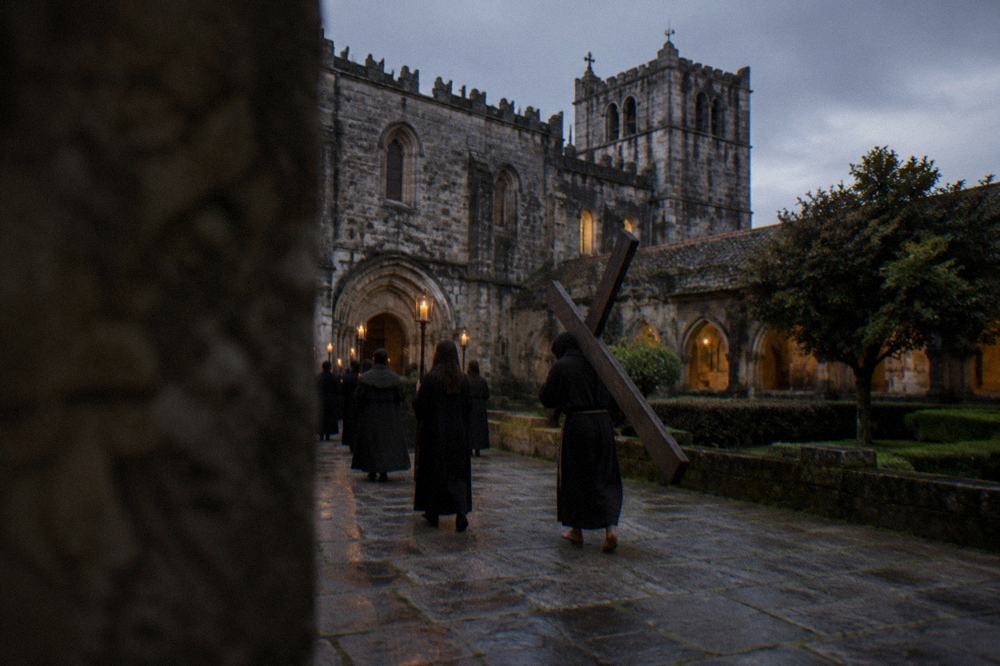
The Procissão do Enterro do Senhor on Good Friday is the funeral of Christ, the most solemn procession of the week, with the decorated litter bearing the dead Christ carried from the cathedral through the centre. Braga slows right down on Good Friday itself: the cathedral suspends tourist visits during services, and many businesses close or shorten hours.
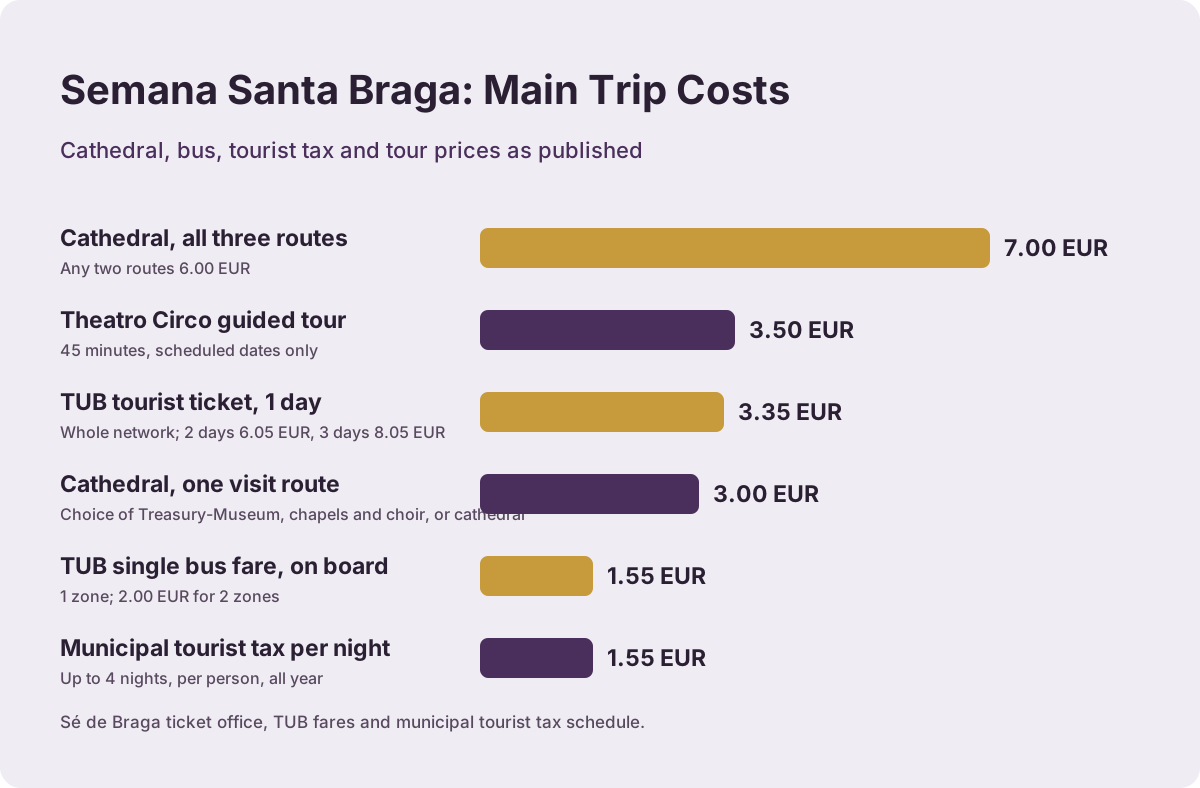
The Sé de Braga is the hub for all of this. During the week the cathedral is primarily a working church, and visits are suspended during services, which during Holy Week are frequent. The cathedral's ticket office lists three visit routes, the Treasury-Museum, the chapels and high choir, and the cathedral itself, at 3.00 EUR each, with any two routes for 6.00 EUR and all three for 7.00 EUR. If you want the interior, plan it before Palm Sunday weekend or after Easter Sunday, and check the cathedral's schedule before going.
A guide also changes how the processions read. On your own, the Burrinha is a charming parade and the Ecce Homo is a striking spectacle; with someone explaining the farricocos, the brotherhoods and the iconography of each andor, the same streets become a text you can follow. That is the difference between watching two hours of candles and understanding what each figure in the column represents.
Where Are The Best Places To Watch The Processions?
The processions start and end at the Sé de Braga, so the cathedral square, the Terreiro da Sé, is the anchor point, while Rua do Souto and the Avenida Central stretch give longer views of the passing columns, and the side streets off Praça da República let you watch from close range without the thickest crowds. Arrive 45 to 60 minutes early for the night processions.
The Terreiro da Sé is where the processions form up and return, so you see the full choreography there: the gathering of the brotherhoods, the exit from the cathedral and the final re-entry. The trade-off is that it is the most crowded spot and the municipality barriers off parts of it.
Rua do Souto, the pedestrian spine of the historic centre, gives you the classic long view: the candlelit column stretching away down the street with the crowd pressed to the barriers on both sides. The Avenida Central section is wider, easier with strollers or wheelchairs, and has café terraces where you can wait seated until the procession arrives.
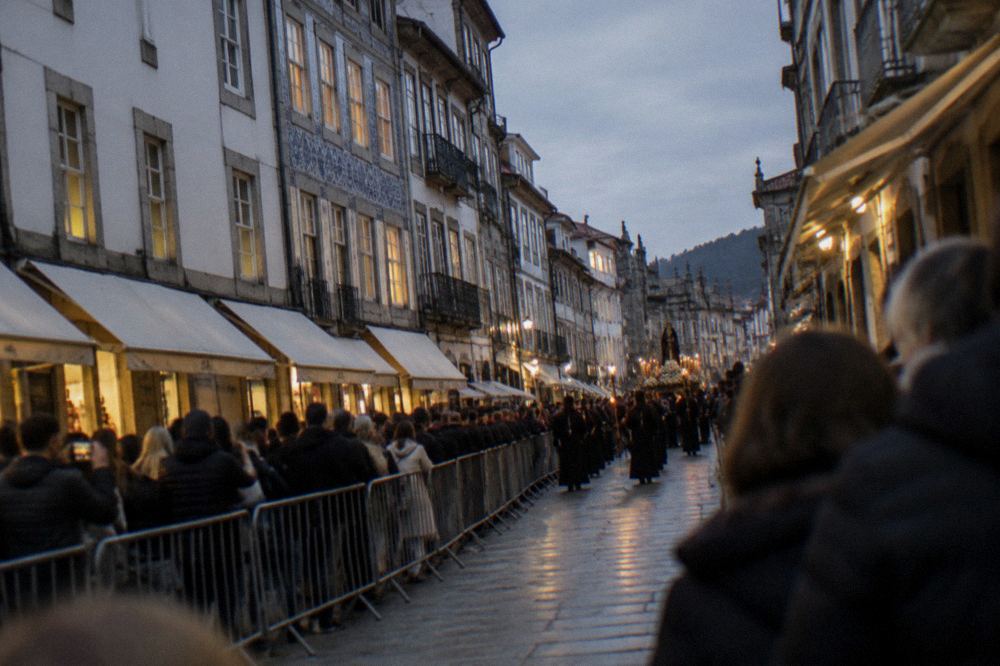
Three practical notes make the difference between a good evening and a frustrating one. Dress for standing in 10 to 15 degree night air, which the IPMA normals for the Braga station say is typical for late March and early April nights. Keep your phone use discreet; the atmosphere depends on darkness and quiet. And plan your exit: the crowd disperses at once when a procession passes, so a spot near a side street beats a spot from which you must walk the whole route backwards.
A tuk tuk tour earlier in the day is a popular way to learn the geography before the evening, since the driver covers the centre, the hill sanctuaries and the procession streets in a short loop. The Braga: Tuk Tuk City Tour runs from 30 minutes up to two hours depending on the option chosen.
What Does A Semana Santa Trip To Braga Cost?
The processions themselves are free and need no ticket, since they are public acts of worship, so the main costs are the cathedral visit routes at 3.00 EUR each or 7.00 EUR for all three, local transport at 1.55 EUR per single on-board bus fare or 3.35 EUR for a one-day TUB tourist ticket, and the municipal tourist tax of 1.55 EUR per person per night for up to four nights, charged by your accommodation.
Braga is one of Portugal's more affordable city breaks, and Holy Week does not change that, though accommodation in the centre books out early and prices firm up as Easter approaches. Here is what the verified figures look like:
| Item | Price | Notes |
|---|---|---|
| Cathedral, one visit route | 3.00 EUR | Choice of Treasury-Museum, chapels and choir, or cathedral |
| Cathedral, all three routes | 7.00 EUR | Any two routes 6.00 EUR |
| TUB single bus fare, bought on board | 1.55 EUR | 1 zone; 2.00 EUR for 2 zones |
| TUB pre-bought or digital single | 0.75 EUR | 1 zone; 1.50 EUR for 2 zones |
| TUB tourist ticket, 1 day | 3.35 EUR | Whole network; 2 days 6.05 EUR, 3 days 8.05 EUR |
| Municipal tourist tax | 1.55 EUR per night | Up to 4 nights, per person, all year |
| Theatro Circo guided tour | 3.50 EUR | 45 minutes, scheduled dates only |
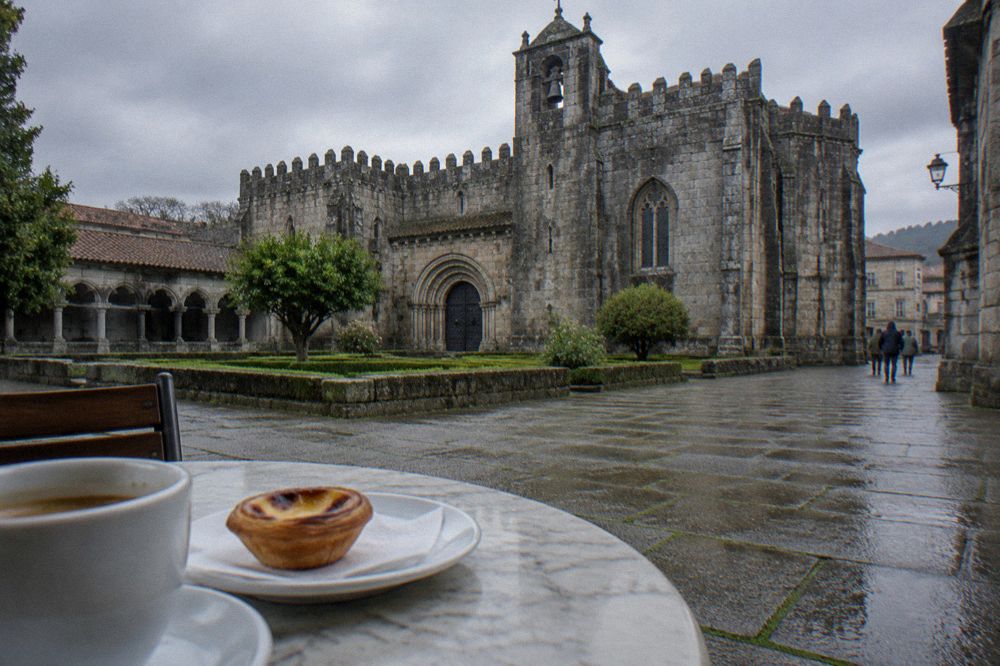
Food costs behave like the rest of northern Portugal. A coffee and a pastry in a centre café runs at small-change prices, and a sit-down dinner in a traditional tasca is far below Lisbon or Porto levels. The food scene around Holy Week leans into Lenten and Easter baking, and the city's famous desserts, including the pudim Abade de Priscos, appear on nearly every menu. For wine, the local pour is Vinho Verde, and a glass costs less than a cathedral ticket.
One thing not to buy is a city pass. No city-wide attraction pass is on sale in Braga, despite a card announced by the municipality in 2025, so buy each ticket separately. The TUB tourist ticket is the only multi-use product that genuinely exists, and it is a bus product, not an attraction pass. More of these guides are collected on Braga Travel Guide.
What Is The Weather Like During Holy Week In Braga?
Holy Week falls in late March or April, when IPMA's 1991 to 2020 normals for the Braga station show mean temperatures of 11.9 C in March and 13.7 C in April, with nights down to 5.9 C and 7.8 C on average, and rain on 11.8 and 12.0 days a month respectively, so pack for cool evenings and the real possibility of showers.
The numbers matter more than the season label. Spring in the Minho is green because it rains, and the rain does not stop for Easter. The full picture from the normals:
| Month | Mean Temp | Mean Max | Mean Min | Rainfall | Days With 1mm+ Rain |
|---|---|---|---|---|---|
| March | 11.9 C | 17.8 C | 5.9 C | 150.1 mm | 11.8 |
| April | 13.7 C | 19.6 C | 7.8 C | 127.9 mm | 12.0 |
| May (if Easter is late) | 16.7 C | 23.0 C | 10.4 C | 89.8 mm | 8.9 |
For the night processions, the number that matters is the mean minimum. Standing still for two hours at 21:30 in early April means temperatures in the single digits, and the record low for the station is well below freezing, though that is a December figure. Layers, a proper coat and flat shoes for cobbles are the uniform.
Rain rarely cancels anything. The processions are worship, not entertainment, and they run in drizzle. Bring a compact umbrella rather than a hood that blocks the view of the people behind you, and note that wet cobblestones are the main safety issue of the week. If the weather turns truly bad, the city has strong indoor options, from the Museu de Arqueologia D. Diogo de Sousa at 5.00 EUR to the Biscainhos museum at 7.50 EUR with its gardens included.
What Closes And What Stays Open During Semana Santa?
The processions close streets in the historic centre, especially around the Sé de Braga, Rua do Souto and the Avenida Central, on the evenings of the main processions, while museums keep normal hours except that the cathedral suspends tourist visits during services, and Good Friday is the day when the most businesses shut or shorten hours. Easter Sunday itself is quiet, with museums on reduced or holiday schedules.
Museum closures follow the municipal holiday pattern. The state and municipal museums close on 1 January, Easter Sunday, 1 May, the municipal holiday of 24 June and 25 December, and most also close Mondays. During Holy Week itself the relevant one is Easter Sunday. The practical picture:
| Venue | Normal Hours | Closed |
|---|---|---|
| Museu dos Biscainhos | Tue to Sun 10:00 to 12:30, 14:00 to 17:30 | Mondays, Easter Sunday, 1 May, 24 Jun, 25 Dec |
| Museu de Arqueologia D. Diogo de Sousa | Tue to Sun 10:00 to 17:30 | Mondays and the same holidays |
| Museu Pio XII and Medieval Tower | Tue to Sat 09:30 to 12:30, 14:00 to 18:00 | Sundays and Mondays |
| Treasury-Museum of the Sé | Tue to Sun, seasonal split hours | Mondays |
| Theatro Circo guided tours | Scheduled dates only, 45 minutes | Depends on programme |
Restaurants and cafés mostly stay open during Holy Week, and it is one of the busiest weeks of their year, but Good Friday is the exception, when many close or serve limited menus in keeping with the day. Book dinner ahead for the nights of the big processions, since the centre fills with visitors and locals alike.
Getting around during procession evenings means walking. The TUB buses serve the whole city, and Line 2 runs to the Portico at the foot of the Bom Jesus stairway, but on procession nights the centre's streets are closed to traffic and the buses detour. The getting around guide covers the network in detail. If Bom Jesus is on your list for the same trip, note that the funicular is currently out of service and a replacement shuttle runs between the Portico and the sanctuary, while the 566-step stairway by the Confraria's count remains the classic route on foot, as the Bom Jesus access guide explains.
For visitors who want the week's context in depth, a private guide can build the procession routes and the religious history into one coherent walk. The Braga Private Walking Tour with a Professional Guide runs about two hours with a professional guide.
How Do You Plan A Holy Week Trip To Braga?
Plan three to four days: arrive by Thursday at the latest for the Ecce Homo and Enterro nights, book accommodation inside or just outside the historic centre well in advance because Holy Week is Braga's peak spring demand, use the train from Porto or Lisbon for the easiest arrival, and reserve your evenings for the processions while spending the days on the cathedral quarter, the museums and a Bom Jesus or Sameiro excursion.
Arrival logistics are simple. Braga is the terminus of CP's urban line from Porto São Bento via Campanhã, with the current timetable valid since 26 July 2026, and the journey takes a little over an hour. From Lisbon, the direct Alfa Pendular takes about 3 hours 20 minutes at fastest, with 2026 full single fares of 38.50 EUR in Turística class and 54.60 EUR in Conforto. From Porto Airport, the Getbus coach runs direct to Braga bus station from 9.00 EUR and takes about 45 minutes. The Porto to Braga guide and the airport transfer guide cover each option.
Where to stay matters more than usual. The procession routes pass through the centre, so a hotel within a ten minute walk of the Sé means you can drop back to your room between the afternoon programme and the 21:30 starts. The where to stay guide breaks the neighbourhoods down, and the general advice for event weeks applies: book early, expect the tourist tax of 1.55 EUR per person per night for up to four nights on your bill, and prefer refundable rates in case the dates shift.
A sample shape for the days, assuming a Thursday arrival:
| Day | Daytime | Evening |
|---|---|---|
| Thursday | Cathedral quarter, Treasury-Museum, centre churches | Ecce Homo procession, 21:30 |
| Friday | Biscainhos museum or D. Diogo de Sousa, quiet centre | Enterro do Senhor procession, 21:30 |
| Saturday | Bom Jesus do Monte and the stairway, or Sameiro | Free evening, centre restaurants |
| Sunday | Easter service or a relaxed morning, Picoto park viewpoint | Departure or a final centre stroll |
The week also rewards slow mornings. Braga's café culture is a genuine institution, and the pastry shops fill with Easter baking as the week goes on. The restaurant guide and the walking tours overview list the guided options if you would rather not navigate the procession streets alone.
For a structured first morning, a small-group walking tour that includes the sanctuary gives you both the centre and Bom Jesus in one three-hour block, leaving the evenings free. The Braga Small-Group Walking Tour & Bom Jesus is the natural pick.
Whichever way you structure the days, keep the evenings light. The processions are the reason to be here, and a schedule that leaves you rested at 21:30 beats one that has you sprinting back from a day trip as the candles are being lit.
Common Questions About Semana Santa In Braga
When is Semana Santa in Braga?
Semana Santa de Braga 2026 ran from 29 March to 5 April. Holy Week is movable and always falls in the week before Easter, so the dates shift each year between mid-March and late April. Check the organiser's page for the coming edition's dates.
Are the processions free to watch?
Yes. The processions are public acts of worship and no ticket is needed. Just arrive early for a good spot, especially for the night processions, which start at 21:30.
What is the most famous procession in Braga?
The Procissão do Enterro do Senhor on Good Friday night is the most solemn and best known, while the Procissão do Ecce Homo on Thursday night, with its barefoot penitent carrying the burden of the cross, is the most dramatic to watch.
Is Braga crowded during Semana Santa?
Yes, Holy Week is Braga's peak spring event and the centre fills for the night processions, particularly the Enterro. Book accommodation early, reserve dinners, and arrive 45 to 60 minutes before a procession starts for a good viewing spot.
Is the cathedral open during Holy Week?
The Sé de Braga suspends tourist visits during services, which are frequent during Holy Week. Visit routes cost 3.00 EUR each, 7.00 EUR for all three, but plan your visit before Palm Sunday weekend or after Easter Sunday, and check the schedule on the day.
What should I wear to the night processions?
Dress for cool to cold evenings. IPMA's normals for the Braga station show March nights averaging 5.9 C and April nights 7.8 C, so a proper coat, layers and flat shoes for cobbles are the right call, plus a compact umbrella, since rain is common and the processions run regardless.
Holy Week in Braga rewards a little planning: dates checked on the organiser's page, a bed booked near the centre, evenings kept free for the 21:30 starts, and days given to the cathedral quarter, the museums and the hill sanctuaries. Do that, and the week delivers what it has delivered for centuries, candlelit streets, near-total silence, and one of Europe's great Easter spectacles unfolding a few metres from where you stand.