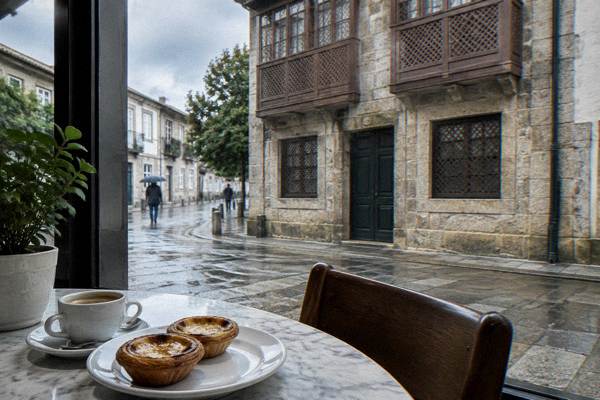
Braga Cafes: A Practical Guide To Coffee, Pastries And Historic Coffee Houses In Braga
Braga, the city in northern Portugal's Minho region, runs on coffee: small cups, long sits, and pastries with Roman and convent roots. Here is how the cafe culture actually works.
Short answer
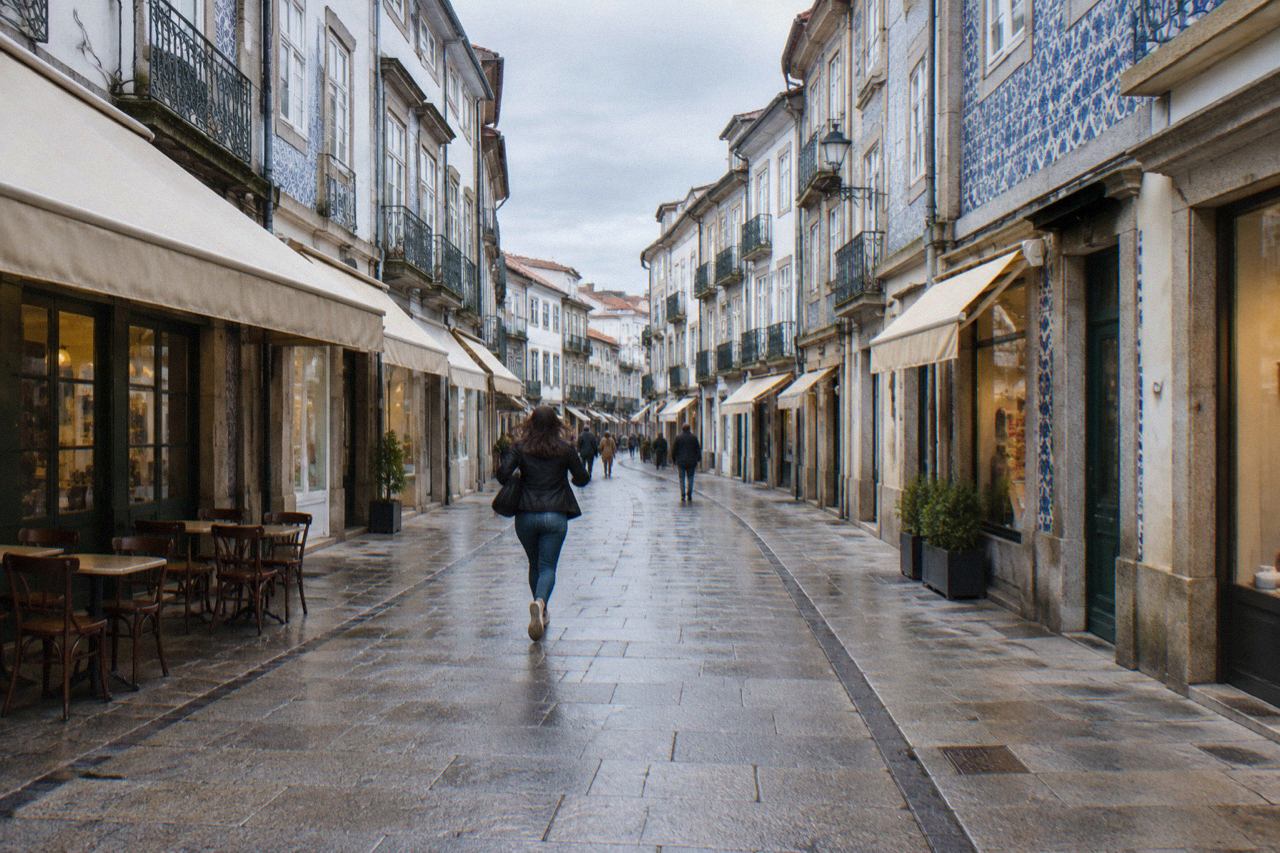
Braga cafes range from ornate historic coffee houses around Avenida da Liberdade and Rua do Souto to plain neighbourhood pastelarias. Order at the counter (um café, uma meia de leite, um galão), pair it with a pastry, and expect to pay a few euros. Service is included in the bill; a small extra tip is customary.
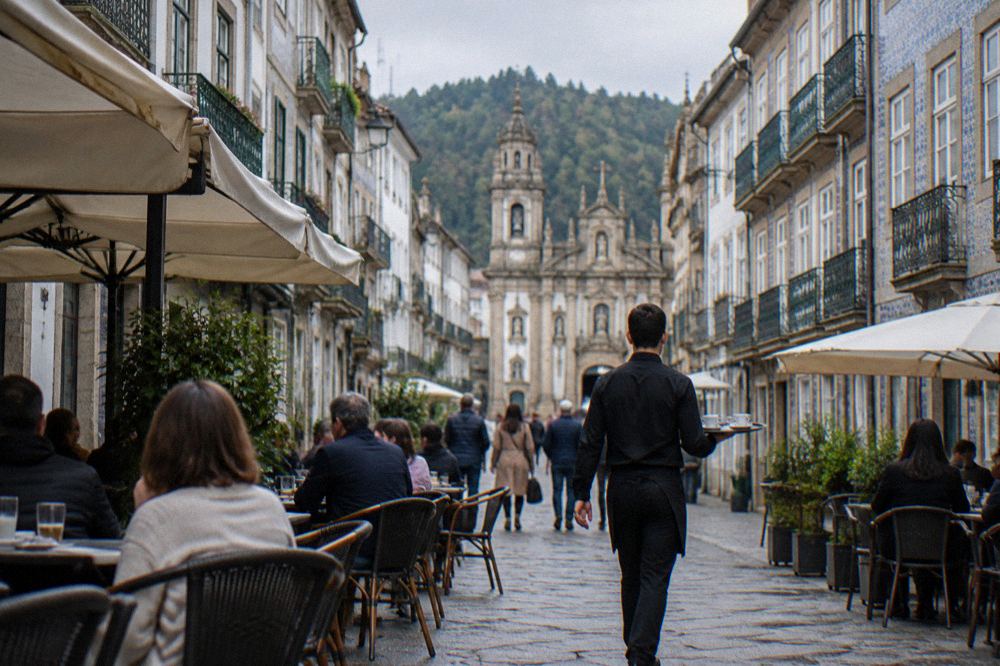
Braga, the city in the Minho region of northern Portugal, is one of the great cafe cities of the Iberian peninsula, and it does not advertise the fact. The historic centre holds ornate coffee houses with mirrored walls and marble counters, plain pastelarias where regulars stand at the balcão for ninety seconds, and garden terraces that fill with students from the university quarter. The ritual is compact: a small strong coffee, something sweet, a chair with a view of a baroque facade, and no hurry. This guide explains how that ritual works, how to order in it, which pastries belong to the city, and how the cafes slot into a day of churches, museums and the climb to Bom Jesus do Monte.
Nothing on this page tells you what a coffee costs in a specific house, because nothing of the sort was verified for this build. Prices move, menus change, and a confidently printed wrong number is worse than none. What you can plan on is the structure: how ordering works, what the drinks and pastries are, and where the famous houses sit. For the wider food picture, read the companion guide to what to eat in Braga and the Braga restaurants guide, which covers full meals rather than the counter culture described here.
What Makes Braga Cafes Different From Cafes Elsewhere In Portugal?
Braga's cafe culture is older, more ecclesiastical and more concentrated than Lisbon's or Porto's: the city's coffee houses grew up around a cathedral city and a university, so they sit in a walkable historic core, they favour long ornate rooms over quick counters, and the pastry tradition leans on convent sweets rather than the bigger cities' broader ranges. The differences are of degree, not of kind, but they shape a visit.
Three things mark it out. First, geography: the centre of Braga is compact, and the main cafe streets, Avenida da Liberdade, Rua do Souto and the squares off the Sé de Braga, are all within a short walk of one another. A cafe crawl in Braga is a walking tour, not a transit project, which is one reason the Braga walking tours guide pairs so naturally with this page.
Second, the ecclesiastical inheritance. Braga is a cathedral city, and much of Portuguese convent pastry, egg-yolk-rich sweets born in monastic kitchens, has deep roots in the Minho region. The city's most famous pudding, pudim Abade de Priscos, a caramel egg pudding, and it appears on cafe and restaurant menus across the city. No date of origin and no inventor claim is printed here, because none was verified; the pudding is simply, verifiably, everywhere.
Third, the student layer. The University of the Minho region has its Braga campus, and the cafes near the historic centre carry the noise of a student city: laptops at lunchtime, cheap beer at night, and a terrace season that starts earlier and ends later than the weather alone would justify.
How Do You Order Coffee Like A Local In Braga?
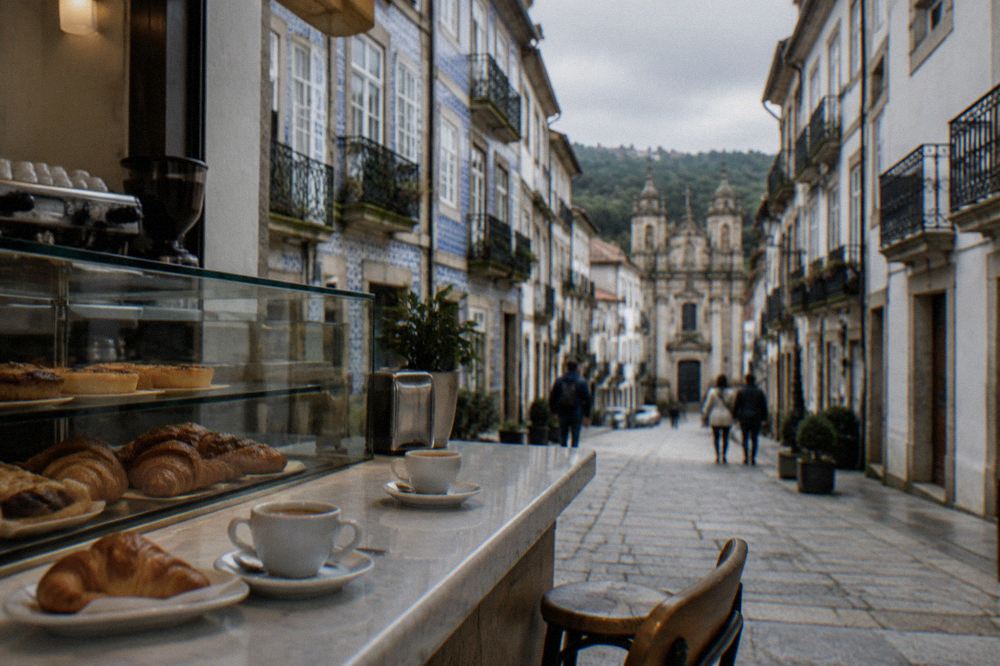
Ask for um café and you get a small strong espresso, the default drink of the whole country; um galão is the tall milky breakfast glass; uma meia de leite is the half-and-half cup that most people drink mid-morning; and um café duplo is the double when one is not enough. Ordering at the counter, rather than at a table, is normal and quicker, and nobody will hurry you off a table either.
The vocabulary is the whole trick. Portuguese cafe culture has a compact set of words that map to exactly one drink each, and learning six of them covers ninety percent of situations. The table below is the working set.
| You say | You get | When locals drink it |
|---|---|---|
| Um café | A small strong espresso, the national default | Any time, standing at the counter |
| Um café duplo | The same, double volume | After a heavy lunch |
| Uma meia de leite | A small cup, half coffee, half milk, no foam | Mid-morning, with a pastry |
| Um galão | A tall glass, one part coffee, three parts milk | Breakfast, with toast or a sweet |
| Um garoto | An espresso with a splash of milk | Afternoon |
| Um café com cheirinho | An espresso with a measure of brandy or aguardente | After a big Sunday lunch |
Two habits matter more than the words. First, the counter is not a lesser option: at breakfast and after lunch, most of the room is standing at the balcão, and the same coffee costs the culture nothing in terms of time, since it is drunk in minutes. Second, the day has a rhythm. The galão belongs to the morning; the plain café belongs to the afternoon and after meals; and asking for a cappuccino in a traditional house will get you coffee with milk, which is fine, but it marks you as a visitor. Nobody minds being marked. Braga is a patient city.
A food tour is the fastest way into this vocabulary, because a local guide orders first and the counter staff respond to a regular. The Braga Small-Group Food Tour: Taste Real Portugal with Local Guide walks a small group through the city's dishes and drinks, cafes included, over about three hours. Check availability
Which Pastries Should You Try In Braga Cafes?
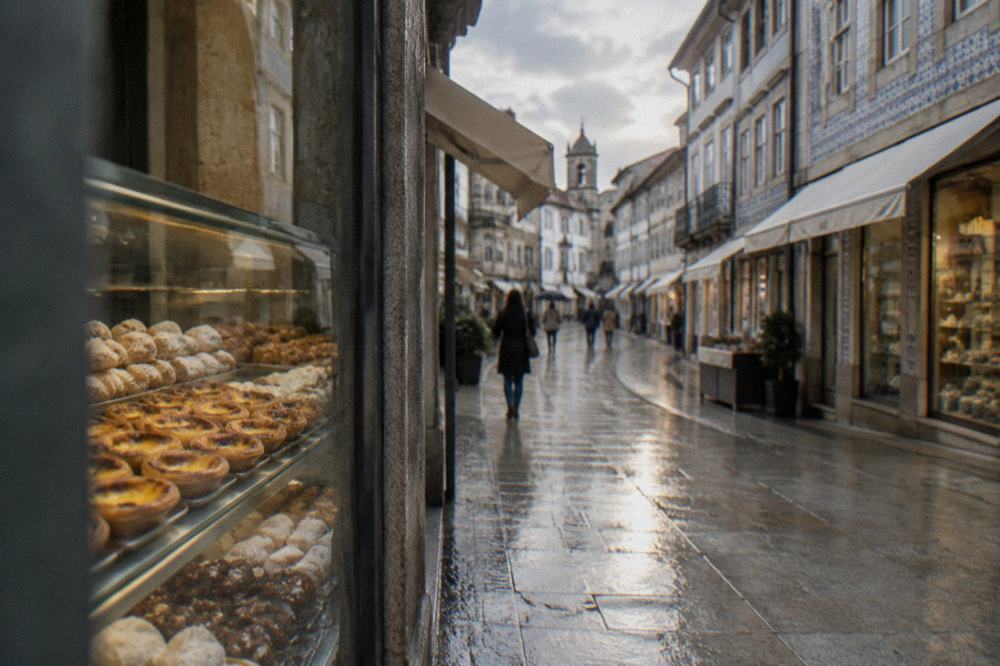
Order the frigideira, a small sweet or savoury pastry named for the pan it is fried in and strongly linked to Braga; the pudim Abade de Priscos, a caramel egg pudding; and the standard convent repertoire of pastéis de nata and ovos moles that every Minho pastry case carries. Nothing here needs a date or a story to be worth eating.
The pastry case in a Braga pastelaria holds two overlapping traditions. The national one is familiar: custard tarts, sponge cakes, chila-squash sweets. The regional one is what distinguishes the city, and frigideiras are its emblem: small, pan-fried and tied to Braga by name and habit, they appear in sweet and savoury forms and are the thing to point at when the case is crowded. The dedicated page on frigideiras and Braga pastries goes deeper on the whole family.
| Pastry or sweet | What it is | How to eat it |
|---|---|---|
| Frigideira | A small fried pastry, sweet or savoury, associated with Braga | Warm, mid-morning, with a meia de leite |
| Pudim Abade de Priscos | A dark caramel pudding of eggs, sugar and pork fat | As a dessert after lunch, or by the slice in a cafe |
| Pastel de nata | The national custard tart in puff pastry | Any time, dusted with cinnamon |
| Ovos moles | Egg-yolk sweet in a wafer shell, a convent tradition | With coffee, in the afternoon |
| Bolo rei | Ring-shaped fruited king cake | The Christmas season, in slices |
| Leite creme | Egg custard, often finished with a burnt-sugar crust | Winter, in small cups |
The pudim deserves its own sentence because it is the one sweet that is unambiguously Braga's. Rich, dense and faintly savoury from the pork fat in the traditional recipe, it divides first-time visitors cleanly into converts and refuseniks, and both reactions are correct. The full story of the pudding, and of the savoury dishes of the region, is in the guide to what to eat in Braga.
Where Are The Classic Historic Cafe Addresses In Braga?
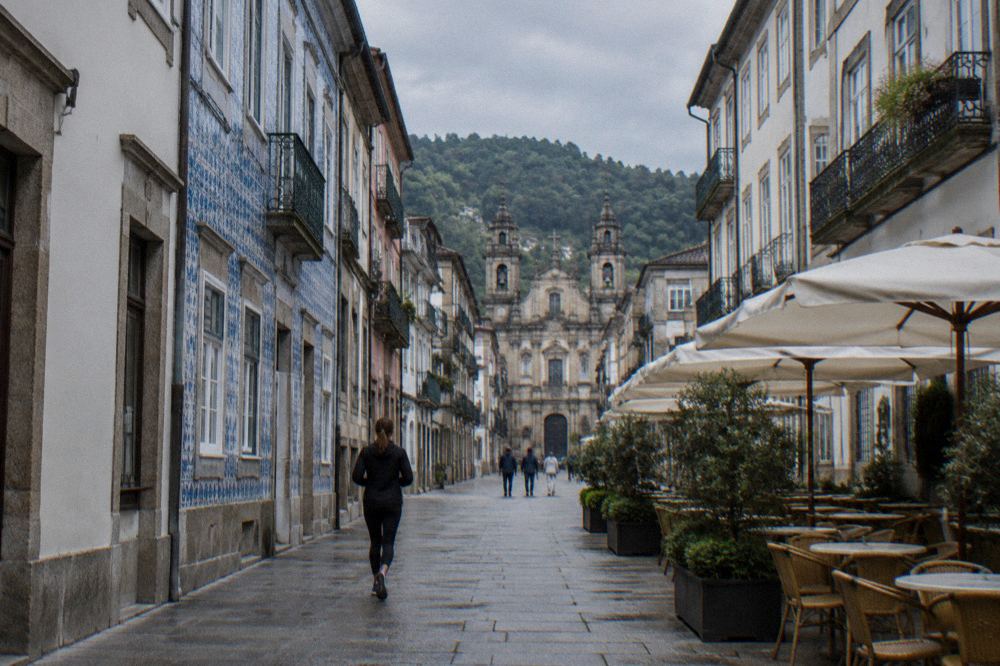
The classic houses sit on and around Avenida da Liberdade and the streets leading off it: A Brasileira is the landmark, a grand coffee house that has anchored the avenue for generations and gives the street its cafe identity, and the rest of the historic-centre circuit runs along Rua do Souto, Praça da República and the lanes near the Sé de Braga, all within a short walk of one another.
A Brasileira in Braga is a landmark in the way that certain cafes become landmarks: a grand room, a terrace on the avenue, and a name that locals use as a reference point. Say what it is rather than what it costs; no price, hour or ranking for any venue is verified on this build. Around it, the circuit is short and obvious once you are standing in the middle of it.
| Area | Character of the cafes | Best moment in the day |
|---|---|---|
| Avenida da Liberdade | Grand rooms, terraces, the classic houses | Mid-morning coffee, people-watching |
| Rua do Souto | Student-heavy, quick counters, cheaper drinks | Breakfast galão before sightseeing |
| Praça da República and off-squares | Terrace seats facing the fountains and facades | Late afternoon, sun on the square |
| Around the Sé de Braga | Small pastelarias serving the cathedral crowd | Mid-afternoon pick-me-up between visits |
| Santa Barbara Garden edge | Garden terraces near the historic walls | Weekend mornings, families |
The pattern to notice is that the grand houses and the plain pastelarias are not in competition. A local might have a galão standing at a counter on Rua do Souto in the morning, take a visitor to a mirrored room on the avenue at eleven, and never think of the two as the same category. Do the same. The walk between all of these is minutes, and it passes the historic centre and the Arco da Porta Nova, so the cafe circuit doubles as the sightseeing circuit.
A guided food walk is worth pausing on here, because the historic cafe circuit is exactly the terrain it covers best. The counter vocabulary, the pastry case and the ordering rhythm all come easier when someone who belongs to the culture goes first, and the food tour's route through the centre overlaps almost entirely with the cafe streets described above.
When Is The Best Time Of Year For Cafe Terraces In Braga?
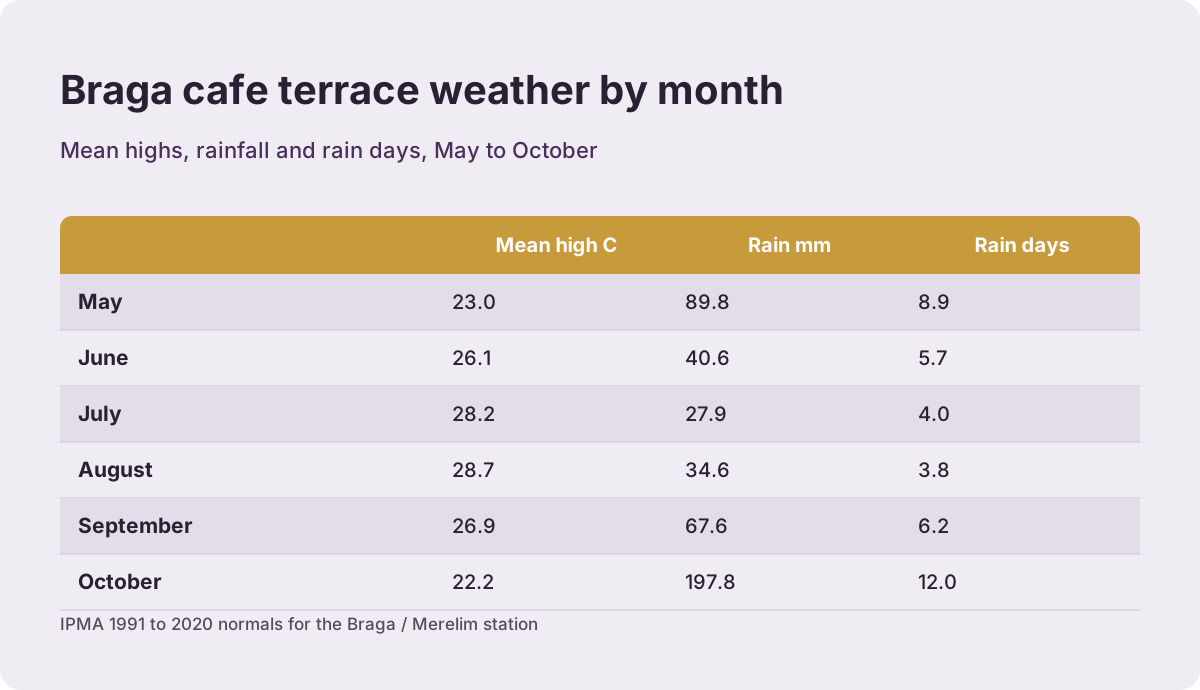
Terrace season in Braga runs from late spring to early autumn, and the numbers back the instinct: IPMA's 1991 to 2020 normals for the Braga / Merelim station show July and August as the warmest and driest months, with mean highs of 28.2 and 28.7 C and only about four days of rain each, while October is the wettest month of the year on average with 197.8 mm, so the outdoor cafe year is really May to September.
The climate table deserves a careful read, because Braga's rainfall pattern surprises people who assume southern Portuguese weather applies to the Minho. October, not a winter month, is the wettest on average; December and January follow close behind; and the rain-day count runs twelve to thirteen days a month from October through January. Summer, by contrast, is genuinely dry. The wider set of guides lives on Braga Travel Guide.
| Month | Mean high C | Rain mm | Rain days (1 mm or more) | Terrace verdict |
|---|---|---|---|---|
| May | 23.0 | 89.8 | 8.9 | Good, warming up |
| June | 26.1 | 40.6 | 5.7 | Excellent |
| July | 28.2 | 27.9 | 4.0 | Excellent, hot afternoons |
| August | 28.7 | 34.6 | 3.8 | Excellent, hot afternoons |
| September | 26.9 | 67.6 | 6.2 | Very good, quieter |
| October | 22.2 | 197.8 | 12.0 | Indoors, umbrella weather |
Two seasonal notes for cafe planning. September is the sleeper month: it is nearly as warm as June at the top end and the terraces are calmer once the school holidays end. And the wet months are not a loss, they are a different pleasure; the indoor rooms of the old houses are at their best in December, when the Braga in December guide covers the Christmas cakes, the bolo rei season and the indoor side of the city. For the full month-by-month picture, see the best time to visit Braga.
What Is Cafe Etiquette And Tipping In Braga?
Service is included in the bill by law of custom, and Turismo de Portugal's own guidance says it is customary to leave an additional tip of about 5 to 10 percent in restaurants, or to round up the amount paid to the nearest euro for a taxi; in a cafe, rounding a small coffee bill up or leaving the small coins is the local norm, and nobody tips a percentage on an espresso.
The etiquette is lighter than the restaurant guidance suggests, because the amounts are small. At a counter, no tip at all is normal. At a table on a terrace, leaving the coins from a rounded-up bill is polite and unremarkable. The one thing that would look odd is calculating a percentage on a coffee.
| Situation | What locals do |
|---|---|
| Standing at the counter | Pay, no tip expected |
| Table service, coffee and pastry | Round up, leave the coins |
| Terrace with a full snack order | A small extra, a few percent at most |
| Cafe breakfast for a family | Round up or a small note |
| Ordering at the counter for takeaway | No tip |
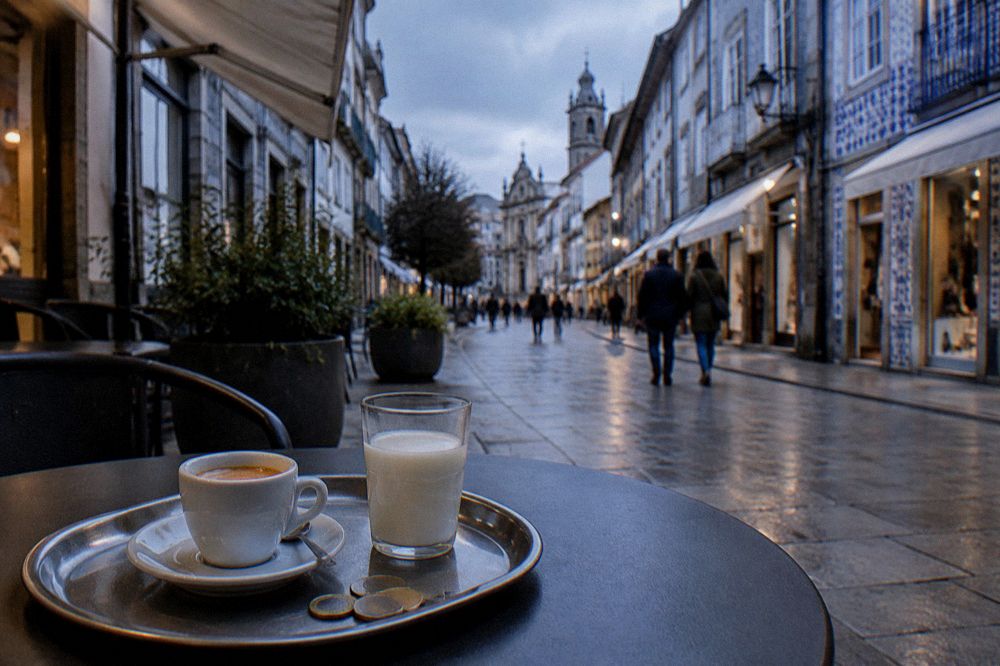
A few behavioural notes complete the picture. It is normal to sit a long time over one coffee; the table is yours. It is normal to ask for um copo de água, a glass of tap water, alongside a coffee, and houses provide it. And the day's rhythm is respected: a galão after midday marks you as a tourist faster than any accent, while a plain café after lunch marks you as someone who has understood the place. If you are pairing the cafe stops with sightseeing, the free things to do in Braga guide lists the sights that cost nothing between coffees.
How Do Cafes Fit Into A Day Of Sightseeing In Braga?
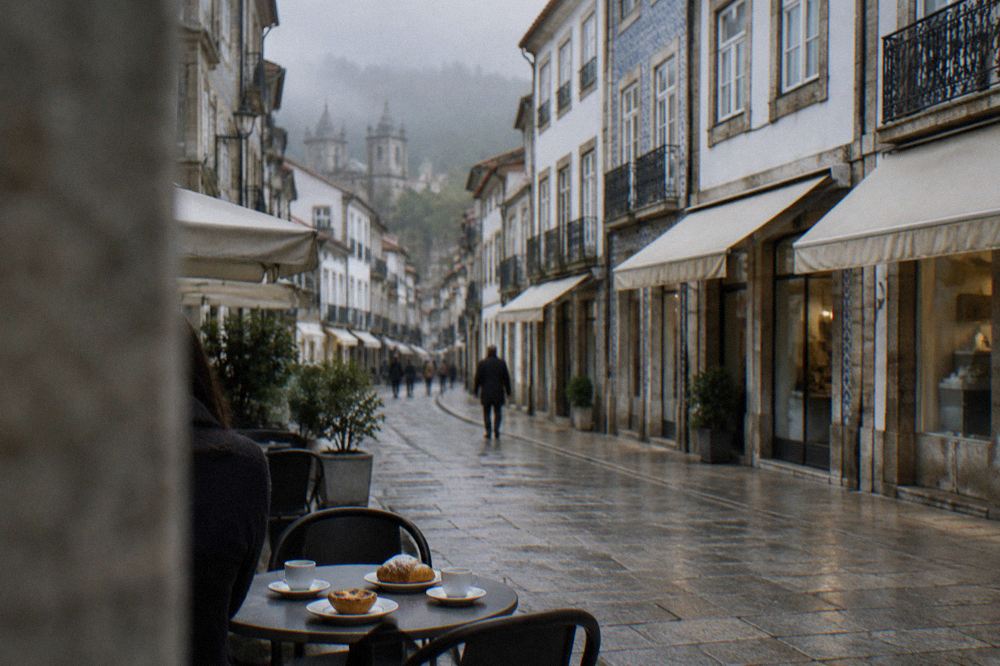
Build the day around two cafe stops, one mid-morning and one mid-afternoon, because Braga's sights cluster in the same walkable core as its cafes: the Sé de Braga, the Santa Barbara Garden and the historic streets in the morning, a long lunch, then the museums and the climb or bus to Bom Jesus do Monte in the afternoon, with the evening spent back on a terrace near Avenida da Liberdade.
The compactness of the city makes this almost automatic. A morning that starts with a galão on Rua do Souto can reach the cathedral, the Santa Barbara Garden and the Biscainhos Museum on foot before noon, with a pastry stop somewhere in the middle. Lunch is a restaurant matter, and the Braga restaurants guide covers it.
The afternoon is where the hills come in. Bom Jesus do Monte sits above the city, and the guide to how to get to Bom Jesus do Monte explains the TUB Line 2 bus option and the stairway; note that the funicular has been out of service since 26 September 2026 with no end date published, and a replacement shuttle runs between the Portico and the sanctuary. The stairway is 566 steps by the Confraria's count, so a coffee at the top or the bottom is not a luxury, it is first aid.
| Time of day | Plan | Cafe role |
|---|---|---|
| 08:00 to 09:30 | Breakfast near your base | Galão and toast, counter or table |
| 10:00 to 12:30 | Cathedral, garden, historic streets | Mid-morning meia de leite and a pastry |
| 13:00 to 15:00 | Long lunch | Restaurant, not cafe |
| 15:30 to 18:30 | Museums or Bom Jesus do Monte | Afternoon café, or coffee at the sanctuary |
| 19:00 onwards | Terrace, people-watching | Café com cheirinho if the day earned it |
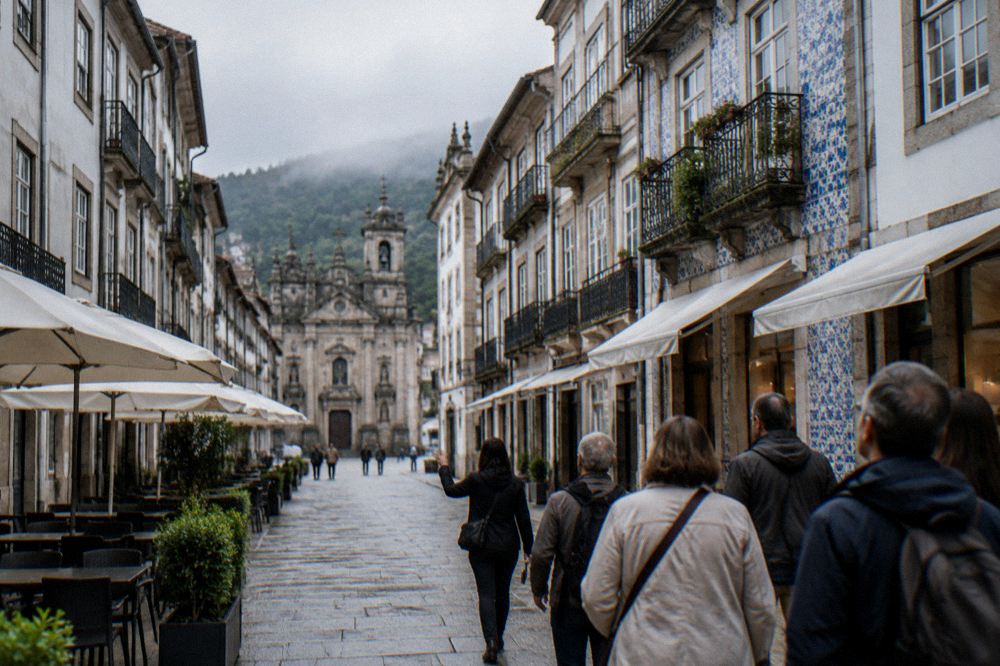
For a day that wants structure without self-navigation, a guided walk stitches the sights and the stops together. The Braga Small-Group Walking Tour & Bom Jesus covers the historic centre and the sanctuary in about three hours, which leaves the rest of the day for the cafe circuit at your own pace.
Can You Visit Braga Cafes On A Guided Tour?
Yes, and it is the most efficient way in: a food tour with a local guide covers the ordering vocabulary, the pastries and the dishes in one walk, while a private guided walk lets you set the pace and linger where a group cannot; both types run in the city itself, not from Porto, and both pair naturally with a morning or afternoon spent in the historic core.
The food-first option is the Braga Small-Group Food Tour: Taste Real Portugal with Local Guide, about three hours with a local guide, tastings included in the structure of the walk. The listing carries its current price and rating; check it there rather than trusting any number printed on a third page.
The structure-first option is a private walk. The Braga Private Walking Tour with a Professional Guide runs about two hours with a professional guide and can be steered toward the cafe streets, the churches or both, depending on what the group wants on the day.
A note on the free walks, because they belong in the same sentence even though they are not this site's products. GuruWalk lists several pay-what-you-want walking tours of Braga, including the Essential Free Tour of Braga (guided in Spanish) with its blue-umbrella guide and a green-umbrella alternative, each about two hours and each covering the historic core. These are tip-based walks on the GuruWalk platform, not paid tours, and the gurus who run them are named on their own listings. They will not feed you, but they will show you where the cafes are.
Common Questions About Braga Cafes
What coffee should I order in Braga?
Ask for um café for the standard small espresso, uma meia de leite for the half-coffee, half-milk mid-morning cup, and um galão for the tall milky breakfast glass. Ordering at the counter is normal and quick.
What pastry is Braga known for?
Frigideiras, small fried pastries strongly associated with the city, and pudim Abade de Priscos, a caramel egg pudding. Both are described in detail in the guide to frigideiras and Braga pastries.
Do you tip in cafes in Braga?
Not at the counter. At a table, rounding the bill up or leaving the small coins is the local norm. Turismo de Portugal's guidance reserves the 5 to 10 percent figure for restaurants and taxis.
Is there a famous cafe in Braga?
A Brasileira is the city's landmark coffee house, a grand room anchoring Avenida da Liberdade, with a terrace that locals use as a reference point. No price, hour or ranking for any venue is printed on this page, because none was verified.
Can you sit a long time in a Braga cafe?
Yes. The table is yours once you have ordered, and lingering over one coffee is entirely normal in the historic houses and on the terraces.
When is terrace season in Braga?
Roughly May to September. IPMA's 1991 to 2020 normals for the Braga / Merelim station show July and August as the driest months, with about four rain days each, while October averages 197.8 mm and pushes everyone indoors.
The cafe is where a day in Braga pauses, and the city has engineered itself so that the pause is never more than a street away. Order small, sit long, and let the baroque facades do the rest.