Frigideiras And Braga Pastries
Frigideiras are Braga's signature savoury pastry, and they sit inside a much broader Minho tradition of convent-style sweets, egg-rich puddings and café counters that anchor the city's daily life. This guide explains the dishes themselves, how to taste them, and how to plan the visit around them.
Short answer
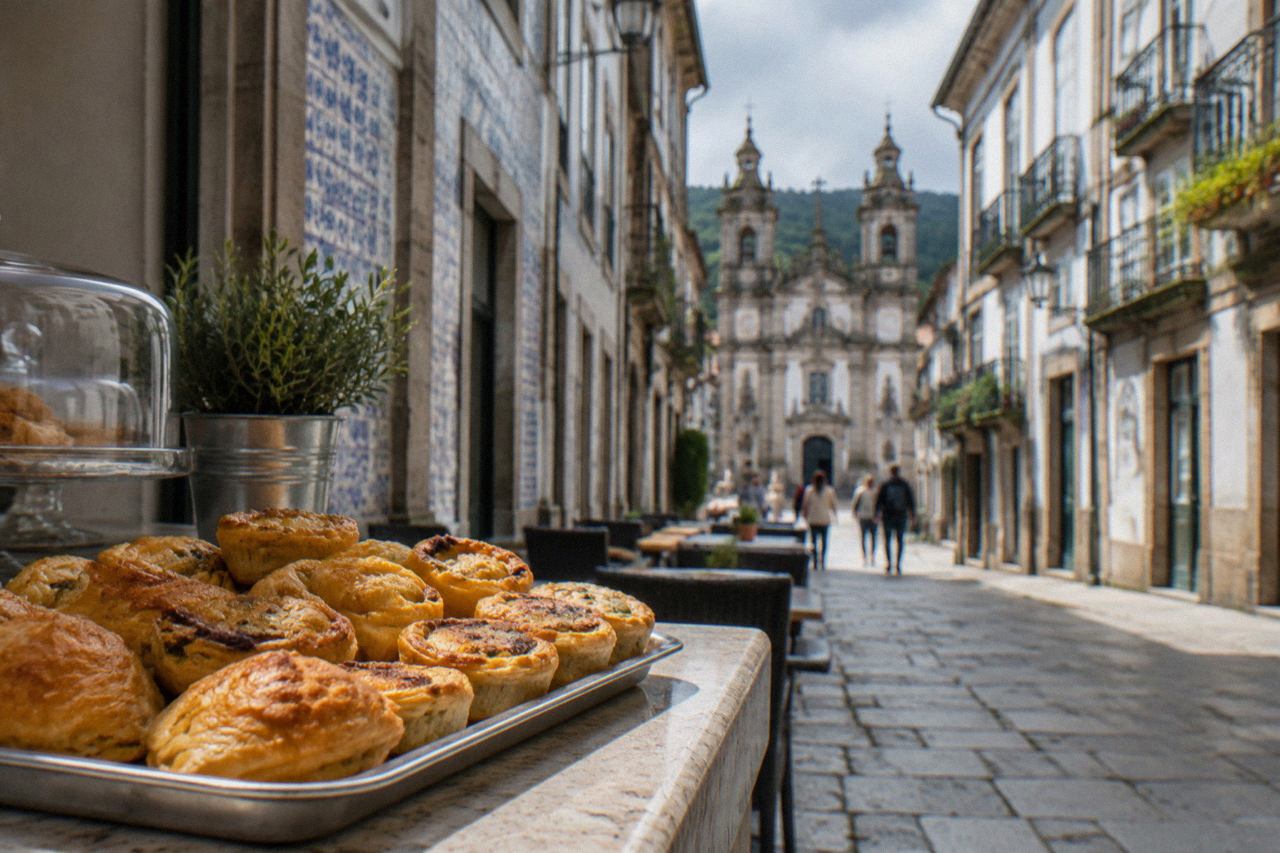
Frigideiras are small round pastries of flaky dough filled with seasoned minced meat, served warm, and they are the best-known savoury pastry of Braga in northern Portugal. Around them sit egg-and-caramel puddings, puff-pastry sweets and a café culture best explored on foot in the historic centre.
Braga, the historic city of northern Portugal's Minho region, answers most food questions with pastry. The counters of its cafés in the historic centre carry small savoury pastries called frigideiras alongside egg-rich sweets whose recipes trace to the region's monastic kitchens, and the whole repertoire is close enough together to be eaten, in principle, in a single long afternoon of walking. This guide is about the food itself: what each pastry is, how the dishes relate to the city's café culture, and how to plan a visit that treats eating as the main event rather than an afterthought between the Sé de Braga and the Bom Jesus do Monte stairway.
What Are Frigideiras In Braga?
Frigideiras are small round pastries made from thin, flaky dough wrapped around a filling of seasoned minced meat, baked or fried until golden and eaten warm, and they are the best-known savoury pastry of Braga in northern Portugal. The name comes from the Portuguese word for frying pan, the frigideira, and the pastry is sold by weight or by the piece at café counters in the historic centre, most famously at the Café A Brasileira landmark on Rua do Souto's pedestrian stretch.
That is the whole dish: dough, seasoned meat, heat. There is no sauce to speak of, no complicated presentation, and no window in which they improve. A frigideira is at its best within minutes of leaving the oven or the pan, which is why locals buy them in small numbers and eat them standing or at the counter rather than carrying them across town. The pastry is small enough that two or three make a snack rather than a meal, and savoury rather than sweet, which sets it apart from almost everything else sharing the glass case with it.
The Café A Brasileira is the name most attached to them, and it is a genuine Braga landmark rather than a marketing invention: the café sits in the historic centre and has been a fixture of the city's social life for generations. The honest way to treat it, though, is as the most famous address rather than the only one. Pastry shops and café counters across the centre carry frigideiras or close cousins of them, and the differences between one counter and the next are matters of dough thickness and seasoning rather than of category. The broader story of what to eat across the city, from rojões to bacalhau à Braga, is covered in the site's guide to eating in Braga.
Why Does Braga Have Such A Strong Pastry Culture?
Braga's pastry culture runs deep because the city has been a religious centre for centuries, and Portugal's egg-rich sweets were largely developed in convent and monastery kitchens, where sugar and egg yolks were abundant and the religious calendar demanded festive baking. Braga, as a city of churches and pilgrimage, kept that tradition alive commercially in its cafés and pastry shops, and the historic centre's compact, walkable layout means those counters sit within a few minutes of one another.
The convent-sweet lineage explains the texture of almost everything in a Braga pastry case. Egg yolks, sugar and a small amount of starch or ground almond produce the dense, glossy, spoonable desserts that Portugal is known for, and the Minho region's version of that repertoire is as rich as any. Pudim Abade de Priscos, the region's famous pudding of eggs, sugar, caramel and bacon fat, carries the name of an abbot, which tells you exactly which kind of kitchen the recipe belongs to. The bacon fat is not a gimmick: it is part of the old technique, and it is what gives the pudding its unusual depth. No one should print a date of origin for the dish or a claim about who invented it, because those stories exist mostly as legend, but the pudding itself, dense and caramel-dark, is easy to find in Braga's restaurants and worth ordering once for the experience.
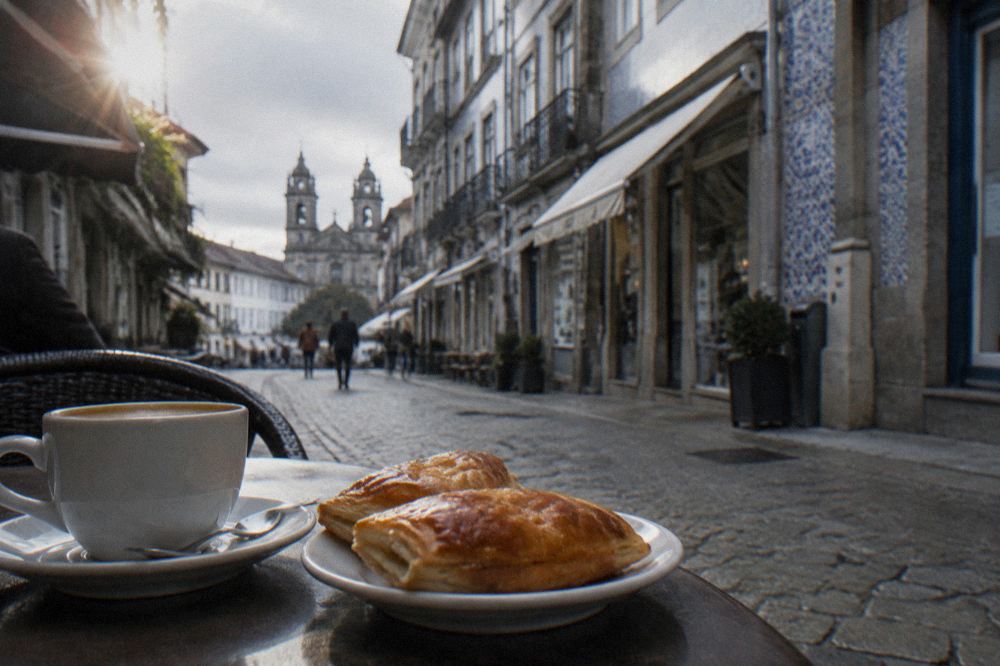
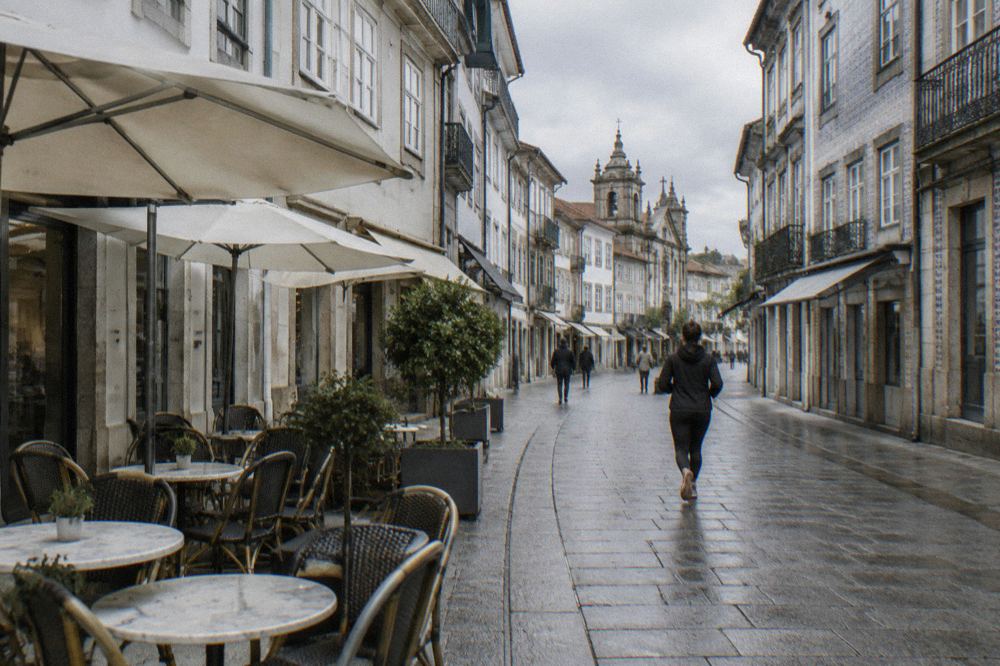
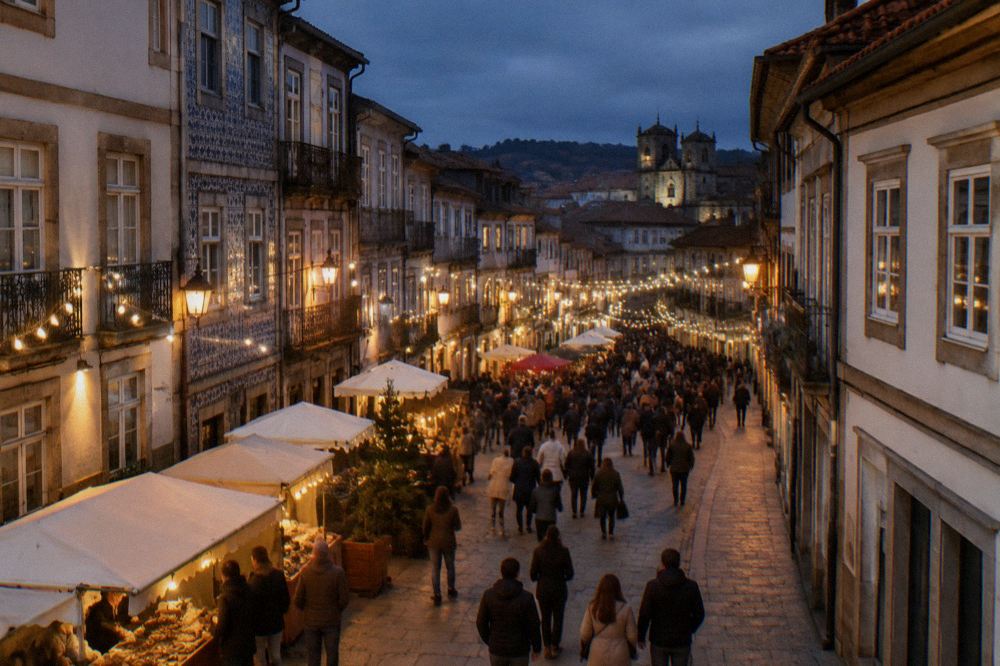
Around the savoury frigideira and the sweet puddings sits a third strand: the everyday café culture of the Portuguese north. Coffee standing at a counter, a pastry bought by the piece, a mid-morning stop that is social as much as nutritional. Braga's historic centre, with its pedestrianised Rua do Souto and its café terraces running from the Arco da Porta Nova down towards the Avenida da Liberdade, is built for exactly that rhythm. A first-time visitor does not need an itinerary to find it: walk Rua do Souto and the streets immediately off it, and the counters find you.
The most efficient way to put all of this in context is with someone who does the ordering for you. The Braga Experience guided tour pairs a historic-centre walk with tastings, and it is the site's featured tour for this page, precisely because it converts a pastry case full of unfamiliar names into an explained sequence of dishes. The guided tour with tastings runs about three hours, and the operator's live listing carries the current price and availability. Check availability
Want someone to do the ordering for you? Book a food tasting tour here.
What Pastries And Sweets Should You Try In Braga?
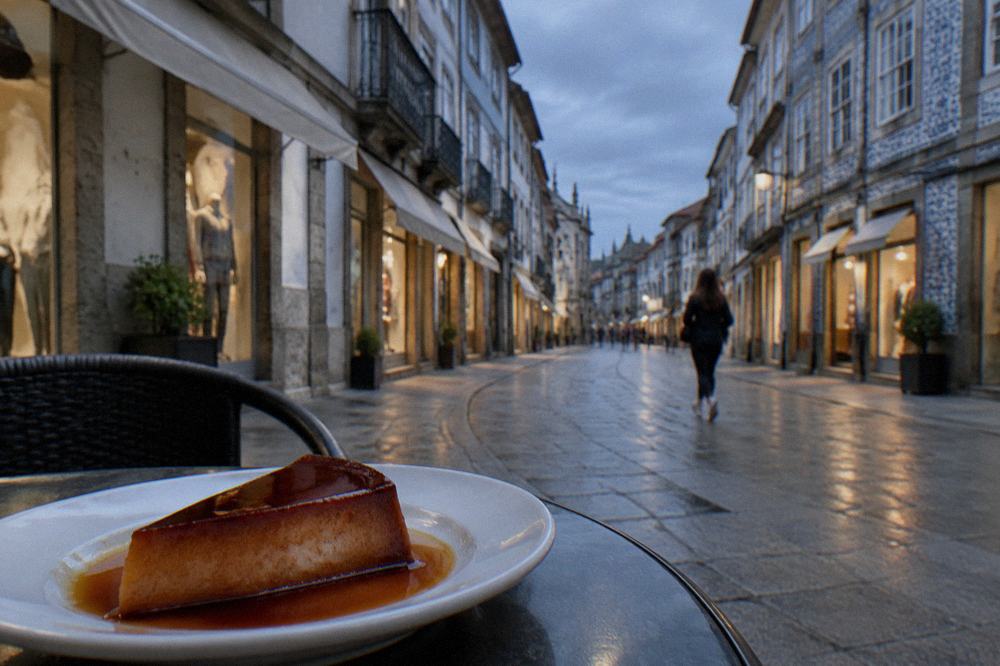
Start with frigideiras, then pudim Abade de Priscos, then the puff-pastry sweets that fill the counters around Rua do Souto: the egg-yolk and sugar desserts of the convent tradition, the almond and cinnamon pastries of the Minho region, and the simple, warm, filled pastries that Portuguese cafés sell by the piece all morning. Everything on that list is available in Braga's historic centre without a car, and none of it needs a reservation, a ticket or a timetable.
The honest way to present the repertoire is as a glossary rather than a ranking, because nothing about any individual venue in Braga can be verified as a "best" on this site. What can be described is the dish itself.
| Dish | What it is | How it is typically served |
|---|---|---|
| Frigideiras | Small round pastries of flaky dough around seasoned minced meat | Warm, by the piece or by weight, at café counters |
| Pudim Abade de Priscos | A Minho pudding of eggs, sugar, caramel and bacon fat | Chilled, as a restaurant dessert, in a caramel sauce |
| Rojões | Pieces of pork, typically braised or fried, in the Minho style | As a main dish, often with potatoes |
| Bacalhau à Braga | Fried salt cod layered with fried potatoes, onion, egg and olives | As a main dish in traditional restaurants |
| Sarrabulho | A Minho pork and rice dish in the region's traditional style | As a main dish, seasonal and not on every menu |
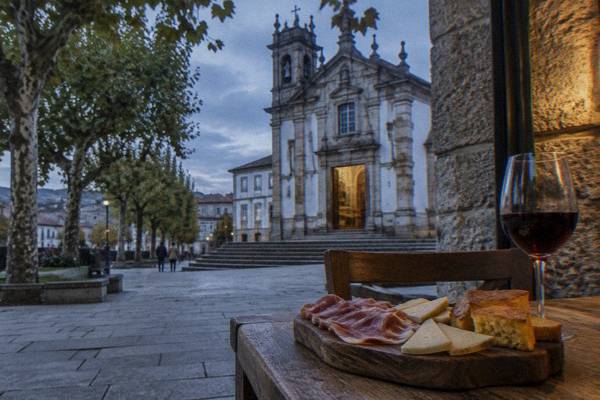
| Charcutaria and regional cheeses | Cured meats and cheeses of the Minho region | As starters or with vinho verde |
Two things to hold onto when reading that table. First, the savoury and sweet traditions are genuinely separate: frigideiras belong to the snack-and-counter world, pudim Abade de Priscos to the restaurant dessert course, and a good day in Braga touches both. Second, the restaurant dishes matter to a pastry crawl only as the savoury spine of the day. The guide to Braga's restaurants covers where that side of the city's food culture sits, and the walking is short enough between them that food and sightseeing stop being separate activities.
For visitors who want the tasting structure without a group, the self-guided option is the cheapest way into the city's food geography. The self-guided scavenger hunt costs from $5.78 per person and runs about two hours through the historic centre, which is the same territory the pastry counters occupy. It is a game rather than a food tour, but it solves the one problem a food crawl has on a first visit: it forces a route through streets you would otherwise wander at random.
How Much Do Braga Food And Walking Tours Cost?
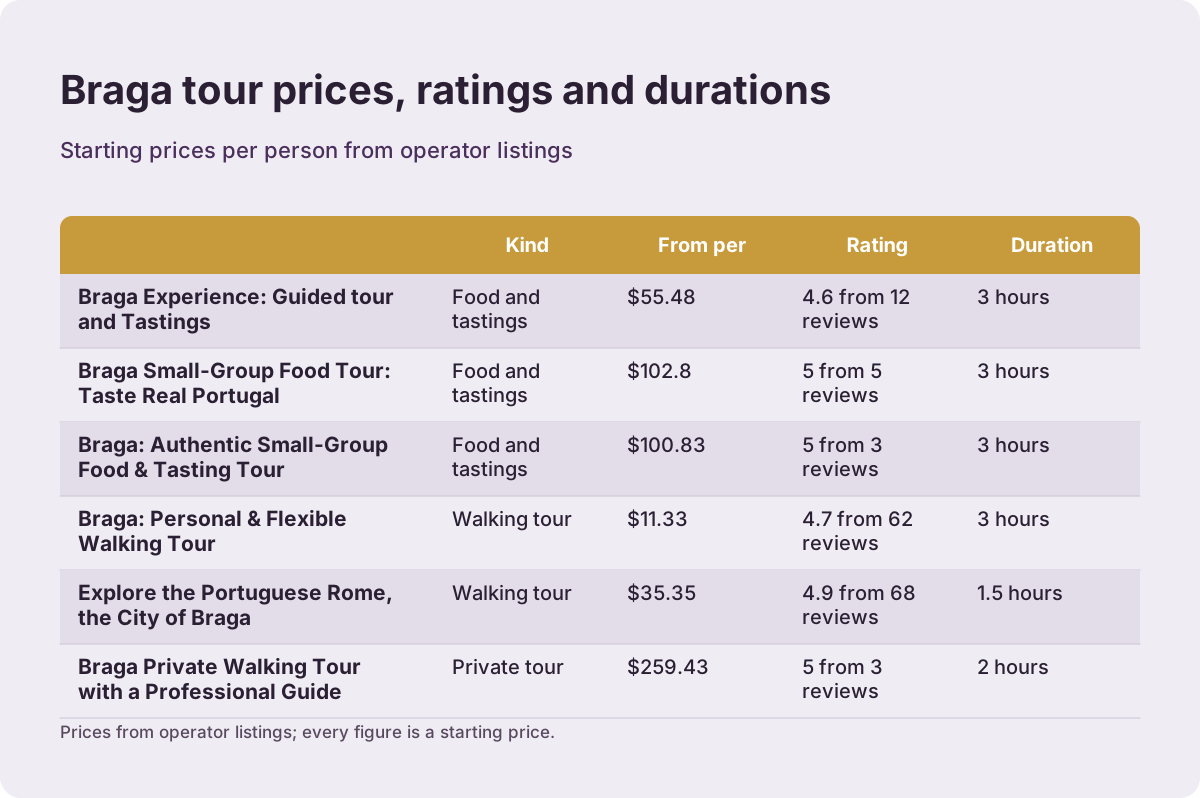
The food and tasting tours listed for Braga run from roughly $55 to $103 per person, and the walking tours that cover the historic centre run from about $11 upwards depending on group size and whether a private guide is included, with the small-group food tour at the top of the price range and the flexible group walking tour at the bottom. Every price below is a starting price from the operator's listing, and ratings and review counts are as the listings state them.
| Tour | Kind | From (per person) | Rating | Duration |
|---|---|---|---|---|
| Braga Experience: Guided tour and Tastings | Food and tastings | $55.48 | 4.6 from 12 reviews | 3 hours |
| Braga Small-Group Food Tour: Taste Real Portugal | Food and tastings | $102.80 | 5 from 5 reviews | 3 hours |
| Braga: Authentic Small-Group Food & Tasting Tour | Food and tastings | $100.83 | 5 from 3 reviews | 3 hours |
| Braga: Personal & Flexible Walking Tour in Historic Center | Walking tour | $11.33 | 4.7 from 62 reviews | 3 hours |
| Explore the Portuguese Rome, the City of Braga | Walking tour | $35.35 | 4.9 from 68 reviews | 1.5 hours |
| Braga Private Walking Tour with a Professional Guide | Private tour | $259.43 | 5 from 3 reviews | 2 hours |
The spread is wide, and it is mostly explained by two variables: how much food is included, and how many people share the guide. The small-group food tours sit at the top because tastings are bought, not walked; the flexible group walking tour sits at the bottom because a larger group shares a single guide's fee. A private tour is a different product again, priced per person for a guide dedicated to your group, and it makes sense mainly for visitors with specific interests or limited time.
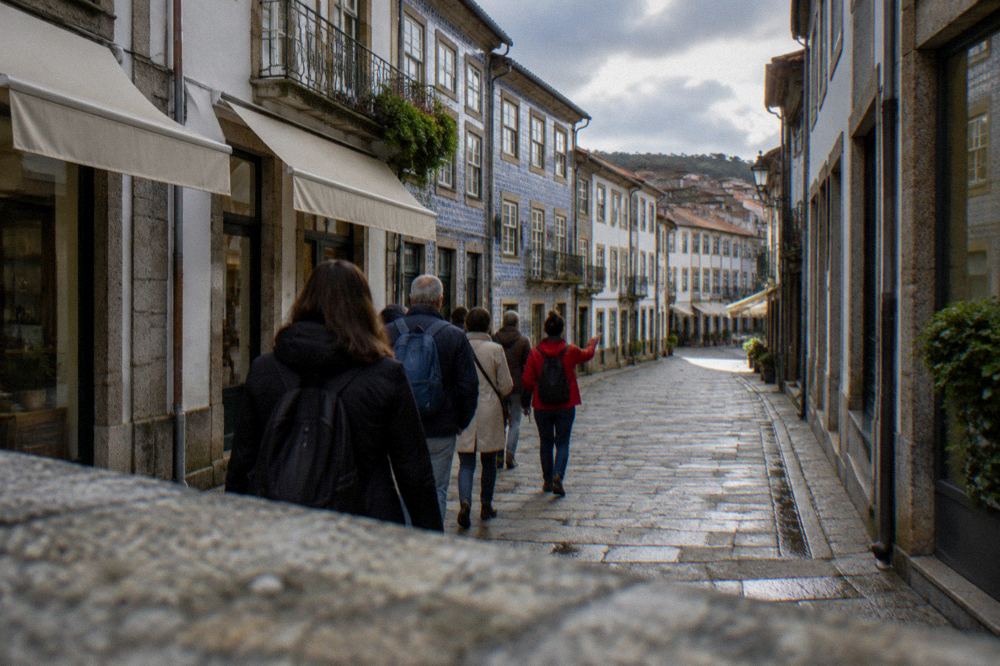
There is also a free layer, and it is a real one. GuruWalk lists several pay-what-you-want walks in Braga, including an essential free tour of the historic centre led by a guru under a blue umbrella, rated 4.58 from 586 reviews, and a green-umbrella equivalent rated 4.75 from 446 reviews. These are tip-based, genuinely free to join, and a fair way to test whether a guided format suits you before paying for a tasting tour. The trade-off is simple: a free walk covers the city, a food tour covers the city plus the contents of its pastry cases.
What Is Vinho Verde And Why Does It Belong On A Braga Pastry Stop?
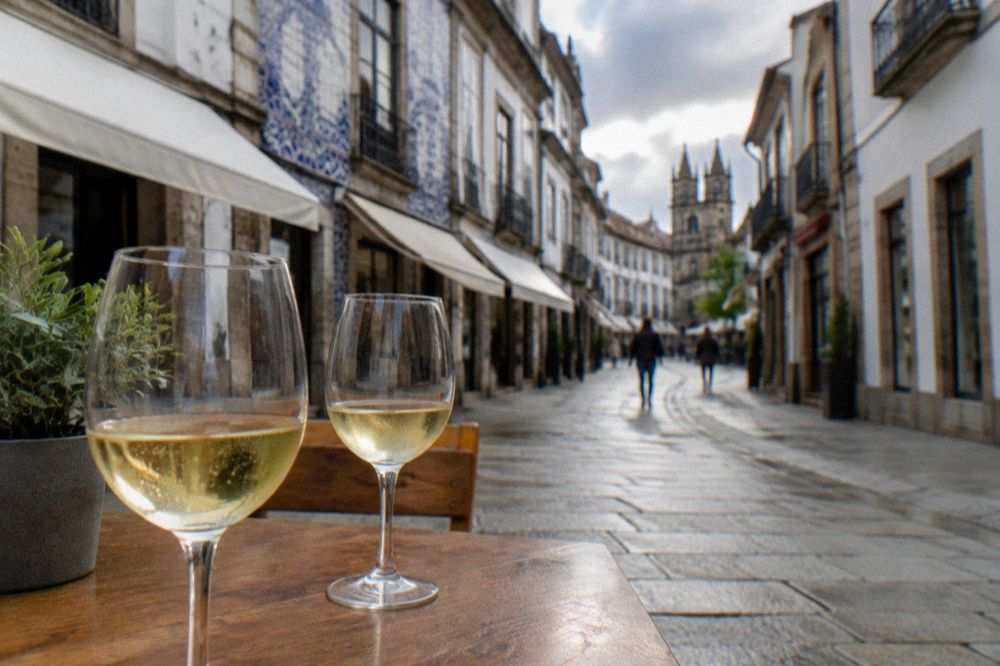
Vinho verde is the wine style of the Minho region of northern Portugal, typically light, fresh and often slightly sparkling, and it is the default regional pour alongside everything from frigideiras to restaurant mains in Braga. It is not a single grape and not a single colour: the style covers white, red and rosé wines from the region, and the slight spritz that many bottles carry is a characteristic of how the wines are made and sold young.
The name means "green wine", but the green is youth rather than colour. The wines are released early, drunk young, and priced as everyday pours, and the region that produces them is the same Minho that Braga sits at the heart of. The pairing logic with pastry is straightforward: a light, slightly sparkling white cuts through fried and flaky dough better than anything heavier, which is why a glass of vinho verde next to a plate of warm frigideiras is such a common sight in the Minho. The site's vinho verde guide covers the style in detail, including the question of whether it is sweet or dry, and no figure for any bottle, vintage or producer belongs on this page because none is verified.
For visitors who want to go to the source, the region's quintas, the wine estates of the Minho, run tastings within reach of the city. The Identity Tasting at Quinta de Santa Cristina is listed from $28.88 per person, rated 4.9 from 47 reviews, and runs about an hour and a half; the monastery wine tour at Mosteiro de Tibães is listed from $63.53 per person and runs about four hours. Both are bookable through the operator's live listing, and both convert a pastry afternoon into a full day built around the same region's produce.
When Is The Best Time To Visit Braga For Its Food Scene?
Late spring through early autumn is the most comfortable window for a food-focused visit to Braga, because the pastry-and-café rhythm of the historic centre is an outdoor, walking activity, and the city's own climate data shows July and August as the warmest and driest months, with mean daily maximums of 28.2 and 28.7 degrees Celsius and only about 28 to 35 millimetres of rain each, while October and December are the wettest months of the year.
The numbers come from IPMA's 1991 to 2020 climate normals for the Braga / Merelim station, and they matter more here than on a generic sightseeing page, because a pastry crawl is weather-exposed in a way a museum visit is not. The counters are indoors, but the walking between them is not.
| Month | Mean daily max (°C) | Mean temp (°C) | Rain (mm) | Days with 1 mm or more |
|---|---|---|---|---|
| March | 17.8 | 11.9 | 150.1 | 11.8 |
| May | 23.0 | 16.7 | 89.8 | 8.9 |
| July | 28.2 | 21.2 | 27.9 | 4.0 |
| September | 26.9 | 19.7 | 67.6 | 6.2 |
| October | 22.2 | 16.1 | 197.8 | 12.0 |
| December | 14.9 | 9.3 | 190.3 | 13.3 |
Read the table before packing. October is the wettest month on average at that station, at 197.8 millimetres, and December is close behind at 190.3, with twelve to thirteen days of measurable rain in each. That does not rule out an autumn or winter visit, and the guide to Braga in December makes the case for the city's cold-season charms, but it does mean a pastry crawl planned for October should assume some rain and build indoor café time into the route deliberately rather than by accident.
The event calendar adds a second layer. Braga's food traditions are at their most public during the city's festivals: Semana Santa, the Holy Week processions that in 2026 ran from 29 March to 5 April, fills the historic centre with visitors and changes the rhythm of every café on the processional routes; the Festas de São João, which in 2026 ran from 17 to 24 June with the peak night on 23 June into the 24 June municipal holiday, puts sard grills and street food into the same streets that carry pastry counters the rest of the year. No 2027 dates for any of these festivals are announced, so plan against the pattern, not a calendar: Holy Week moves with Easter, São João peaks on the night of 23 June, and the best-time-to-visit guide works through the trade-offs in full.
How Do You Get Around Braga For A Pastry Crawl?
You walk. Braga's historic centre is compact and largely pedestrianised, and every pastry counter that matters sits within a few minutes on foot of the others, so the only transport decision most visitors face is the trip in from the train or bus station and the bus up to Bom Jesus do Monte, which is TUB Line 2 from the centre to the foot of the stairway.
A TUB tourist ticket covers the whole city network at 3.35 euros for one day, 6.05 for two and 8.05 for three.
The TUB tariff, in force since 21 February 2026, makes the arithmetic simple for a food-focused stay.
| TUB ticket | Price per person | Notes |
|---|---|---|
| Tourist ticket, 1 day | 3.35 EUR | Whole network, one person |
| Tourist ticket, 2 days | 6.05 EUR | Whole network, one person |
| Tourist ticket, 3 days | 8.05 EUR | Whole network, one person |
| Group of 5, 1 day | 13.95 EUR | 2.79 EUR per person |
| Group of 10, 1 day | 25.85 EUR | 2.59 EUR per person |
| On-board single, 1 zone | 1.55 EUR | Bought from the driver |
For a pastry crawl the single-day tourist ticket is usually enough, and often unnecessary at all: the historic centre's counters are closer together than the walk from most hotel doors to the first one. The ticket earns its price when Bom Jesus do Monte enters the plan, because the sanctuary sits on the hill above the city and TUB Line 2 is the regular service that ends at the Pórtico at the foot of the stairway. One standing caveat for anyone combining pastry and pilgrimage: the Bom Jesus funicular has been out of service since 26 September 2026 with no end date published, and a replacement shuttle runs every day between the Pórtico and the sanctuary, so check the operator's notice before promising anyone the ride. The getting-around guide covers the full picture.
One cost that surprises visitors is not transport at all. Braga levies a municipal tourist tax of 1.55 euros per person per night, for up to four nights, all year, charged by hotels and local accommodation to guests aged 16 and over, and it is separate from the room rate. It is worth knowing before the bill arrives, and the comparison with the rest of northern Portugal is a fair one to make.
| City | Tourist tax per night | Max nights | Applies from age |
|---|---|---|---|
| Braga | 1.55 EUR | 4 | 16 |
| Porto | 3.00 EUR | 7 | 13 |
| Guimarães | 1.50 EUR | 2 | 21 |
| Viana do Castelo | 1.50 EUR high season / 1.00 EUR low season | 5 | 17 |
Tipping, for completeness, follows the national norm rather than a local one: Turismo de Portugal's own guidance is that service is included in restaurant bills, though it is customary to leave an additional tip of about 5 to 10 percent, and normal to tip taxi drivers 5 to 10 percent or round up to the nearest euro. A pastry bought at a counter needs no tip at all.
Should You See The Sights Between The Pastry Stops?
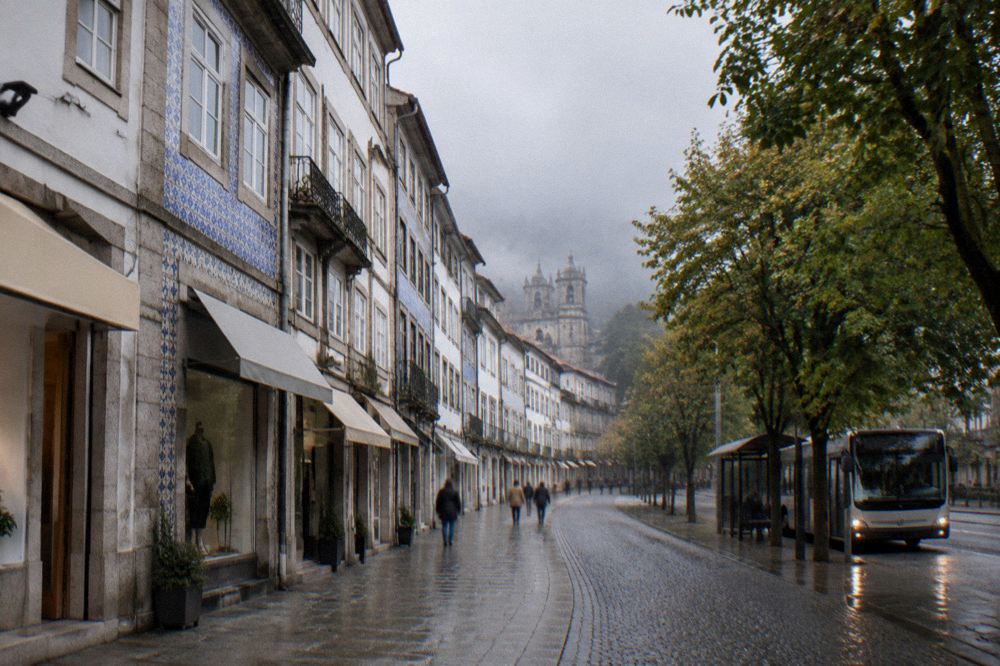
Yes, and in Braga the sights and the food occupy the same few streets, so the choice is not really between them: the Sé de Braga cathedral's three visit routes cost 3.00 euros each or 7.00 euros for all three combined, the historic centre's baroque churches are free to enter outside service times, and a walking tour that explains the city between tastings costs from about 11 dollars, meaning a full day of food and architecture costs less than a single dinner in many European cities.
The cathedral is the anchor. Its ticket office sells three separate routes, the Treasury-Museum, the chapels and high choir, and the cathedral itself, at 3.00 euros each, with any two combined for 6.00 euros and all three for 7.00 euros, and visits are suspended during services. That is the one paid interior in the centre that a food-focused visitor most often adds, and it sits a few minutes' walk from the main café streets. The Braga churches guide and the free things to do guide cover the rest of the ecclesiastical inventory, which in this city is considerable.
For visitors who want the architecture explained rather than merely walked past, the small-group options are the natural fit. The Explore the Portuguese Rome walking tour runs from $35.35 per person, rated 4.9 from 68 reviews over about 90 minutes, and the private walking tour with a professional guide runs from $259.43 per person for a dedicated two-hour walk. Both are bookable on the operator's live listing, and both route through the same historic-centre streets that carry the pastry counters, which is the entire point: in Braga, the sightseeing and the eating are the same walk.
For a fuller comparison of the city's guided options, the Braga walking tours guide lays out the whole roster, and this site's Braga Travel Guide homepage carries the wider destination coverage from airport transfers to day trips into the Minho.
Common Questions About Frigideiras And Braga Pastries
What are frigideiras?
Small round pastries of flaky dough wrapped around a filling of seasoned minced meat, served warm, and the best-known savoury pastry of Braga in northern Portugal. They are sold by the piece or by weight at café counters in the historic centre, most famously at the Café A Brasileira landmark, and they are eaten as a snack rather than a meal.
Are frigideiras sweet or savoury?
Savoury. The filling is seasoned minced meat, which sets frigideiras apart from nearly everything else in a Braga pastry case, where the egg-yolk and sugar desserts of the convent tradition dominate. The sweet counterpart on most Minho menus is pudim Abade de Priscos, a caramel egg pudding, sugar and bacon fat.
What is pudim Abade de Priscos?
A dense caramel pudding of the Minho region made with eggs, sugar, caramel and bacon fat, carrying the name of an abbot, which places its origins in the region's monastic kitchen tradition. It is served chilled as a restaurant dessert in Braga and across northern Portugal. No verified date of invention exists, and any specific one printed elsewhere should be treated as legend rather than fact.
Where can you buy frigideiras in Braga?
At café and pastry counters in the historic centre, with the Café A Brasileira the most famous address. This site publishes no ranking, address list or opening hours for individual venues in Braga, because none was verified for this build; the practical advice is to walk the pedestrianised Rua do Souto and the streets immediately around it and buy from any counter with frigideiras warm in the case.
What should you drink with frigideiras?
Vinho verde, the Minho region's wine style, typically light, fresh and often slightly sparkling, is the default regional pour and works well against fried, flaky pastry. A coffee at the counter is the other traditional pairing, and both are everyday purchases rather than occasion ones.
How much does a food tour in Braga cost?
The tasting and food tours listed for Braga start from $55.48 per person for three hours, the group walking tours from $11.33, and a private guided walk from $259.43 per person. GuruWalk also lists free, tip-based walks of the historic centre. Every price is a starting price on the operator's live listing, and free cancellation terms are shown there before you pay.
The short version of all of this: frigideiras are the savoury key that unlocks Braga's pastry case, pudim Abade de Priscos is the sweet one that proves the region's convent lineage, and the historic centre packs both into a walk measured in minutes rather than kilometres, which is why a food-focused visit to Braga tends to end with more eaten than planned.