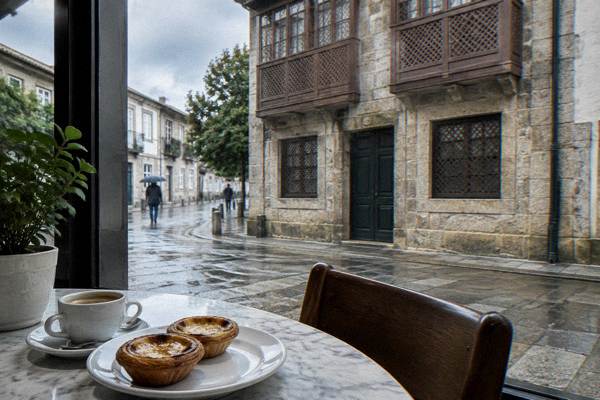
A Brasileira Cafe In Braga
A Brasileira is one of Braga's best-known cafes, a landmark of the historic centre in the Minho region of northern Portugal, and a natural pause on any walk through the city.
Short answer
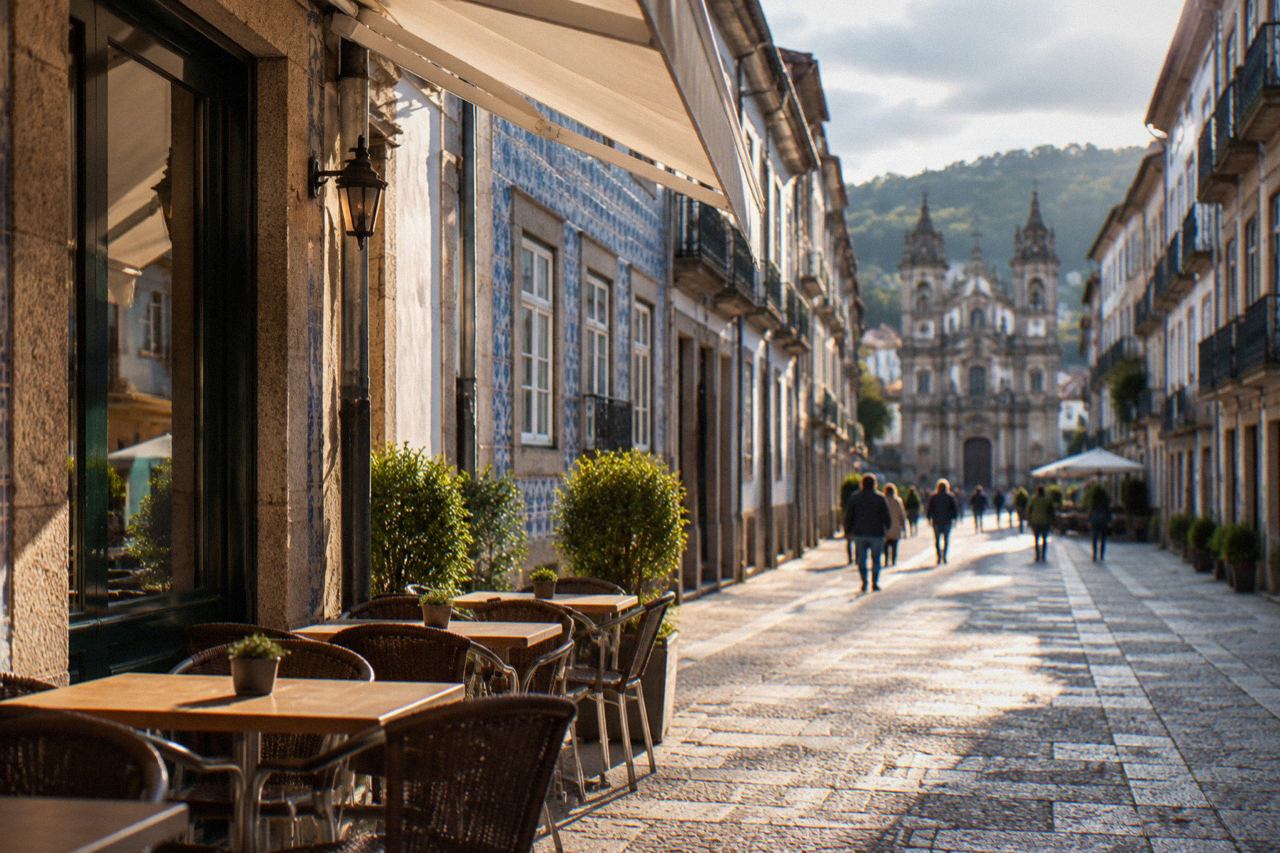
A Brasileira is a famous cafe in the centre of Braga, Portugal, known as a meeting point and coffee house. It is the kind of stop that anchors a visit: order a coffee at the counter or a table, try a local pastry, then continue to the cathedral, Rua do Souto or the Santa Bárbara Garden.
Braga, the city in Portugal's Minho region, packs its historic centre with churches, baroque facades and busy pedestrian streets, and few stops in it are as familiar to locals as A Brasileira. The cafe is a landmark of the city, a name that comes up in almost any conversation about where to pause for a coffee between the cathedral and the shopping streets. This page from Braga Travel Guide explains what the cafe is, what to order once you are seated, and how to build a full day around it, with verified ticket prices and hours for the sights you will pass on the way.
What Is A Brasileira In Braga?
A Brasileira is a landmark cafe in the historic centre of Braga, Portugal, one of the city's best-known meeting points and coffee houses. It belongs to the classic Portuguese tradition of the grande cafe: an ornate interior, a terrace or counter service, and a menu built on coffee, pastries and light meals. It is a place to understand as much as to visit, because the cafe ritual sits at the centre of daily life in the Minho region.
Portugal's cafe culture grew out of the coffee trade with Brazil, and the name "A Brasileira", meaning "the Brazilian one", is one of the most recognisable cafe names in the country. Several Portuguese cities have a cafe with this name, and each is its own institution. The Braga cafe stands on its own reputation as a fixture of the city centre, a spot where people meet before a walk, stop mid-morning for a coffee, or end an evening.
What makes the cafe worth a place in a Braga itinerary is not a single exhibit or ticketed interior but its position in the rhythm of the city. Braga is a walkable city whose centre is threaded by pedestrian streets, and a cafe like A Brasileira functions as a natural pause between the Sé de Braga, the Rua do Souto shopping axis and the gardens and museums a few minutes away. You do not plan a whole day around it, but almost any good day in Braga ends up passing it.
For first-time visitors, the practical value is simple: it is an easy, low-pressure place to try the way Braga drinks coffee. Portuguese cafe service is fast, unhurried but efficient, and the counter is as legitimate as the table. Order a bica, the Portuguese espresso, or a garoto, an espresso softened with a splash of milk, and you are drinking what the city drinks.
How Does A Brasileira Fit Into A Walk Through Braga?
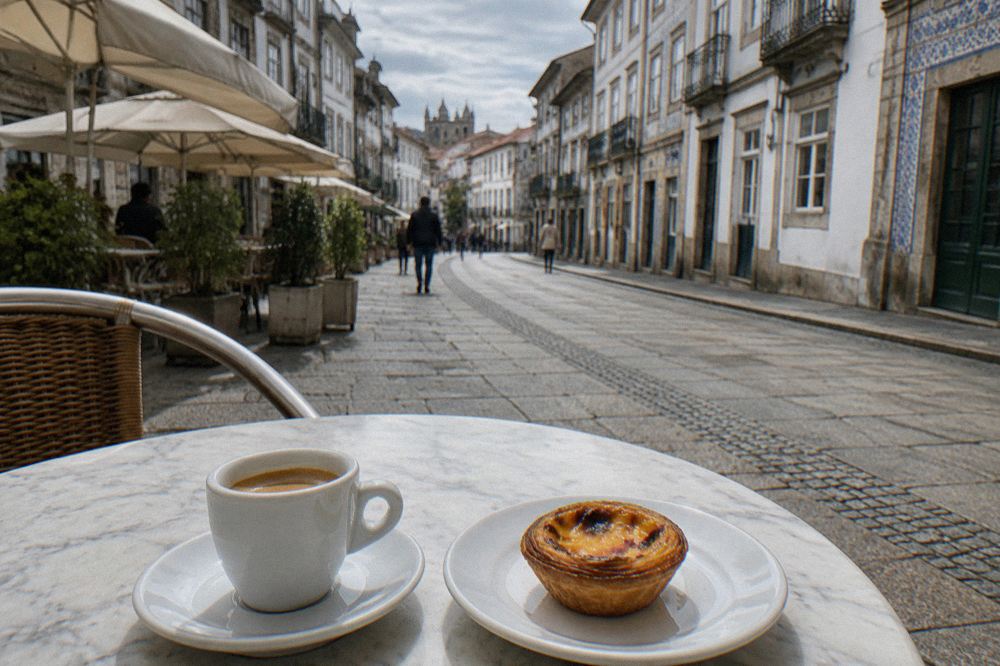
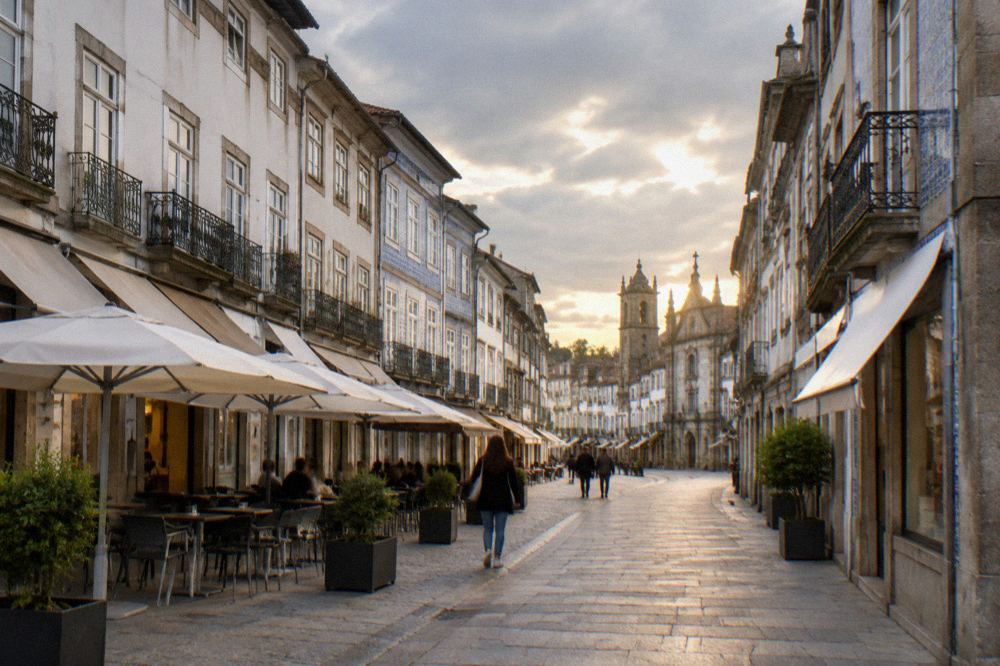
A Brasileira sits in the compact core of Braga, Portugal, within walking distance of nearly everything a visitor comes to see: the cathedral is minutes away on foot, the Rua do Souto pedestrian axis runs close by, and the Santa Bárbara Garden, the Arco da Porta Nova and several museums all sit in the same central belt. The cafe works best as a mid-walk stop rather than a destination in itself.
The historic centre of Braga is small enough that a visitor can cross it in a quarter of an hour at an easy pace, and the cafe lands in the middle of that walkable rectangle. A natural route runs from the Sé de Braga down through the pedestrian shopping streets, past the cafe, and on to the Praça da República. From there the Santa Bárbara Garden and the Arco da Porta Nova extend the stroll without any transport at all.
A guided walk is one way to give that core some structure, and a food-and-sightseeing combination suits this part of the city especially well. The Braga Experience: Guided tour and Tastings pairs the historic centre with stops built around local flavours, runs about three hours, and starts from $55.48 per person; Check availability on the operator's live listing. A lighter option is the flexible walking tour of the historic centre, and a tuk tuk tour covers the same ground for anyone who prefers to ride.
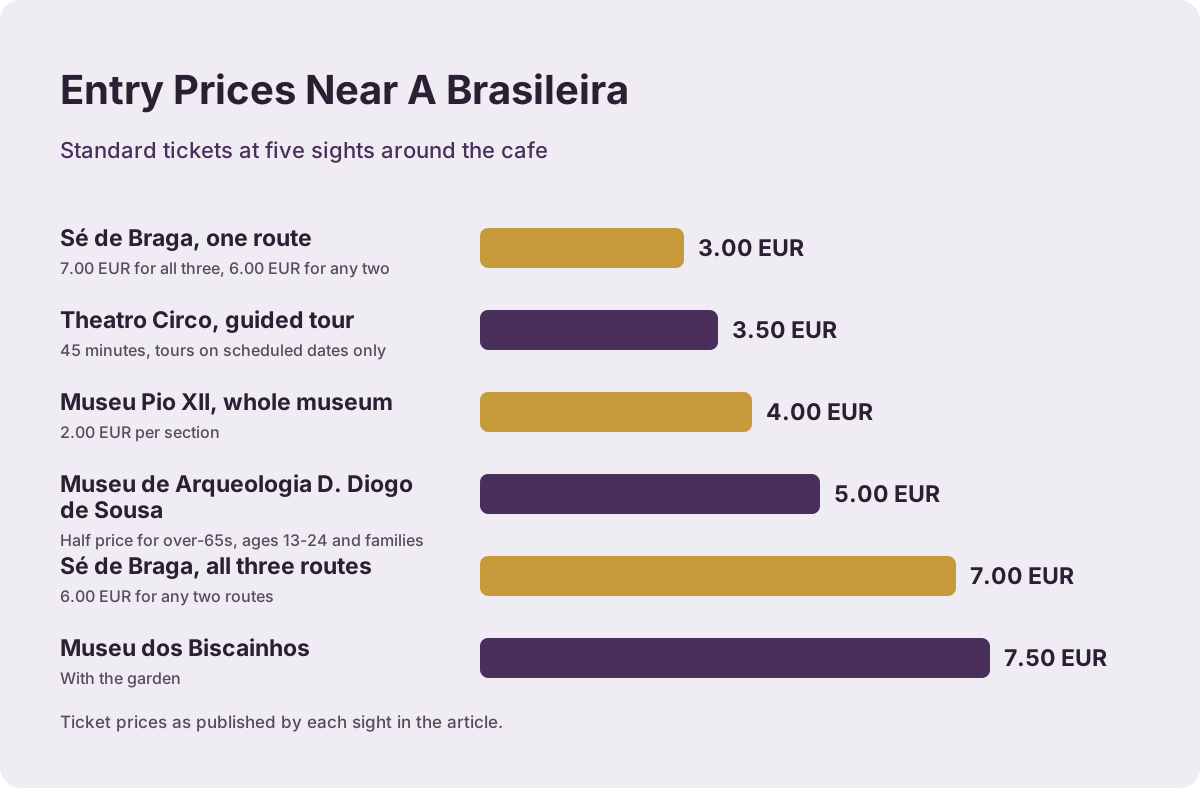
The table below shows how the central sights line up around the cafe, with the verified ticket prices and hours for each.
| Sight | What it is | Ticket | Hours |
|---|---|---|---|
| Sé de Braga | The city's cathedral, with three visit routes | 3.00 EUR per route, 7.00 EUR for all three, 6.00 EUR for any two | Mon-Sat 09:30-13:00 and 14:30-17:00, Sun 09:30-10:45 and 14:30-17:00 |
| Museu dos Biscainhos | Decorative arts museum in a baroque palace | 7.50 EUR with the garden | Tue-Sun 10:00-12:30 and 14:00-17:30 |
| Museu de Arqueologia D. Diogo de Sousa | Regional archaeology museum | 5.00 EUR, half price for over-65s, ages 13-24 and families | Tue-Sun 10:00-17:30 |
| Museu Pio XII | Museum with a medieval tower | 4.00 EUR for the whole museum, 2.00 EUR per section | Tue-Sat 09:30-12:30 and 14:00-18:00 |
| Theatro Circo | Ornate theatre with guided visits | Guided tour 3.50 EUR, 45 minutes | Tours on scheduled dates only |
One planning note that matters: the cathedral's interior closes to tourists during services, and the building itself opens earlier for worship than the tourist-visit window, so treat the hours above as the visiting hours rather than the building's whole day.
What Should You Order At A Brasileira?
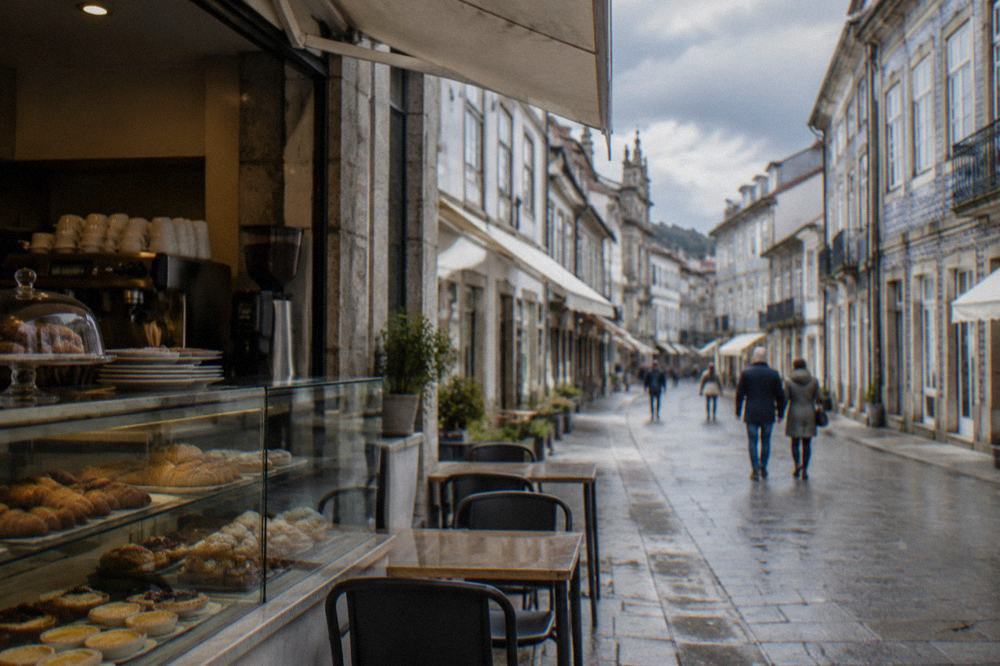
Order coffee the Portuguese way: a bica (espresso), a garoto (espresso with a dash of milk), a meia de leite (half coffee, half milk) or a galão (coffee topped with steamed milk in a glass). Pair it with the pastry Braga is famous for, and if you are staying for more than a coffee, the cafe menu format in Portugal covers toasts, soups and light plates at any hour of the day.
The coffee vocabulary is small and worth learning before you order. A bica is the short, strong espresso; a carioca is the same but weaker, with more water and less punch; a galão comes in a tall glass and is the mildest of the lot; a meia de leite is the closest thing to a flat white in a cup. Ordering at the counter is normal and cheaper in most Portuguese cafes, and nobody expects you to linger over a single bica for an hour, though you absolutely can.
The pastry counter is where Braga's own traditions show up. The city's signature sweet is the pudim Abade de Priscos, a rich caramel pudding with a savoury undertone that belongs to the Minho rather than to the national canon, and the region's frigideiras, small pastries filled with minced meat, sit on the savoury side of the same counter. Beyond the local specialities, the standard Portuguese cafe pastries, from the custard tart to the simple buttery pastel, are always in play.
| Order | What it is | When it fits |
|---|---|---|
| Bica | Short strong espresso, the default coffee | Any time of day, at the counter or the table |
| Garoto | Espresso with a splash of milk | The mid-morning standard |
| Galão | Coffee with steamed milk in a tall glass | Breakfast, with toast or a pastry |
| Meia de leite | Half coffee, half milk, in a cup | The breakfast compromise |
| Pudim Abade de Priscos | Braga's caramel pudding, the city's signature dessert | After a meal, or as the point of the stop |
| Frigideiras | Small baked pastries with a minced-meat filling | A savoury snack with a coffee |
If the stop turns into a meal, Portuguese cafe food is straightforward and honest: soups, tostas (grilled ham and cheese), bifanas (pork sandwiches) and often a short list of pratos do dia, the daily plates. Braga's restaurant tradition runs deeper than any cafe kitchen, and the dishes the Minho is known for, from bacalhau a Braga, shredded salt cod bound with egg and fried potatoes, to the slow-cooked pork of rojões, belong to the city's restaurants rather than to its coffee counters. The cafe is the place for the small rituals; save the big plates for lunch or dinner.
For visitors who want those traditions explained rather than just served, a guided tasting walk does the job well. The Braga Experience tour includes tastings alongside the sights, and the same operator family of small-group food tours in the city runs about three hours.
The tour pairs well with the cafe for a simple reason: it covers the ground first, so the coffee stop afterwards lands with context. A guide who has explained the city's monastic sweet-making traditions, the role of the convent kitchens in Portuguese pastry, and the vinho verde that the Minho drinks with everything turns a pastry counter into a menu of stories. Book the morning slot, take the cafe at midday, and the afternoon is free for the museums or the hill.
Is A Brasileira In Braga The Same As The Famous Lisbon Cafe?
No, the Braga cafe is its own establishment, not a branch of the better-known A Brasileira in Lisbon. The name is shared by several historic Portuguese cafes, a legacy of the coffee trade with Brazil, and each one is a separate house with its own history. In Braga the name stands for a local landmark in the city centre, and visitors should not arrive expecting the Lisbon cafe's interior or its particular fame.
The shared name trips people up. The Lisbon A Brasileira on the Chiado is one of the most photographed cafes in Portugal, associated with the poet Fernando Pessoa and the bronze figure at its terrace table. Braga's cafe trades on the same naming tradition but on a different reputation: it is known as a meeting point and a fixture of the city's daily life rather than as a literary monument.
For a visitor, the distinction is mostly liberating. The Braga cafe does not come with a queue of photographers, and it delivers the thing a traveller actually wants from a Portuguese cafe: a proper coffee, a pastry, and a seat in the middle of a working city. Treat it as Braga's own institution and judge it on its own terms.
It also helps to place the cafe within Braga's wider cafe scene. The city has a strong coffee-house tradition, from old-school pastelarias to modern specialty espresso bars, and the Rua do Souto pedestrian axis and the streets around the Praça da República hold most of them. A Brasileira is the name with the landmark status, but a cafe crawl through the centre is easy to improvise.
| Cafe stop type | What you get | Where it fits in Braga |
|---|---|---|
| The landmark cafe | A historic name, central location, full pastry counter | The scheduled pause, the meeting point |
| The neighbourhood pastelaria | Counter coffee, hot pastries, zero ceremony | The second coffee of the day |
| The pastry specialist | Regional sweets, including the pudim Abade de Priscos | Dessert as a destination |
| The modern espresso bar | Specialty beans, slower service | The afternoon slow-down |
What Else Sits Within A Few Minutes Of A Brasileira?
Almost everything in central Braga sits within a short walk of the cafe: the Sé de Braga, the Santa Bárbara Garden, the Arco da Porta Nova, the Praça da República, the Museu dos Biscainhos and the Theatro Circo are all in the same central belt, and the Bom Jesus do Monte sanctuary is a bus ride out on its hill. The cafe is effectively the middle of the map for a day's sightseeing.
Start with the cathedral, because it is the city's single most important building. The Sé de Braga sells its visits as three routes, each 3.00 EUR on its own, with a combined ticket at 7.00 EUR for all three and 6.00 EUR for any two. The routes cover the Treasury-Museum, the funerary chapels and high choir, and the cathedral itself, and tickets are bought at the reception point in the cloister, reached from Rua do Cabido or the side entrance by Rua D. Diogo de Sousa. Visits are suspended during services, so check the day's schedule if the interior matters to you.
From the cathedral, the walk rolls downhill through the pedestrian streets. The Rua do Souto is the main car-free shopping axis, and the Praça da República at its heart is the city's outdoor living room, ringed with terraces. The Santa Bárbara Garden offers the green pause, a small formal garden beside a church, and the Arco da Porta Nova marks the old gate into the medieval city.
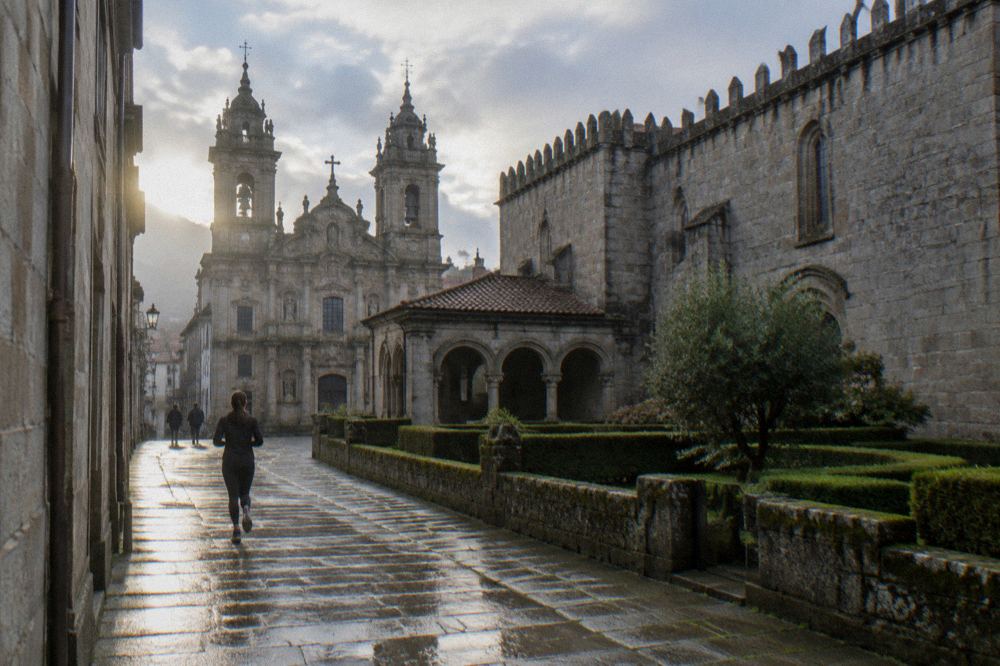
The museums fill the gaps in bad weather. The Museu dos Biscainhos, a baroque palace with a garden, charges 7.50 EUR and opens Tuesday to Sunday; the Museu de Arqueologia D. Diogo de Sousa covers the Roman past of the region for 5.00 EUR; the Museu Pio XII with its medieval tower costs 4.00 EUR for everything. The Theatro Circo runs guided tours on scheduled dates at 3.50 EUR, a 45-minute look inside one of the country's loveliest theatres.
Then there is the hill. Bom Jesus do Monte, the UNESCO-listed sanctuary, stands above the city with its monumental stairway of 566 steps by the Confraria's count, and TUB Line 2 runs from the centre to the Portico at the foot of the climb. The funicular has been out of service since 26 September 2026 with no end date published, and a replacement shuttle runs daily between the Portico and the sanctuary, so check the operator's notice before counting on a ride.
| Direction from the cafe | Sights in that belt | Ticket notes |
|---|---|---|
| Uphill to the cathedral | Sé de Braga, Treasury-Museum, chapels and choir | 3.00 EUR per route, 7.00 EUR combined |
| Through the pedestrian core | Rua do Souto, Praça da República, Arco da Porta Nova | Free to walk |
| The garden and museum belt | Santa Bárbara Garden, Museu dos Biscainhos, Museu Pio XII | Garden free, museums 7.50 and 4.00 EUR |
| Out to the hill | Bom Jesus do Monte, the stairway, the funicular halt | Sanctuary grounds free; check the shuttle notice |
When Is The Best Time To Pause At A Brasileira?
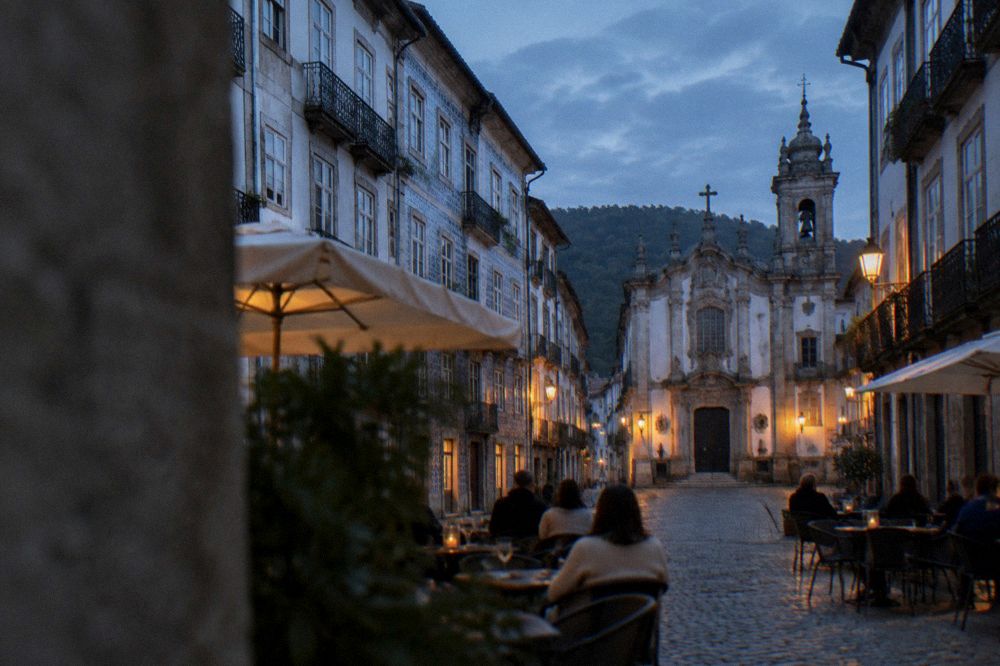
Mid-morning, between roughly ten and noon, is the classic Portuguese cafe hour, when the counter fills with locals taking a bica between errands, and mid-afternoon is the second natural slot, the lanche, when pastries and a galão bridge the gap to dinner. Evenings shift the cafe toward terrace mode as the pedestrian streets empty of shoppers and fill with people out for a stroll.
The Portuguese day has its own clock, and it rewards anyone who follows it. Breakfast is light, often nothing more than coffee and a pastry, so the mid-morning coffee is the first real pause of the day. Lunch is the main restaurant sitting, generally earlier than in northern Europe. The afternoon lanche, the snack around four or five, keeps the cafes busy again, and dinner in the Minho runs late.
For a visitor, that means the cafe is at its most alive when the city is: mid-morning on a weekday, when the counter crowd is genuine, and late afternoon into the evening, when the terraces fill. The quietest stretch is usually the early afternoon, when Braga eats lunch and the shopping streets go calm, and that is the moment for an unhurried table rather than a quick counter stop.
Season matters less for a cafe than for a hilltop sanctuary, but it shapes the walk on either side of the coffee. IPMA's 1991 to 2020 normals for the Braga / Merelim station show July as the driest month of the year on average and October as the wettest, with 12 to 13 rain days a month from October through January. A rainy-day plan built around the cathedral, the museums and a long cafe stop is a genuinely Bragança-style answer to an October afternoon, and the best time to visit Braga question has its own page.
Festival weeks change the atmosphere entirely. During Semana Santa, the Holy Week processions that give Braga a national reputation, the centre fills with visitors and the streets around the processional routes are transformed; in late May, Braga Romana turns parts of the centre into a Roman market camp. A cafe stop in those weeks comes with street theatre as a backdrop, and terraces fill early.
Can You Visit A Brasileira With A Tour In Braga?
Yes, several Braga tours pass through the same central streets where the cafe sits, and a food-focused guided walk is the most natural pairing, because it explains the pastries and the coffee culture instead of just walking past them. The city's small-group food tours, its flexible historic-centre walks and its tuk tuk circuits all cover the core where A Brasileira is a landmark.
The food-tour family is the obvious match. The Braga Experience: Guided tour and Tastings, from $55.48 per person and rated 4.6 from 12 reviews, runs about three hours and mixes the historic centre with local tasting stops, and the small-group food tours led by local guides run in the same territory. The flexible walking tour of the historic centre, from $11.33 per person, is the budget option for a guided version of the same streets, and the tuk tuk city tour, from $22.66 per person, suits anyone who wants the circuit without the legwork.
Guided walks earn their price in the centre of Braga for one reason: the city's history is layered and mostly unlabelled. The Roman past under the streets, the baroque rebuilding that shaped the churches, the story of the archbishopric that gave the city its wealth, all of it reads better with someone pointing at the right facade. The Braga walking tours page compares the options in detail.
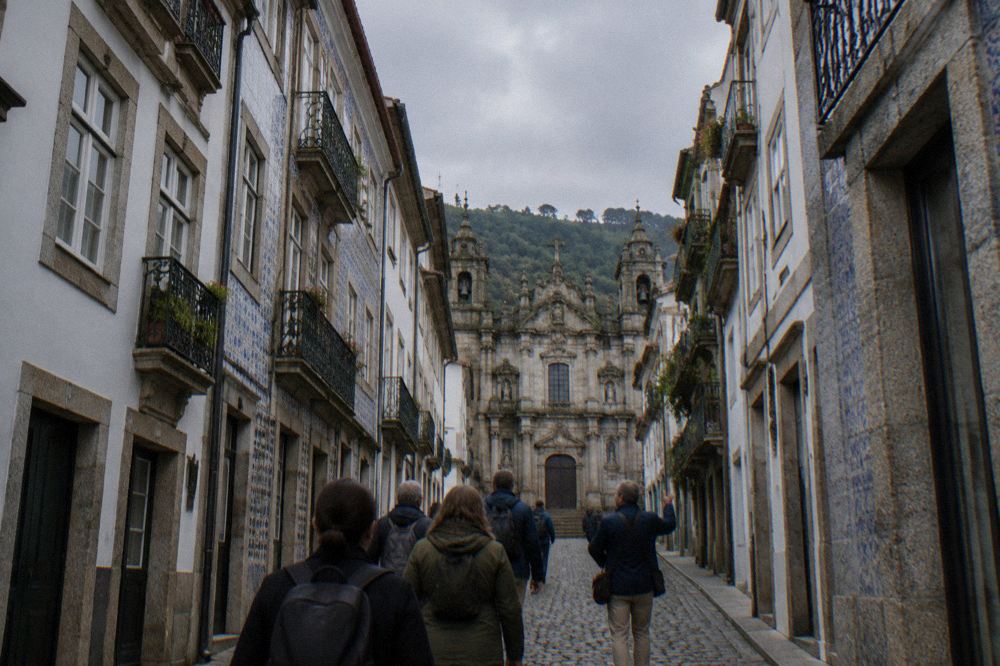
The table below compares the central-Braga tour types that fit a day built around the cafe.
| Tour type | From (per person) | Length | Best for |
|---|---|---|---|
| Guided tour with tastings | $55.48 | 3 hours | Combining sights with food and wine traditions |
| Flexible historic-centre walk | $11.33 | 3 hours | A guided overview on a small budget |
| Tuk tuk city tour | $22.66 | 30 minutes to 2 hours | Covering the centre without walking it |
| Self-guided scavenger hunt | $5.78 | 2 hours | Families and puzzle-minded visitors |
A note on how the pieces fit: none of these tours is a cafe tour, and none promises a seat at A Brasileira. What they do is put a guide in the streets around it, which turns the coffee stop from a pause into a punctuation mark on a story. Book the walk for the morning, take the cafe at midday, and give the afternoon to the museums or the hill.
For visitors arriving from Porto on a day trip, the same logic applies with a clock attached. The Braga day trip from Porto compresses the centre into a single day, and a cafe stop is the most efficient rest available, because everything else on the list is walking. The things to do in Braga roundup carries the full menu of options for longer stays.
How Much Does A Day Around A Brasileira Cost In Braga?
A full day built around the cafe and the central sights costs about 15 to 20 EUR per person in attraction tickets, if you take the cathedral's combined 7.00 EUR ticket, one museum at 4.00 to 7.50 EUR and the Theatro Circo tour at 3.50 EUR, plus whatever you spend in the cafe itself, which is a separate matter of taste. Transport inside the centre is free on foot, and the TUB tourist ticket covers the buses if you branch out.
Braga is not an expensive city to sightsee, and the numbers are transparent. The cathedral's three-route combined ticket at 7.00 EUR is the single biggest line, and it is worth it: the Treasury-Museum and the chapels are the parts visitors remember. Museums run 4.00 to 7.50 EUR at the top of the range, and the garden and the pedestrian core cost nothing.
The TUB tourist ticket is the one multi-use transport product worth knowing about: 3.35 EUR for one day of the whole urban network, 6.05 EUR for two days and 8.05 EUR for three, per person, with the tariff in force since 21 February 2026. There is no city attraction pass on sale in Braga, so buy each ticket separately; the bus ticket is the only pass-shaped product that exists.
One more line belongs on the bill: the municipal tourist tax. Braga charges 1.55 EUR per person per night, up to a maximum of 4 nights, all year, charged by hotels and local accommodation. It is small, but it is real, and it applies whatever the booking channel.
| Item | Cost | Notes |
|---|---|---|
| Sé de Braga, all three routes | 7.00 EUR | Any two routes cost 6.00 EUR |
| Museu dos Biscainhos | 7.50 EUR | Garden included |
| Museu Pio XII, whole museum | 4.00 EUR | Tower and galleries 2.00 EUR each |
| Museu de Arqueologia D. Diogo de Sousa | 5.00 EUR | Half price for over-65s, 13-24s and families |
| Theatro Circo guided tour | 3.50 EUR | Scheduled dates only, 45 minutes |
| TUB tourist ticket | 3.35 EUR per day | 6.05 EUR for 2 days, 8.05 EUR for 3 |
| Municipal tourist tax | 1.55 EUR per person per night | Maximum 4 nights, all year |
Common Questions About A Brasileira In Braga
What is A Brasileira in Braga?
A Brasileira is a landmark cafe in the historic centre of Braga, Portugal, one of the city's best-known coffee houses and meeting points. It belongs to the classic Portuguese cafe tradition, with a menu built on coffee, pastries and light meals, and it sits within a short walk of the cathedral, the pedestrian shopping streets and the main museums.
Is A Brasileira in Braga the same cafe as the one in Lisbon?
No. The name is shared by several historic Portuguese cafes, a legacy of the coffee trade with Brazil, and each is a separate establishment. The Braga cafe is its own local institution, known as a fixture of the city centre, and it is not a branch of the famous Chiado cafe in Lisbon.
What should you order at A Brasileira?
Order coffee the Portuguese way: a bica (espresso), a garoto (espresso with a dash of milk), a meia de leite or a galão (coffee with steamed milk). Pair it with a pastry, and if you want the local sweet, ask for the pudim Abade de Priscos, a caramel egg pudding. Prices and hours change, so check the cafe's own notice before you go.
Is A Brasileira a good stop with kids or a short visit?
Yes. A cafe stop is the most flexible item on any Braga itinerary: it takes as little as ten minutes at the counter or as long as you like at a table, and the pastry counter does the persuading with children. It also sits in the middle of the walkable centre, so it slots into a short visit without detouring.
Can a guided tour include a stop at A Brasileira?
Guided tours of Braga's historic centre cover the streets around the cafe, and food-focused tours such as the Braga Experience: Guided tour and Tastings include local tasting stops, though no tour guarantees a seat at this particular cafe. Ask the operator what the route covers when you book.
How far is A Brasileira from the cathedral and Bom Jesus do Monte?
The cafe sits in the central belt of Braga, a few minutes on foot from the Sé de Braga and the pedestrian core. Bom Jesus do Monte is outside the centre on its hill; TUB Line 2 runs to the Portico at the foot of the sanctuary stairway, and the funicular has been out of service since 26 September 2026, with a replacement shuttle running daily, so check the operator's notice before you go.
A Brasileira earns its place in a Braga day the way the best cafes do: by being exactly where you need it, exactly when the walking catches up with you. Order the bica, take the pastry, and let the rest of the city carry on around the table.