Braga History
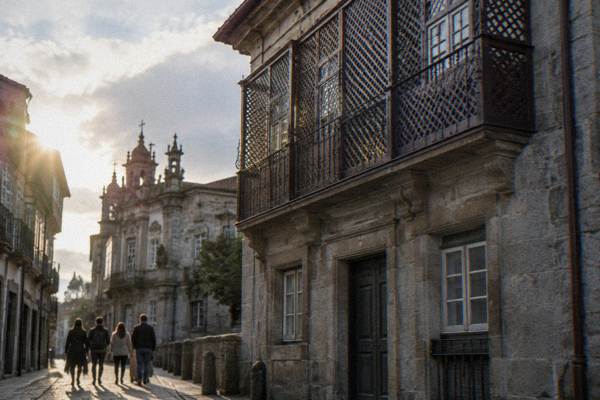
Braga, the city in Portugal's Minho region, packs two thousand years of history into a walkable centre: Roman remains, a medieval cathedral, a UNESCO-listed hill sanctuary and festivals that still follow the liturgical calendar.
Short answer
Braga's recorded history runs from the Roman city of Bracara Augusta, through a medieval archiepiscopal seat built around the Sé de Braga, to the baroque Escadório do Pórtico at Bom Jesus do Monte, inscribed by UNESCO in 2019. The funicular there dates from 1882, and the city's Holy Week processions are held every year in the week before Easter.
Braga, the city in Portugal's northern Minho region, is one of those places where the past is not kept behind glass. The recorded story begins with Roman Bracara Augusta, whose name survives in the modern city, and it runs forward through a medieval cathedral, a baroque pilgrimage sanctuary on the hill and a calendar of festivals that still moves to the liturgical year. This guide walks through that history using only dates and figures that can be checked, and points you to the places where each chapter is still visible, with the tickets and opening hours you need to plan a visit.
What Is The History Of Braga?
Braga's history is the story of a Roman city that became a religious capital: Bracara Augusta gave the city its name, the medieval period left the Sé de Braga at its heart, the baroque era built the Escadório do Pórtico on the hill at Bom Jesus do Monte, and UNESCO inscribed that sanctuary on the World Heritage List in 2019. The municipality counts 193,324 residents in the 2021 census, and the city's Holy Week is registered in Portugal's National Inventory of Intangible Cultural Heritage.
That sentence carries the whole arc, and the rest of this page unpacks it. What makes Braga unusual among Portuguese cities is how tightly the layers sit together. The Roman street logic of the historic centre still shapes the blocks around Rua do Souto, the cathedral squats in the middle of it, and the great baroque statement of the region, the stairway of Bom Jesus do Monte, is a short bus ride uphill. You can move through two millennia in a morning.
One caution before the details. What follows instead is a timeline built from dates that were read on official pages, which is a shorter list but a solid one.
| Year or period | What happened | Where to see it today |
|---|---|---|
| Roman era | The city of Bracara Augusta existed on this site and gave modern Braga its name | Fonte do Ídolo and the Museu de Arqueologia D. Diogo de Sousa |
| Medieval period | The Sé de Braga became the centre of the city's religious life | Sé de Braga, three visit routes, combined ticket 7.00 EUR |
| 1882 | The Bom Jesus funicular was inaugurated on 25 March, designed by Niklaus Riggenbach | Bom Jesus do Monte, currently out of service, shuttle replacement |
| 2019 | UNESCO inscribed the Sanctuary of Bom Jesus do Monte, cultural property, criterion (iv), 26 ha | Bom Jesus do Monte, grounds free |
| 2020 | Braga's municipal tourist tax took effect on 1 March | 1.55 EUR per person per night in 2026, up to 4 nights |
| 2025 | Braga held the title of Portuguese Capital of Culture | Legacy projects continue at Theatro Circo and elsewhere |
The 2026 municipal fee table sets the tourist tax at 1.55 EUR per person per night, charged all year for up to four consecutive nights, whatever the booking channel. It is a small number that matters when you budget a stay, and it is worth knowing the rate rose from 1.50 EUR in 2025.
What Did The Romans Leave Behind In Braga?
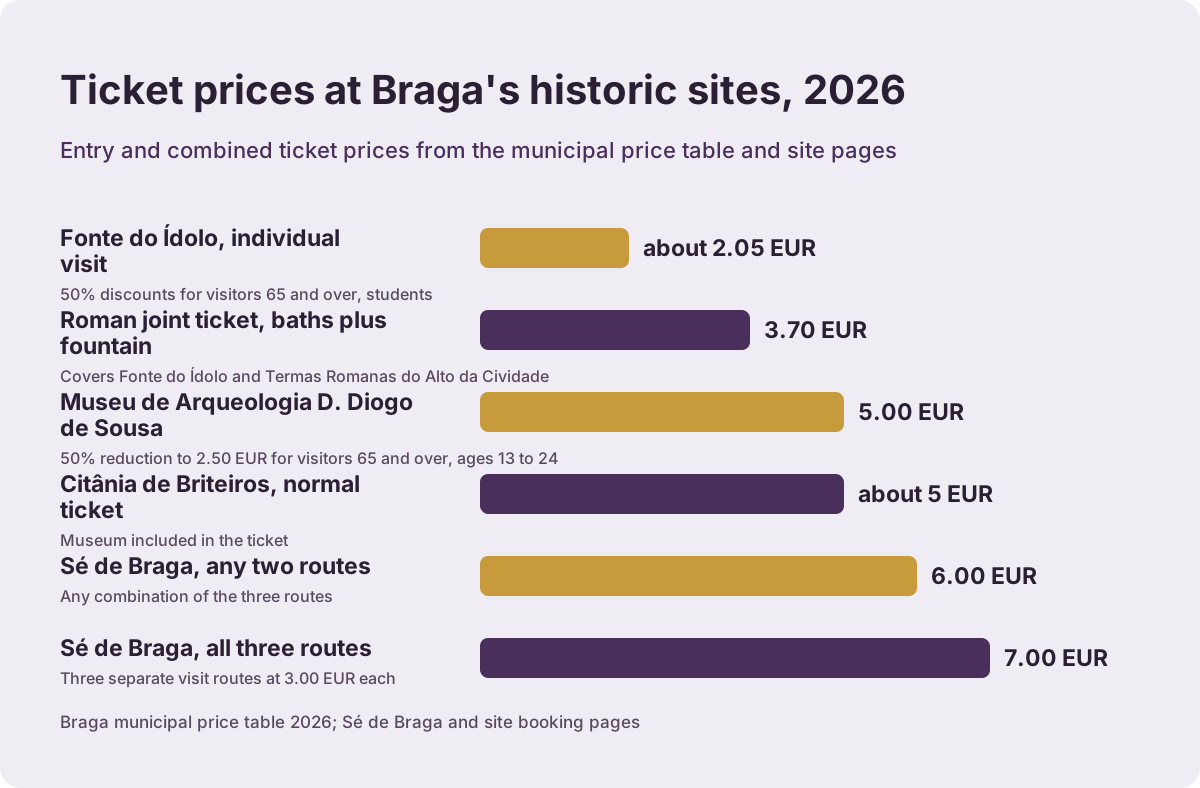
The visible Roman inheritance includes the Fonte do Ídolo, a carved granite monument, the Termas Romanas do Alto da Cividade, the municipal archaeology museum named after D. Diogo de Sousa, and the annual Braga Romana festival, whose 2026 edition was the twenty-second. The Roman circuit of Fonte do Ídolo and the baths runs Monday to Friday 09:30 to 13:00 and 14:00 to 17:30, Saturday 11:00 to 17:30, with a joint ticket at 3.70 EUR.
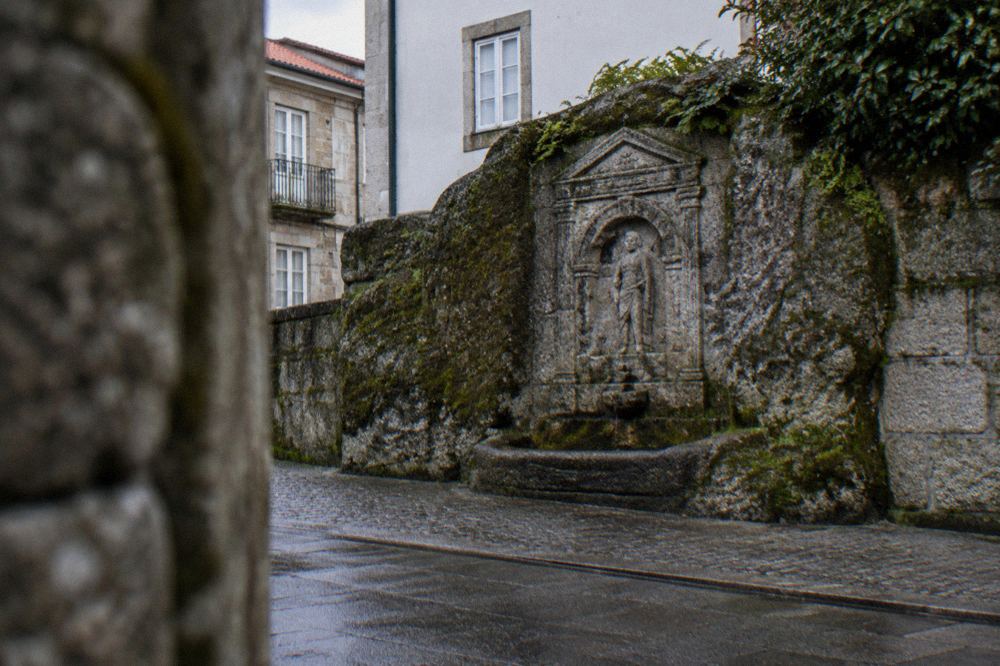
The Fonte do Ídolo is the most evocative piece: a religious monument cut into living rock, small enough that you can stand in front of it and wonder at the hands that carved it. The municipal price table for 2026 lists an individual visit at about 2.05 EUR and the joint ticket covering both the baths and the fountain at 3.70 EUR, with 50% discounts for visitors 65 and over, students, teachers, youth card holders and families, and free entry for under 14s. Last entry is 30 minutes before closing, and guided tours run by appointment Tuesday to Friday.
The Museu de Arqueologia D. Diogo de Sousa is where the excavated material is interpreted. It opens Tuesday to Sunday 10:00 to 17:30, closed Mondays and public holidays including 1 January, Easter Sunday, 1 May, 24 June and 25 December. Admission is 5.00 EUR, with a 50% reduction to 2.50 EUR for visitors 65 and over, ages 13 to 24, and families, and free entry for under 12s accompanied by an adult. Residents of Portugal can claim free entry on 52 days a year of their choosing, a rule the museum's own page states plainly.
For a fuller picture of the region's pre-Roman and Roman layers, the Citânia de Briteiros sits in the neighbouring Guimarães area, an iron age hill settlement with a museum included in the ticket. The site opens daily 09:30 to 12:30 and 14:00 to 18:00 from 27 March to 31 October, and the normal ticket is about 5 EUR. It pairs well with Braga's own archaeology museum, because between them they cover the centuries on either side of the Roman arrival.
Every May the city also turns its own history into a festival. Braga Romana is organised by the municipality, and the 2026 edition, under the theme "Braga Romana antes de Augusto", was the twenty-second. Expect re-enactment camps, markets and costumed processions in the streets around the historic centre, with the exact dates announced each year on the festival's own page.
How Old Is The Sé De Braga And What Can You Visit Inside?
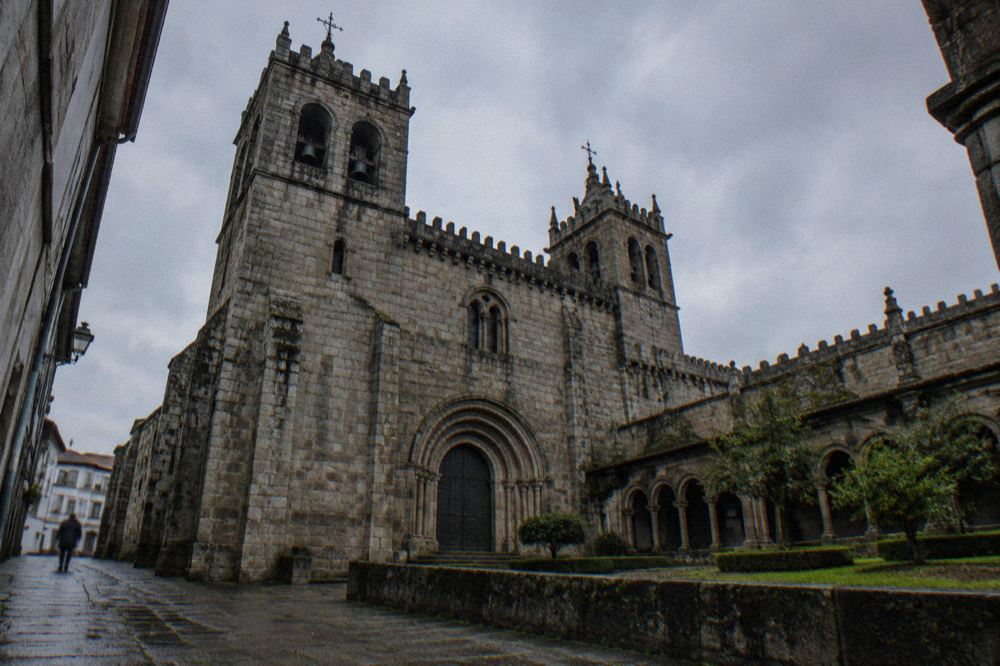
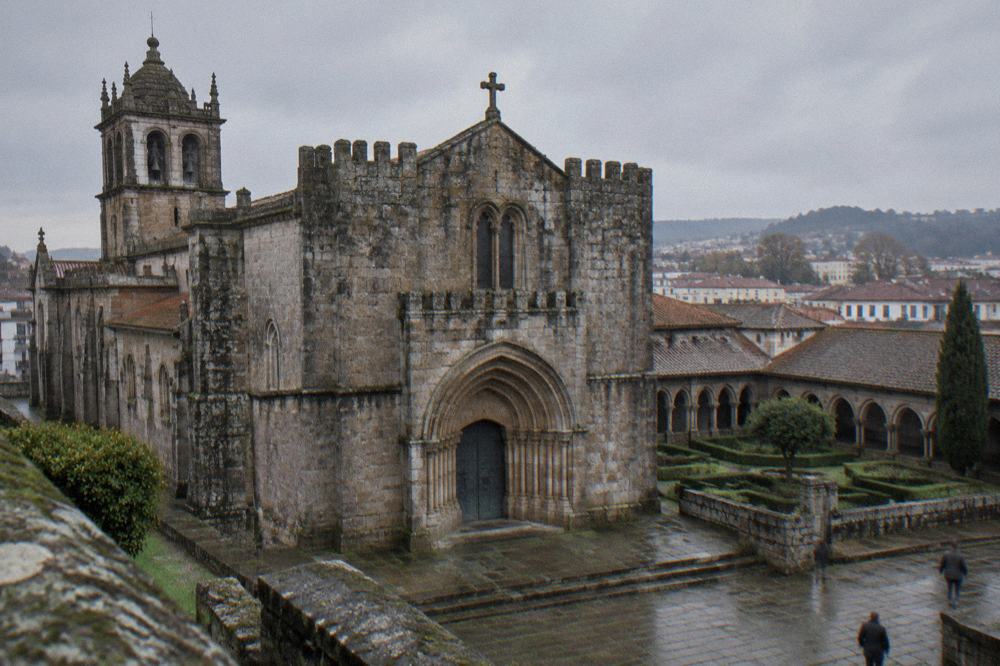
The Sé de Braga, the cathedral at the heart of the city, sells three separate visit routes at 3.00 EUR each, a combined ticket for all three at 7.00 EUR, and any two routes for 6.00 EUR. Tourist visits run Monday to Saturday 09:30 to 13:00 and 14:30 to 17:00, Sunday 09:30 to 10:45 and 14:30 to 17:00, with last entry 30 minutes before closing, and tickets are bought at the reception point in the cloister.
The cathedral's own founding year cannot be stated as a verified fact, and this page will not guess at it. What is verifiable is what the building offers now, and it is more than most cathedrals in Portugal. The three routes are: the Tesouro-Museu, the treasury museum; the Capelas e Coro, the funerary chapels and high choir; and the Catedral itself. Each costs 3.00 EUR on its own, so the combined ticket saves money from the second route onwards. Children up to 12 enter free, as do clergy, visitors with disabilities and the organiser of a group visit, and reduced tickets apply to school, catechism and scout groups and to Santiago pilgrims.
| Cathedral visit route | What it covers | Price |
|---|---|---|
| Percurso 1, Tesouro-Museu | The treasury museum | 3.00 EUR |
| Percurso 2, Capelas e Coro | Funerary chapels and high choir | 3.00 EUR |
| Percurso 3, Catedral | The cathedral interior | 3.00 EUR |
| Any two routes | Any combination of the three | 6.00 EUR |
| All three routes | Full visit | 7.00 EUR |
Two practical notes from the cathedral's own booking page. Tourist visits are suspended during services, so a Sunday visit needs to work around the mass schedule, and access is from Rua do Cabido or the side entrance by Rua D. Diogo de Sousa. Group bookings go through the cathedral's visits email address, which the booking page lists. The Treasury-Museum keeps its own hours, Tuesday to Sunday, 09:30 to 12:30 and 14:30 to 18:30 in summer and until 17:30 in winter, closed Mondays.
Why Is Bom Jesus Do Monte A UNESCO World Heritage Site?
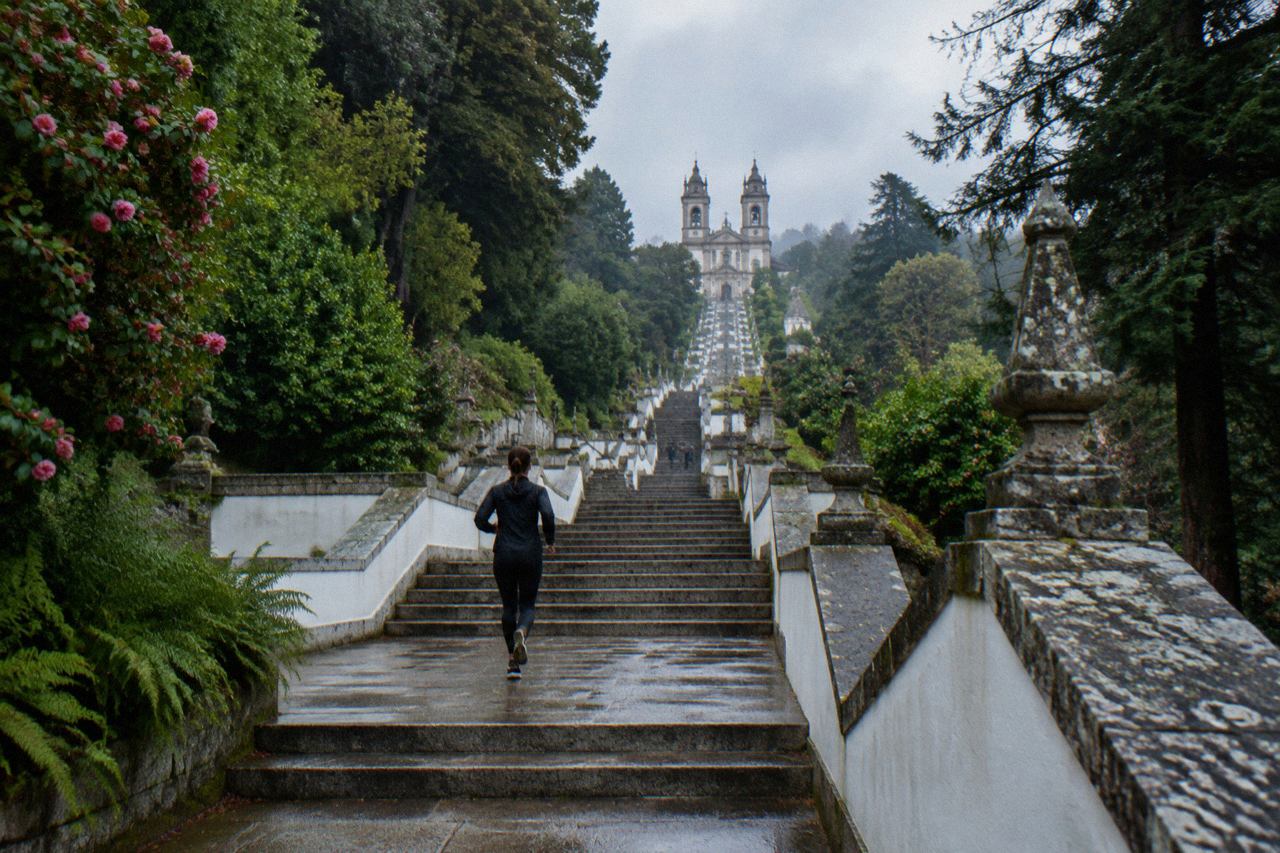
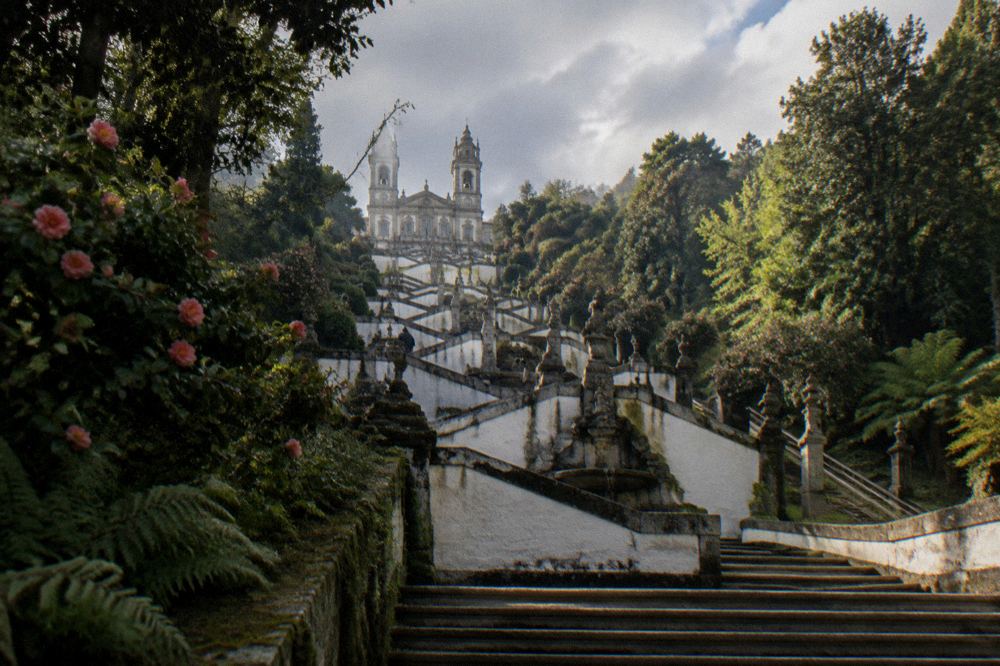
UNESCO inscribed the Sanctuary of Bom Jesus do Monte in Braga on the World Heritage List in 2019, as a cultural property under criterion (iv), covering 26 hectares. The sanctuary was built facing west over more than 600 years and centres on a Via Crucis of chapels, fountains, sculptures and formal gardens, reached by a stairway of 566 steps, 615 metres long, with 116 metres of ascent, by the Confraria's own count.
The stairway is the masterpiece, and it is made of three named sections: the Escadório do Pórtico, the Escadório dos Cinco Sentidos and the Escadório das Virtudes. Climbing it is a devotional act as much as a walk, because the whole ensemble was designed as a pilgrimage route, with each flight of fountains and chapels building towards the basilica at the top. The Confraria do Bom Jesus do Monte, which operates the site, gives the count as 566 steps, and that is the only figure worth printing: other numbers circulate online, but the Confraria's own page is the authority.
The funicular that bypasses the climb dates from 25 March 1882, designed by the Swiss engineer Niklaus Riggenbach with site works supervised by Raul Mesnier du Ponsard, and promoted by the Braga businessman Manuel Joaquim Gomes. The Confraria's page describes it as the oldest in service in the world still using the water counterweight system, a claim best attributed to the Confraria rather than stated as independent fact. One thing matters right now more than the history: the funicular has been out of service since 26 September 2026, with no end date published, and a replacement shuttle runs every day 09:00 to 20:00, roughly every 30 minutes each way, between the Pórtico, where TUB Line 2 ends, and the sanctuary. Check the operator's notice before you go, and see the guide to reaching Bom Jesus do Monte for the bus details.
Nothing about the visit is expensive. The Confraria's information page lists no admission charge for the sanctuary, the grounds or the basilica, which opens every day 08:00 to 19:00 in summer and 08:00 to 18:00 in winter. The high choir and bell tower cost 1 EUR, parking is 1.00 EUR for cars and motorcycles, and the rowing boats on the lake run 10:00 to 13:00 and 14:00 to 19:00 at 3 EUR per person per 15 minutes, minimum two people per boat.
A guided walk is the easiest way to carry all of this in your head at once. The Explore the Portuguese Rome, the City of Braga tour covers the historic centre and the sanctuary in about an hour and a half, with the price and current availability on the operator's live listing. Check availability
The same tour also works as a first-day orientation, because once you have seen the Roman grid, the cathedral and the sanctuary laid out in sequence, every other street in the historic centre starts to make sense. Guides on this kind of walk tend to anchor each stop to a period, which is exactly the structure a history-focused visitor needs.
Which Museums Tell Braga'S Story Best?
Four museums carry most of Braga's narrative: the Museu de Arqueologia D. Diogo de Sousa for the Roman city at 5.00 EUR, the Museu dos Biscainhos for the domestic baroque at 7.50 EUR with its garden included, the Museu Pio XII with its Medieval Tower for 4.00 EUR for the whole museum, and the Mosteiro de São Martinho de Tibães on the edge of town for about 4 to 5 EUR. All four close on Mondays.
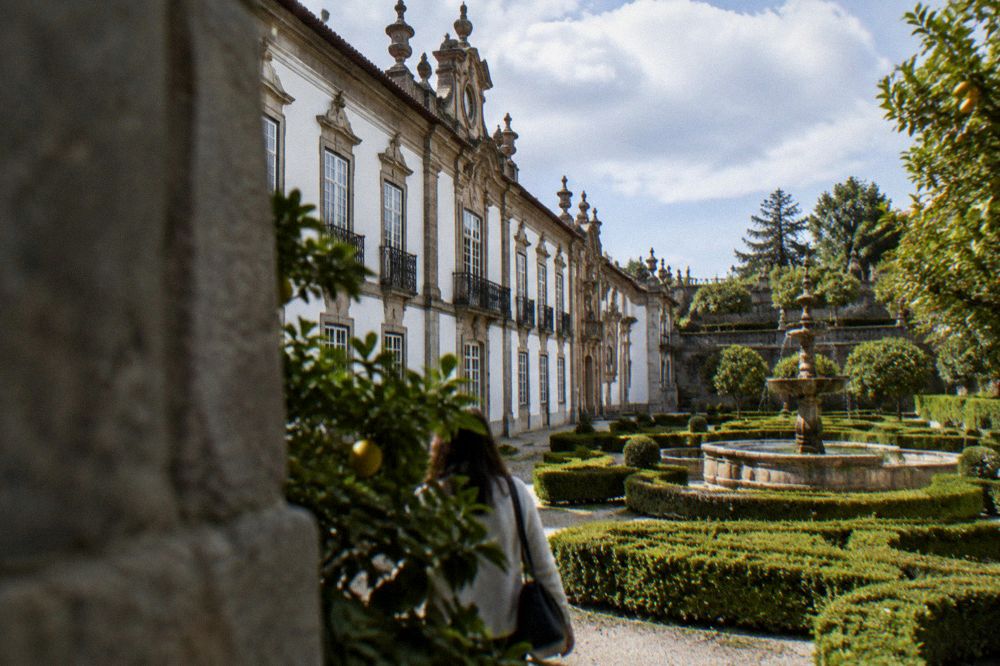
The Museu dos Biscainhos is the one that surprises people. It is a state museum, part of the Museus e Monumentos de Portugal network, set in a baroque palace with gardens, and it reopened after a major restoration around May and June 2025. The operator's page lists the normal ticket, garden included, at 7.50 EUR, Tuesday to Sunday 10:00 to 12:30 and 14:00 to 17:30, with last entry 15 minutes before closing. Note that the municipality's own page still shows an older, lower price; the operator's page is the one to trust for the ticket in your hand. The wider set of guides lives on Braga Travel Guide.
| Museum | Focus | Normal ticket | Opening pattern |
|---|---|---|---|
| Museu de Arqueologia D. Diogo de Sousa | Roman and pre-Roman Braga | 5.00 EUR | Tue to Sun 10:00 to 17:30 |
| Museu dos Biscainhos | Baroque domestic life and gardens | 7.50 EUR | Tue to Sun 10:00 to 12:30, 14:00 to 17:30 |
| Museu Pio XII and Medieval Tower | Sacred art, painting, city walls | 4.00 EUR whole museum | Tue to Sat 09:30 to 12:30, 14:00 to 18:00 |
| Museu Nogueira da Silva | Decorative arts, card payment only | 3.00 EUR | Tue to Sat, closed Sun and Mon |
| Mosteiro de São Martinho de Tibães | Monastic heritage | about 4 to 5 EUR | Tue to Sun, closed Mon |
The Museu Pio XII charges 2 EUR for each of its three parts, the permanent exhibition, the Medina Gallery and the Medieval Tower, or 4 EUR for the whole museum, with under 12s free alongside a paying adult and a smartphone audio guide for 1 EUR. Its page lists Tuesday to Saturday hours and no Sunday opening, so plan it for a weekday. The Museu Nogueira da Silva is smaller and takes card payment only, 3.00 EUR general, with hours Tuesday to Friday 10:00 to 12:30 and 14:00 to 18:00 and Saturday afternoons to 19:00.
Tibães deserves a half-day of its own. The monastery was the mother house of the Portuguese Benedictine congregation, and its church reopened in March 2026 after conservation works closed it for a period. The monastery opens Tuesday to Sunday, 10:00 to 18:00 in winter and 10:00 to 19:00 in summer, and the municipality's page lists general admission at 4.00 EUR with 2.00 EUR for students and over 65s, while the state ticket office has been read as showing 4 or 5 EUR depending on the circuit, so treat the price as about 4 to 5 EUR and check the ticket office page before you go. Free mornings on Sundays and holidays apply to Portuguese residents, not to most visitors.
If you want the whole story told to you rather than read off wall panels, a private guide changes the experience completely. The Braga Private Walking Tour with a Professional Guide runs about two hours with a guide to yourself, and the walking tours overview compares every option in the city, including the free, tip-based walks.
Which Braga Festivals Carry The City'S History?
Braga's calendar is anchored by four historic events: Semana Santa, Holy Week, whose 2026 edition ran 29 March to 5 April with processions listed by the municipality; the Festas de São João, 17 to 24 June 2026, peaking on the night of 23 June before the 24 June municipal holiday; Braga Romana in late May; and Noite Branca on the first weekend of September, 4 to 6 September in 2026. Semana Santa is registered in the National Inventory of Intangible Cultural Heritage.
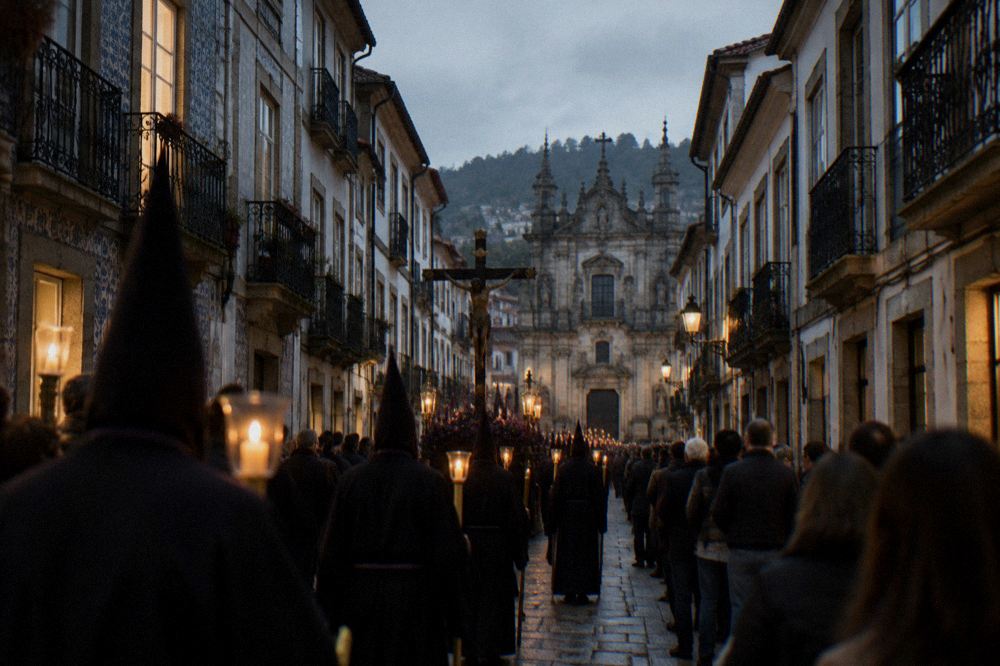
Semana Santa is the one with the deepest documented roots. It is organised by the Comissão da Quaresma e Solenidades da Semana Santa de Braga together with the cathedral chapter, the brotherhoods and the Santa Casa da Misericórdia, and Turismo de Portugal has declared it of interest for tourism. The 2026 processions were published by the municipality: the Passos procession on Sunday 29 March at 17:00, the Burrinha on 1 April at 21:30, the Ecce Homo on 2 April at 21:30 and the Enterro do Senhor on 3 April at 21:30. Because Holy Week moves with Easter, the dates shift each year and the 2027 dates have not been announced, so check the festival's own programme page before booking anything around it. The dedicated Semana Santa guide covers the processions street by street.
| Festival | 2026 dates | Organiser | Evergreen timing |
|---|---|---|---|
| Semana Santa | 29 March to 5 April | Comissão da Quaresma e Solenidades | The week before Easter, movable |
| Braga Romana | Late May, XXII edition | Câmara Municipal de Braga | Late May |
| Festas de São João | 17 to 24 June | Associação de Festas de São João de Braga | Peaks on the night of 23 June |
| Noite Branca | 4 to 6 September | Câmara Municipal de Braga | First weekend of September |
| Encontros da Imagem | 18 September to 1 November | Associação Cultural Encontros da Imagem | Autumn photography festival |
São João turns the city into a street party for a week, with the main ceremonies on 23 June, the Cortejo da Mordomia among them, and the 24 June municipal holiday closing the museums that day. Noite Branca runs from 19:00 on the Friday to 23:30 on the Sunday, with museums open late and free, and the Encontros da Imagem photography festival spreads more than 30 exhibitions across the city from mid-September. For planning around the weather, the best time to visit guide matches these events against the IPMA rainfall normals, and October, not a winter month, is statistically the wettest month at the Braga station.
How Has Braga Changed In Recent Years?
Braga's recent chapter is cultural: the city was Portuguese Capital of Culture in 2025, the MUZEU contemporary art museum opened in the historic centre in April 2026, the Museu da Imagem reopened in early September 2026 after about seven years closed, and Casa dos Crivos reopened on 19 and 20 September 2026 as a municipal gallery. The Lince Braga hotel, a renovation of the former Hotel da Falperra, opened in summer 2025 and holds a Michelin Key in the 2026 guide.
The Capital of Culture year, "Braga 25", ended in December 2025 after roughly 1,200 activities, but several of its projects were designed to continue, including Supracasa for emerging artists at Theatro Circo, the Clube Raiz music programme and a Festival Square planned for January 2027. The theatre itself is open with a full programme, and its guided tours are a good piece of living history: 45 minutes, 3.50 EUR for adults, in Portuguese and English, on scheduled dates only, with tickets at the box office 30 minutes before the tour, first come first served, maximum 30 people.
Practical history matters too. For getting around, the 2026 TUB tariff sets an on-board single at 1.55 EUR for one zone and 2.00 EUR for two, with pre-bought or digital tickets at 0.75 EUR and 1.50 EUR, and tourist day tickets at 3.35, 6.05 and 8.05 EUR for one, two and three days. The getting around guide explains the rest.
What Is The Best Way To Explore Braga'S History In One Day?
A one-day history circuit works in this order: the Sé de Braga in the morning with the combined 7.00 EUR ticket, the Roman circuit of Fonte do Ídolo and the Termas Romanas before lunch, the Museu de Arqueologia D. Diogo de Sousa in the early afternoon, and Bom Jesus do Monte from late afternoon, using TUB Line 2 to the Pórtico and allowing time for the 566 steps or the shuttle. Everything sits within the municipality, and the historic centre pieces are all walkable.
Start early, because the cathedral's visit hours close at 13:00 and reopen at 14:30, and the Treasury-Museum closes on Mondays. The Roman circuit keeps the same afternoon rhythm, and the archaeology museum is a short walk from both. Save Bom Jesus for the end of the day: the basilica stays open until 19:00 in summer, and the light across the stairway in the late afternoon is the best of the day. If your legs object to the climb, the shuttle is running while the funicular is out of service, and the grounds are free to enter.
A tuk tuk tour compresses the same circuit when time is short or the hills are not welcome. The Braga Tuk Tuk City Tour runs from 30 minutes up to two hours, covers the historic centre and the viewpoints, and the operator's listing carries the current price and availability. For a longer stay, the one day in Braga itinerary and the where to stay guide build the history circuit into a full visit, and the food of the Minho region, covered in the what to eat in Braga guide, is itself part of the story, from bacalhau à Braga to the Vinho Verde that the region has always made.
Braga rewards exactly this kind of layered visit, because the city does not separate its history from its life. The processions still walk the same streets as the Roman grid, the cathedral still suspends tourist visits for worship, and the Confraria still counts the steps on its own hill. Walk it slowly, check the notices before you go, and the two thousand years hold together.
Common Questions About Braga'S History
Is Braga the oldest city in Portugal?
That claim circulates widely, but it cannot be stated as a verified counted fact, because no primary source for it was confirmed. What is verifiable: the city's name comes from the Roman Bracara Augusta, and the Roman-era monuments, the Fonte do Ídolo and the Termas Romanas, can still be visited on a joint ticket at 3.70 EUR.
How old is Braga Cathedral?
The cathedral's founding year is not stated as a verified fact on this site, because no primary source for it was read. What is verified is what you can visit today: three routes at 3.00 EUR each, or 7.00 EUR for all three combined, with visits Monday to Saturday 09:30 to 13:00 and 14:30 to 17:00.
How many steps does Bom Jesus do Monte have?
566 steps, by the Confraria's own count, over a stairway 615 metres long with 116 metres of ascent. The stairway has three named sections, the Escadório do Pórtico, the Escadório dos Cinco Sentidos and the Escadório das Virtudes. Higher figures circulate online, but the Confraria's page is the authority.
Is the Bom Jesus funicular running?
No. The funicular has been out of service since 26 September 2026, with no end date published. A replacement shuttle runs every day 09:00 to 20:00, roughly every 30 minutes each way, between the Pórtico, where TUB Line 2 ends, and the sanctuary. Check the operator's notice before you go.
When is Semana Santa in Braga?
Holy Week is the week before Easter, so the dates move every year. The 2026 edition ran 29 March to 5 April, with processions on 29 March, 1, 2 and 3 April. The 2027 dates have not been announced, so check the festival's programme page before planning a trip around it.
Do I need a city pass for Braga's historic sites?
No city-wide pass is on sale in Braga. A "Braga Card" was announced in 2025 but no purchase page exists, so buy each ticket separately. The only multi-use product is the TUB tourist ticket for the buses, at 3.35 EUR for one day, 6.05 EUR for two and 8.05 EUR for three.