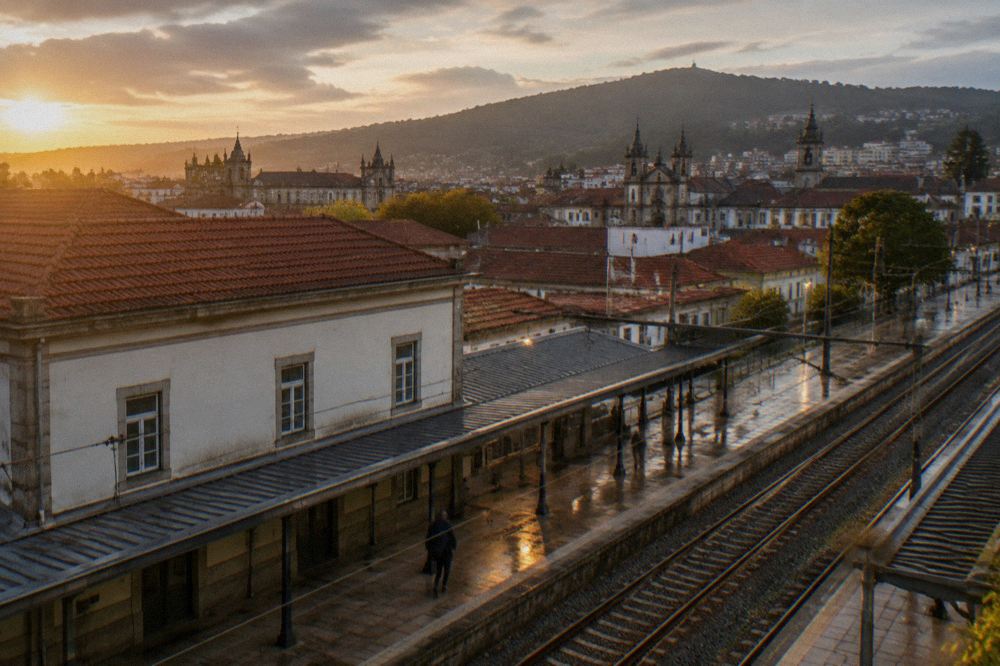
Santiago De Compostela From Braga
Santiago de Compostela sits just across the Spanish border from Braga, Portugal, and direct buses cover the route in a few hours, making Galicia's cathedral city a realistic long day trip or an easy overnight from the Minho.
Short answer
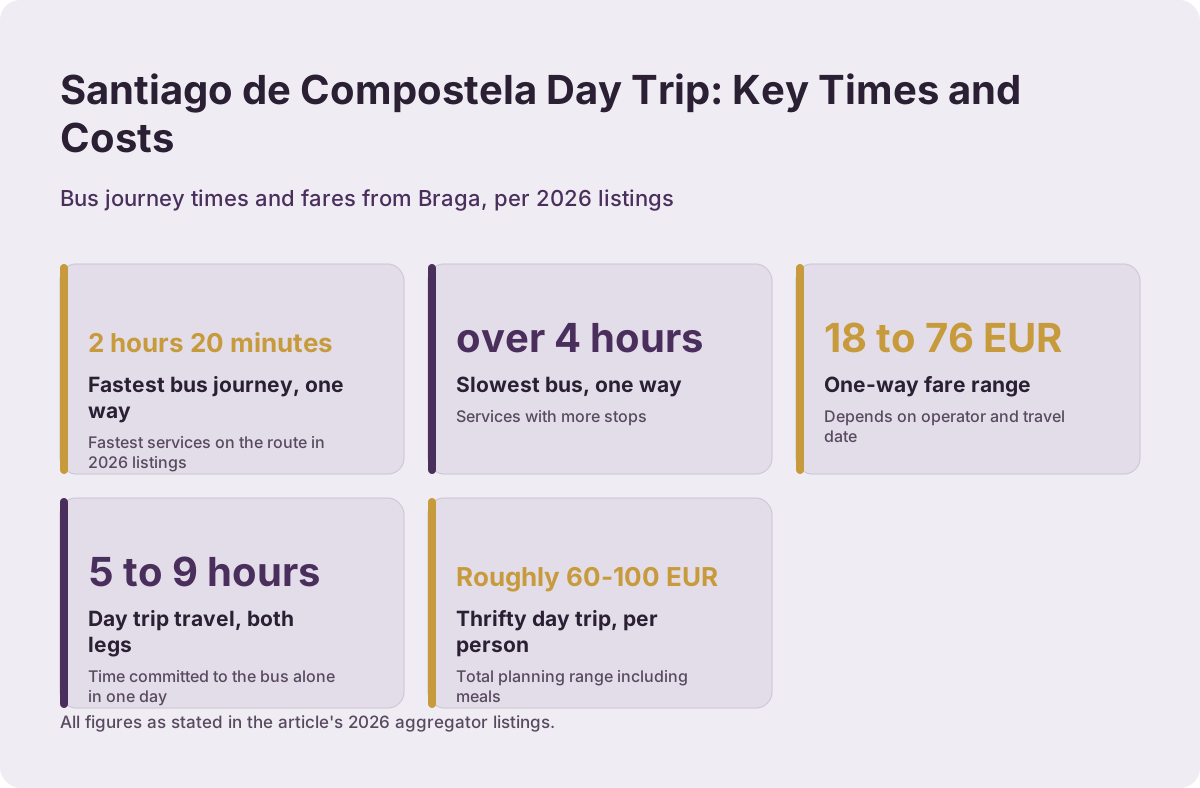
Direct buses run from Braga to Santiago de Compostela with several operators, taking roughly 2 hours 20 minutes to over 4 hours depending on the service, with one-way fares from around 18 to 76 EUR and up in 2026 listings. There is no border control between Portugal and Spain, both countries use the euro, and the city's old town is compact enough to explore on foot.
Braga, the city in northern Portugal's Minho region, sits close enough to Galicia that Santiago de Compostela, the cathedral city at the end of the Camino de Santiago pilgrimage routes, is a practical destination for a long day trip or a relaxed overnight stay. Direct buses link the two cities with a journey that 2026 listings place at roughly 2 hours 20 minutes to over 4 hours depending on the operator and the number of stops, and because Portugal and Spain are both in the Schengen Area and both use the euro, the crossing involves no border formalities and no currency exchange.
How Do You Get From Braga To Santiago De Compostela?
The only practical public transport between Braga and Santiago de Compostela is the direct bus, with several operators running the route and 2026 aggregator listings showing journey times from about 2 hours 20 minutes to over 4 hours, and one-way fares ranging from roughly 18 to 76 EUR and up depending on the operator and the travel date. BlaBlaCar Bus, FlixBus, Rede Expressos and ALSA all appear on the route in 2026 listings, so it pays to compare operators before booking.
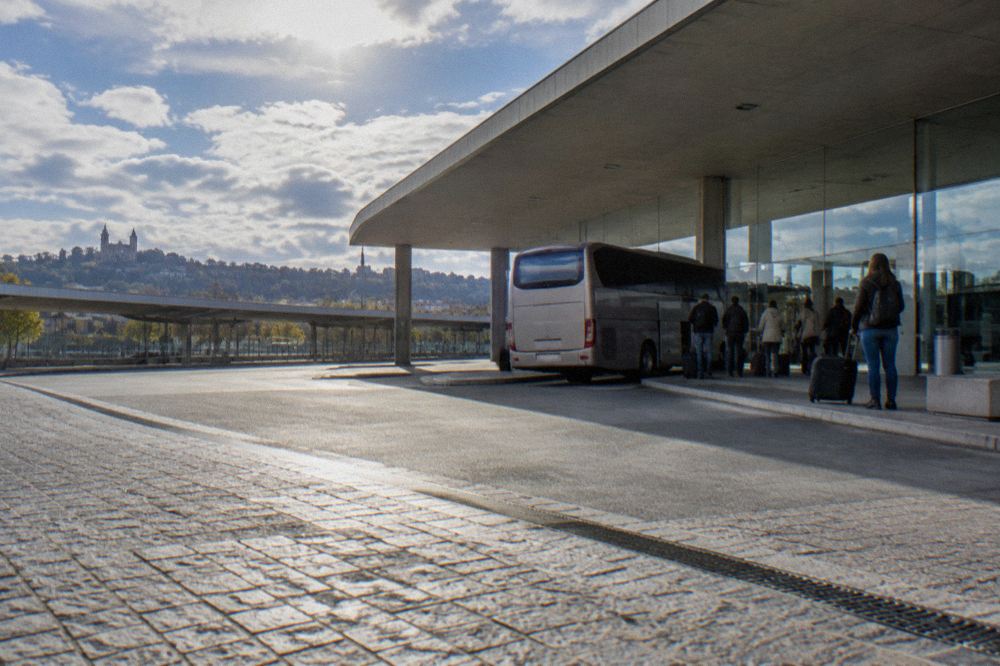
Buses to Santiago depart from Braga's central bus station, the Centro Coordenador de Transportes on Avenida General Norton de Matos, which is the same station that handles regional AITC lines to Guimarães, Ponte de Lima and the Gerês park, and the Getbus coach to Porto Airport. That makes the station a familiar place by the time most visitors leave for Spain: it is the transport hub of the city, not a peripheral terminal.
The spread in journey times is real and worth understanding before you book. The fastest services on the route, according to 2026 listings, cover the distance in about 2 hours 20 minutes, while slower services with more stops take over 4 hours. The fare spread is just as wide: the same 2026 listings show one-way prices from around 18 EUR on the cheapest services to 76 EUR and above on others, with the usual dynamic pricing that comes with long-distance coach travel in Iberia. Booking ahead, travelling midweek and comparing operators are the three levers that matter.
There is no useful rail alternative. The Spanish and Portuguese rail networks meet awkwardly in this corner of the peninsula, and no 2026 source shows a direct train between Braga and Santiago. A rail journey would mean multiple changes and a much longer day. For a traveller based in Braga, the bus is the route.
| Operator (2026 listings) | Typical journey time | One-way fare range (2026 listings) | Notes |
|---|---|---|---|
| BlaBlaCar Bus | Varies by service | From the low end of the range | Appears on aggregator route listings |
| FlixBus | Varies by service | Dynamic pricing | Compare against Rede Expressos on the same date |
| Rede Expressos | Varies by service | Mid-range in listings | Long-standing Iberian coach network |
| ALSA | Varies by service | Up to the top of the range | Spanish operator with the widest Galicia network |
Before or after the trip, the Minho side deserves its own time, and a small-group Braga and Guimarães tour with lunch and tickets included covers the two great historic cities of the region in a single day. Check availability
Is Santiago De Compostela A Realistic Day Trip From Braga?
Yes, but it works best as a long day with an early start, because the bus each way takes from about 2 hours 20 minutes to over 4 hours, which means a realistic day trip commits 5 to 9 hours to travel alone. With the fastest services and a full day on site, the trip is comfortably doable. With the slower services, or with a late return, an overnight in Santiago serves the city far better.
The arithmetic is the whole decision. A traveller who catches a fast morning service and a fast evening return spends less time on the coach than a traveller from Porto spends on some of the popular Douro excursions, and Santiago's compact old town rewards a focused day: the cathedral square, the old town streets, a proper Galician lunch and one or two museums fit inside a well-planned visit. The risk is the return leg. Late-evening coach travel after a full day of walking is tiring, and the slower services turn a day trip into an endurance exercise.
The practical middle path is the overnight stay. Santiago's value is partly atmospheric, and the atmosphere is at its best early in the morning and in the evening, when the day-trippers from farther away have gone and the square in front of the cathedral belongs to arriving pilgrims and locals. An overnight lets you see the city at both hours. Braga's own hotel market is modestly priced by European standards, and Galician hotel prices in the low season are similarly gentle, so the cost of splitting the trip across two days is small.
For travellers who want the Minho and Galicia in one itinerary, a sensible sequence is two or three nights in Braga, an overnight in Santiago, and the return by bus. The things to do in Braga list fills the Braga days easily: the Sé de Braga, the Bom Jesus do Monte sanctuary on its hill, and the Tibães monastery among them.
| Trip shape | Time on the bus (both legs) | Best for | Main drawback |
|---|---|---|---|
| Long day trip, fast services | Around 5 hours total | Confident walkers who want a first taste | No evening atmosphere, tiring return |
| Long day trip, slow services | Up to 9 hours total | Travellers locked into a specific date | Most of the day spent travelling |
| One overnight | One leg per day | Photographers, pilgrims, slow travellers | One extra night's accommodation |
| Two nights | One leg per day | Camino curious travellers, museum-goers | Uses half a week |
What Are The Must-See Sights In Santiago De Compostela?
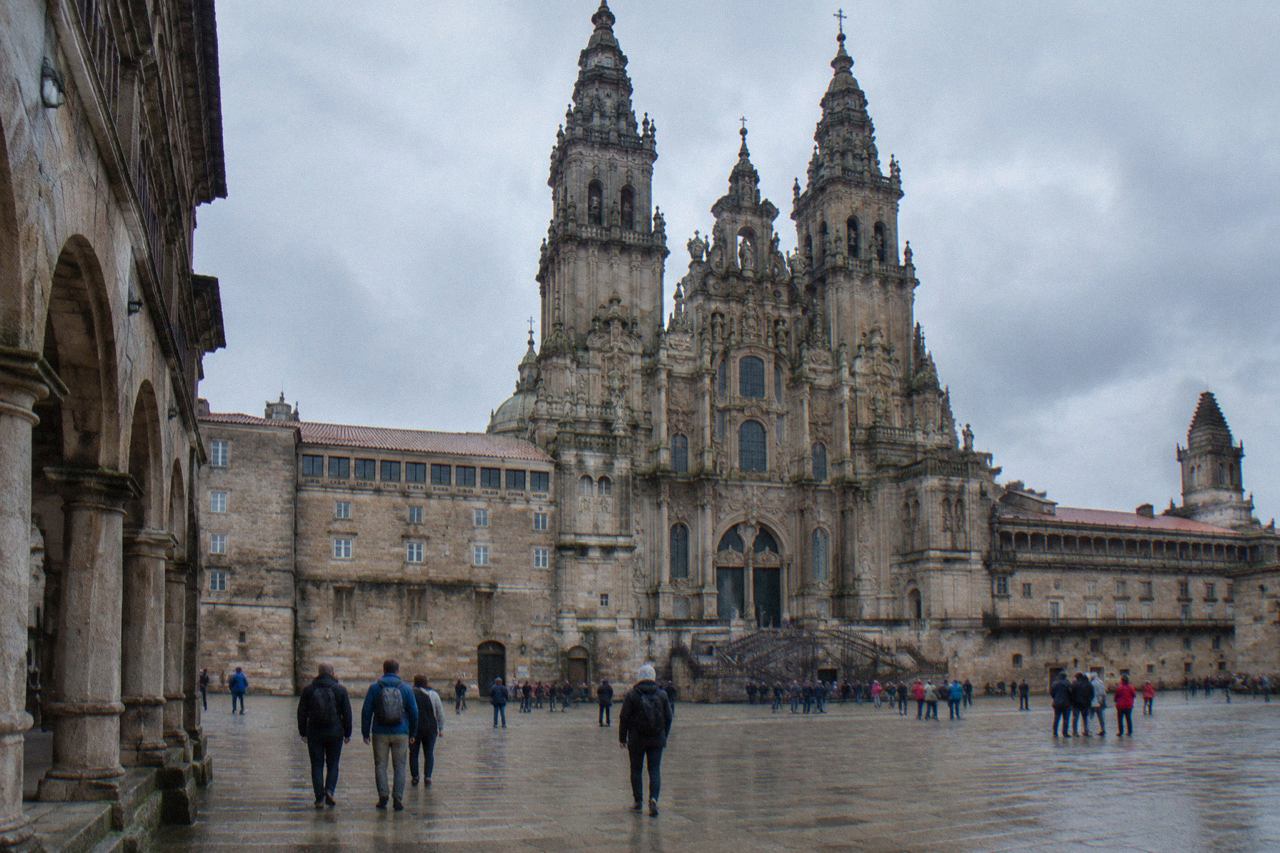
The cathedral and the square in front of it, the Praza do Obradoiro, are the heart of the city and the reason it exists on the tourist map, with the surrounding granite old town, the Praza da Quintana behind the cathedral, the Praza das Praterías with its carved facade and the Alameda park viewpoint west of the centre making up the essential circuit, all of it walkable in a few hours.
The cathedral is the destination of the Camino de Santiago, the network of pilgrimage routes that has brought walkers to this corner of Galicia for centuries, and the building's west facade, flanked by twin towers, is one of the most recognisable images in Spain. Pilgrims arriving at the end of their walk come up the final street and into the square in front of it, and watching them arrive, dusty and emotional, is itself one of the experiences of a visit.
Behind the cathedral, the Praza da Quintana gives a quieter, sterner face of the same building, and the narrow streets radiating from these squares hold the old town's restaurants, tapas bars and shops. The Praza das Praterías, on the south side, faces the cathedral's Romanesque carved portal. A short walk west, the Alameda park offers the classic postcard view of the cathedral towers across the old town rooftops, and it costs nothing.
| Sight | What it is | Where it sits |
|---|---|---|
| Cathedral of Santiago de Compostela | The endpoint of the Camino pilgrimage routes | Centre of the old town |
| Praza do Obradoiro | The grand square in front of the cathedral's west facade | Immediately west of the cathedral |
| Praza da Quintana | The quiet square behind the cathedral's east end | Immediately east of the cathedral |
| Praza das Praterías | Square facing the carved Romanesque south portal | South side of the cathedral |
| Old town streets | Granite lanes with tapas bars, restaurants and shops | Around the cathedral |
| Alameda park viewpoint | The classic panorama of the cathedral and rooftops | A short walk west of the centre |
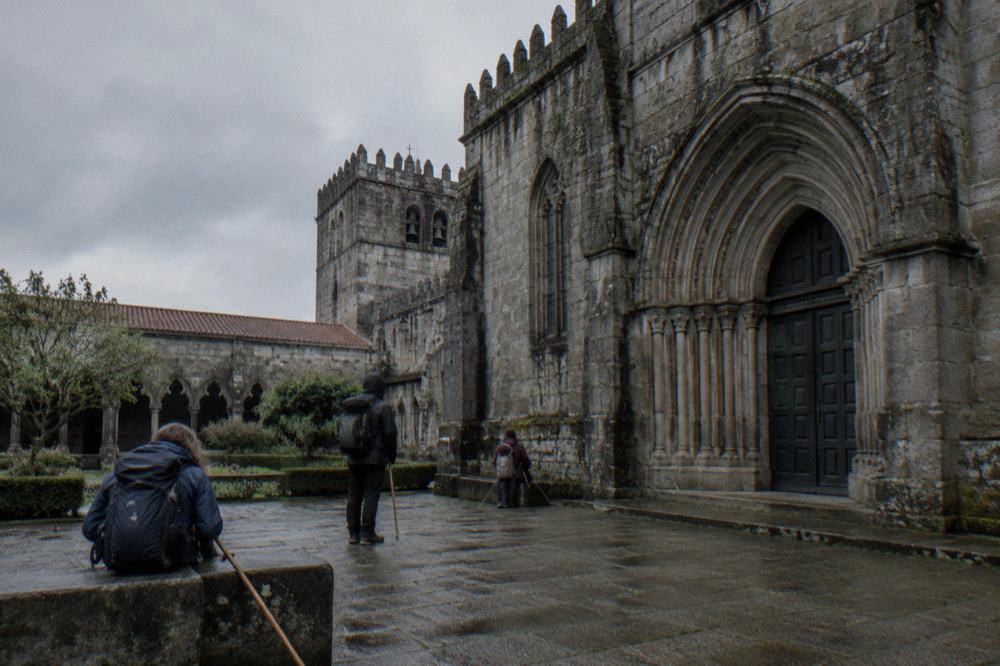
A day in Santiago is a walking day, and the same is true of Braga itself, where the historic centre between the Sé and the Arco da Porta Nova is equally compact. The Braga and Guimarães small group tour with lunch and tickets included exists precisely for travellers who want a guided version of that walking circuit on the Portuguese side, with the logistics of lunch and entry tickets handled in the price. Check availability
Can You Walk The Camino From Braga To Santiago?
Yes, pilgrims have long set out from Portuguese territory toward Santiago, and Braga sits in a region threaded with historical Camino routes, but planning a walk requires the official pilgrim authorities' material for stage lengths, waymarking and the credential, the pilgrim's record that walkers carry and stamp along the way. Read the official pilgrim authorities' material before planning a walk, because the practical details of the route from this part of Portugal are theirs to publish.
The Camino de Santiago is not one path but a network, and the Portuguese routes are among the most walked in the network today. The main Portuguese way runs north from Lisbon and Porto along the Atlantic corridor, and the coastal and inland variants thread the Minho before crossing into Galicia. A traveller based in Braga who wants to experience the pilgrimage without committing to a multi-week walk has a realistic option: travel to a point along the route and walk a final stretch, or walk a section as a day experience and return by bus.
The credential is the piece of paper that matters. Walkers collect stamps in it at accommodation, churches and cafés along the route, and the record of the walked distance is what the pilgrim authorities in Santiago recognise. The rules about how much walking qualifies for the pilgrim certificate are set by those authorities, and they are the only source to rely on. The Camino from Braga guide on this site covers the route context in more detail.
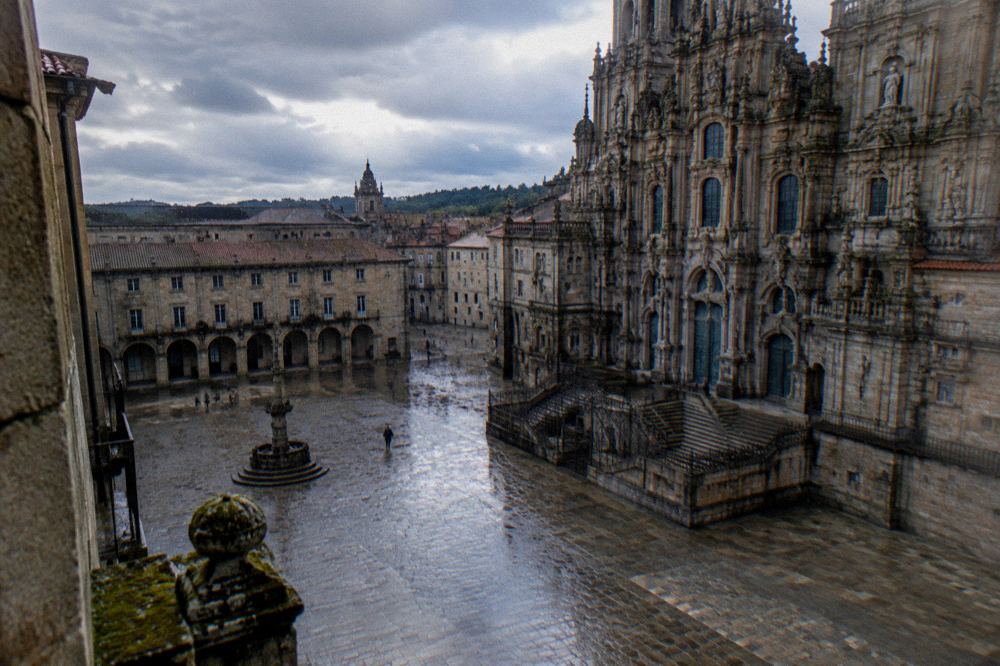
For travellers whose interest in the Camino is cultural rather than devotional, the honest framing is this: the pilgrimage shapes everything you see in Santiago, from the pilgrim traffic in the squares to the iconography in the cathedral, and understanding a little of it before arrival turns a sightseeing day into something richer. The Minho's own religious landscape, from the Bom Jesus do Monte sanctuary to the Sameiro sanctuary on the hill above Braga, belongs to the same peninsular tradition of hilltop devotion, and seeing both sides of the border gives the trip a coherence that either half alone lacks.
How Much Does A Trip From Braga To Santiago De Compostela Cost?
The bus is the largest variable, with one-way fares in 2026 listings running from roughly 18 to 76 EUR and up depending on operator and date, so a round trip can cost anywhere from under 40 EUR to over 150 EUR for transport alone. Add modest Galician restaurant prices, optional cathedral-visit fees you should confirm on site, and, if you overnight, a hotel bill, and the total depends almost entirely on the fare you find and the night you choose.
The honest way to budget this trip is to treat the fare as a range, not a number. The same 2026 aggregator listings that show a roughly 18 EUR floor also show 76 EUR and above at the top, and where in that range you land depends on when you book, which operator you choose and when you travel. The planning table below works in ranges for exactly that reason. The wider set of guides lives on Braga Travel Guide.
| Cost item | Thrifty day trip (per person) | Comfortable overnight (per person) |
|---|---|---|
| Bus, both legs | Roughly 40-60 EUR total | Same, one leg each day |
| Meals in Santiago | One lunch, about 15-25 EUR | Lunch, dinner, breakfast |
| Cathedral-related visits | Confirm fees on site | Confirm fees on site |
| Overnight stay | Not applicable | One night in the city |
| Total planning range | Roughly 60-100 EUR | Depends on the hotel and season |
Two structural savings are worth knowing. First, travelling midweek and booking early pushes the bus fare toward the bottom of the range in the 2026 listings, the same dynamic that applies to every long-distance coach in Iberia. Second, an overnight in Santiago does not need to be expensive: the city has accommodation across the price spectrum, and the low-season months, outside the summer pilgrimage peak, are the gentlest on every line of the budget.
Back on the Portuguese side, Braga itself is inexpensive by northern European standards, and its municipal tourist tax is 1.55 EUR per person per night for up to four nights, charged by hotels and local accommodation. A multi-base trip that spends most nights in Braga and one in Santiago keeps the accommodation line low while giving both cities their due.
Where Is Santiago De Compostela And Why Does It Matter?
Santiago de Compostela is the capital of Galicia, the autonomous community in Spain's northwest, and it lies roughly 100 kilometres or so north of the Portuguese border, reached from Braga by road through the Minho and across into Spain near Valença or Chaves, depending on the route the bus takes. It matters because it is the historical endpoint of the Camino de Santiago, one of the great pilgrimage traditions of the Christian world, and its old town is a UNESCO-listed ensemble centred on the cathedral.
The city's identity is inseparable from the pilgrimage. For centuries, walkers have arrived here from across Europe, and the infrastructure they created, the hospitals, the churches, the hostels and the streets themselves, is what the modern visitor walks through. The old town's granite architecture, its arcaded squares and its network of lanes exist in their present form largely because of that history.
For a traveller based in Braga, the geography is the appeal. Galicia and the Minho share a landscape of green hills, granite villages and Atlantic weather, and the drive north from Braga passes through some of the prettiest territory on either side of the border, including the towns covered in this site's Ponte de Lima day trip and Viana do Castelo day trip guides, both of which sit on or near the corridor a Santiago-bound bus travels.
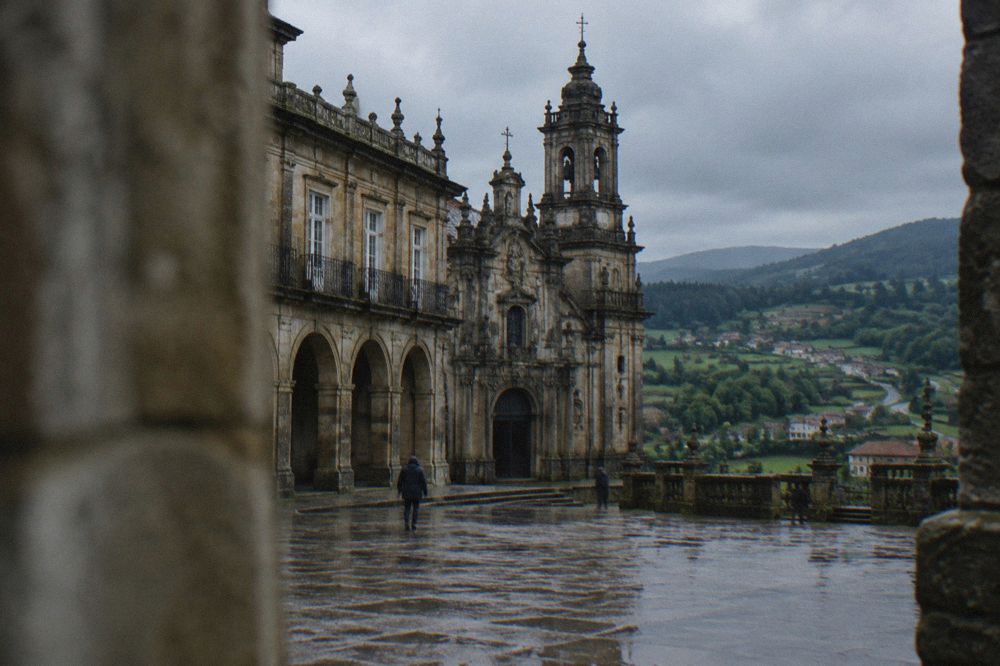
The cultural continuity across the border is real and visible. The Minho's romaria tradition, the hilltop sanctuaries and the festival calendar around Holy Week and São João, belongs to the same peninsular Catholic culture that Santiago represents at its most concentrated. A traveller who has walked up the Escadório do Pórtico at Bom Jesus do Monte, the monumental stairway of 566 steps by the Confraria's count, arrives in Santiago already fluent in the visual language of pilgrimage.
How Does Santiago Compare With The Other Day Trips From Braga?
Santiago is the only day trip from Braga that crosses an international border, which makes it the longest and most ambitious of the options, while the other great day trips, Guimarães, Ponte de Lima, Viana do Castelo, Barcelos and the Gerês park, are all shorter hops within Portugal, and the right choice depends on whether you want a foreign city, a historic Portuguese town or mountain landscape.
The comparison matters because most visitors to Braga have limited days and must choose. Guimarães, the other great historic city of the Minho, is covered in the Guimarães day trip guide, and it is the natural pairing with Braga, close enough that the two cities share a bus line. Ponte de Lima and Viana do Castelo offer river town and Atlantic coast respectively, Barcelos holds its famous weekly market, and the Peneda-Gerês National Park, covered in the Peneda-Gerês day trip guide, is the region's great mountain wilderness.
| Day trip from Braga | What it offers | Travel character |
|---|---|---|
| Santiago de Compostela | A foreign cathedral city, pilgrimage atmosphere, Galician food | Longest trip, international but borderless |
| Guimarães | Medieval centre, castle, palace, the other great Minho city | Short regional hop by AITC Line 101 |
| Ponte de Lima | River town, Roman bridge, rural Minho scenery | Regional hop by AITC Line 105 |
| Viana do Castelo | Atlantic coast, elegant squares, riverside setting | Regional hop toward the coast |
| Barcelos | Weekly market, rooster legend, riverside old town | Short trip by bus or rail via a change |
| Peneda-Gerês National Park | Mountains, waterfalls, trails, wild scenery | Regional bus into the park, best with a tour |
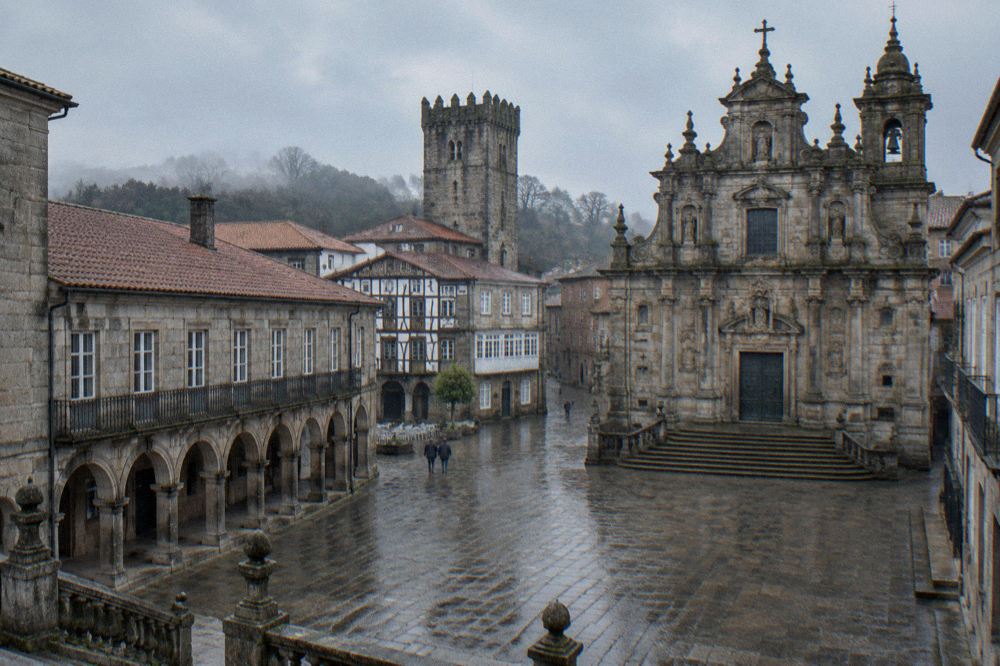
The honest recommendation is to treat Santiago as a different category from the rest. The Minho day trips are half-day or full-day affairs with short travel times and no planning burden. Santiago asks for a full day at minimum, an early start, a booked bus ticket and a decision about the overnight. In exchange, it delivers something none of the others can: the experience of standing in a square where a thousand years of arriving travellers have stood, in a different country, before dinner back in Portugal or a night in Galicia.
For travellers who want the Minho's own highlights covered with the logistics handled, the water canyoning experience in the Gerês park and the Quinta de Santa Cristina Vinho Verde tasting each make a strong counterweight to a cathedral day: one is the region's landscape at its most physical, the other is its signature wine at its source.
What Should You Know Before Crossing From Braga Into Spain?
Portugal and Spain are both in the Schengen Area and both use the euro, so there are no border controls, no passport checks on the bus and no currency exchange, but your passport or ID card still needs to be valid and carried, because spot checks at internal borders remain legally possible, and non-EU visitors should remember that the Schengen 90-day clock covers the whole area, not each country separately.
The practicalities are minimal, which is part of why the trip works so well. The bus crosses the border without stopping, the same way it crosses a district line, and everything you buy in Santiago, from the bus ticket onward, is in the same currency you used in Braga. Mobile phones on Portuguese and Spanish networks roam without issue under EU rules for EU-based travellers; visitors from outside the EU should check their own roaming arrangements.
Language is the one genuine difference. Galician is the regional language of Galicia, closely related to Portuguese, and Spanish is universally spoken; English is common in the tourist core of Santiago but thinner outside it. A visitor who has picked up even a few words of Portuguese in Braga will find Galician signage surprisingly readable, which is a small pleasure of the trip that deserves mentioning.
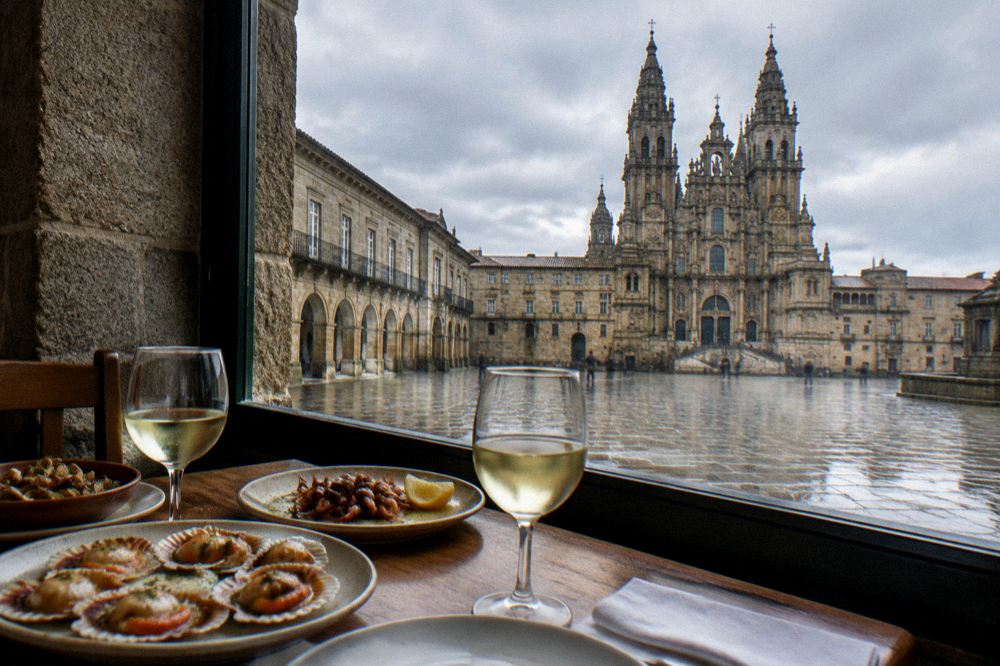
Food is the other border-crossing pleasure. Galicia is one of Spain's great seafood regions, and Santiago's restaurants, from the tapas bars of the old town lanes to the proper dining rooms, are a genuine draw in their own right. The Minho's own table, from its Vinho Verde wines to dishes like the ones covered in the Braga market guide and the pudim Abade de Priscos guide, is the Portuguese counterpart, and travellers who care about eating well should plan for both.
Common Questions About Santiago De Compostela From Braga
How do you get from Braga to Santiago de Compostela?
By direct bus. BlaBlaCar Bus, FlixBus, Rede Expressos and ALSA all appear on the route in 2026 listings, with journey times from about 2 hours 20 minutes to over 4 hours and one-way fares from roughly 18 to 76 EUR and up depending on operator and date. There is no practical rail alternative.
Can you do Santiago de Compostela as a day trip from Braga?
Yes, with an early start and a fast service, but the bus each way takes from about 2 hours 20 minutes to over 4 hours, so a day trip commits 5 to 9 hours to travel. An overnight serves the city better, especially for the early morning and evening atmosphere around the cathedral.
Do you need a passport to travel from Braga to Santiago de Compostela?
You need a valid passport or ID card, and you should carry it, but there are no routine border controls between Portugal and Spain, as both are in the Schengen Area. Non-EU visitors should remember that the Schengen 90-days-in-180 rule covers the whole area, not each country separately.
Can you walk the Camino de Santiago starting from Braga?
Pilgrims have long set out from Portuguese territory toward Santiago, and the Minho is threaded with historical Camino routes, but stage lengths, waymarking and the credential rules are published by the official pilgrim authorities. Read the official pilgrim authorities' material before planning a walk.
Is Santiago de Compostela expensive compared with Braga?
The bus fare is the largest variable, with one-way prices in 2026 listings running from roughly 18 to 76 EUR and up. Once there, Galician restaurant prices are modest, and the city has accommodation across the price spectrum, with the low season outside the summer pilgrimage peak the gentlest on the budget.
What is the single best thing to see in Santiago de Compostela?
The cathedral and the Praza do Obradoiro in front of it. The square is where arriving pilgrims end their walk, and the west facade with its twin towers is the image the city is known for. Everything else in the old town, the Quintana, the Praterías and the Alameda viewpoint, is a short walk from it.
A trip from Braga to Santiago de Compostela is the most ambitious day out the Minho offers, and the planning is honest work: compare the four bus operators, book the fast service if a day trip is the plan, and read the official pilgrim authorities' material if the Camino is calling. Done that way, the cathedral city of Galicia sits comfortably within reach of Braga Travel Guide's home city, and the border between the two is the quietest border a traveller could cross.