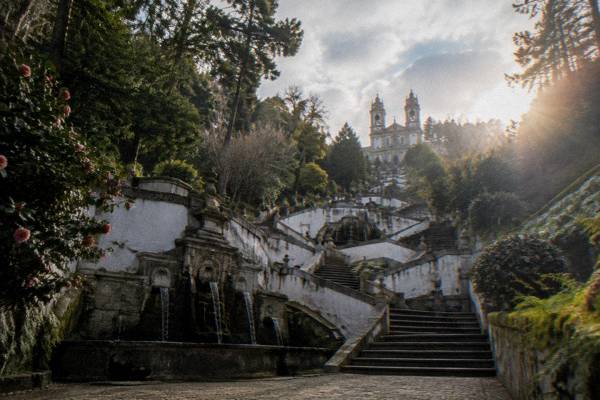
Sameiro Sanctuary, Braga: Hours, The Zimbório Viewpoint And How To Visit
The Santuário do Sameiro stands on the hills southeast of Braga, Portugal, a monumental basilica dedicated to Our Lady of the Assumption. The whole precinct is free and open around the clock, the dome viewpoint costs 2 EUR, and the hill is easy to reach on a half-day loop from the historic centre.
Short answer
The Santuário do Sameiro in Braga, Portugal, is a free Marian sanctuary open 24 hours a day. The basilica keeps seasonal hours, the Zimbório dome viewpoint costs 2 EUR, and the hill sits close to Bom Jesus do Monte, so the two sanctuaries combine naturally on one outing.
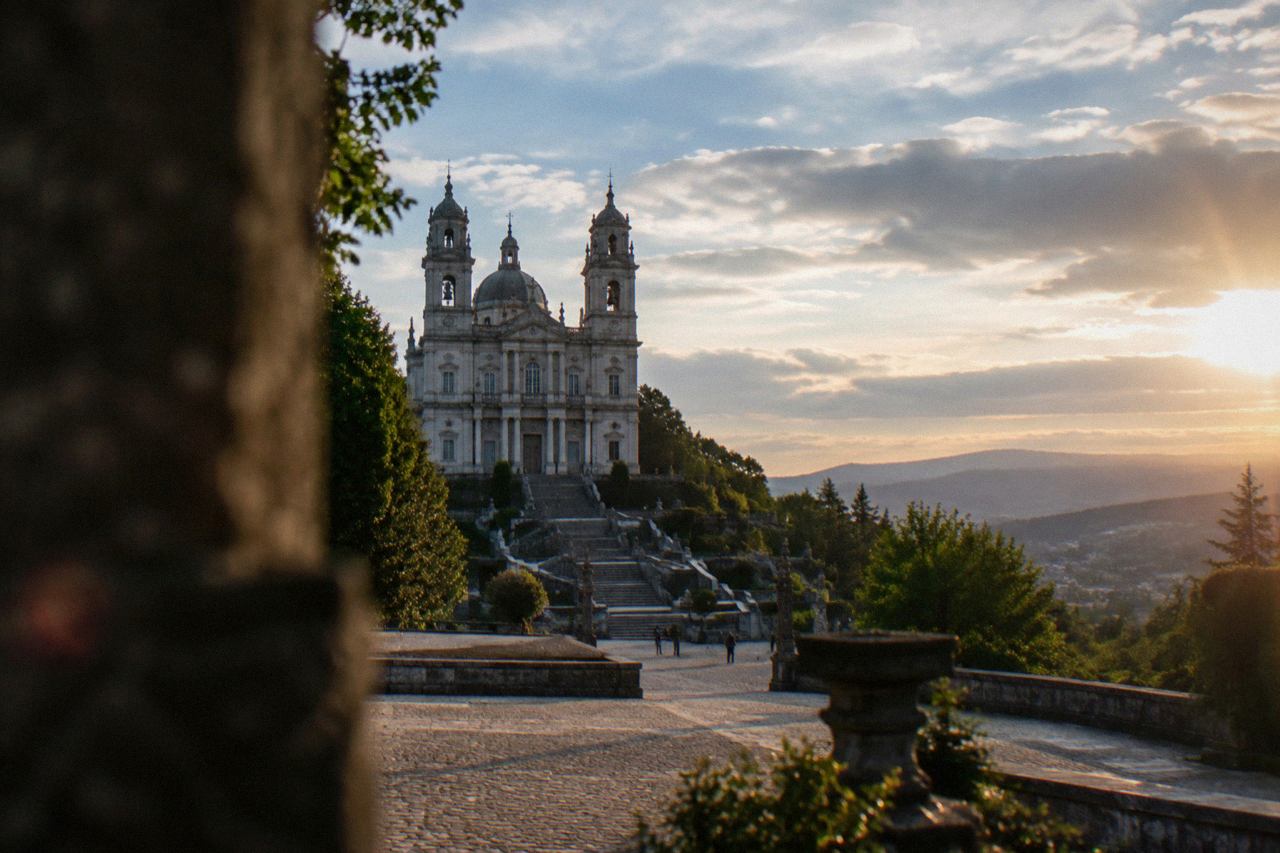
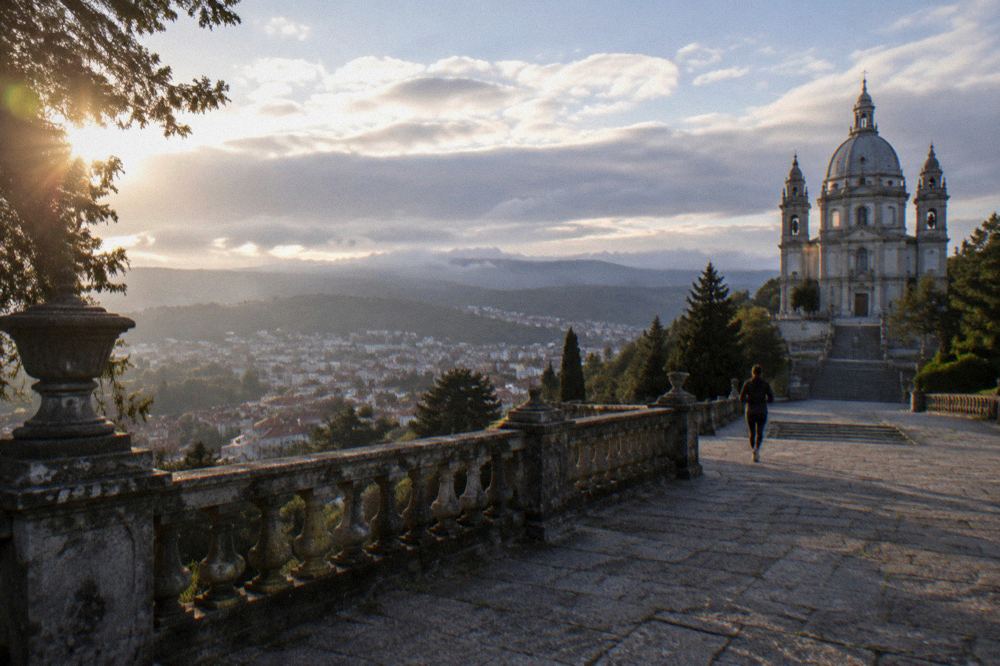
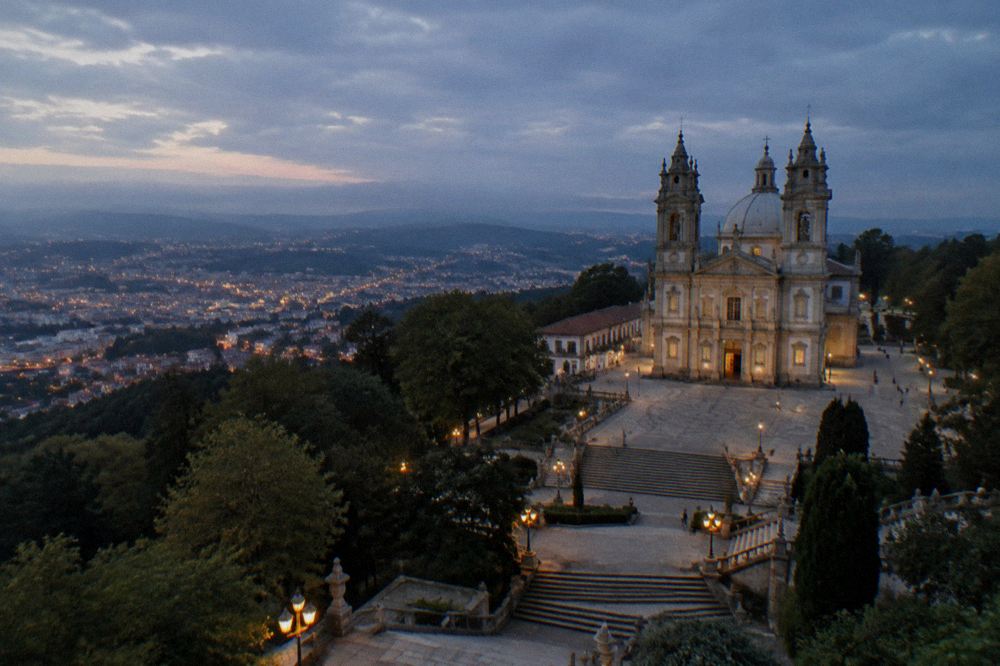
The Santuário do Sameiro rises on the green hills just southeast of Braga, Portugal, the great Marian basilica of the Minho region's religious landscape. Where Bom Jesus do Monte climbs its monumental stairway to the west of the city, Sameiro faces it from the opposite side of the valley: a wide paved esplanade, a twin-towered basilica, and a dome you can climb for one of the broadest views over Braga and the hills beyond. The whole precinct is open 24 hours a day and entry is free, which makes it one of the most generous sights in northern Portugal: no ticket, no gate, no closing time for the grounds.
What Is The Sanctuary Of Our Lady Of Sameiro?
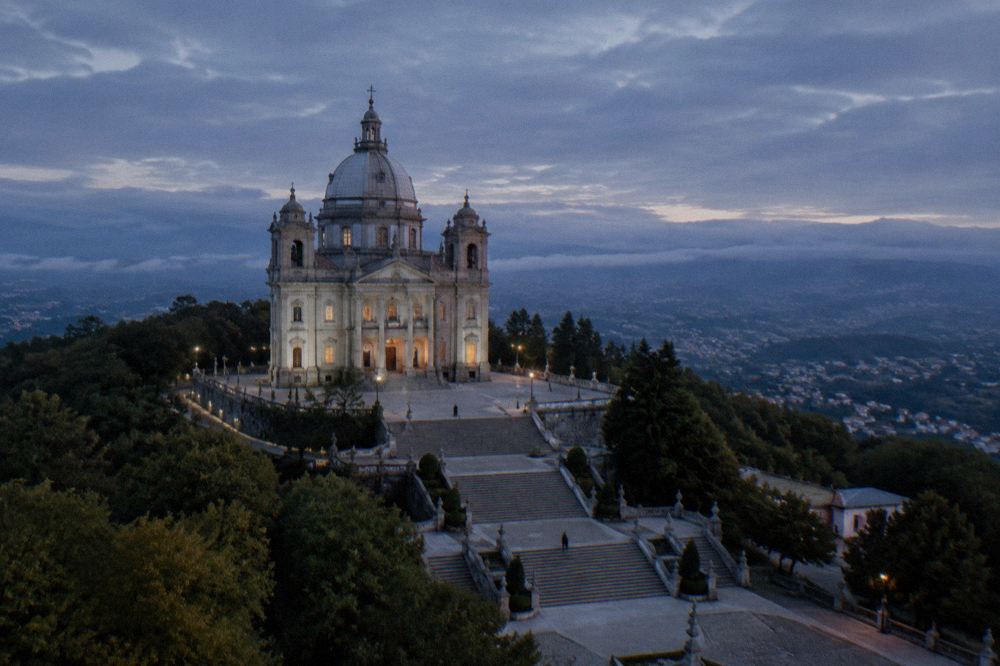
The Santuário do Sameiro is Braga's great Marian pilgrimage sanctuary, a monumental basilica dedicated to the Immaculate Conception and Our Lady of the Assumption, standing on a hill on the city's southeastern side. The entire precinct is open 24 hours a day, seven days a week, and entry is free, according to the sanctuary's own information page. It is the second of Braga's two hill sanctuaries, the counterpart to Bom Jesus do Monte on the opposite hill.
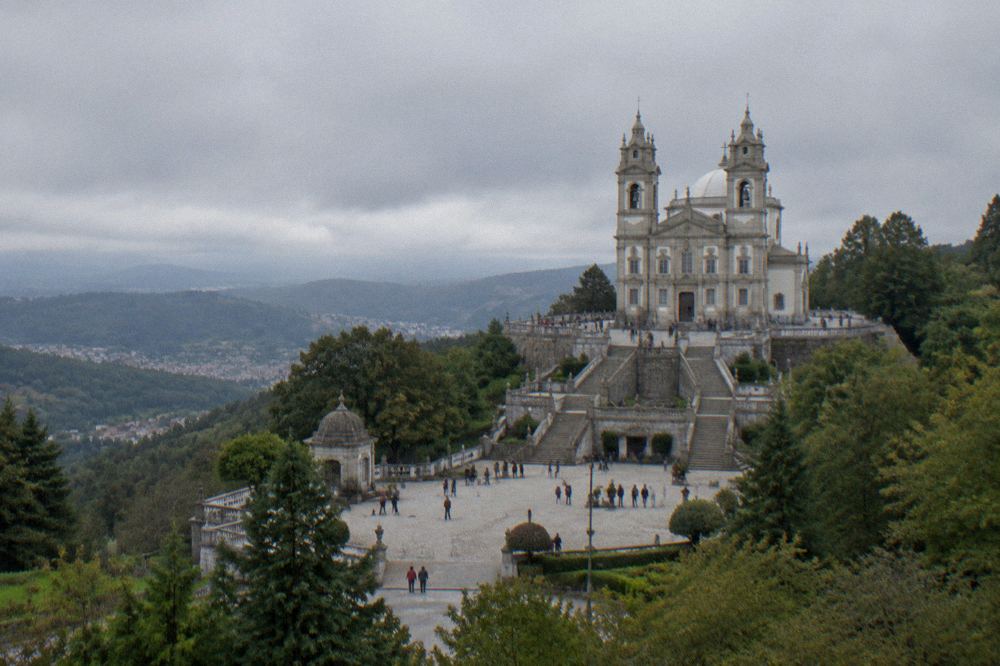
The basilica is the building most visitors come for: a broad neo-classical church with two bell towers, a statue of Our Lady of the Assumption above the portico, and a painted interior centred on the Marian devotion that drew pilgrims here long before the present church was finished. The esplanade in front, with its stone balustrades and viewpoints, was built for crowds, and it still fills on the major feast days, above all around 15 August, the Assumption, when pilgrims climb and drive up to the sanctuary in numbers.
What surprises many first-time visitors is the scale of the setting. The hill gives the sanctuary its sense of arrival: you come out of Braga's compact historic centre, with its Sé de Braga and its baroque churches, and within a short drive or a stiff walk you are standing on an open platform with the whole city below. The sanctuary is a working place of worship rather than a museum, so mass times, pilgrim groups and quiet hours shape the atmosphere more than ticketing queues do.
Want the city core explained before heading up the hill? Book a city walking tour here.
What Are The Opening Hours And Admission Costs At Sameiro?
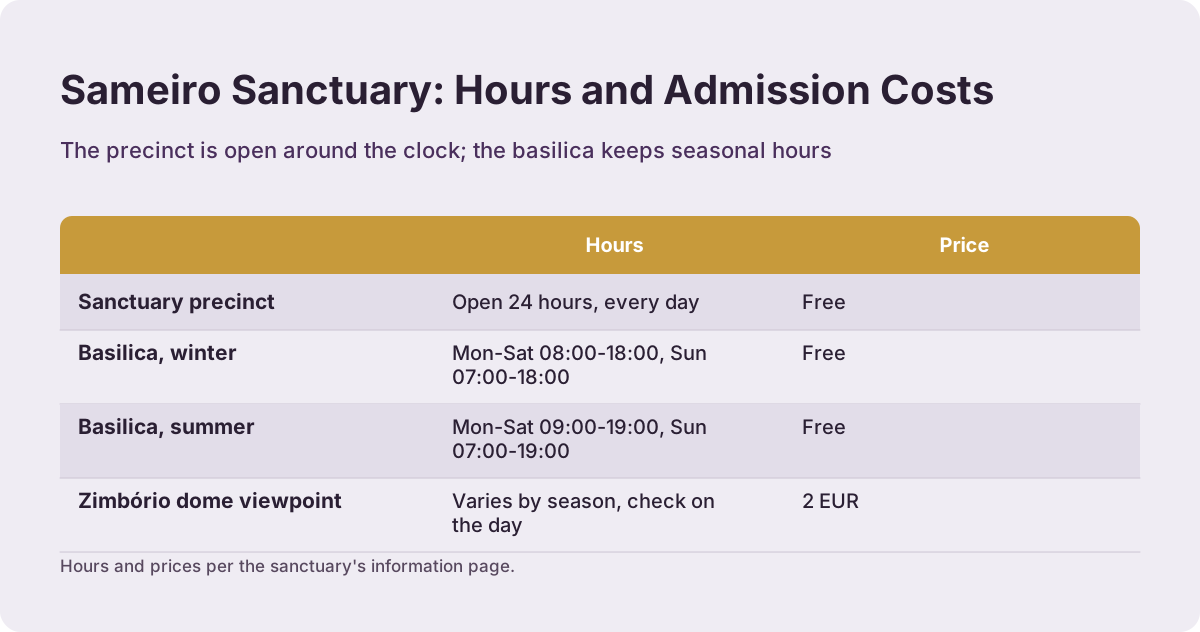
The whole Sameiro precinct is open 24 hours a day, every day, and entry is free. The basilica keeps seasonal hours: in winter it opens 08:00 to 18:00 Monday to Saturday and 07:00 to 18:00 on Sundays; in summer, 09:00 to 19:00 Monday to Saturday and 07:00 to 19:00 on Sundays. The only paid element is the Zimbório, the dome viewpoint, at 2 EUR per person, with the entrance at the back of the basilica.
That is the entire cost structure of a visit. There is no combined ticket, no timed entry and no booking system for the basilica or the grounds. The sanctuary's own contacts and hours page is the source for the basilica times above, and it is the page to check before an early or late visit, because services can close the church to sightseers while remaining open for worship.
The Zimbório deserves its 2 EUR more than almost any viewpoint ticket in the region. You climb inside the drum of the dome and come out on a gallery that turns a full circle: Braga's historic centre one way, the Bom Jesus hill and the Bom Jesus funicular slope another, and the mountains of the Minho and Peneda-Gerês on the horizon. One caution: the dome's opening days differ between the sanctuary's own page and the municipal tourism site, so check on the day you go rather than assuming it is open.
| Element | Hours | Price |
|---|---|---|
| Sanctuary precinct | Open 24 hours, every day | Free |
| Basilica, winter | Mon-Sat 08:00-18:00, Sun 07:00-18:00 | Free |
| Basilica, summer | Mon-Sat 09:00-19:00, Sun 07:00-19:00 | Free |
| Zimbório dome viewpoint | Varies by season, check on the day | 2 EUR |
For visitors building a budget, Braga is gentle with its sights. The cathedral's combined ticket is 7.00 EUR for all three routes, the D. Diogo de Sousa museum is 5.00 EUR, and Sameiro costs nothing but the dome. Add the municipal tourist tax, 1.55 EUR per person per night for up to four nights, and a two-day stay with one paid sight a day still comes in cheap by western European standards.
How Do You Get To Sameiro Sanctuary From Braga?
Sameiro sits on the hillside southeast of Braga's historic centre, and the practical options are the city bus network, a taxi or ride-hailing car, a rental car, or the walk up from the city, which is steep but feasible for anyone used to hills. A single TUB bus journey costs 1.55 EUR bought on board or 0.75 EUR pre-bought or digital for one zone, per the 2026 TUB tariff. There is no train and no funicular to Sameiro.
The TUB network covers the city and its hill sanctuaries, and the 2026 tariff is simple: 1.55 EUR on board for a one-zone single, 2.00 EUR for two zones, and 0.75 EUR or 1.50 EUR if you buy before boarding or use the digital ticket. A tourist day ticket for the whole network costs 3.35 EUR, with two-day and three-day versions at 6.05 EUR and 8.05 EUR, which makes a day that buses out to Sameiro and Bom Jesus very inexpensive indeed. Confirm the current route serving the sanctuary on the TUB site or app before setting out, as timetables and line arrangements change.
By car, the sanctuary has parking on the hill, and the road up is a steady climb through residential streets that give way to trees. Taxis and ride-hailing cars from the centre are the fastest option and suit anyone combining Sameiro with Bom Jesus do Monte in one loop, since the two sanctuaries sit on facing hills with the city between them. On foot, allow a proper hill walk: the climb is real, the reward is arriving at the balustrade with the city below you, and comfortable shoes matter more than speed.
This is where a guided option earns its keep. The Braga Personal & Flexible Walking Tour in Historic Center covers the city core, and several operators run half-day tours that include the hill sanctuaries with transport handled.
A tuk tuk tour is another way to reach the hill without the climb, and the open-sided vehicles suit Braga's mild climate for most of the year.
What Can You See Inside The Basilica And From The Zimbório?
Inside the basilica, the sights are the high altar with its image of Our Lady of the Assumption, the painted ceiling over the nave, the twin towers' bell arrangement and the quiet chapels around the nave; from the Zimbório gallery, the reward is a full-circle panorama over Braga, the Bom Jesus hill and the Minho mountains, included in the 2 EUR ticket. The basilica itself is free to enter during opening hours.
The interior is lighter and more restrained than Braga's baroque churches. Where the Igreja do Pópulo and the city's other centre churches layer gilded carving, Sameiro's nave runs to stone, plaster and paint, with the focus pulled forward to the altar and the Marian image above it. Pilgrim groups give the space its life: on feast days the nave fills, and on ordinary weekdays you may have it nearly alone.
The Zimbório climb is the physical highlight. The entrance is at the back of the basilica, the staircase winds inside the dome's structure, and the gallery at the top is narrow enough that you will want to keep small children by the hand. Give it twenty minutes unhurried: the view changes character as you circle, from the dense tile roofs of the historic centre to the wooded ridge where Bom Jesus stands, and on clear days the horizon reaches a long way north.
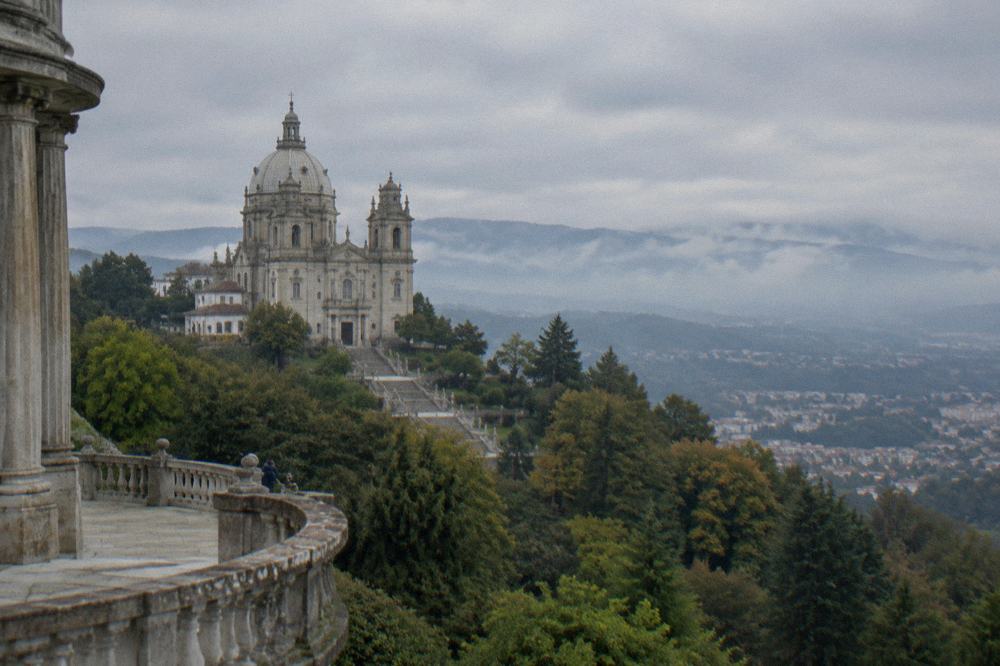
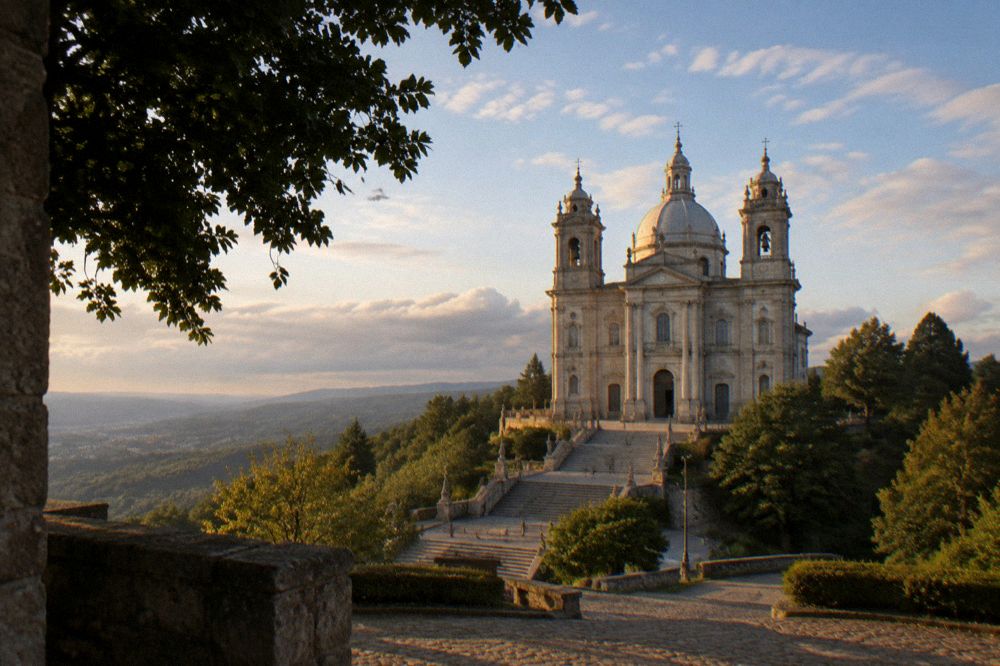
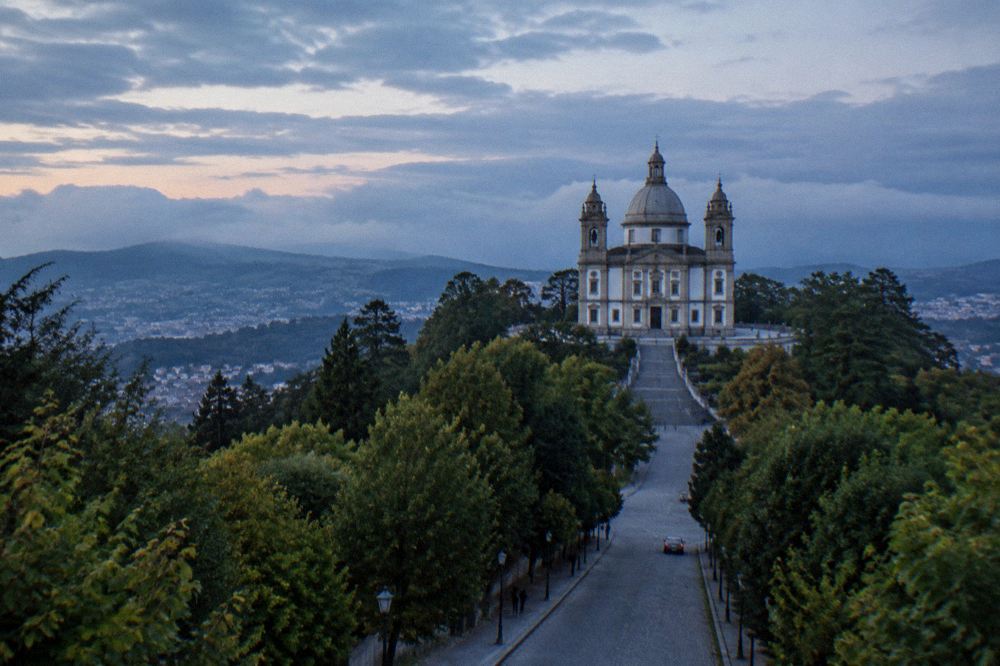
Around the precinct, the esplanade's balustrades are the free viewpoints, and they are generous enough that many visitors skip the dome. The difference is height and angle: the balustrade gives you the city, the Zimbório gives you the region. Photographers aiming for the classic shot of the basilica itself should walk the access road below the sanctuary, where the twin towers rise against the hillside.
Is Sameiro Or Bom Jesus Do Monte Better To Visit?
Bom Jesus do Monte is the more spectacular sanctuary, with its 566-step monumental stairway, its UNESCO World Heritage inscription from 2019 and its historic funicular, while Sameiro is the freer, quieter, more spacious one, open around the clock with a larger panorama from its dome. The honest answer for most visitors is both: they sit on facing hills above Braga and combine into a single half-day loop.
The comparison is worth making properly, because many guides treat the two as interchangeable and they are not. Bom Jesus is architecture as theatre: the Escadório do Pórtico and the stairway's other sections climb 116 metres over 615 metres, with fountains, chapels and allegorical figures all the way up, and the ensemble was inscribed by UNESCO in 2019 as the "Sanctuary of Bom Jesus do Monte in Braga". Sameiro is architecture as monument: you arrive at the top, the basilica is the event, and the view is the point. Everything else covered here is indexed on Braga Travel Guide.
One standing caution for anyone planning the pair: the Bom Jesus funicular has been out of service for maintenance since 26 September 2026, per the operator's notice, with no end date published. A replacement shuttle runs every day between 09:00 and 20:00, roughly every 30 minutes each way, between the Pórtico, where TUB Line 2 ends, and the sanctuary. Check the operator's notice before you go, and do not plan a trip around riding the funicular until it is confirmed back.
| Sameiro | Bom Jesus do Monte | |
|---|---|---|
| Grounds and basilica | Free, precinct open 24 hours | Free entry, no admission charge listed |
| Signature feature | Zimbório dome viewpoint, 2 EUR | Monumental stairway, 566 steps by the Confraria's count |
| Recognition | Major Marian sanctuary | UNESCO World Heritage, inscribed 2019 |
| Funicular | None | Out of service since 26 Sept 2026, shuttle replacing it |
| Best for | Panorama, quiet, arrival by car or bus | Architecture, the climb, the gardens |
| Typical visit | 45-90 minutes | 2-3 hours with the stairway |
If you have time for only one and you care about architecture, choose Bom Jesus. If your day is short, your legs are tired or you are timing a sunset, Sameiro is the easier win. And if you are visiting Braga with kids, the boat lake and gardens at Bom Jesus will hold them longer than the esplanade at Sameiro will.
When Is The Best Time Of Day And Year To Visit Sameiro?
The best time to visit Sameiro is late afternoon into sunset between May and September, when the basilica is open until 19:00 and the west-facing view over Braga catches the evening light. For weather, IPMA's 1991 to 2020 normals for the Braga / Merelim station show July and August as the warmest, driest months, with mean maximums of 28.2 C and 28.7 C and only about 4 rain days each.
The climate table matters more here than in most Portuguese cities, because Braga is a rainy place by national standards. The same station's normals show October as the wettest month on average, 197.8 mm, with December and January close behind at 190.3 mm and 179.5 mm, and 12 to 13 rain days a month from October through January. Summer inverts the picture: July averages just 27.9 mm of rain over about 4 days.
| Month | Mean max C | Mean C | Rain mm | Days with 1 mm+ rain |
|---|---|---|---|---|
| May | 23.0 | 16.7 | 89.8 | 8.9 |
| June | 26.1 | 19.7 | 40.6 | 5.7 |
| July | 28.2 | 21.2 | 27.9 | 4.0 |
| August | 28.7 | 21.4 | 34.6 | 3.8 |
| September | 26.9 | 19.7 | 67.6 | 6.2 |
| October | 22.2 | 16.1 | 197.8 | 12.0 |
For pilgrimage atmosphere rather than weather, the great date is 15 August, the feast of the Assumption, when the sanctuary fills with pilgrims arriving on foot from across the region. Holy Week belongs to the city below, with Semana Santa de Braga's processions centred on the historic centre and the cathedral, but the Marian calendar peaks on Sameiro's hill. If you want the sanctuary almost to yourself, go on a weekday morning outside feast days; if you want it at its most alive, go on the feast.
What Is The History Of The Sameiro Sanctuary?
Sameiro's history is a Marian devotion story: devotion to the Immaculate Conception took hold on the hill, a first chapel was raised, and the monumental basilica that stands today was built in stages over a long period, completing Braga's pair of hill sanctuaries. The sanctuary belongs to the same devotional wave that spread Marian shrines across Portugal in the modern era.
The cult at the heart of the sanctuary is the Immaculate Conception, and it is that devotion which gave the hill its name: the "sameiro" cult of Mary. A modest chapel first served the pilgrims, and as the numbers grew the project expanded into the basilica, whose construction stretched across generations and gave the building its transitional style, neo-classical in mass with later interior work.
What the sanctuary became, though, is a pilgrimage centre of national standing. Processions still climb to it, the esplanade was built to hold them, and the sanctuary's place in Braga's religious geography is fixed: the cathedral in the valley for the Holy Week processions, Bom Jesus for the Via Crucis and the stairway, Sameiro for Mary. The santa Maria Madalena da Falperra church, the eighteenth-century baroque sanctuary on the neighbouring Falperra hill, belongs to the same landscape of hillside devotions around the city.
Can You Combine Sameiro With Other Sights Around Braga?
Yes, and you should: Sameiro pairs naturally with Bom Jesus do Monte on the facing hill, with the Falperra sanctuary beyond it, and with any of Braga's city-centre sights on the same day, since the sanctuary visit itself takes under two hours. A realistic loop is the historic centre in the morning, Bom Jesus after lunch, and Sameiro for the sunset view, using a car, taxis or the TUB network to link the hills.
The classic combination is the two sanctuaries, and it works in either direction. Doing Bom Jesus first means the stairway climb comes before the day's heat; doing Sameiro first means you end at the gardens and lake of Bom Jesus, where you can sit. With the funicular out of service, the replacement shuttle and the TUB Line 2 bus to the Pórtico cover the transport on that side of the valley, while Sameiro's road access makes it the easier of the two by car.
For a fuller day, the hills can precede or follow the city. The Sé de Braga's three visit routes cost 3.00 EUR each or 7.00 EUR combined, the Museu dos Biscainhos at 7.50 EUR with its garden, and the Mosteiro de São Martinho de Tibães, about 4 to 5 EUR, sits on yet another of the city's surrounding hills and fits the same devotional route. The Theatro Circo and the Praça da República then take the evening.
| Sight | Entry | Hours summary |
|---|---|---|
| Sameiro precinct and basilica | Free | Precinct 24 h; basilica seasonal hours |
| Bom Jesus do Monte sanctuary and grounds | Free | Basilica summer 08:00-19:00, winter 08:00-18:00 |
| Sé de Braga, all three routes | 7.00 EUR combined | Mon-Sat 09:30-13:00, 14:30-17:00 |
| Museu dos Biscainhos | 7.50 EUR | Tue-Sun 10:00-12:30, 14:00-17:30 |
| Mosteiro de São Martinho de Tibães | About 4 to 5 EUR | Winter 10:00-18:00, summer 10:00-19:00 |
| Museu de Arqueologia D. Diogo de Sousa | 5.00 EUR | Tue-Sun 10:00-17:30 |
Guided tours simplify the logistics considerably, especially for visitors without a car. suits anyone who wants the hills and the history explained in one continuous narrative, while handles the climbs mechanically.
What Should You Know Before You Go To Sameiro?
Take water and sensible shoes, expect the esplanade to be fully exposed to sun and wind, check the Zimbório's opening on the day because the sanctuary's and the municipal site's days differ, and treat the basilica as a place of worship first: visits pause for services. There is no admission charge to plan around, no ticket to book, and no cafe dependency, though the precinct has open ground where a picnic works.
Practicalities are few, which is part of the sanctuary's appeal. The hill is exposed: in July and August, when the mean maximum runs to 28.2 C and 28.7 C, the middle of the day is hot on the esplanade, and in winter the wind can be sharp on the same stone. The basilica dress code is the ordinary one for Portuguese churches, shoulders covered, hats off, and voices low.
For access, the precinct's flat esplanade is far easier than Bom Jesus's stairway, and arrival by car or taxi puts you level with the basilica. The Zimbório staircase is a spiral inside the dome, so it is not a step-free viewpoint; the balustrade views, by contrast, need no climb at all. Anyone planning a fuller accessibility picture for the city should read the dedicated accessibility guide, and anyone wondering whether the city justifies the trip at all can start with things to do in Braga.
Common Questions About The Sameiro Sanctuary
Is the Sameiro Sanctuary free to visit?
Yes. The whole precinct is open 24 hours a day and entry is free, including the basilica during its opening hours. The only paid element is the Zimbório dome viewpoint at 2 EUR per person.
What are the Sameiro basilica opening hours?
In winter, Monday to Saturday 08:00 to 18:00 and Sunday 07:00 to 18:00. In summer, Monday to Saturday 09:00 to 19:00 and Sunday 07:00 to 19:00. The grounds outside the basilica never close.
How do I get from Braga to Sameiro without a car?
The TUB city bus network serves the hill; a single one-zone journey costs 1.55 EUR on board or 0.75 EUR pre-bought or digital, and a whole-network tourist day ticket is 3.35 EUR. Taxis and ride-hailing cars are a fast alternative, and the climb on foot is steep but possible.
Is Sameiro or Bom Jesus do Monte better?
Bom Jesus is the more spectacular ensemble, with its 566-step stairway and UNESCO inscription in 2019, while Sameiro is the freer and quieter one with the wider panorama from its dome. Most visitors can and should do both in one half-day loop.
Can you climb the dome at Sameiro?
Yes, the Zimbório costs 2 EUR, with the entrance at the back of the basilica. Its opening days differ between the sanctuary's page and the municipal tourism site, so check on the day of your visit.
When is the best time to visit Sameiro?
Late afternoon between May and September, when the basilica is open until 19:00 and the west-facing view catches the evening light. For pilgrimage atmosphere, the feast of the Assumption on 15 August is the sanctuary's great day.
Sameiro rewards the visitor who treats it as what it is: Braga's open hilltop, free at any hour, with a 2 EUR staircase to the best roof in the Minho.