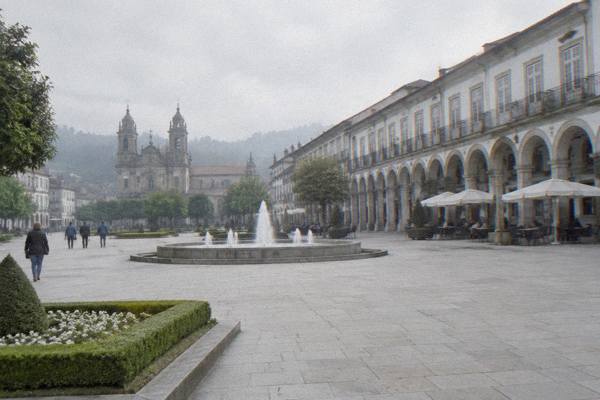
Braga Spas And Thermal Baths: Where To Unwind In Northern Portugal
Braga, the historic city in Portugal's Minho region, has been shaped by water since Roman times. This guide covers the Roman baths you can still visit, the hotel spas, the thermal towns of the surrounding hills, and what a restful break here actually costs.
Short answer
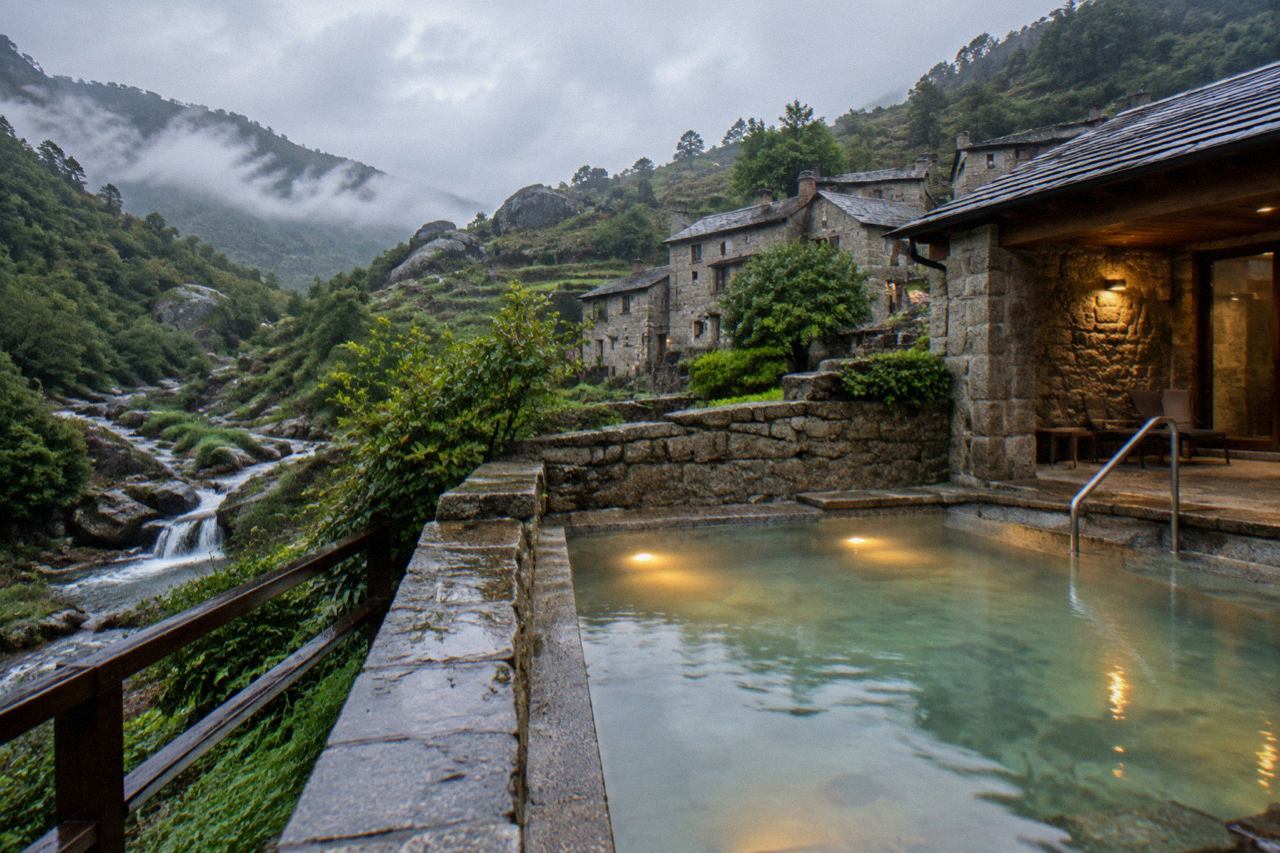
Braga itself has one true ancient bathing site open to visitors, the Roman baths of Alto da Cividade, plus hotel spas led by The Lince Braga, which holds a Michelin Key in the 2026 guide. The classic thermal spa towns, above all Caldas do Gerês in the Peneda-Gerês park, sit in the hills around the city.
Braga, the city in the Minho region of northern Portugal, has been shaped by water for as long as it has existed. Roman Bracara Augusta was built around baths, fountains and an aqueduct network, and the hills above the modern city still carry the eighteenth-century Sete Fontes hydraulic system that fed its fountains until around 1913. A visitor coming here to slow down is not inventing a tradition. The city's own museum circuit includes a Roman bathhouse you can walk into, its newest hotels sell themselves on wellness, and the thermal towns of the surrounding hills have long been drawing people to their springs.
What surprises most first-time visitors is how quietly this side of Braga sits next to the baroque churches and the processions. The spa and bath story here is not a separate industry tacked onto a religious city. It runs through the archaeology, the hotel scene and the landscape of the Minho in one continuous thread, and this guide follows it from a Roman caldarium to a modern hotel spa and out to the springs of the Gerês mountains.
What Kind Of Spa And Bath Experiences Does Braga Offer?
Braga offers three distinct layers of bathing culture: the ancient Roman baths of Alto da Cividade, a small but growing hotel spa scene centred on The Lince Braga, and the historic thermal spa towns of the surrounding Minho hills, above all Caldas do Gerês inside the Peneda-Gerês National Park. The city itself is compact and walkable, so a restful break can mix a museum morning, a thermal afternoon and an evening of Minho cooking without ever needing a car.
The first layer is archaeological. Braga's Roman past is unusually visible for a mid-sized city, and the municipal circuit that includes the Roman baths of Alto da Cividade also takes in Fonte do Ídolo, a Roman-period rock sanctuary dedicated to the water deity Nabia. Neither is a working bathhouse, but together they explain why Braga grew where it did: the water was the point.
The second layer is modern wellness. Braga's hotel stock renewed itself quickly after the city's 2025 run as Portuguese Capital of Culture, and the standouts for a spa-minded traveller are new or newly renovated properties in and around the historic centre. The third layer sits outside the city limits, in the hills, where genuine thermal towns have long been operating and remain reachable by public bus from Braga's central bus station.
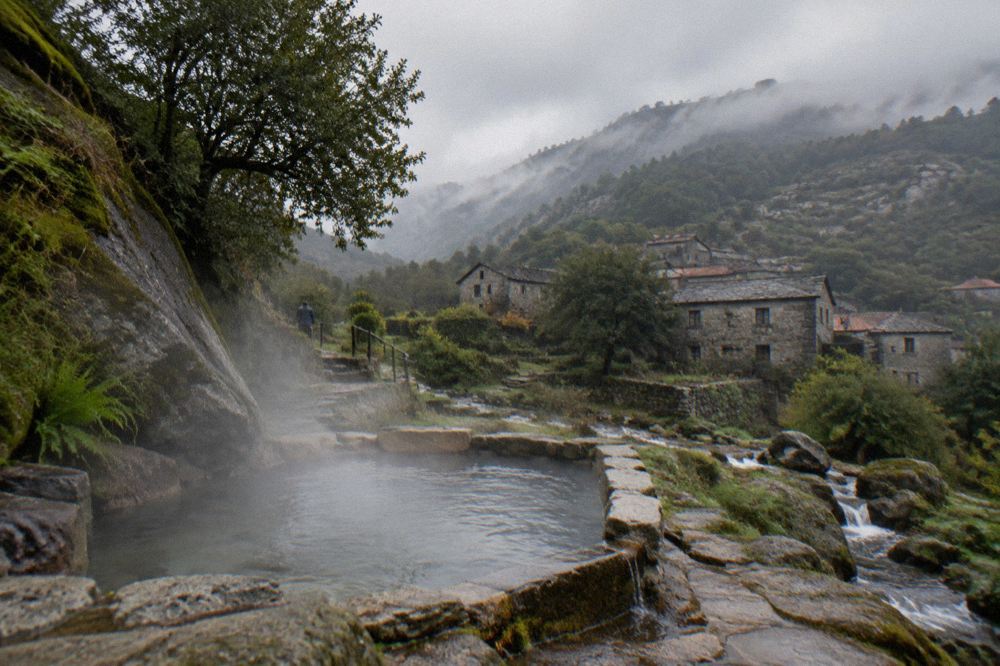
The honest framing matters. Braga is not a spa town in the way Caldas do Gerês is. It is a historic city with one exceptional ancient bath site, a handful of good hotel spas, and the best possible base for reaching the thermal springs of northern Portugal. Plan for that and the city rewards you well.
Can You Visit Real Roman Baths In Braga?
Yes. The Termas Romanas do Alto da Cividade are the excavated public baths of Roman Bracara Augusta, open to visitors as part of Braga's municipal archaeological circuit. The 2026 municipal price table lists an individual visit at about 2.05 EUR, or 3.70 EUR for a joint ticket covering the baths and Fonte do Ídolo, with free entry for children under 14 and a 50 percent discount for visitors over 65, students and several other categories.
The site sits on the Alto da Cividade, the plateau where the Roman city's civic centre stood, a short walk uphill from the modern streets around the Sé de Braga. What you see is the real infrastructure of a public bathhouse: the heated rooms, the hypocaust system that warmed them and the drainage that carried the water away. The municipality runs the baths on a fixed schedule, with guided tours available by appointment from Tuesday to Friday.
| Site | What It Is | Hours (Municipal Circuit) | 2026 Admission |
|---|---|---|---|
| Termas Romanas do Alto da Cividade | Excavated Roman public baths | Mon to Fri 09:30 to 13:00 and 14:00 to 17:30; Sat 11:00 to 17:30; closed Sundays and holidays | About 2.05 EUR |
| Fonte do Ídolo | Roman rock sanctuary to the water deity Nabia | Same circuit hours as the baths | Included in the 3.70 EUR joint ticket |
| Joint circuit ticket | Baths plus Fonte do Ídolo | Last entry 30 minutes before closing | 3.70 EUR |
Two practical notes from the municipal listing. Last entry is 30 minutes before closing, and the free-entry and discount categories are broad: children under 14 enter free, and the 50 percent reduction covers visitors aged 65 and over, students, teachers, youth-card holders and families. Check the notice at the site before you go, since the circuit occasionally closes for maintenance.
Fonte do Ídolo deserves its half of the joint ticket. It is a sanctuary carved into living rock, with an inscription to Nabia, a deity associated with springs and water. For a visitor interested in Braga's bathing history, the two sites together tell the whole Roman story: where the city bathed, and where it worshipped the water itself.
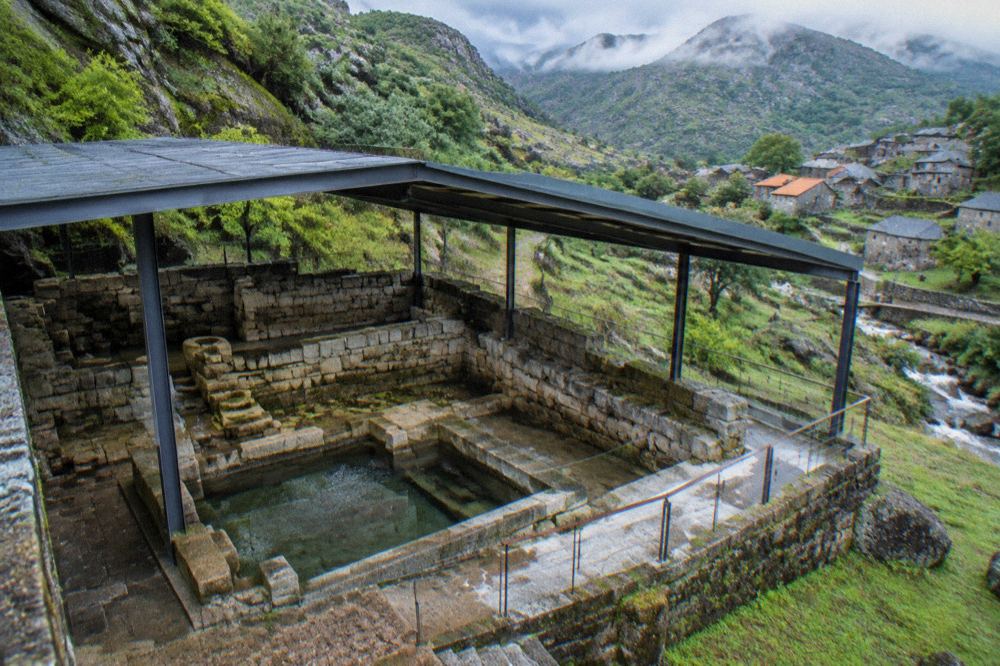
Pairing the ancient with the modern works well here. A morning at the baths and the sanctuary, lunch in the historic centre, and an afternoon in a hotel spa or a garden is a genuinely restful Braga day, and the whole thing is walkable or a short bus ride apart.
Which Braga Hotels Have Spa Facilities?
The clearest spa option in the city is The Lince Braga, a four-star hotel that opened in summer 2025 in the renovated former Hotel da Falperra building and includes a spa among its facilities; the property received a Michelin Key in the 2026 guide, the strongest signal of quality in Braga's current hotel stock. Beyond it, Braga's hotel scene is compact, so travellers wanting a full thermal-spa resort should look to the hills rather than the city centre.
The Lince Braga is the notable arrival. The building's renovation transformed one of the city's familiar older hotels into a modern four-star property with a spa, and the Michelin Key it holds in the 2026 guide places it among the hotels the guide's inspectors rate most highly in Portugal. For a visitor whose priority is a sauna, a treatment or simply a pool after a day of walking Braga's hills, it is the obvious first call.
The city-centre options are also changing. The Esperança Hotel, a Vignette Collection property of 58 rooms converted from two buildings in the centre, was scheduled to open in September 2026, adding further full-service capacity within walking distance of the historic core. For current spa facilities and treatment availability, contact the hotels directly before booking, since facilities and opening schedules change with the seasons.
| Property | Status | Why It Matters For A Spa Break |
|---|---|---|
| The Lince Braga | Open since summer 2025, four-star | Includes a spa; holds a Michelin Key in the 2026 guide |
| Esperança Hotel | Scheduled to open September 2026 | 58-room conversion in the city centre, full-service brand |
| Caldas do Gerês hotels | Long-established thermal town | The full resort-style thermal experience, in the hills outside the city |
For choosing where to base yourself, the trade-off is simple and covered in detail in the where to stay in Braga guide: the city centre puts you walking distance from the Roman baths, the gardens and the restaurants, while the hill properties buy quiet and views. A spa-minded traveller who wants thermal water specifically should read the next section before deciding.
Ready to pick a base for a restful stay? Book a hotel in Braga here.
Are There Thermal Spa Towns Near Braga?
Yes, and this is where the genuine thermal tradition of the region lives. Caldas do Gerês, the thermal town inside the Peneda-Gerês National Park, is the classic destination, reachable by regional bus from Braga's central bus station on the AITC intermunicipal network. These are real spa towns built around mineral springs, with hotels, bathhouses and treatment programmes, not day-spa operations, and they are long-established destinations in northern Portugal.
Caldas do Gerês sits in the Gerês valley, where the spring water and the mountain setting together created one of northern Portugal's historic termas, the thermal resorts that Portuguese families have visited for rest cures for generations. The town's bathhouses and hotels are built around the spring, and the surrounding national park adds walking trails, waterfalls and river beaches to the classic thermal routine.
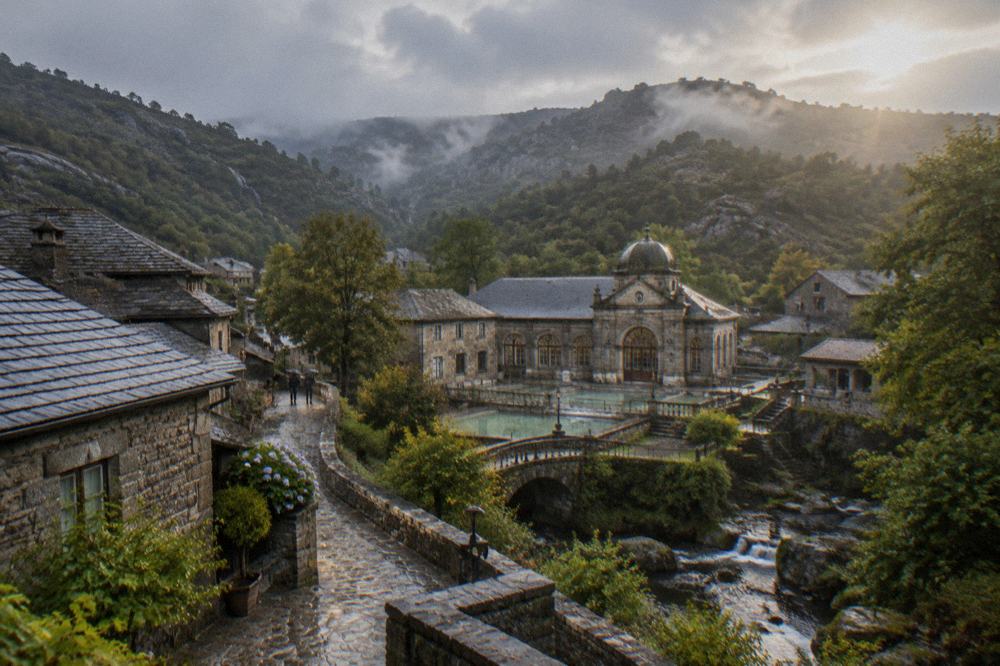
Getting there from Braga is a regional bus journey on the AITC network from the central bus station, and the wider Peneda-Gerês park, covered in the site's things to do in Braga overview, adds canyoning, hiking and waterfall routes for anyone who wants activity between soaks. Treatments, opening seasons and prices at the thermal establishments vary by operator and season, so check with the specific bathhouse or hotel before planning a visit around a particular treatment.
The honest planning advice is to treat Caldas do Gerês as an overnight or a full-day destination rather than a quick dip. The thermal houses operate seasonal schedules, and the journey into the mountains is part of the experience. Visitors combining it with Braga usually give the city two days and the park one or two more, a split the itinerary guides on this site handle in detail.
What Does A Spa And Bath Day In Braga Cost?
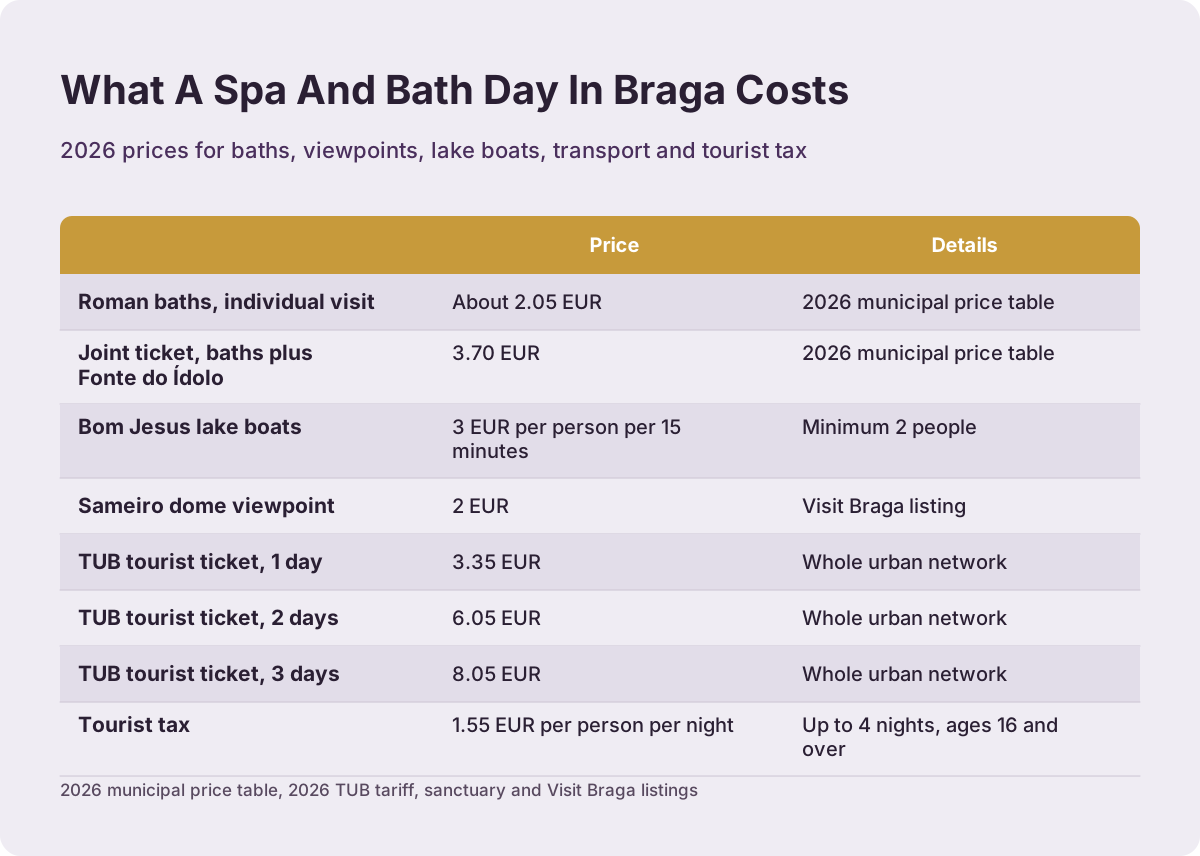
The archaeological side is inexpensive: the 2026 municipal price table lists the Roman baths at about 2.05 EUR, or 3.70 EUR for the joint ticket with Fonte do Ídolo. Hotel spa treatments and thermal resort programmes are priced individually by each operator, and no reliable single price list exists for them, so treat any figure you see online for a Braga spa treatment as unverified and check the operator's own listing before booking.
What can be stated with confidence is the cost of the public, verifiable parts of a restful Braga day. The table below gathers the priced, checkable items from the municipal and operator sources. More of these guides are collected on Braga Travel Guide.
| Item | Price | Source Basis |
|---|---|---|
| Roman baths, individual visit | About 2.05 EUR | 2026 municipal price table |
| Joint ticket, baths plus Fonte do Ídolo | 3.70 EUR | 2026 municipal price table |
| Bom Jesus lake boats | 3 EUR per person per 15 minutes, minimum 2 people | Sanctuary information page |
| Sameiro dome viewpoint | 2 EUR | Visit Braga listing |
| TUB tourist ticket, whole network | 3.35 EUR for 1 day, 6.05 EUR for 2 days, 8.05 EUR for 3 days | 2026 TUB tariff |
| Municipal tourist tax | 1.55 EUR per person per night, up to 4 nights | 2026 municipal fee table |
Two of these deserve comment. The TUB tourist ticket is the best transport buy for a restful stay, since it covers the whole urban network including the bus to the foot of the Bom Jesus stairway, and the 2026 tariff is unambiguous on its prices. The tourist tax applies year-round to guests aged 16 and over, charged by hotels and local accommodation, so budget roughly 1.55 EUR per night per adult for up to four nights.
On tipping, Turismo de Portugal's own guidance states that service is included in restaurant bills, though it is customary to leave an additional tip of about 5 to 10 percent, and normal to tip taxi drivers 5 to 10 percent or round up to the nearest euro. Spa and treatment staff are not covered by that guidance, so follow the house custom at each establishment.
When Is The Best Time For A Spa Break In Braga?
The most comfortable months are May, June and September: IPMA's 1991 to 2020 normals for the Braga / Merelim station show mean daily highs of 23 C in May, 26.1 C in June and 26.9 C in September, with September actually warmer at the top end than June. Rain is the real variable, because October is the wettest month on average at 197.8 mm, and July is the driest at just 27.9 mm.
The climate data tells a clear story for a rest-focused trip. Braga's summer is warm but not extreme, with mean daily maxima of 28.2 C in July and 28.7 C in August, and the station's records show roughly ten days a summer month reaching 30 C or more. Winter is mild by northern European standards but wet: January averages 179.5 mm of rain over about 13 rainy days of 1 mm or more, and December 190.3 mm.
| Month | Mean Daily High | Mean Temperature | Rainfall | Days With 1 mm Or More |
|---|---|---|---|---|
| May | 23.0 C | 16.7 C | 89.8 mm | 8.9 |
| June | 26.1 C | 19.7 C | 40.6 mm | 5.7 |
| July | 28.2 C | 21.2 C | 27.9 mm | 4.0 |
| August | 28.7 C | 21.4 C | 34.6 mm | 3.8 |
| September | 26.9 C | 19.7 C | 67.6 mm | 6.2 |
| October | 22.2 C | 16.1 C | 197.8 mm | 12.0 |
For a spa-and-sightseeing mix, September is the sweet spot. The best time to visit Braga and Braga weather guides on this site unpack the seasons in full, but the short version is that early September combines the year's warmest sea-adjacent evenings with manageable rain before the October peak arrives. A rainy October or November break is not a write-off either: the Roman baths, the museums and the hotel spas are all indoors, and the city's café culture exists precisely for that weather, a mix the braga on a rainy day angle covers well.
One timing note for 2026 specifically: the Bom Jesus funicular has been out of service since 26 September 2026, with a replacement shuttle running daily between the Portico and the sanctuary. The stairway itself, 566 steps by the Confraria's count, is unaffected, and the sanctuary's information page lists no admission charge for the grounds or the basilica. Check the operator's notice before planning a hill visit around the funicular.
How Do You Build A Restful Two Days Around Braga'S Baths?
A good pattern is one slow city day and one hill day: on the first, visit the Roman baths and Fonte do Ídolo in the morning, eat in the historic centre, and finish in a hotel spa or the Santa Bárbara garden; on the second, take the bus to Bom Jesus do Monte, walk the lake and gardens, and return for an evening of Minho food and vinho verde. Everything in this plan is reachable on foot or by a single bus ride.
The city day needs no car at all. The Roman baths and Fonte do Ídolo sit within the walkable municipal circuit, the historic centre around the Sé de Braga and Rua do Souto is a five-minute stroll from both, and the afternoon can end in a garden or a spa depending on the weather. The braga walking tours guide covers the guided options, and a small-group half-day tour with the Bom Jesus sanctuary included is a natural fit for the second morning, pairing the historic centre and the hill in one organised sweep: Check availability.
The hill day rewards an early start. TUB Line 2 runs to the Portico at the foot of the Bom Jesus stairway, and the 2026 tariff makes the whole urban network cheap with a pre-bought ticket at 0.75 EUR for one zone against 1.55 EUR on board. On the hill, the lake boats run daily at 3 EUR per person per quarter hour, the gardens are free to wander, and the basilica is open daily. The how to get to Bom Jesus do Monte guide has the full transport detail.
For travellers with less walking in their legs, a tuk tuk city tour covers the centre and the main squares in a seated loop, and a private walking tour with a professional guide lets you set the pace and the rest stops yourself. Both are honest answers to the same problem: Braga's sights sit on hills, and a restful trip should budget energy, not just money.
Evenings in Braga belong to the table, and the Minho kitchen is built for slow eating. The what to eat in Braga guide covers the regional dishes, and a glass of local vinho verde is the region's own contribution to unwinding. For anyone extending the trip, the how to get to Braga guide covers arrivals from Porto, Lisbon and the airports, and the city's transport page handles the rest.
What About Braga'S Other Water Heritage?
Beyond the baths, Braga's water story includes the Sete Fontes hydraulic complex, an eighteenth-century system of aqueducts, mines and reservoirs that supplied the city until around 1913 and was classified a National Monument in 2011, and the rowing lake at Bom Jesus do Monte, where boats run daily in the warm months. The Sete Fontes site is currently undergoing eco-park works that began in October 2025, so check the municipal notices before planning a visit there.
The Sete Fontes is the most underrated chapter of the story. The complex, on the northern edge of the municipality, fed Braga's fountains and households for two centuries, and the municipality is converting its surroundings into what it bills as one of the largest eco-monumental parks in Portugal, with the first phase of works under way since October 2025. The visible aqueduct arches and underground galleries are genuine heritage, but until the works and access arrangements settle, treat a visit as something to check rather than promise.
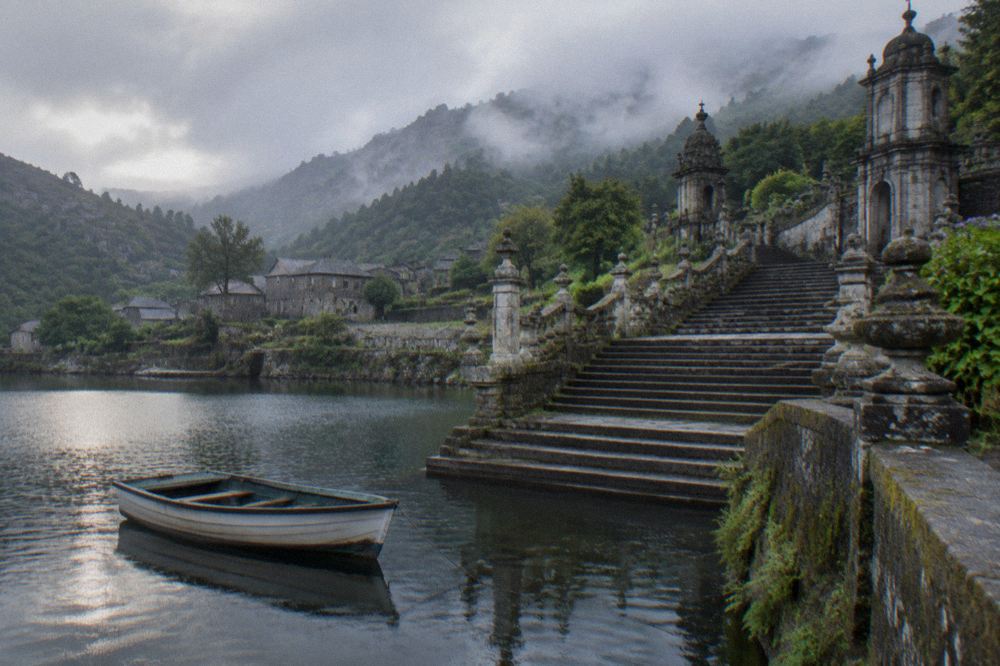
The Bom Jesus lake is the gentler option, and it is already fully operational: rowing boats run every day from 10:00 to 13:00 and 14:00 to 19:00, at 3 EUR per person per 15 minutes with a minimum of two people per boat. Floating on the water below the 566-step stairway, with the funicular's 1882 track beside you, is about as close as Braga gets to combining its water heritage and its relaxation in a single quarter hour.
Common Questions About Spas And Thermal Baths In Braga
Are there working thermal baths in Braga itself?
No. The Roman baths of Alto da Cividade are an archaeological site, not a working bathhouse. Working thermal spa facilities in the region are found at the thermal towns in the surrounding hills, above all Caldas do Gerês in the Peneda-Gerês National Park, plus hotel spas in the city such as the one at The Lince Braga.
How much do the Roman baths in Braga cost to visit?
The 2026 municipal price table lists an individual visit to the Termas Romanas do Alto da Cividade at about 2.05 EUR, or 3.70 EUR for a joint ticket that also covers Fonte do Ídolo. Children under 14 enter free, and a 50 percent discount applies to visitors over 65, students, teachers and several other categories.
What are the opening hours of Braga's Roman baths?
The municipal circuit lists Monday to Friday 09:30 to 13:00 and 14:00 to 17:30, Saturday 11:00 to 17:30, closed on Sundays and national holidays, with last entry 30 minutes before closing. Guided tours are available by appointment from Tuesday to Friday.
Do any Braga hotels have a spa?
Yes. The Lince Braga, a four-star hotel that opened in summer 2025, includes a spa and received a Michelin Key in the 2026 guide. Treatment menus, hours and prices are set by the hotel, so check directly with the property before booking.
Is Caldas do Gerês worth visiting from Braga?
For a genuine thermal experience, yes. Caldas do Gerês is a historic thermal town inside the Peneda-Gerês National Park, reachable by regional bus from Braga's central bus station, with bathhouses and hotels built around the spring. Treat it as a full-day or overnight destination rather than a short trip.
When is the best time of year for a spa break in Braga?
May, June and September offer the best balance of warmth and manageable rain, according to IPMA's 1991 to 2020 climate normals for the Braga / Merelim station. October is the wettest month on average at 197.8 mm of rain, while July is the driest at 27.9 mm, so a spa-focused trip in the wetter months should lean on the indoor baths, museums and hotel spas.
A restful break in Braga, Portugal, ends up being a trip about water in all its forms: the spring the Romans worshipped, the aqueduct that watered the city, the lake under the sanctuary and the thermal springs in the hills. Plan the ancient parts with the verified prices above, book the spa parts with the operators directly, and the city takes care of the rest.