Braga Parks And Gardens
Braga, the city in the Minho region of northern Portugal, is one of the greenest city breaks in the country: a UNESCO-listed hillside sanctuary, a baroque garden in the middle of the historic centre and a large lakeside municipal park, all reachable by a one-zone bus ticket.
Short answer
The main green spaces in Braga, Portugal are the Parque da Ponte, the Jardim de Santa Bárbara beside the Sé de Braga, the formal gardens and wooded slopes of Bom Jesus do Monte, the open precinct of the Santuário do Sameiro and the forested hill of Monte do Picoto. The garden grounds at Bom Jesus and Sameiro are free to enter, and the TUB tourist ticket covers the whole city bus network for a day.
Braga, the city in Portugal's Minho region, is a destination where the green spaces are not an afterthought but half of the reason to come. The historic centre holds a formal baroque garden a minute from the cathedral steps, the eastern edge of the city spreads into the lakeside lawns of the Parque da Ponte, and the hills just outside town carry a UNESCO World Heritage sanctuary whose gardens, fountains and zigzag stairway are the most famous landscaped ensemble in northern Portugal. Rain is generous here, and it shows: IPMA's 1991 to 2020 normals for the Braga / Merelim station record 1,387.3 mm across a typical year, and that water feeds lawns, camellias and tree cover that drier Portuguese cities cannot match.
This guide walks through each of the city's principal green spaces in turn: what it is, what it costs, when it opens and how to reach it. Every price and hour below comes from the operators' own published pages, and where a source is silent, the guide says so plainly rather than guessing. For the wider picture of the city's sights, start with things to do in Braga and come back here for the leafy half of the story.
What Is The Parque Da Ponte In Braga?
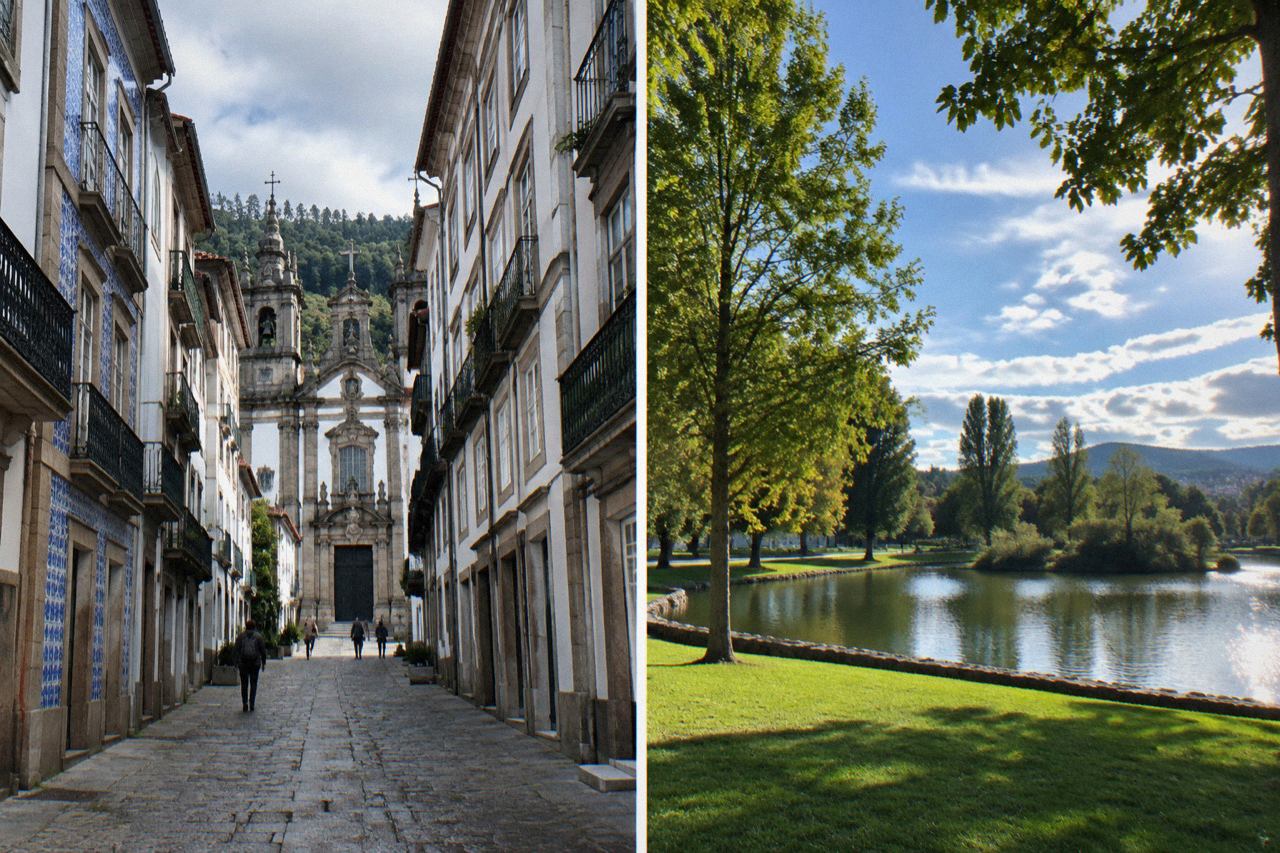
The Parque da Ponte is Braga's principal municipal park, a broad landscaped space of lawns, mature trees, a lake and walking paths that gives the city its best-known green expanse outside the historic centre, and it sits within the city itself rather than in the wider district of the same name. It is free to enter, open to the public as an unfenced city park, and it is the place where locals run, picnic and walk dogs on any dry afternoon.
The park's name, which means "bridge park", is the one most Braga residents use for the whole green area on this side of the city, and it is the destination most searchers mean when they look up "parque da ponte braga". Unlike the sanctuary hills, it is flat, which matters if you are travelling with a pram, a wheelchair or tired legs: the outdoor spaces of Braga divide cleanly between the level gardens of the centre and east, and the climbing landscapes of Bom Jesus do Monte, Sameiro and Falperra on the hills. The park is a short bus ride from the centre on the TUB city network, and a day ticket covers the whole system, which makes it an easy add-on to a morning in the historic streets.
What the park offers is the ordinary pleasure of a well-kept urban green space: shade, water, space to spread out. Braga's municipal tourism office describes the city's parkland in terms of native tree cover and walking routes rather than amusements, and that is the honest way to approach it. There is no admission gate, no ticket and no published closing time to check; it is a neighbourhood park, used as one. Combine it with a look at the nearby Estádio Municipal de Braga, whose guided tours are sold by the club at 6 EUR for the classic guided option and 4 EUR self-guided, and you have a full half-day on the eastern side of the city without once needing a car.
Which Gardens Can You Visit Inside The Historic Centre Of Braga?
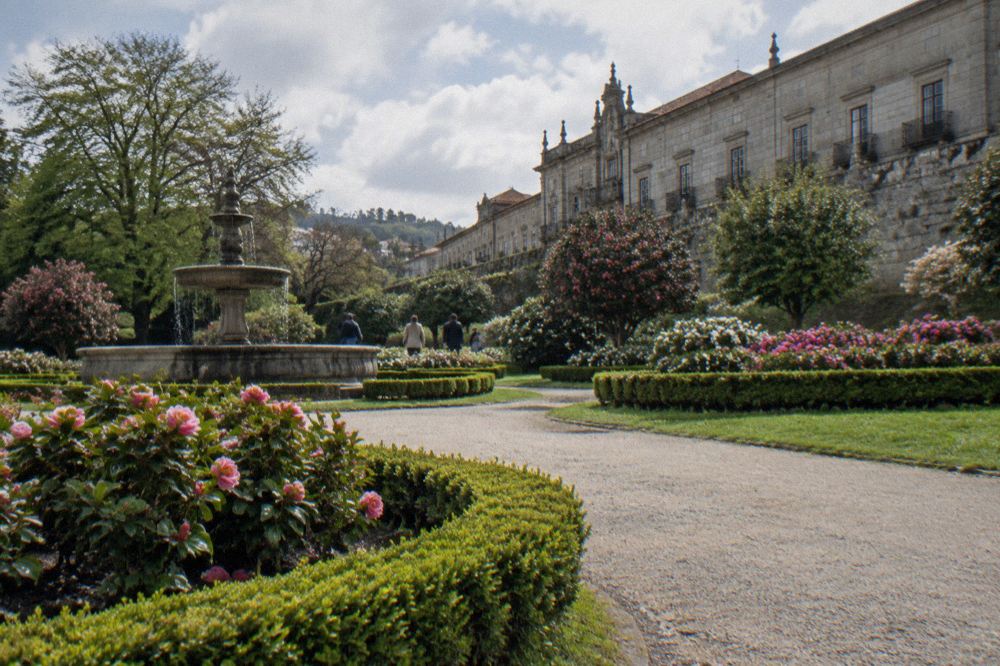
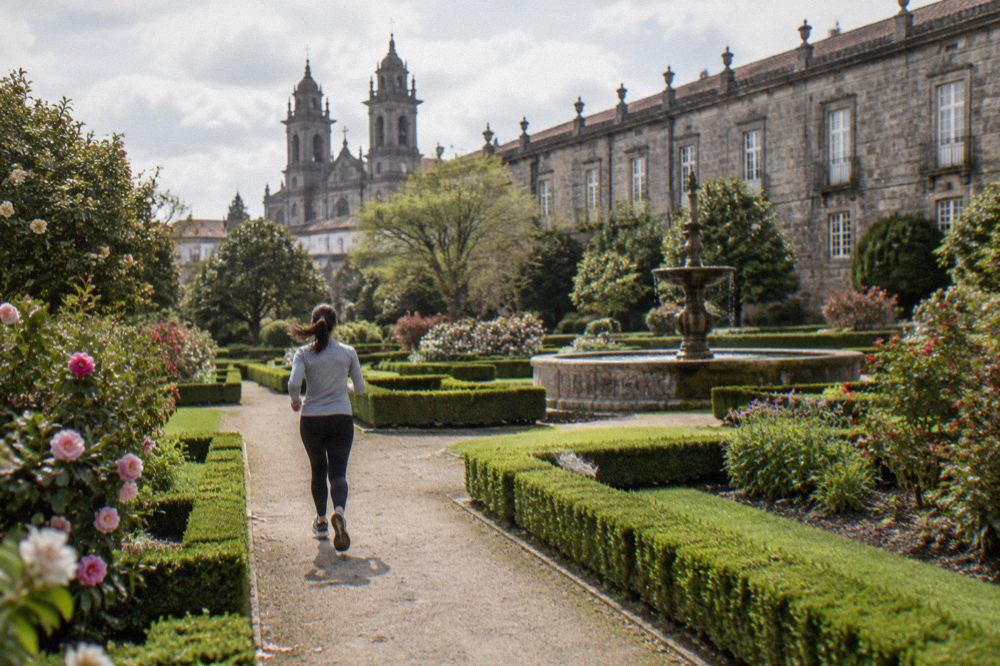
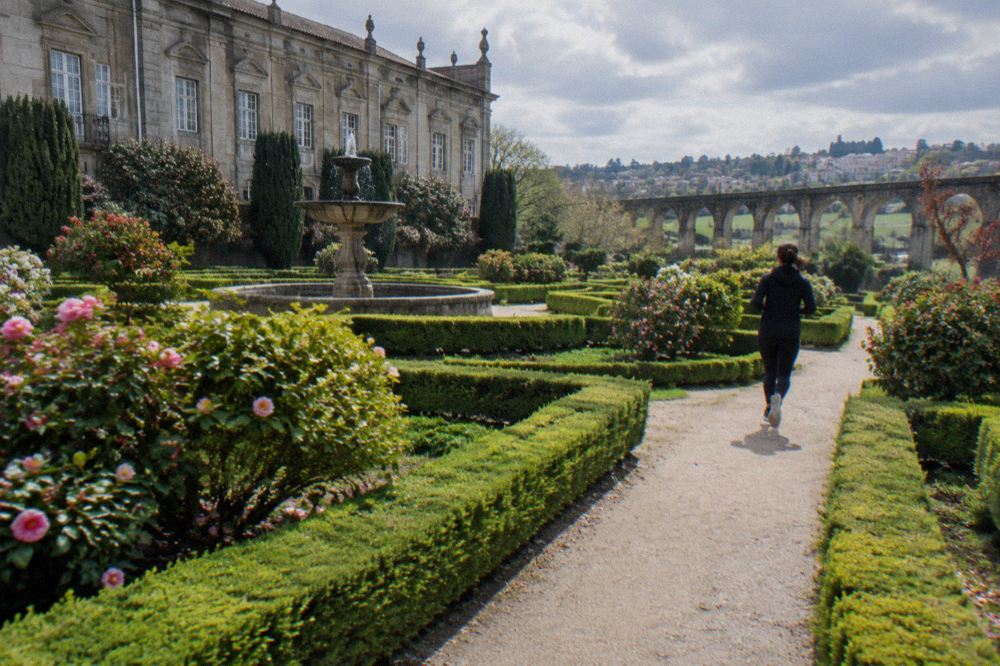
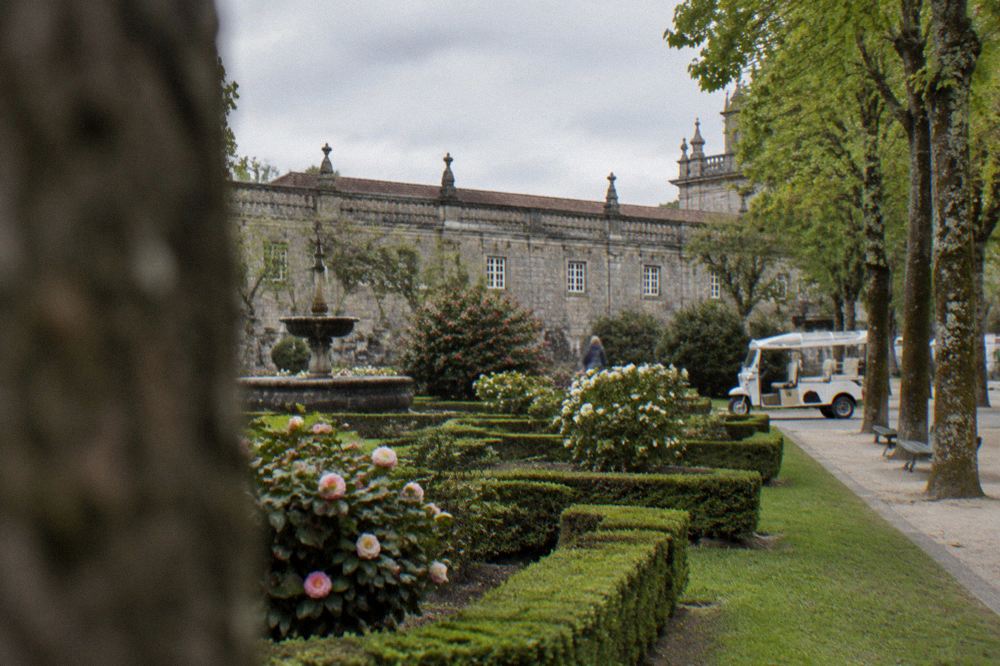
The Jardim de Santa Bárbara is the historic centre's flagship garden, a formal terraced space of clipped box hedges, flowerbeds and a fountain that sits directly beside the Sé de Braga, and it is free, unfenced and open at all hours like the squares around it. Around it sit the Avenida da Liberdade's tree-lined walk, the Praça da República and the small garden spaces attached to museums such as the Museu dos Biscainhos, whose garden is included in the museum's 7.50 EUR ticket.
The Jardim de Santa Bárbara is the garden that appears on nearly every photograph of Braga, and for good reason: its geometric parterres sit in the shadow of the cathedral's towers and the Palácio dos Biscainhos' boundary, so a visit costs nothing and takes minutes from anywhere in the centre. The garden is at its most photographed in spring, when the bedding plants are changed, and it functions as a public crossing point as much as a destination, which means it is busy at lunchtime and quiet in the early morning. The historic centre guide covers where to base yourself to be within walking distance of it.
Two other central green stops deserve the walk. The garden of the Museu dos Biscainhos is included in the state museum's normal ticket, which the operator's own page prices at 7.50 EUR with the garden included, and the museum is open Tuesday to Sunday, 10:00 to 12:30 and 14:00 to 17:30. The Praça da República is paved rather than grassed but carries the city's plane-tree shade and is the natural resting point of any centre walk; the Praça da República page covers its cafés and atmosphere. If rain arrives, the Nogueira da Silva museum and the Roman baths at Alto da Cividade are the standard indoor fallbacks nearby.
A garden walk through the centre is easy to do alone, but the sanctuary hills are where a guide adds the most, because the landscape there is loaded with iconography most visitors cannot decode unaided. The Small-Group Braga Half-Day Tour with Bom Jesus Sanctuary pairs the centre with the hill in three hours, Check availability if that structure suits your dates.
Curious to explore the city's streets and squares on foot? Book a free walking tour here. (Guided in Spanish)
What Do The Gardens Of Bom Jesus Do Monte Cost To Visit?
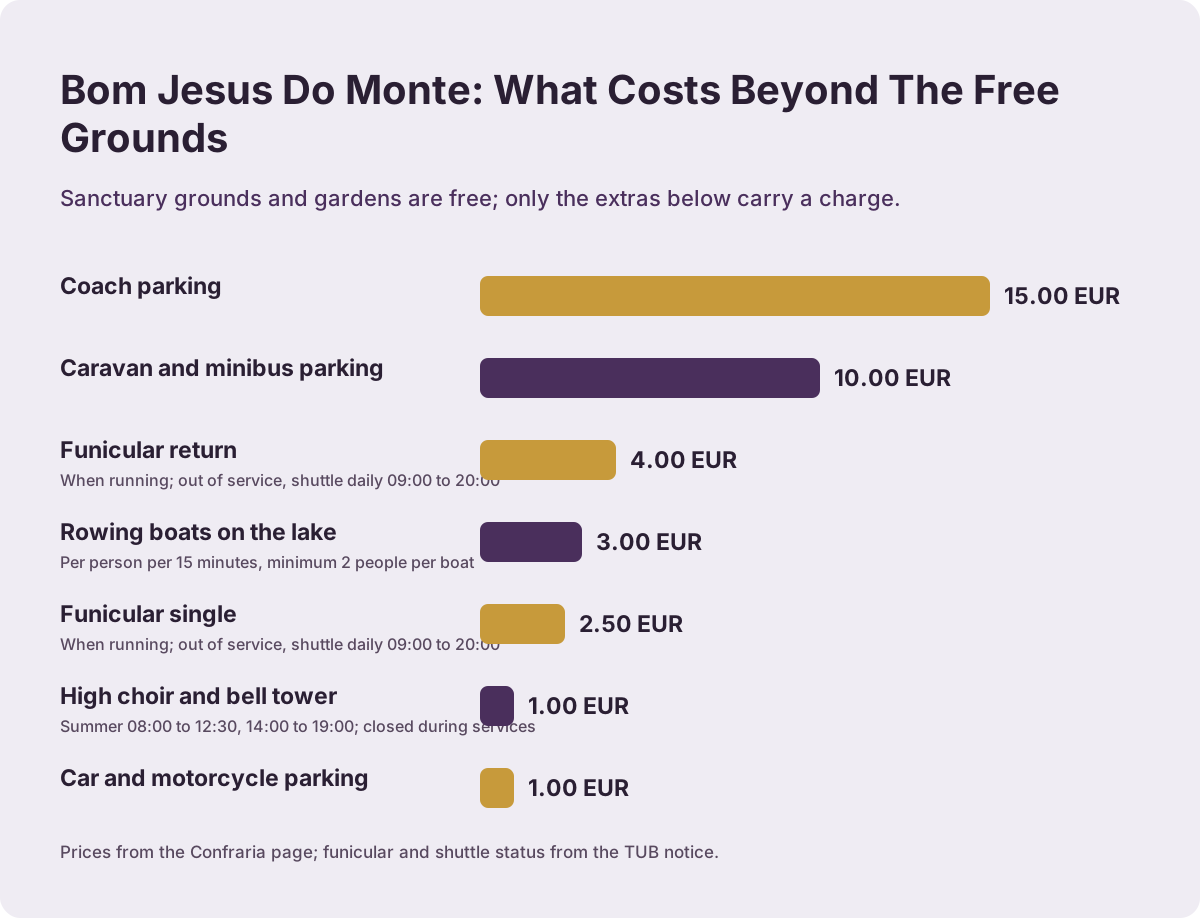
The sanctuary grounds, formal gardens and terraces of Bom Jesus do Monte are free to enter, with no admission charge listed on the Confraria's own information page, which prices only the extras: the rowing boats on the lake at 3 EUR per person per 15 minutes, the high choir and bell tower at 1 EUR, and parking at 1.00 EUR for cars and motorcycles. The funicular, normally 2.50 EUR single and 4.00 EUR return, is out of service with no end date published.
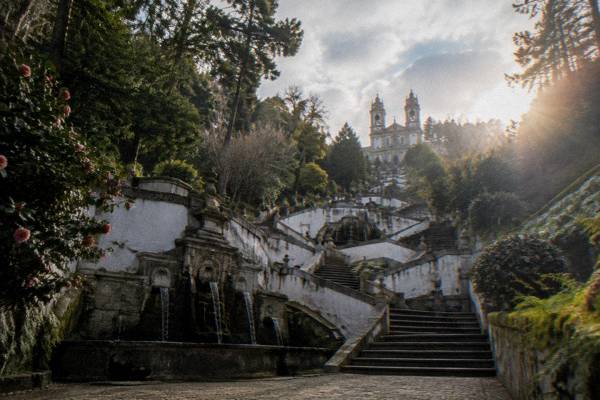
That last point matters for a gardens visit, because the funicular is part of the hill's charm. The TUB notice dated 26 September 2026 puts the Elevador do Bom Jesus out of service for maintenance with no end date given, and a replacement shuttle runs every day from 09:00 to 20:00, roughly every 30 minutes each way, between the Portico, where TUB Line 2 ends, and the sanctuary. Check the operator's notice before you go rather than assuming either option. The alternative to both is the stairway itself: 566 steps by the Confraria's own count, 615 metres long with 116 metres of ascent, climbing past the fountains and chapels of the Escadório do Pórtico, the Escadório dos Cinco Sentidos and the Escadório das Virtudes. Walking up through the gardens is not a consolation prize; it is the way the ensemble was designed to be experienced, and UNESCO inscribed the sanctuary in 2019 precisely for that landscape.
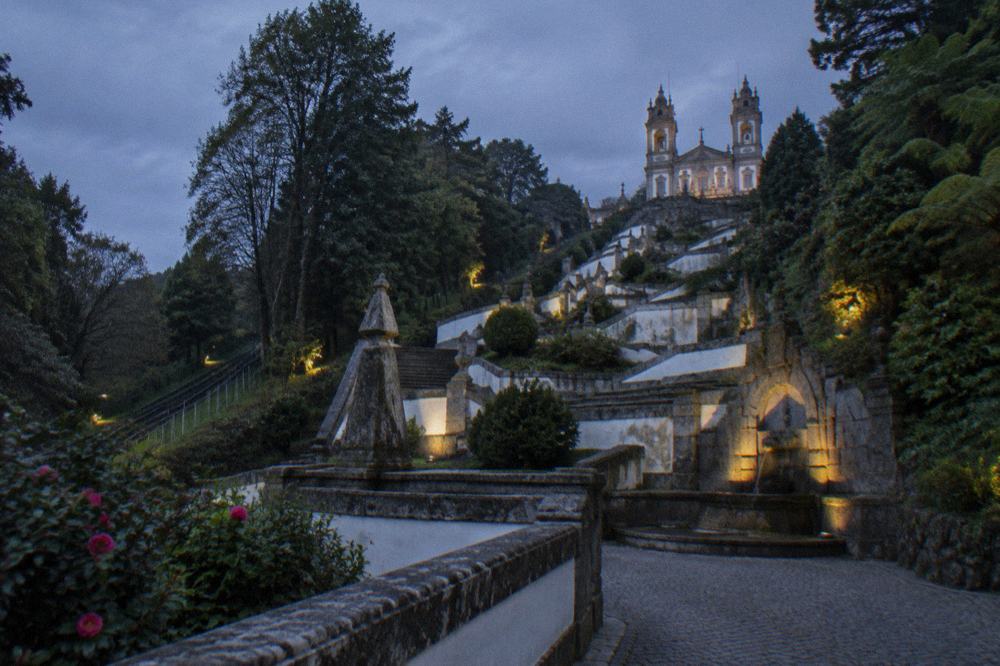
The hill's other hours and prices, all from the Confraria's information page:
| Item at Bom Jesus do Monte | Price | Hours / notes |
|---|---|---|
| Sanctuary grounds and gardens | Free | No entry charge listed |
| Basilica | Free to enter | Summer 08:00 to 19:00, winter 08:00 to 18:00, every day |
| High choir and bell tower | 1.00 EUR | Summer 08:00 to 12:30, 14:00 to 19:00; closed during services |
| Rowing boats on the lake | 3.00 EUR per person per 15 minutes | Daily 10:00 to 13:00 and 14:00 to 19:00, minimum 2 people per boat |
| Funicular (out of service) | 2.50 EUR single, 4.00 EUR return when running | Replacement shuttle daily 09:00 to 20:00, about every 30 minutes |
| Car and motorcycle parking | 1.00 EUR | Coaches 15.00 EUR, caravans and minibuses 10.00 EUR |
The gardens above the stairway are the quiet half of the visit: terraced lawns, the lake with its boats, and wooded paths behind the hotels that fade into the hillside within a few minutes of the basilica. The Bom Jesus do Monte guide and the page on getting there cover the hill in depth, including the bus options from the centre.
If the stairway's 566 steps are more than your knees will accept, the shuttle and the tour options both solve the ascent, and the gardens at the top are level once you arrive.
What Can You See At The Santuário Do Sameiro And Monte Do Picoto?
The Santuário do Sameiro's whole precinct is open 24 hours a day, every day, and free, with the basilica open winter 08:00 to 18:00 Monday to Saturday and 07:00 to 18:00 Sunday, and summer 09:00 to 19:00 Monday to Saturday and 07:00 to 19:00 Sunday; the Zimbório dome viewpoint costs 2 EUR. Monte do Picoto is an urban park of about 23 hectares with a free 360-degree viewpoint at its roughly 298-metre summit.
Sameiro is the second of Braga's two great hill sanctuaries, and the contrast with Bom Jesus is the point: where Bom Jesus is architecture and water, Sameiro is a wide, open, windswept precinct with long views over the Minho landscape. The sanctuary's own contacts page gives the basilica hours above, and the dome's opening days vary by season, so check on the day if climbing the Zimbório matters to you; the entrance is at the back of the basilica. The precinct being always open makes Sameiro the natural spot for sunset, and no ticket or booking stands between you and it.
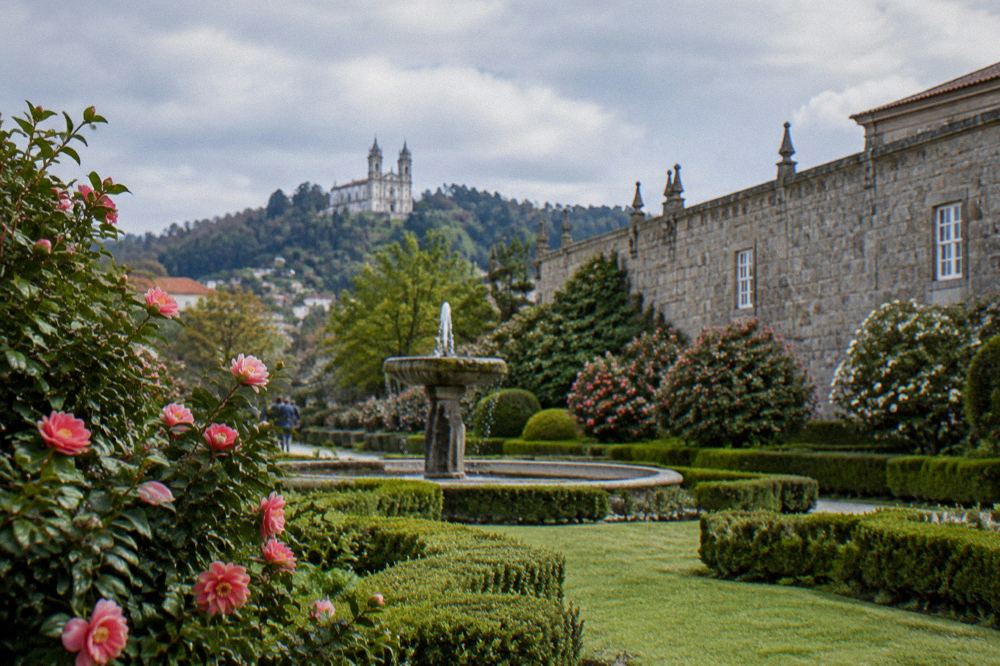
Monte do Picoto is the city's own hill, a park of native forest on Braga's edge that the municipal tourism site describes with picnic areas, walking, jogging and cycling paths, a dog park and a summit cross at the viewpoint. It is free to enter, and because it sits inside the city it is the hill you can walk to from the centre, unlike the sanctuary hills, which want a bus. The two places bracket the kind of green experience Braga offers: pilgrimage grandeur on the periphery, ordinary woodland close in. The Sameiro sanctuary guide covers the basilica in detail.
| Green space | Where it sits | Entry | Signature feature |
|---|---|---|---|
| Jardim de Santa Bárbara | Historic centre, beside the Sé de Braga | Free, always open | Baroque parterres and seasonal bedding |
| Parque da Ponte | Eastern side of the city | Free, unfenced | Lake, lawns and mature trees |
| Bom Jesus do Monte gardens | Hill east of the centre, TUB Line 2 | Free grounds; extras priced | UNESCO stairway, fountains and lake |
| Santuário do Sameiro precinct | Hill south-east of the city | Free, open 24 hours | Dome viewpoint at 2 EUR and wide views |
| Monte do Picoto | Inside the city, north-east | Free | About 23 ha of native forest, summit viewpoint |
| Museu dos Biscainhos garden | Historic centre | Included in the 7.50 EUR ticket | Walled baroque garden of a palace house |
When Is The Best Time Of Year For Braga'S Gardens?
By the IPMA 1991 to 2020 climate normals for the Braga / Merelim station, the best months for Braga's gardens are May and June, which combine mean maxima of 23.0 and 26.1 C with only 89.8 and 40.6 mm of rain, while July and August are the driest and warmest but see 9.8 and 10.4 days at 30 C or above; October is the wettest month at 197.8 mm, and December and January follow closely at 190.3 and 179.5 mm.
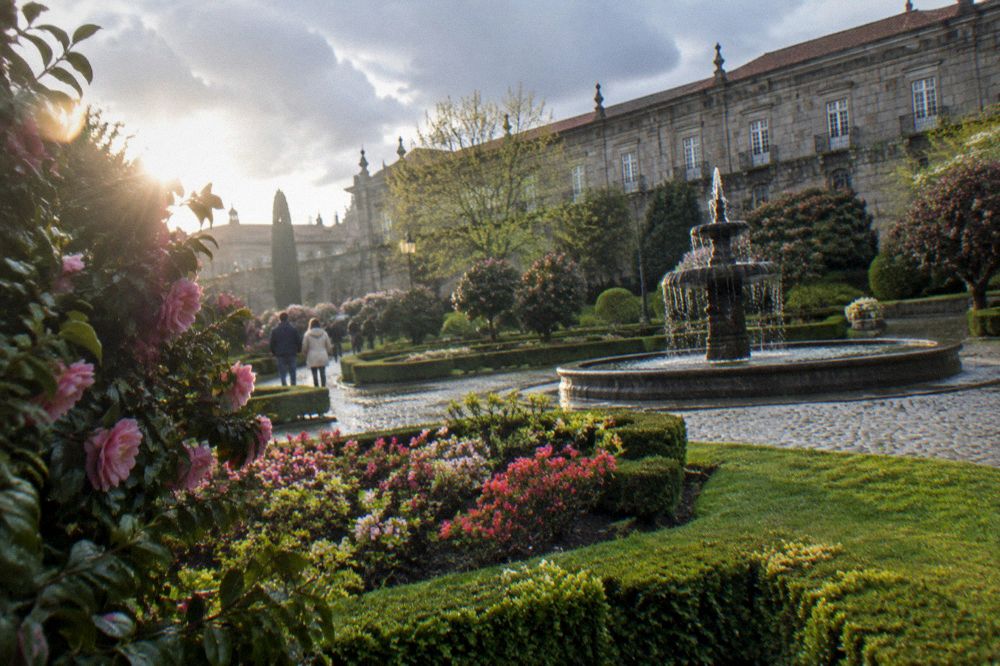
The rain numbers are the ones to plan around, because they are large. Braga's gardens are at their most lush precisely because the city averages 113.5 rain days of 1 mm or more per year, but that same water means October to January sees 12 to 13 wet days a month, and a garden itinerary in those months will lose hours to showers. Spring turns the balance: March and April still carry 150.1 and 127.9 mm, but temperatures are mild and the camellias and bedding plants are at their peak. The best time to visit Braga and Braga weather pages expand on this with month-by-month detail.
| Month | Mean max C | Mean C | Rain mm | Rain days of 1 mm or more |
|---|---|---|---|---|
| March | 17.8 | 11.9 | 150.1 | 11.8 |
| April | 19.6 | 13.7 | 127.9 | 12.0 |
| May | 23.0 | 16.7 | 89.8 | 8.9 |
| June | 26.1 | 19.7 | 40.6 | 5.7 |
| July | 28.2 | 21.2 | 27.9 | 4.0 |
| August | 28.7 | 21.4 | 34.6 | 3.8 |
| September | 26.9 | 19.7 | 67.6 | 6.2 |
| October | 22.2 | 16.1 | 197.8 | 12.0 |
One detail from the same normals worth knowing for garden planning: September is warmer at the top end than June, 26.9 C against 26.1 C mean maximum, and wetter, 67.6 mm against 40.6 mm. Early autumn is a genuinely good garden season here, green from the first September rains and warm enough for the lake and picnic lawns.
What Is Happening At The Sete Fontes Eco-Park?
The Sete Fontes, Braga's 18th-century hydraulic complex of aqueducts, water mines and reservoirs, is a National Monument since 2011, and the first phase of works to turn it into an eco-park began in October 2025, covering 8.6 hectares with 1.5 million euros of investment; the works are ongoing, so do not plan a visit around completed park facilities.
The Sete Fontes supplied Braga's water historically, until around 1913 or 1914, and its surviving aqueduct arches and underground galleries thread the fields on the city's northern edge. The municipality's project, announced as an aim to create the largest eco-monumental park in Portugal, is the most significant green development in Braga in a generation, and the honest position for a visitor is that it is a construction site with a heritage core, not a finished park. The visible above-ground structures can be seen from the surrounding lanes, and the municipal pages describe the complex as a heritage site without published opening hours or fees; treat it as a drive-past or a local walk, and check the municipality's notices before making it the purpose of a trip. The São Vítor area guide covers the neighbourhood it sits in.
The wider pattern is worth naming: Braga was Portugal's Capital of Culture in 2025, and the green and cultural investments of that year, from the eco-park works to the reopened Museu da Imagem and Casa dos Crivos, are still landing through 2026. A gardens visit this year happens in a city mid-renewal, which mostly means better facilities and occasional scaffolding.
How Do You Reach Braga'S Parks And Gardens Without A Car?
The TUB city network is the practical answer, and its 2026 tariff, in force since 21 February 2026, sells a whole-network tourist ticket at 3.35 EUR for one day, 6.05 EUR for two days and 8.05 EUR for three days, against single journeys of 1.55 EUR on board for one zone or 0.75 EUR pre-bought or digital; TUB Line 2 runs from the centre to the Portico at the foot of the Bom Jesus stairway, where the sanctuary shuttle picks up.
The tourist ticket is the one genuinely useful product for a gardens itinerary, because the green spaces of Braga fan out across the city: the centre gardens on foot, the Parque da Ponte to the east, Bom Jesus and Sameiro on the hills. There is no city-wide attraction pass on sale in Braga, so buy each garden-adjacent museum ticket separately and put the multi-day money into the bus ticket instead. The getting around Braga page covers the network in full, including the pre-bought ticket cards at 1.00 EUR and the tourist card at 1.50 EUR.
| TUB ticket (2026 tariff) | 1 zone | 2 zones | Notes |
|---|---|---|---|
| On board, single | 1.55 EUR | 2.00 EUR | Bought from the driver |
| Pre-bought or digital, single | 0.75 EUR | 1.50 EUR | Via the TUB app or sales points |
| Tourist ticket, 1 day | 3.35 EUR | whole network | Per person |
| Tourist ticket, 2 days | 6.05 EUR | whole network | Per person |
| Tourist ticket, 3 days | 8.05 EUR | whole network | Per person |
For the hills, the practical sequence is TUB Line 2 to the Portico, then either the stairway on foot or the replacement shuttle up to the sanctuary, checking the operator's notice for the funicular's status on the day. Sameiro and Monte do Picoto are also served by the city network, though line details beyond Line 2 vary and are best confirmed in the TUB app before setting out.
Can You See Braga'S Gardens Comfortably On A Guided Tour?
Yes, and the small-group half-day format is the best fit, because it covers both the centre's garden-adjacent streets and the Bom Jesus sanctuary in about three hours, from 68.15 USD per person with a 4.8 rating from 24 reviews on the operator's listing; a private walking tour and a tuk tuk city tour are the alternatives, at 259.43 USD and from 22.66 USD respectively, for travellers who want exclusivity or minimal walking.
The half-day small-group tour is the one this site features for good reason: the pairing of historic centre and sanctuary hill is exactly the shape of a gardens-focused visit, and a guide explains the iconography of the stairway's fountains and chapels, which is the difference between seeing Bom Jesus and understanding it. The Braga Private Walking Tour with a Professional Guide suits travellers who want the route bent around particular interests, gardens included, and the Braga: Tuk Tuk City Tour covers the flat city, the Parque da Ponte included, without the walking.
For a no-cost introduction to the centre before deciding on anything paid, GuruWalk's free walking tours of Braga, tip-based and led by named local gurus, cover the historic streets and the garden squares; they book through GuruWalk and you tip what you choose. They do not climb to Bom Jesus, so pair one with the shuttle or the stairway for the hill.
Families and anyone travelling with limited mobility should weigh the tuk tuk option seriously: it removes the centre's cobbles and slopes from the equation entirely, and the driver's commentary covers the same squares and gardens a walking route would.
Beyond the city, the gardens logic extends to the Minho day trips: Ponte de Lima, reached by AITC Line 105 from Braga's bus station, pairs river gardens with its famous medieval bridge, and the Ponte de Lima guide plus the answers on what to do near Ponte de Lima cover it. The Arcos de Valdevez and Ponte da Barca day trip continues the same green corridor into the Peneda-Gerês foothills.
One last planning note: Braga levies a municipal tourist tax of 1.55 EUR per person per night, for up to four nights, all year, charged through your accommodation, so factor it into a garden-season stay. More on planning the whole trip, including transport from Porto and Lisbon, is in the Porto to Braga and Lisbon to Braga guides, and Braga Travel Guide holds the full index.
Common Questions About Braga Parks And Gardens
Is the Parque da Ponte in Braga free to enter?
Yes. The Parque da Ponte is an unfenced municipal park with no admission charge, no ticket office and no published closing time; it functions as a neighbourhood park open to the public.
Are the gardens of Bom Jesus do Monte free?
Yes. The Confraria's own information page lists no admission charge for the sanctuary, the grounds or the basilica; only the funicular, the high choir and bell tower, the lake boats and parking are priced.
Can you ride the Bom Jesus funicular to the gardens?
Not at present. The funicular has been out of service since 26 September 2026 with no end date published, and a replacement shuttle runs daily 09:00 to 20:00, roughly every 30 minutes each way, between the Portico and the sanctuary. Check the operator's notice before you go.
How many steps does the Bom Jesus stairway have?
566 steps, by the Confraria's own count, over 615 metres with 116 metres of ascent, climbing through the three named sections of the Escadório do Pórtico, the Escadório dos Cinco Sentidos and the Escadório das Virtudes.
What is the wettest month for gardens in Braga?
October, with 197.8 mm of rain on average in the IPMA 1991 to 2020 normals for the Braga / Merelim station, followed by December at 190.3 mm and January at 179.5 mm. July is the driest at 27.9 mm.
Is there a bus ticket that covers all of Braga's parks and gardens?
Yes. The TUB tourist ticket covers the whole city network at 3.35 EUR for one day, 6.05 EUR for two days and 8.05 EUR for three days under the 2026 tariff, including Line 2 to the foot of the Bom Jesus stairway.