Is Braga The Oldest City In Portugal?
Braga, the city in Portugal's Minho region, is often called the oldest city in Portugal. Here is what the documented record actually shows, and what to see of it.
Braga, the city in Portugal's Minho region, is introduced over and over as the oldest city in the country. The label appears in guidebooks, in tourism copy and in almost every search result for the city, usually attached to a Roman name, Bracara Augusta, and a confident adjective. The problem is that the superlative is a tradition rather than a documented fact. No primary source publishes a founding date for the settlement, and the sites that answer questions like where Braga is located and what made it important are older than any surviving record of a first stone. This page separates what the record actually shows from what has simply been repeated often enough to sound official, and points at the monuments where Braga's long, documented history can still be walked through.
Is Braga The Oldest City In Portugal?
No document settles the question. Braga's history runs back through the Roman city of Bracara Augusta, and it ranks among the longest continuously inhabited places in the country, but no primary source gives a founding date for the settlement, and the "oldest city in Portugal" title is a repeated tradition rather than a verified fact. The city's age is real. The superlative, as a counted or dated claim, is not on the record.
The honest version of the story starts with what can be checked. Braga was the Roman Bracara Augusta, an administrative centre of the province that later became Gallaecia, and its street grid still shapes the historic centre around the Sé de Braga. What no verified source supplies is a year of foundation, a comparison table of Portuguese cities by age, or an official designation of Braga as "the oldest". The claim circulates because it is plausible and flattering, not because anyone has produced a record.
That matters for how the city should be described. A guide that prints "founded in 16 BC" or similar is filling a gap with a guess. What can be said, and what this page sticks to, is that Braga has a documented Roman past, a medieval core, and a religious weight that made it one of the most important cities in northern Portugal for centuries. Readers who want the wider picture of the city's standing today can start with what Braga is famous for.
There is also a geography trap worth naming. "Braga" is three things: the city, the municipality around it, and a district that contains Guimarães, Barcelos, Famalicão and part of the Peneda-Gerês park. The municipality counted 193,324 residents at the 2021 census, the only population figure on the record. Age claims attached to the district or the region are even looser than the ones attached to the city.
What Did Roman Bracara Augusta Leave In Braga Today?
The visible Roman legacy in Braga includes the Termas Romanas do Alto da Cividade, the excavated baths site, and the Fonte do Ídolo, a rock-relief sanctuary from the Roman period, both in the Maximinos area west of the centre. The Museu de Arqueologia D. Diogo de Sousa holds the material record of Bracara Augusta, and its permanent exhibition is built around finds from the city itself.
The baths site sits below the present street level, a reminder of how much Roman Braga lies under the modern city. The Fonte do Ídolo is the more evocative of the two: a carved stone fountain shrine, one of the few surviving Roman religious monuments in northern Portugal in situ. Neither needs more than a short walk from the centre, and both belong to the same archaeological circuit.
The museum is the place where the claim about Braga's age becomes tangible. The Museu de Arqueologia D. Diogo de Sousa is open Tuesday to Sunday, 10:00 to 17:30, and the ticket costs 5.00 EUR, with a 50 percent reduction for visitors aged 65 and over, ages 13 to 24, and families. Residents of Portugal can enter free on 52 days a year of their choosing, the one free-entry rule that was actually read on an official page. For a visitor, the museum is the best single answer to the question of how old Braga really is, because it displays the evidence rather than the slogan.
A guided walk ties these threads together efficiently. The Small-Group Braga Half-Day Tour with Bom Jesus Sanctuary covers the historic centre and the sanctuary hill in three hours, Check availability if the schedule fits.
Which Historic Monuments Can You Visit In Braga, And What Do They Cost?
The main historic monuments in Braga are all open to visitors with individual tickets: the Sé de Braga charges 3.00 EUR per visit route or 7.00 EUR for all three combined, the Museu dos Biscainhos charges 7.50 EUR, the Museu de Arqueologia D. Diogo de Sousa 5.00 EUR, and the Museu Pio XII 4.00 EUR for the whole museum. No city-wide attraction pass is on sale, so each ticket is bought separately.
The cathedral deserves its own note on tickets, because the pricing is unusual. The Sé de Braga sells three separate visit routes, the Treasury-Museum, the funerary chapels and high choir, and the cathedral itself, at 3.00 EUR each, with any two at 6.00 EUR and all three at 7.00 EUR. Tourist visits run Monday to Saturday 09:30 to 13:00 and 14:30 to 17:00, with a reduced Sunday morning window, and the building itself opens earlier for worship. There is a separate and longer story about the cathedral's own age, covered in which is the oldest cathedral in Portugal.
| Monument | Ticket | Hours (verified) |
|---|---|---|
| Sé de Braga, one route | 3.00 EUR | Mon-Sat 09:30-13:00, 14:30-17:00 |
| Sé de Braga, all three routes | 7.00 EUR | Same visit window, last entry 30 min before close |
| Museu dos Biscainhos | 7.50 EUR, garden included | Tue-Sun 10:00-12:30, 14:00-17:30 |
| Museu de Arqueologia D. Diogo de Sousa | 5.00 EUR | Tue-Sun 10:00-17:30 |
| Museu Pio XII, whole museum | 4.00 EUR | Tue-Sat 09:30-12:30, 14:00-18:00 |
| Theatro Circo guided tour | 3.50 EUR | Scheduled dates only, 45 minutes |
The Biscainhos museum is worth the ticket for the building alone: a baroque palace with gardens, reopened in 2025 after a major restoration, with a further garden project running into late 2026. The Pio XII museum pairs its collection with the medieval tower next door, one of the few surviving pieces of the city's medieval defences.
One thing not to look for is a Braga Card or any combined attraction pass. A digital tourist card was announced by the municipality in 2025, but no purchase page, price or list of inclusions exists, so the honest advice is to buy each ticket separately. The only multi-use product actually on sale is the TUB tourist transport ticket, covered below.
How Does Braga'S History Compare With Guimarães?
Braga and Guimarães sell different versions of age: Braga leans on its Roman past and its religious architecture, while Guimarães leans on its medieval role in the founding of the Portuguese kingdom. There is no direct train between them, and the verified public link is the AITC line 101 bus, which runs between the two central bus stations in roughly 45 to 60 minutes.
The two cities are natural rivals and natural companions, and the comparison is really about what each does with its history. Braga's centre is ecclesiastical: the cathedral, the baroque churches, the sanctuary hills. Guimarães is the castle-and-palace town, and the question of which one deserves a visit more has no wrong answer, only different itineraries. The honest head-to-head is laid out in is it better to visit Braga or Guimarães, and the case for the other side in is Guimarães worth visiting.
Practically, the bus is the link. The line 101 service runs via the A11 motorway between Braga's Central de Camionagem and Guimarães, with a journey time of about 45 to 60 minutes depending on the schedule. Anyone planning to do both in one day should read how many days you need in Braga first, because the honest answer is that one day per city is a sprint and two is comfortable.
Both cities also levy a municipal tourist tax, which surprises visitors who assume it is a Porto thing. Braga charges 1.55 EUR per person per night for up to four nights, all year; Guimarães charges 1.50 EUR per night for up to two nights, from May to October.
How Do You Cover Braga'S Old Centre Without A Car?
Braga's historic centre is compact and walkable, and the one journey worth planning is the climb to Bom Jesus do Monte, reached by TUB Line 2 to the portico at the foot of the stairway. The TUB tourist ticket covers the whole urban network at 3.35 EUR for one day, 6.05 EUR for two days and 8.05 EUR for three days, and single pre-bought fares are 0.75 EUR for one zone.
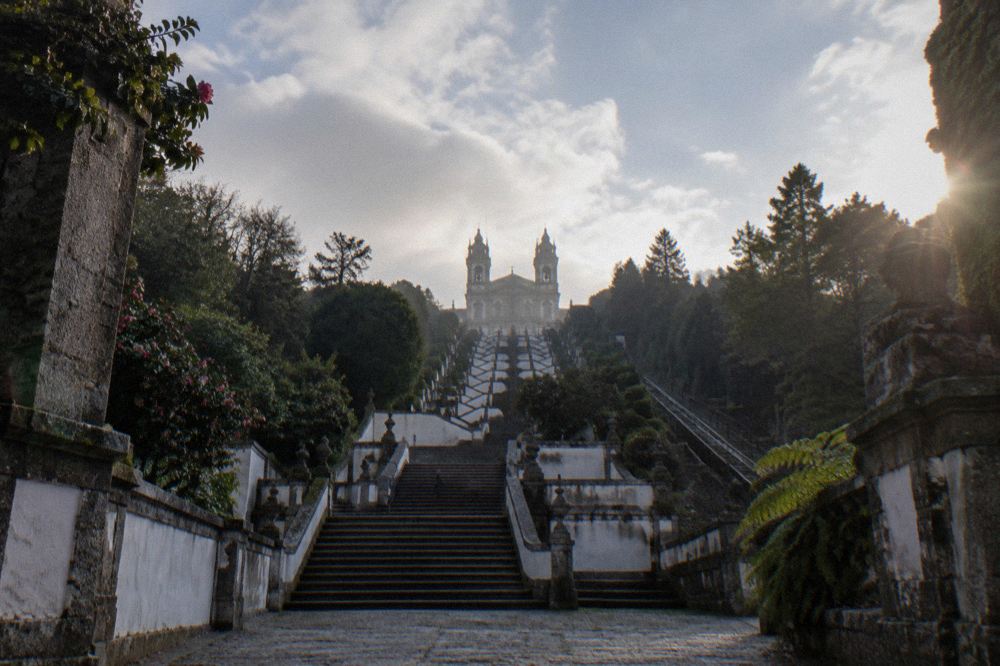
The Line 2 bus ends at the portico, where the Escadório do Pórtico begins. The Confraria do Bom Jesus do Monte's own page counts the stairway at 566 steps, 615 metres long with 116 metres of ascent, and the sanctuary grounds and basilica are free to enter. The basilica is open every day, 08:00 to 19:00 in summer and 08:00 to 18:00 in winter.
One standing fact needs a warning. The Bom Jesus funicular, the water-counterweight lift from 1882, has been out of service since 26 September 2026, with no end date published. A replacement shuttle runs every day between 09:00 and 20:00, roughly every 30 minutes each way, between the portico and the sanctuary. Check the operator's notice before planning a ride.
For visitors who would rather not navigate buses at all, the tuk tuk and walking options cover the same ground: the trio below pairs the half-day small-group walk with a tuk tuk city tour and a shorter "Portuguese Rome" walk.
Common Questions About Braga'S Age And History
Is Braga the oldest city in Portugal?
It is regularly called that, but no primary source documents a founding date or an official comparison of Portuguese cities by age. Braga has a documented Roman past as Bracara Augusta and ranks among the longest inhabited places in the country, yet the superlative is a tradition, not a verified record.
What was Braga called in Roman times?
Bracara Augusta. It was an administrative centre of the Roman province that later became Gallaecia, and excavated sites such as the Termas Romanas do Alto da Cividade and the Fonte do Ídolo survive from that period.
Can you still see Roman Braga today?
Yes. The baths site and the Fonte do Ídolo are visitable in the Maximinos area, and the Museu de Arqueologia D. Diogo de Sousa displays the archaeological record of the Roman city, open Tuesday to Sunday for 5.00 EUR.
Is Braga older than Guimarães?
There is no verified founding date for either city, so no honest ranking exists. Braga's documented emphasis is Roman and religious; Guimarães' is medieval. The two are linked by the AITC line 101 bus, about 45 to 60 minutes apart.
Is there a combined ticket for Braga's monuments?
No city-wide pass is on sale. A "Braga Card" was announced in 2025 but has no purchase page or published price, so tickets are bought separately at each site. The only multi-use product is the TUB tourist transport ticket at 3.35 EUR for one day.
Is the Bom Jesus funicular running?
Not at present. It has been out of service since 26 September 2026 with no end date published, and a replacement shuttle runs daily between 09:00 and 20:00, roughly every 30 minutes, between the portico and the sanctuary. Check the operator's notice before you go.
The honest summary is that Braga does not need the superlative. A city with a Roman sanctuary in situ, baths under its streets, a cathedral selling three separate visit routes, and a UNESCO-listed baroque stairway on the hill above has enough documented history to fill several days, whatever the guidebooks decide to call it, and Braga Travel Guide covers each of those pieces in its own detail.