What Does "Bom Jesus Do Monte" Mean In English?
The name of Braga's Bom Jesus do Monte sanctuary translates to English as Good Jesus of the Mount. Here is what each word means, how to pronounce it, and why the hill carries that name.
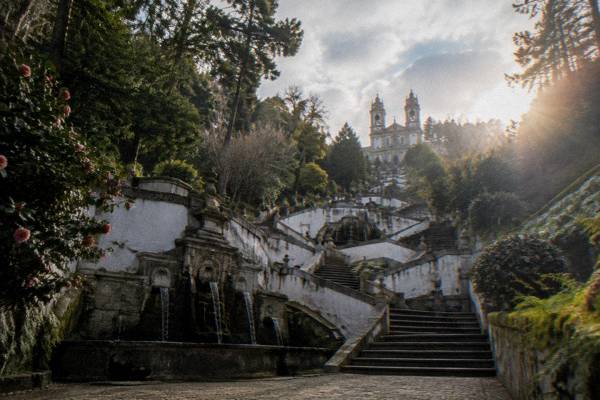
Bom Jesus do Monte means "Good Jesus of the Mount" in English, and it is the name of the pilgrimage sanctuary on the hill just outside Braga, the city in the Minho region of northern Portugal. The Portuguese words are simple ones: "bom" is good, "Jesus" is Jesus, "do" is of, and "monte" is mount or hill. Put together, the name describes exactly what the place is, a sanctuary dedicated to the Good Jesus, built on a mount above the city. The full official name, as UNESCO recorded it when the site was inscribed on the World Heritage List in 2019, is the "Sanctuary of Bom Jesus do Monte in Braga".
What Does "Bom Jesus Do Monte" Mean In English?
"Bom Jesus do Monte" translates into English as "Good Jesus of the Mount". Bom is the Portuguese word for good, Jesus is the same name in both languages, do means of, and monte means mount or hill. The name therefore reads as a dedication: this is the sanctuary of the Good Jesus on the mount, the hill that rises just outside the city of Braga in northern Portugal.
Each word does its own small job. "Bom" is the masculine form of the adjective, agreeing with "Jesus". "Do" is a contraction of "de" (of) and "o" (the), so "do Monte" is literally "of the mount". Portuguese contracts its prepositions and articles the way English once did in words like "o'clock", and the contraction is the giveaway that the phrase is fully naturalised Portuguese rather than a formal church title. The name is not a translation from Latin or a biblical quotation. It is a plain devotional description, in everyday Portuguese, of who the sanctuary honours and where it stands.
The name is used for several things at once, and it helps to keep them straight. "Bom Jesus do Monte" is the sanctuary as a whole: the stairway, the chapels, the fountains, the gardens and the basilica on the summit, all of it inscribed by UNESCO in 2019 as a cultural property of 26 hectares. It is also, more loosely, the name of the hill itself, and locals will say "o Bom Jesus" the way a resident of any city says "the cathedral". The attraction guide to Bom Jesus do Monte on this site covers the whole ensemble, and the Bom Jesus hill area page covers the wider hillside above Braga.
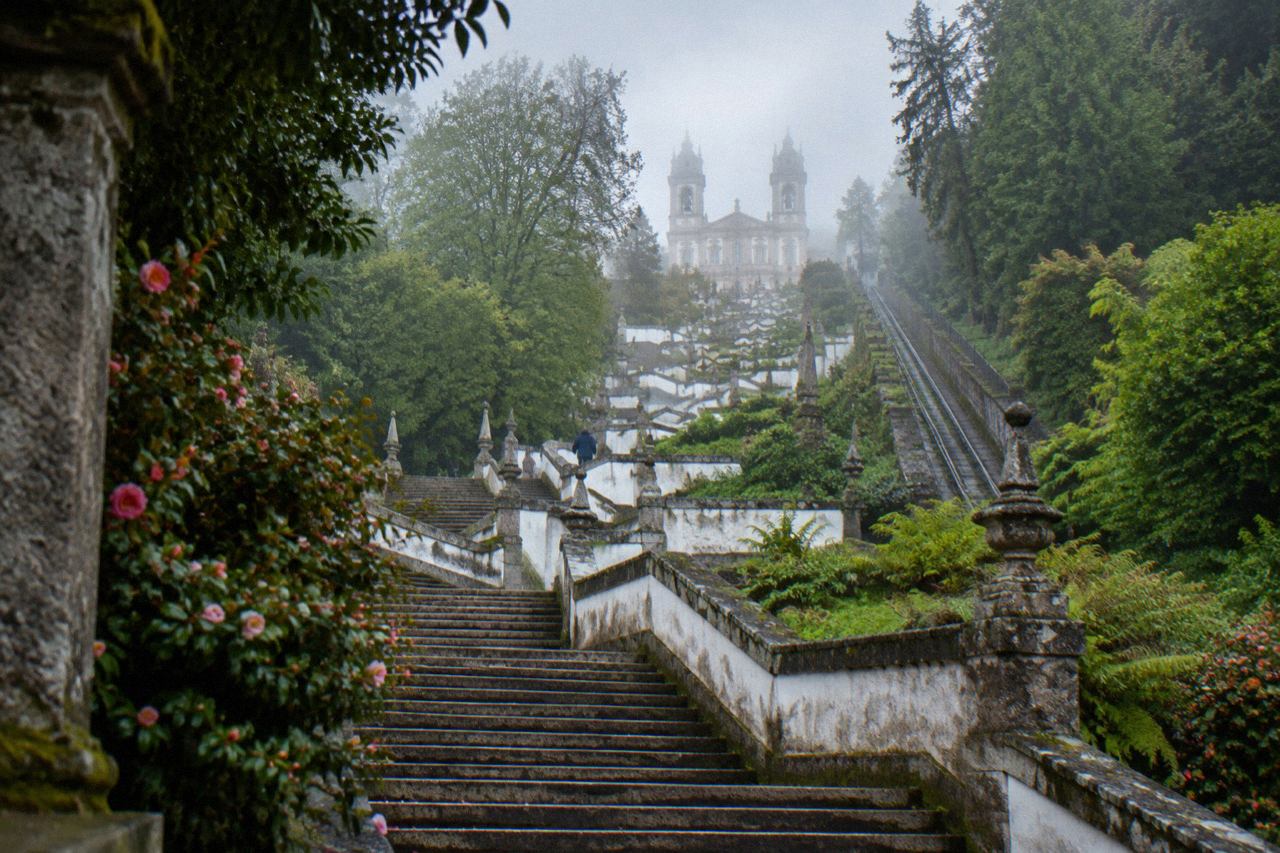
One thing the name does not tell you, and which often catches visitors out, is how steeply the mount rises. The Confraria do Bom Jesus do Monte, the body that owns and runs the sanctuary, counts 566 steps on the great stairway, the Escadório, which climbs 116 metres over a length of 615 metres. The name says "of the mount" with complete honesty.
Why Is It Called Bom Jesus?
The sanctuary is called Bom Jesus because it was built as a devotional pilgrimage site honouring Jesus as the "Good Jesus", a Portuguese invocation of Christ whose cult took root in Braga long before the sanctuary took its present form. The Bom Jesus devotion was a distinctly Portuguese form of the Via Crucis, the Way of the Cross, and the hill became famous as a place to climb while praying the stations.
The Confraria do Bom Jesus do Monte, which has administered the sanctuary since its early days, describes the ensemble as the fruit of a devotional tradition built up over more than 600 years, with construction of the sanctuary as it stands today facing west over a long period. UNESCO's own listing says much the same: a sanctuary developed over six centuries, with a Via Crucis of chapels, fountains, sculptures and formal gardens. The "Bom Jesus" of the name is the object of that devotion. The stairway itself is the pilgrimage: pilgrims ascend through the three named sections of the Escadório, the Escadório do Pórtico, the Escadório dos Cinco Sentidos and the Escadório das Virtudes, each stage carrying its own symbolic programme, the senses and the virtues, laid out in fountains, statuary and chapels.
The choice of a mount was deliberate and echoes the great Christian pilgrimage sanctuaries elsewhere in Europe, though no verified source on file claims a specific model. What the verified record does say is that the ensemble was inscribed by UNESCO in 2019 under criterion (iv), as an outstanding example of a sacromonte, a sacred mount pilgrimage complex, and that the property covers 26 hectares. The name, in other words, is not a leftover or a nickname. It is the working description of what the place was built to be: the mount of the Good Jesus, climbed as an act of devotion.
The devotion still shapes the hill's calendar. Mass is said at the basilica every day, and the sanctuary's information page lists the times: Monday to Friday at 17:00, Saturday at 08:30, and Sunday at 08:00, 11:00 and 17:00. The basilica itself opens every day, 08:00 to 19:00 in summer and 08:00 to 18:00 in winter, and the Confraria's information page lists no admission charge for the sanctuary, the grounds or the basilica.
A guided walk is a good way to hear the stories behind the name, and the city has several. The Explore the Portuguese Rome, the City of Braga tour covers the historic centre with a guide who explains Braga's religious heritage in English, Check availability, and the operator's live listing carries the current times and meeting point.
To hear the stories behind the name in person, book a Braga half-day tour here.
How Do You Pronounce Bom Jesus Do Monte?
In Portuguese the name is pronounced roughly "bong zheh-ZOOSH doo MONTEH", with the stress falling on the final syllable of Jesus and of Monte. Bom rhymes with the English word "long" but ends without a hard g sound, Jesus is said "zheh-ZOOSH" in European Portuguese, do is simply "doo", and monte is said "MON-teh", close to the English word "mont" with a soft ending.
European Portuguese swallows unstressed vowels in a way that surprises many first-time visitors, so "do Monte" can come out closer to "doo MONt" in fast speech. The s at the end of "Jesus" takes the "sh" sound of European Portuguese, which is the single biggest difference from the Brazilian pronunciation, where the same name ends in a clear "zoos". Neither version is wrong, and Braga, being in the north of Portugal, follows the European pattern.
The word "monte" is worth a pause because it carries more weight in Portuguese than "mount" does in English. It is the everyday word for a hill or mount, and in the Minho region it names the granitic heights that ring the city: Bom Jesus, the Santuário do Sameiro to the east, and the Serra da Falperra further south. When a Braga resident says "o monte", they mean the hill country at the city's edge, not a distant mountain. The guide to getting to Bom Jesus do Monte explains the practical side of reaching that hill, including the bus line that ends at the foot of the stairway.
What Does The Rest Of The Name Tell You About The Hill?
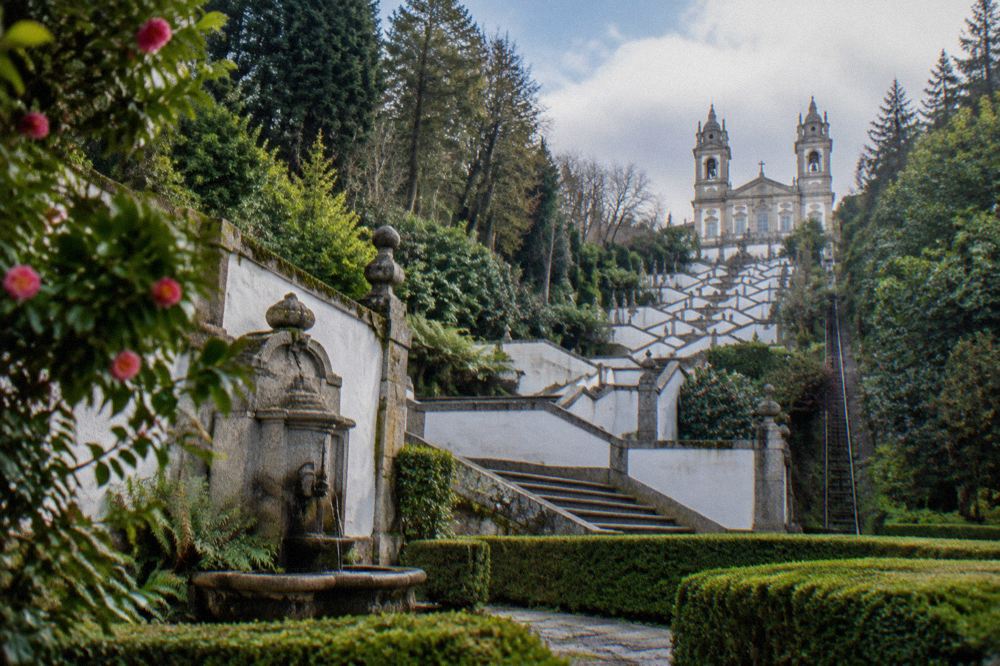
The "do Monte" half of the name is a fair warning about the climb: the sanctuary sits 116 metres above the lower station, reached by a stairway of 566 steps in three named sections, the Escadório do Pórtico, the Escadório dos Cinco Sentidos and the Escadório das Virtudes. The Confraria do Bom Jesus do Monte gives those figures on its own pages, and the three section names each carry their own devotional meaning.
The sections are not just labels. The Escadório do Pórtico is the gateway stairway, the Escadório dos Cinco Sentidos represents the five senses, and the Escadório das Virtudes the virtues, and the Confraria's own pages describe all three. A visitor who knows the translation walks the stairway as a text rather than a workout. The answer to how many stairs there are at Bom Jesus do Monte gives the full count and where it comes from.
The funicular, the Elevador do Bom Jesus, is part of the hill's story even while it is off the tracks. It was inaugurated on 25 March 1882, designed by the Swiss engineer Nikolaus Riggenbach, and the Confraria claims it is the oldest funicular in service in the world using the water counterweight system. It is out of service for maintenance, with no return date published, so anyone planning to ride it should check the operator's notice before going. The normal fare when running is 2.50 EUR single and 4.00 EUR return. The attraction page for the Bom Jesus funicular keeps the full history and the current status.
Is The Sanctuary Free To Visit, And What Costs Money On The Mount?
The Confraria's information page lists no admission charge for the sanctuary, the grounds or the basilica, so the mount itself is free to walk. The priced items on the hill are the high choir and bell tower inside the basilica at 1 EUR, the car park at 1.00 EUR for cars and motorcycles, and the rowing boats on the lake at 3 EUR per person per 15 minutes with a minimum of two people per boat.
The pattern is a common one at Portuguese pilgrimage sites: the sacred space is open to all, and the extras carry the costs. The table below sets out what the Confraria's own information page prices.
| Item on the mount | Price | Notes |
|---|---|---|
| Sanctuary, grounds and basilica | No admission charge listed | Basilica open daily, 08:00 to 19:00 summer, 08:00 to 18:00 winter |
| High choir and bell tower | 1 EUR | Museum space inside the basilica, closed during services |
| Car park, cars and motorcycles | 1.00 EUR | Caravans and minibuses 10.00 EUR, coaches 15.00 EUR |
| Rowing boats on the lake | 3 EUR per person per 15 minutes | Minimum 2 people per boat, daily 10:00 to 13:00 and 14:00 to 19:00 |
| Funicular, when in service | 2.50 EUR single, 4.00 EUR return | Out of service, no return date published |
Getting up the hill without a car means TUB Line 2, the urban bus route from central Braga whose final stop, the Pórtico, sits at the foot of the stairway. From there the choice is the 566 steps or the replacement shuttle that runs between the Pórtico and the sanctuary every day from 09:00 to 20:00, roughly every half hour each way. The name promises a mount, and the mount delivers one.
For visitors who want the name explained in context, a guided visit is worthwhile. The city's walking tours all pass through the historic centre where the devotion to the Bom Jesus took root, and the Explore the Portuguese Rome, the City of Braga tour is the natural companion to a Bom Jesus visit, with current departure times on the operator's live listing.
Common Questions About Bom Jesus Do Monte
What does "Bom Jesus do Monte" mean in English?
"Bom Jesus do Monte" translates as "Good Jesus of the Mount". Bom means good, Jesus is the same in both languages, do means of, and monte means mount or hill. It is the name of the UNESCO-listed pilgrimage sanctuary on the hill just outside Braga, Portugal.
Why is it called Bom Jesus?
The sanctuary is named for the Portuguese devotional invocation of Christ as the "Good Jesus". The hill west of Braga became a site for the Via Crucis devotion, with pilgrims climbing a stairway of chapels, fountains and sculptures dedicated to the senses and the virtues. UNESCO inscribed the sanctuary in 2019 as an outstanding sacromonte, a sacred mount pilgrimage complex.
What does "bom jesus" mean in portuguese?
"Bom Jesus" means "Good Jesus" in Portuguese. "Bom" is the masculine form of "good" and agrees with "Jesus". The phrase is a common devotional name in Portugal, and the sanctuary at Braga is its most famous bearer in the north of the country.
How do you pronounce Bom Jesus do Monte?
Roughly "bong zheh-ZOOSH doo MON-teh" in European Portuguese, with the s at the end of Jesus taking a "sh" sound. The stress falls on the final syllable of Jesus and of monte, and unstressed vowels are swallowed in the Portuguese manner.
Is Bom Jesus do Monte free to visit?
Yes. The Confraria do Bom Jesus do Monte's information page lists no admission charge for the sanctuary, the grounds or the basilica. The priced items are the high choir and bell tower at 1 EUR, the car park at 1.00 EUR for cars, and the rowing boats on the lake at 3 EUR per person per 15 minutes.
Is the Bom Jesus funicular running?
No. The funicular has been out of service for maintenance since 26 September 2026, with no return date published. A replacement shuttle runs every day from 09:00 to 20:00, roughly every 30 minutes each way, between the Pórtico, where TUB Line 2 ends, and the sanctuary. Check the operator's notice before you go.
The name, once translated, tells the whole story: a mount, a climb, and the Good Jesus waiting at the top, and the Braga Travel Guide coverage of the sanctuary and the city below it explains how to fit both into a visit.