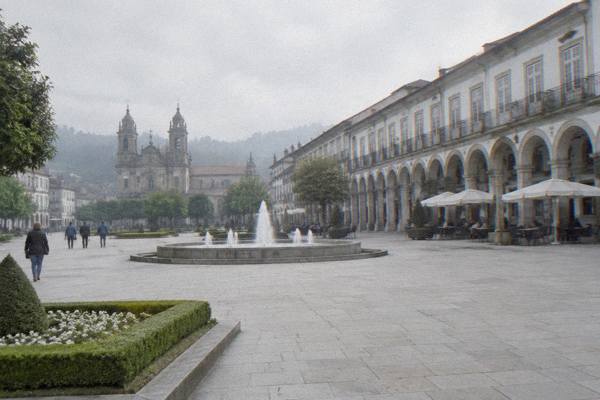
Watching SC Braga: Tickets And Match Day
SC Braga plays its home matches at the Estádio Municipal de Braga, on the city's eastern edge, and a match day is one of the liveliest things you can do in the Minho region's biggest city. This guide covers how tickets work, what the club charges for stadium tours, and how to plan the rest of your day around kickoff.
Short answer
SC Braga match tickets are sold through the club's own ticketing channels, with prices set match by match and never published far ahead, so check the club's official site once fixtures are announced. The stadium sits in the eastern part of Braga, Portugal, reachable by city bus, and the club also sells a Classic Guided Tour at 6 EUR and a Self-Guided Tour at 4 EUR on non-match days.
Braga, Portugal, is a city of baroque churches and Roman roads in the Minho region of northern Portugal, and it is also a football city: SC Braga, the local club, plays its home matches at the Estádio Municipal de Braga on the eastern side of town. Match day changes the rhythm of the whole city, filling cafés early and sending streams of red-clad supporters toward the stadium hours before kickoff. This guide explains how match tickets work, what the club charges for stadium tours, how to reach the ground, and how to fold a fixture into the rest of a visit, without pretending to know a fixture list that changes every season.
Where Does SC Braga Play Its Home Matches?
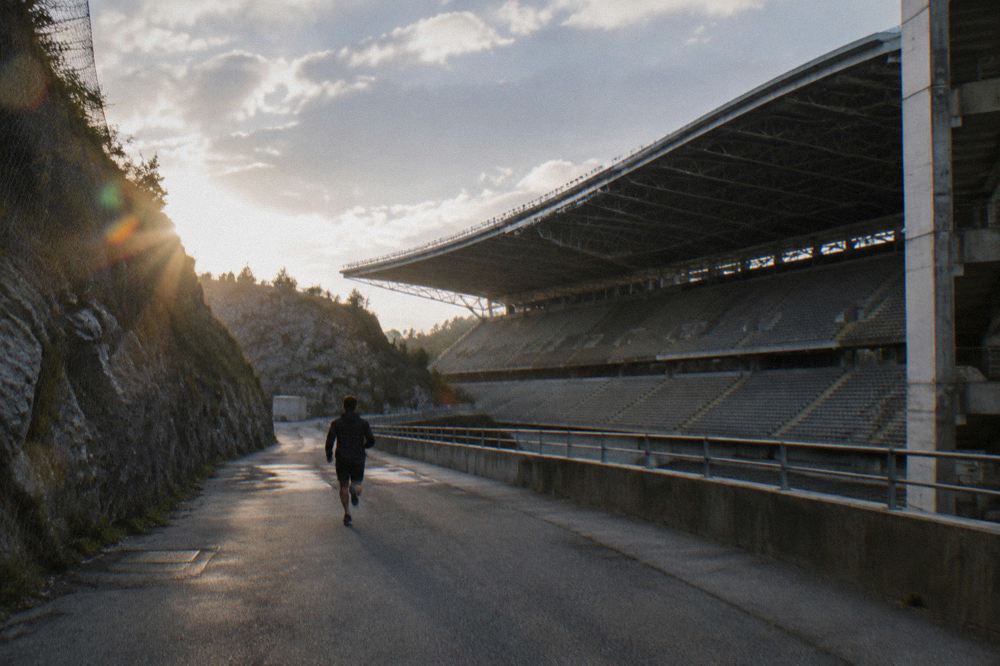
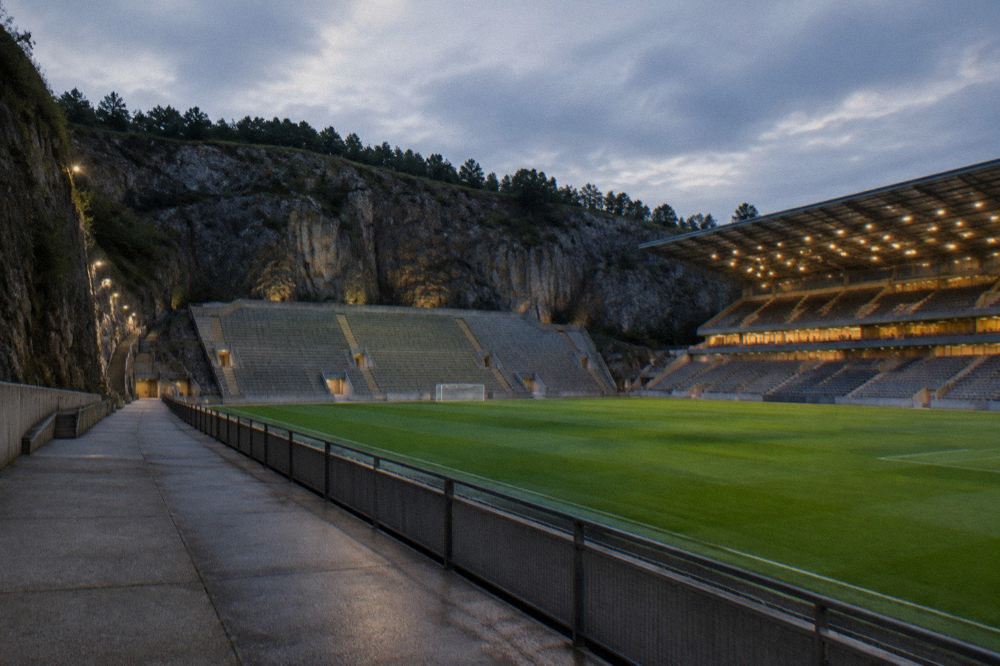
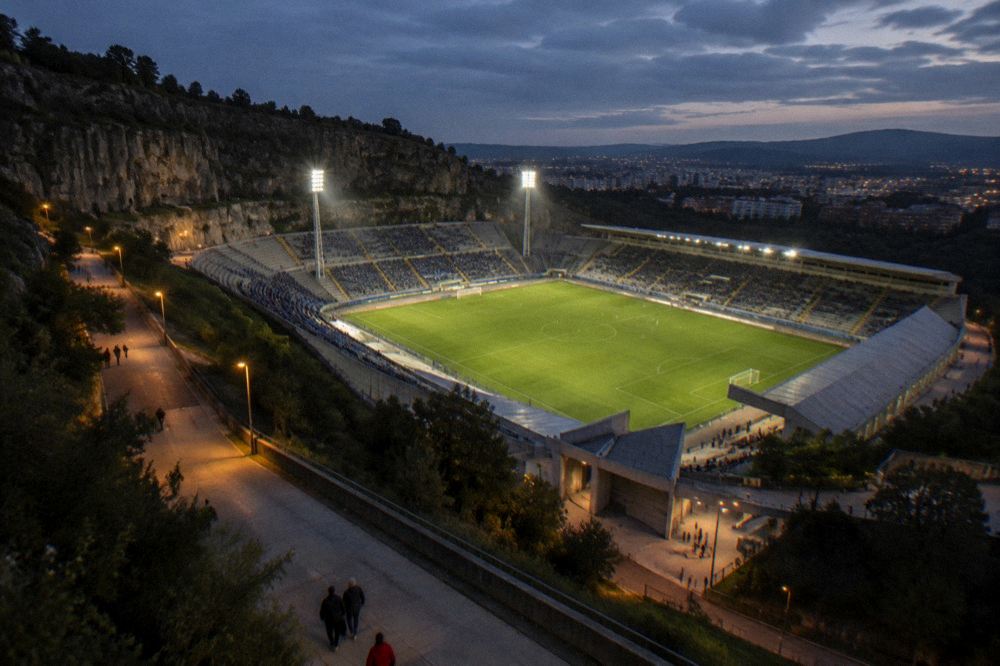
SC Braga plays its home matches at the Estádio Municipal de Braga, a municipal-owned stadium in the eastern part of Braga, Portugal, a short bus ride from the historic centre. The club is the stadium's main tenant and has been for its entire modern history, and the ground gives its name to the surrounding neighbourhood, so locals simply say "no estádio" when a match is on.
The stadium belongs to the municipality, not the club, which is worth knowing because it explains two practical things. First, the surrounding park and access roads are public space, so the pre-match build-up happens outdoors, in the open, rather than inside a private concourse. Second, the club has announced plans to negotiate buying the ground from the city and investing in a renovation, a study-phase plan reported by Portuguese sports media in September 2026, so the match-day layout could evolve over the coming years.
What the stadium does not need is hyperbole.
How Do You Buy SC Braga Match Tickets?
SC Braga sells match tickets through the club's own official ticketing channels, online and at the stadium's ticket office, with sales typically opening in the days before each home fixture rather than months ahead. Prices are set match by match depending on the opponent and the competition, and the club publishes them with each fixture announcement, so there is no fixed price list to quote here.
That last point matters, because plenty of third-party resellers advertise SC Braga seats at marked-up prices, and some of those listings are not authorised. The safe route is the club's official website and its ticket office on match day. Buying at the ground also gives you the local experience: the ticket windows sit within sight of the main entrance, and the queues move with the kind of unhurried friendliness you find everywhere in the Minho.
A few practical habits make the process smoother. Check the club's fixture page early in your trip planning, because kickoff days and times shift for television. Portuguese league matches are usually played across the weekend and occasionally on Friday or Monday evenings, and cup ties can land midweek. If you are already in Braga, the club's ticket office is the place to ask about returns and last-minute availability, and staff deal with visiting supporters regularly, so a polite question in English usually works.
If your trip turns out not to overlap with a home fixture, the stadium is still worth the bus ride for a tour, and the city itself rewards a full day. A good fallback plan is to spend the morning on the main things to do in Braga and decide on the stadium once you know the fixture list.
How Much Do SC Braga Match Tickets Cost?
Match ticket prices at SC Braga vary by fixture, competition and seat category, and the club announces them per match rather than publishing a season-wide price table, so no honest guide can print a single figure. As a planning rule, seats behind the goals are the cheapest category, main-stand seats cost more, and high-profile opponents push every category up, with the club's own ticket channels always the reference price.
What a visitor can do is plan around the structure. Categories are consistent across most home league games: two or three price bands, with the cheapest seats in the ends and the most expensive along the side. Cup matches usually price lower than league fixtures against the big Lisbon and Porto clubs, which are the ones that sell out first. When the club posts a fixture, it posts the prices with it, and that announcement is the moment to buy if you want a seat in the main stand.
Set a budget before you look, and the announcement becomes a simple yes or no. A useful frame from the rest of this guide's verified numbers: the club's own Classic Guided Tour costs 6 EUR and the Self-Guided Tour 4 EUR, so anything a reseller charges for a match seat that climbs well beyond tour territory deserves scrutiny. If a listing looks inflated compared with what the club itself charges for access to the same building, it probably is.
What Does A Match Day In Braga Look Like?
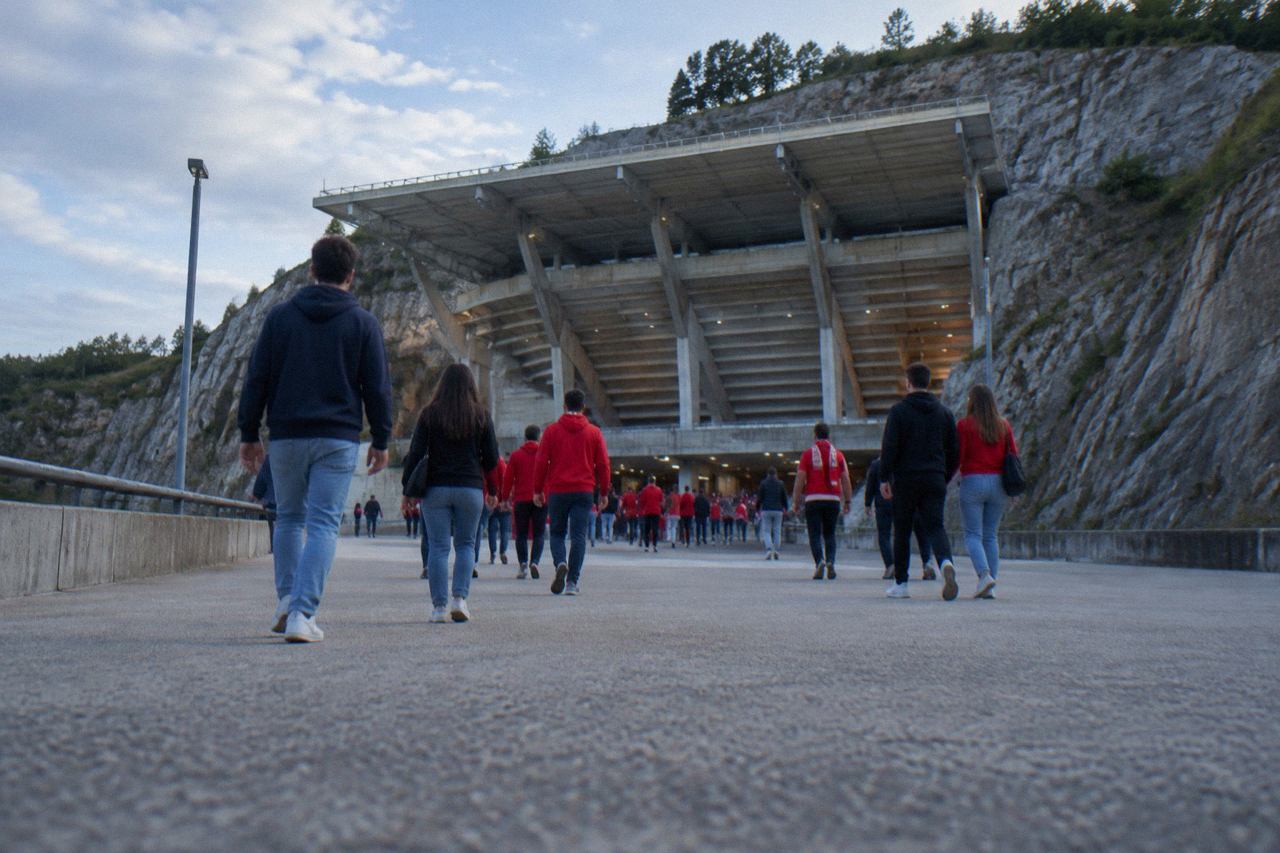
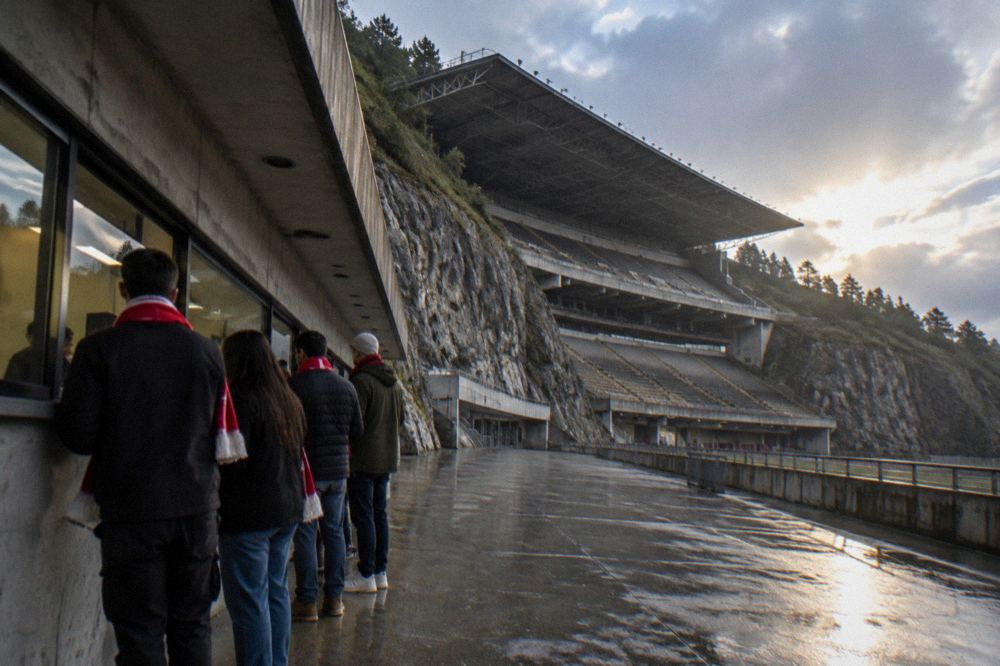
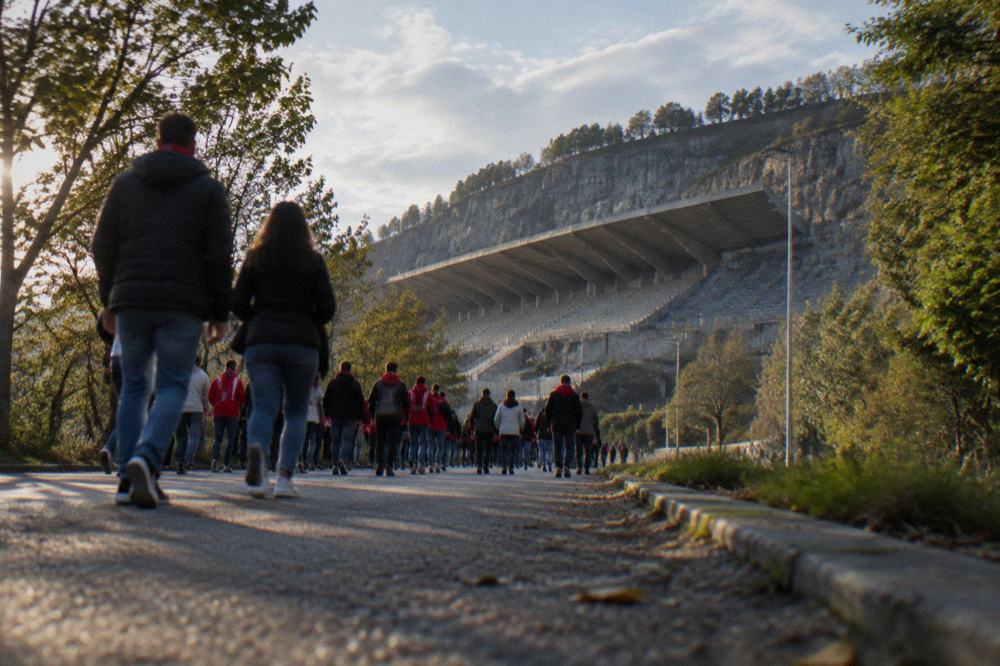
A match day in Braga builds slowly: supporters gather in the cafés of the historic centre through the afternoon, local buses fill toward the stadium in the hour or two before kickoff, and the area around the ground takes on a red-and-white festival mood that empties back into the city within about an hour of the final whistle. There is no violent rivalry culture here; SC Braga's support is family-heavy and relaxed by European standards.
Plan the day backwards from kickoff. If the match starts in the evening, the afternoon belongs to the city: the Sé de Braga's three visit routes, the Santa Bárbara Garden, and a slow coffee on Rua do Souto all sit within a few minutes' walk of each other. If it starts in the afternoon, flip the order and give the evening to the centre, where restaurants fill with supporters replaying the match over dinner. Either way, the stadium is not next to the historic centre, so the bus ride between the two is part of the day.
Eating deserves a word. Around the stadium the offer is limited to kiosks and the usual concourse food, so the local habit is to eat in the city first and travel out shortly before kickoff. In the centre, the kitchen hours run late by northern European standards, and a post-match dinner is easy to find without booking, though the busiest streets fill on match nights. The one day in Braga itinerary maps the centre's eating streets if you want the short version.
One more habit worth copying: travel out early enough to walk the last stretch. The roads approaching the ground carry a steady stream of supporters on foot, and the walk gives you the atmosphere that the bus window filters out. Allow more time than the distance suggests, because the crowd moves at procession pace, not commuting pace.
Can You Tour The Estádio Municipal De Braga Without A Match?
Yes. SC Braga sells two stadium tours on non-match days: a Classic Guided Tour at 6 EUR per person and a Self-Guided Tour at 4 EUR per person, both booked through the club's stadium-tour page, with advance booking recommended and schedules pausing around home fixtures. The tours cover the museum and pitchside areas and take roughly 45 to 60 minutes.
The guided version is the one most visitors enjoy, because the club's guides take in the museum collection and the pitchside view, and the commentary carries the club's recent European campaigns, which have been the most successful in its history. The self-guided option suits anyone who prefers to move at their own pace or arrives outside the guided tour slots. Booking in advance is the practical advice given by the club, and the tour calendar flexes around the fixture list, so a match week shrinks the available slots.
| Stadium tour option | Price per person | What it includes | Booking |
|---|---|---|---|
| Classic Guided Tour | 6 EUR | Guided visit, museum and pitchside access | Club's stadium-tour page, advance booking recommended |
| Self-Guided Tour | 4 EUR | Self-paced visit, museum access | Club's stadium-tour page |
| Match ticket | Set per fixture | Seat for a home match | Club's official ticketing channels |
The tour is also the honest answer for travellers who cannot align their dates with a fixture. Football tourism in Braga does not have to mean a ticket: the museum and the pitchside view give you the club's story in under an hour, and the rest of the day returns to the city, where the club's red is only one colour among the baroque gold of the churches.
How Do You Get To The Stadium And Back?
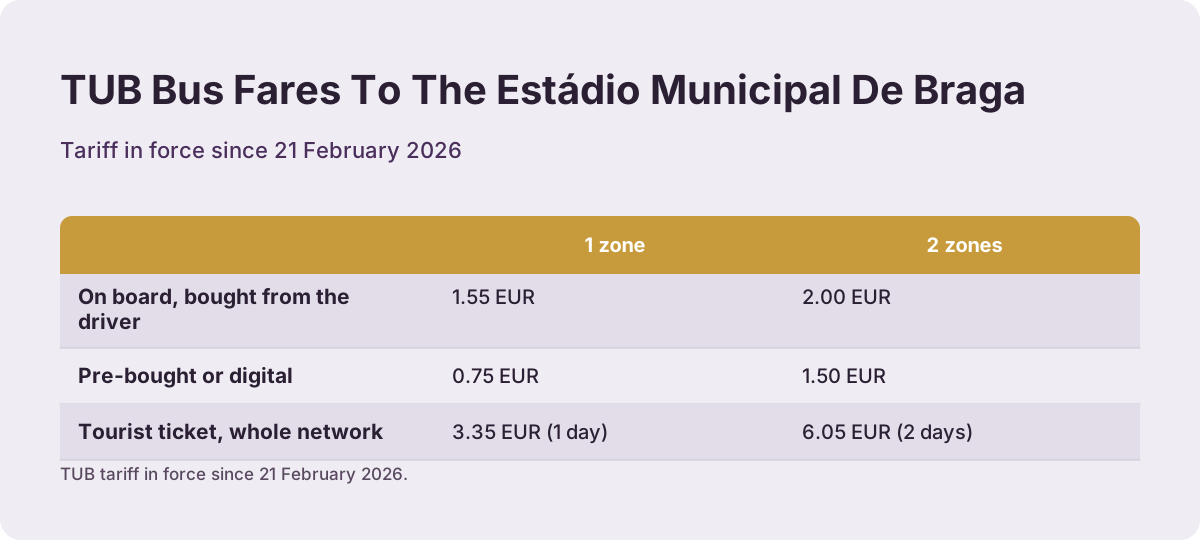
The Estádio Municipal de Braga sits in the eastern part of the city, and the practical way to reach it is Braga's urban bus network, TUB, whose ordinary fares are 1.55 EUR on board for a one-zone ticket or 0.75 EUR pre-bought or digital, with a whole-network tourist ticket at 3.35 EUR for one day. The stadium area also has a dedicated bus interface, and on match days the ordinary services carry the crowd.
The fare structure rewards a small amount of preparation. Buying on the bus costs more than a pre-bought or digital ticket for the same journey, so if you plan several trips in the day, the tourist ticket usually wins. The prices below come from the TUB tariff in force since 21 February 2026.
| TUB ticket type | 1 zone | 2 zones | Notes |
|---|---|---|---|
| On board, bought from the driver | 1.55 EUR | 2.00 EUR | No bank-card contactless confirmed on board |
| Pre-bought or digital | 0.75 EUR | 1.50 EUR | Via the TUB app or sales points |
| Tourist ticket, whole network | 3.35 EUR (1 day) | 6.05 EUR (2 days) | 8.05 EUR for 3 days |
Transfers are valid for one hour on a one-zone ticket and one and a half hours on a two-zone ticket, which matters if your route to the ground involves a change. Fines for travelling without a valid ticket start at 30 EUR, so validate on boarding even if the bus is packed and slow. The full transport picture, including the train station and walking distances, is mapped in the getting around Braga guide.
On the way back, patience is the whole strategy. The crowd leaves in a single wave, and the buses absorb it in stages, so a coffee near the stadium or a slow walk back toward the centre beats a long queue.
What Else Can You Do Around Match Day In Braga?
A match day leaves several hours to fill, and Braga's centre answers with the Sé de Braga's three visit routes at 3.00 EUR each or 7.00 EUR combined, the Museu dos Biscainhos at 7.50 EUR with its garden, and the Museu de Arqueologia D. Diogo de Sousa at 5.00 EUR, all within a compact walkable core. There is no city attraction pass on sale, so each ticket is bought separately at each door.
That last sentence saves you a search: a "Braga Card" was announced by the municipality in 2025, but no purchase page exists, so the honest planning assumption is separate tickets. The cathedral alone justifies the morning. Its three routes, the Treasury-Museum, the funerary chapels and high choir, and the cathedral itself, each cost 3.00 EUR, with any two at 6.00 EUR and all three at 7.00 EUR, bought at the reception point in the cloister. Visits run Monday to Saturday 09:30 to 13:00 and 14:30 to 17:00, and Sunday mornings are shortened for worship, with the building itself opening earlier for mass.
| Sight | Ticket | Hours (verified) |
|---|---|---|
| Sé de Braga, all three routes | 7.00 EUR combined, 3.00 EUR per route | Mon-Sat 09:30-13:00, 14:30-17:00; Sun 09:30-10:45, 14:30-17:00 |
| Museu dos Biscainhos, garden included | 7.50 EUR | Tue-Sun 10:00-12:30, 14:00-17:30 |
| Museu de Arqueologia D. Diogo de Sousa | 5.00 EUR | Tue-Sun 10:00-17:30 |
| Museu Pio XII, whole museum | 4.00 EUR | Tue-Sat 09:30-12:30, 14:00-18:00 |
The detail that most first pages of Google miss: Braga's museum circuit has visibly renewed itself in the last two years. The Museu da Imagem reopened in early September 2026 after roughly seven years closed for rehabilitation, Casa dos Crivos reopened on 19 and 20 September 2026 as a municipal gallery, and MUZEU, a five-floor contemporary art museum, opened in the historic centre in April 2026. A match-day visit in 2026 therefore sees a city mid-renaissance, not the static museum town older guides describe.
If the match falls on a weekend, the surrounding Minho region rewards an extra day. Guimarães is the obvious pairing, a short bus ride away on the AITC line 101 from Braga's bus station, and the Braga and Guimarães in one day itinerary works if your fixture is an evening kickoff. For a fuller comparison of how the two cities split a short trip, the is Braga worth a day trip from Porto answer covers the timing question directly.
When Is The Best Time To Plan A Trip Around SC Braga?
The Portuguese league runs from mid-August to late May, so any trip in that window can potentially catch a home fixture, while the summer months offer only the stadium tour. The sweet spot for combining a match with good weather is September or October, when the city is warm, the fixture list is settled, and Braga's cultural calendar is at its busiest.
The climate data backs the instinct. IPMA's 1991 to 2020 normals for the Braga / Merelim station show July and August as the warmest months, with mean maximums of 28.2 and 28.7 degrees, and October as the wettest month on average, with 197.8 mm of rain. September sits between the two: a mean maximum of 26.9 degrees, warmer on average than June, with 67.6 mm of rain. A September trip can pair a match with Noite Branca, the city's white-night arts festival, which in 2026 ran from the evening of Friday 4 September to Sunday 6 September.
| Month | Mean max (C) | Rain (mm) | Match possible? | Notes for visitors |
|---|---|---|---|---|
| August | 28.7 | 34.6 | Yes, season starts mid-month | Hot afternoons, thin early-season fixtures |
| September | 26.9 | 67.6 | Yes | Noite Branca weekend; museums reopen after summer |
| October | 22.2 | 197.8 | Yes | Wettest month on average; pack a rain layer |
| February | 15.5 | 111.1 | Yes | Coolest match window with league in full swing |
| June | 26.1 | 40.6 | Season ends late May | São João festival peaks 23-24 June instead |
Winter fixtures are perfectly viable, and Braga's mean winter temperatures, 14.1 degrees maximum in January, are mild by northern European standards, though the rain is not: 12 to 13 days a month with a millimetre or more from October to January. The full month-by-month picture, including the festival calendar, is in the site's broader planning coverage, and the Braga attraction tickets and passes guide collects every verified admission price in one table.
Should You Combine A Match With A Guided City Tour?
Yes, and the timing writes itself: a two-hour guided walking tour of Braga's historic centre in the morning, lunch in the centre, then the bus out to the stadium for an evening kickoff, is the pattern most visiting supporters end up wishing they had planned. The city's tour offer runs from a tuk tuk circuit of about 30 minutes to full small-group walks of around three hours, so the tour can be sized to the fixture.
The tuk tuk city tour is the most match-day-friendly option, because it compresses the historic centre, the Sé de Braga's exterior and the garden viewpoints into a short loop that leaves the whole afternoon free, and the operator's listing shows it rated 4.8 from 179 reviews with a duration of 30 minutes to 2 hours depending on the option chosen. For a deeper version, the small-group walks cover the same core with a guide's commentary, and the flexible historic-centre walk lets you set the pace, which suits a day with a hard kickoff deadline at the end of it.
Whichever you choose, book the morning slot, not the afternoon one. Match-day afternoons in Braga move slower than the timetable suggests, the walk to the stadium eats time, and a tour that ends at 17:00 before a 20:00 kickoff leaves no margin for the city's best habit, which is sitting down somewhere with a glass of vinho verde and letting the afternoon finish itself. The Braga Travel Guide covers the vinho verde region, the cafés and the full sight list for the days around your fixture.
Common Questions About SC Braga Match Tickets
How do I buy SC Braga match tickets?
Through the club's own official ticketing channels, online or at the stadium ticket office. Prices are announced per fixture, so check the club's site once the fixture is confirmed, and avoid third-party resellers whose markups are not authorised by the club.
How much do SC Braga match tickets cost?
There is no fixed price list: the club sets prices match by match, with cheaper seats behind the goals and more expensive main-stand categories, and higher prices for high-profile opponents. The club publishes the prices with each fixture announcement.
Can you tour the Estádio Municipal de Braga?
Yes. SC Braga sells a Classic Guided Tour at 6 EUR and a Self-Guided Tour at 4 EUR, booked through the club's stadium-tour page, with advance booking recommended and schedules pausing around home fixtures.
How do you get to the Estádio Municipal de Braga?
By TUB, the city's urban bus network. An on-board one-zone ticket costs 1.55 EUR, a pre-bought or digital one-zone ticket 0.75 EUR, and a whole-network tourist ticket 3.35 EUR for one day. On match days the ordinary services carry the crowd.
When does the SC Braga season run?
The Portuguese league runs from mid-August to late May, so home fixtures are possible in that window only. Summer visitors can still take the stadium tour, and September or October combines settled fixtures with the warmest late-season weather.
Is there a city pass that includes the stadium?
No. No city-wide attraction pass is on sale in Braga; a "Braga Card" was announced in 2025 but no purchase page exists. Buy each attraction ticket separately, and use the TUB tourist ticket for transport.
A match at the Estádio Municipal de Braga is one of the easiest pieces of European football to build a trip around: tickets come straight from the club, the buses are cheap and frequent, and the city around the fixture is one of the most rewarding in northern Portugal. Check the fixture list, book the tour if no match falls on your dates, and give the historic centre the hours the stadium does not need.